6 results for "Jewish History"

Israel is real

Cohen, Rich
“It’s a great irony that Israel was more secure as an idea than it’s ever been as a nation with an army.” In AD 70, when the Second Temple was destroyed, a handful of visionaries saved Judaism by reinventing it—by taking what had been a national religion, identified with a particular place, and turning it into an idea. Jews no longer needed Jerusalem to be Jews. Whenever a Jew studied—wherever he was—he would be in the holy city. In this way, a few rabbis turned a real city into a city of the mind; in this way, they turned the Temple into a book and preserved their faith. Though you can burn a city, you cannot sack an idea or kill a book. But in our own time, Zionists have turned the book back into a temple. And unlike an idea, a temple can be destroyed. The creation of Israel has made Jews vulnerable in a way they have not been for two thousand years. In Israel Is Real , Rich Cohen’s superb new history of the Zionist idea and the Jewish state—the history of a nation chronicled as if it were the biography of a person—he brings to life dozens of fascinating figures, each driven by the same impulse: to reach Jerusalem. From false messiahs such as David Alroy (Cohen calls him the first superhero, with his tallis as a cape) and Sabbatai Zevi, who led thousands on a mad spiritual journey, to the early Zionists (many of them failed journalists), to the iconic figures of modern Jewish Sparta, David Ben-Gurion, Golda Meir, Yitzhak Rabin, and Ariel Sharon, Cohen shows how all these lives together form a single story, a single life. In this unique book, Cohen examines the myth of the wandering Jew, the paradox of Jewish power (how can you be both holy and nuclear?), and the triumph and tragedy of the Jewish state—how the creation of modern Israel has changed what it means to be a Jew anywhere.
Farrar, Straus, and Giroux 2009-07-21 383 pages

We are here: memories of the Lithuanian Holocaust

Cassedy, Ellen
Winner of the 2013 National Book Prize from Grub Street, the Towson Prize for Literature, and the 2013 Prakhin International Literary Foundation Award. Ellen Cassedy's longing to recover the Yiddish she'd lost with her mother's death eventually led her to Lithuania, once the "Jerusalem of the North." As she prepared for her journey, her uncle, sixty years after he'd left Lithuania in a boxcar, made a shocking disclosure about his wartime experience, and an elderly man from her ancestral town made an unsettling request. Gradually, what had begun as a personal journey broadened into a larger exploration of how the people of this country, Jews and non-Jews alike, are confronting their past in order to move forward into the future. How does a nation--how do successor generations, moral beings--overcome a bloody past? How do we judge the bystanders, collaborators, perpetrators, rescuers, and ourselves? These are the questions Cassedy confronts in We Are Here, one woman's exploration of Lithuania's Jewish history combined with a personal exploration of her own family's place in it. Digging through archives with the help of a local whose motives are puzzling to her; interviewing natives, including an old man who wants to "speak to a Jew" before he dies; discovering the complications encountered by a country that endured both Nazi and Soviet occupation--Cassedy finds that it's not just the facts of history that matter, but what we choose to do with them.
University of Nebraska Press 2012 273 pages

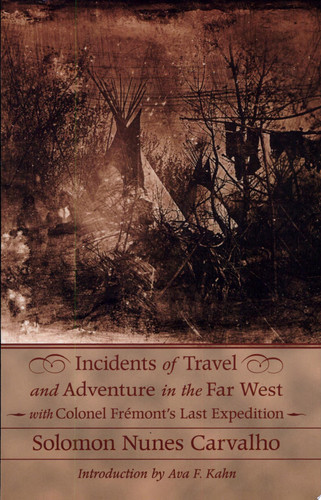
Incidents of travel and adventure in the Far West: with Colonel Fremont's last expedition across the Rocky Mountains, including three months' residence in Utah, and a perilous trip across the great American desert to the Pacific

Carvalho, Solomon Nunes
n August 1853, an American-born Sephardic Jew, Solomon Nunes Carvalho, accepted John Fremont's invitation to join his fifth expedition to find the best overland route to California. A Baltimore artist, inventor, and daguerreotypist, Carvalho was given the job of creating a photographic record of the lands and peoples along the way. Fremont's party left the Missouri on September 14, 1853, traveled up the Kansas River, overland to the Arkansas, upriver past Bent's Fort to the Huerfano, and traversed the Sandhill Pass into the Rocky Mountains. Beset by heavy snows and intense cold, they were reduced to eating their horses and mules and the occasional beaver or porcupine while making their way in midwinter across the Grand, Green, and Sevier Rivers. Suffering from frostbite, scurvy, and dysentery, Carvalho left the expedition in Utah; spent four months among the Mormons in Salt Lake City, where he observed with keen interest their system of spiritual wives; and reached California in 1854. Carvalho became the first Jewish writer to publish accounts of the Great American West and was also one of the first people to photograph the American West. Although only one of his plates is known to survive, others became the models for wood and steel engravings that broadcast the image of the West throughout the world. This Bison Books edition restores the discourses on Mormon doctrine omitted from previous twentieth-century editions. Ava F. Kahn is a visiting scholar at the California Studies Center, University of California, Berkeley. Her books include Jewish Voices of the California Gold Rush: A Documentary History, 1849-1880; Jewish Life in the American West: Perspectives on Migration, Settlement, and Community; and California Jews (coedited with Marc Dollinger).
University of Nebraska Press 2004-01-01 130 pages

Tiny lights for travellers

Lewis, Naomi K.
"When her marriage suddenly ends, and a diary documenting her beloved grandfather's escape from Nazi-occupied Netherlands in the summer of 1942 is discovered, Naomi K. Lewis decides to retrace his journey to learn about her family history. Despite suffering from extreme disorientation and a lifetime of anxiety, she travels alone for the first time. Moving from Amsterdam to Lyon--relying on the marvels of GPS--she discovers family secrets and her own narrative as a second-generation Jewish Canadian. With vulnerability, humour, and wisdom, Lewis's memoir asks tough questions about her identity as a secular Jew, the accuracy of family stories, and the impact of the Holocaust on subsequent generations. How do immigrants weave their sense of identity into their chosen countries? Must we be able to locate ourselves within family and cultural geography to belong?"--
University of Alberta Press 2019-05-15 281 pages

This year in Jerusalem

Richler, Mordecai
"Part memoir, part history, part political commentary - and all Richler - This Year in Jerusalem is a personal, passionate, and quirkily comic examination of the idea of Israel-as-homeland: for Jews, for Palestinians, and, not least, for the author himself. Richler re-creates the Montreal of his adolescence - the local Zionist youth organization functioning as an escape from the zealous Hasidism of his grandfathers; the idea of emigration to Israel growing into a shimmering dream for himself and his friends. And, going to Israel to look up his old pals from St. Urbain Street, he shows us what happened to those who actually did "make aliyah"--Who settled in the cities and on the kibbutzim, survived the turmoils of war, and are faced today with the opportunities and dangers of peace with the Palestinians. He shows us, as well, the course of his own migration - away from Zionism and through the maze of his own sense of Judaism until he rediscovers his true homeland: "I owe as much to the thin gruel of my Canadian experience as I do to my Jewish provenance." Woven through his story are his fond (and not so fond) recollections of his family, his encounters in today's Israel with the kids he grew up with in Montreal a million years ago, and his most mordant observations on the state of the state of Israel and the Israeli-Palestinian conflict. Witty, intelligent, well reasoned, and across-the-board provocative, here is Mordecai Richler at his inimitable - and controversial - best." -- dust jacket
Knopf 1994-09-06 291 pages

Palestine old and new

Hyamson, Albert M.
First published in 1928, Palestine Old and New is a historical travel guide providing a preliminary account of Palestine through the eye of a Zionist. The book takes the reader through the natural landscape of Palestine, familiarizing them with the local Muslim, Jewish and Christian populations, and providing both historical and Biblical accounts of various sites. As the chief immigration officer in British Mandate of Palestine from 1921 to 1934, the intended audience of the author was the Jews thinking about immigrating to Palestine, but his descriptive portrayal of the currently occupied territory is a rich account for present readers of the Palestine that was. The language used is a reflection of its era and no offence is meant by the Publishers to any reader by this republication. This book will be of interest to students of history, political science, international relations and geography.
Routledge 2022-06-30 352 pages