31 results for "Jewish History"

Measure of a man: from Auschwitz survivor to presidents' tailor

Greenfield, Martin,Hall, Wynton
He's been called "America's greatest living tailor" and "the most interesting man in the world." Now, for the first time, Holocaust survivor Martin Greenfield tells his incredible life story. Taken from his Czechoslovakian home at age fifteen and transported to the Nazi concentration camp at Auschwitz with his family, Greenfield came face to face with "Angel of Death" Dr. Joseph Mengele and was divided forever from his parents, sisters, and baby brother. In haunting, powerful prose, Greenfield remembers his desperation and fear as a teenager alone in the death camp—and how an SS soldier's shirt dramatically altered the course of his life. He learned how to sew; and when he began wearing the shirt under his prisoner uniform, he learned that clothes possess great power and could even help save his life. Measure of a Man is the story of a man who suffered unimaginable horror and emerged with a dream of success. From sweeping floors at a New York clothing factory to founding America’s premier custom suit company, Greenfield built a fashion empire. Now 86 years old and working with his sons, Greenfield has dressed the famous and powerful of D.C. and Hollywood, including Presidents Dwight Eisenhower, Bill Clinton, and Barack Obama, celebrities Paul Newman, Leonardo DiCaprio, and Jimmy Fallon, and the stars of Martin Scorsese's films. Written with soul-baring honesty and, at times, a wry sense of humor, Measure of a Man is a memoir unlike any other—one that will inspire hope and renew faith in the resilience of man.
Regnery History 2016-08-22 234 pages

All but my life

Klein, Gerda Weissmann
All But My Life is the unforgettable story of Gerda Weissmann Klein's six-year ordeal as a victim of Nazi cruelty. From her comfortable home in Bielitz (present-day Bielsko) in Poland to her miraculous survival and her liberation by American troops--including the man who was to become her husband--in Volary, Czechoslovakia, in 1945, Gerda takes the reader on a terrifying journey. Gerda's serene and idyllic childhood is shattered when Nazis march into Poland on September 3, 1939. Although the Weissmanns were permitted to live for a while in the basement of their home, they were eventually separated and sent to German labor camps. Over the next few years Gerda experienced the slow, inexorable stripping away of "all but her life." By the end of the war she had lost her parents, brother, home, possessions, and community; even the dear friends she made in the labor camps, with whom she had shared so many hardships, were dead. Despite her horrifying experiences, Klein conveys great strength of spirit and faith in humanity. In the darkness of the camps, Gerda and her young friends manage to create a community of friendship and love. Although stripped of the essence of life, they were able to survive the barbarity of their captors. Gerda's beautifully written story gives an invaluable message to everyone. It introduces them to last century's terrible history of devastation and prejudice, yet offers them hope that the effects of hatred can be overcome.
Hill and Wang 2019-11-19 289 pages

Mr. Sammler's planet

Bellow, Saul
"Sammler, a New Yorker in his seventies, a refugee from Nazism, a thinker of complex thoughts, a touchstone around whom a heterogeneous group revolves, is not simply the protagonist but the prime mover of a many-sided novel held together by the centripetal force of his presence. The counterpoint of personalities, subplots, and incidents constitutes a tragi-comic commentary on twentieth-century urban life but it is Sammler's considered reflections on that life that dominate a novel which, most movingly, asks basic questions about how we live and what we live for at this chaotic point in history. Portions of the novel first appeared in the Atlantic."--Booklist Review.
Viking Press 1970 313 pages

Fear: anti-semitism in Poland after Auschwitz ; an essay in historical interpretation

Gross, Jan Tomasz
Poland suffered an exceedingly brutal Nazi occupation during the Second World War. Close to five million Polish citizens lost their lives as a result. More than half the casualties were Polish Jews. Thus, the second largest Jewish community in the world - only American Jewry numbered more than the three and a half million Polish Jews at the time - was wiped out. Over 90 percent of its members were killed in the Holocaust. And yet, despite this unprecedented calamity that affected both Jews and non-Jews, Jewish Holocaust survivors returning to their hometowns in Poland after the war experienced widespread hostility, including murder, at the hands of their neighbors. The bloodiest peacetime pogrom in twentieth-century Europe took place in the Polish town of Kielce one year after the war ended, on July 4, 1946. Jan Gross's Fear attempts to answer a perplexing question: How was anti-Semitism possible in Poland after the war? At the center of his investigation is a detailed reconstruction of the Kielce pogrom and the reactions it evoked in various milieus of Polish society. How did the Polish Catholic Church, Communist party workers, and intellectuals respond to the spectacle of Jews being murdered by their fellow citizens in a country that had just been liberated from a five-year Nazi occupation? Gross argues that the anti-Semitism displayed in Poland in the war's aftermath cannot be understood simply as a continuation of prewar attitudes. Rather, it developed in the context of the Holocaust and the Communist takeover: Anti-Semitism eventually became a common currency between the Communist regime and a society in which many had joined in the Nazi campaign of plunder and murder - and for whom the Jewish survivors were a standing reproach. Jews did not bring communism to Poland as some believe; in fact, they were finally driven out of Poland under the Communist regime as a matter of political expediency. In the words of the Nobel Prize-winning poet Czeslaw Milosz, Poland's Communist rulers fulfilled the dream of Polish nationalists by bringing into existence an ethnically pure state. For more than half a century, what happened to the Jewish Holocaust survivors in Poland has been cloaked in guilt and shame. Writing with passion, brilliance, and fierce clarity, Jan T. Gross at last brings the truth to light.
Random House Trade Paperbacks 2007-08-14 303 pages

Still alive: a Holocaust girlhood remembered

Klüger, Ruth
Swept up as a child in the events of Nazi-era Europe, Ruth Kluger saw her family's comfortable Vienna existence systematically undermined and destroyed. By age eleven, she had been deported, along with her mother, to Theresienstadt, the first in a series of concentration camps which would become the setting for her precarious childhood. Kluger's story of her years in the camps and her struggle to establish a life after the war as a refugee survivor in New York, has emerged as one of the most powerful accounts of the Holocaust. Interwoven with blunt, unsparing observations of childhood and nuanced reflections of an adult who has spent a lifetime thinking about the Holocaust, Still Alive rejects all easy assumptions about history, both political and personal. Whether describing the abuse she met at her own mother's hand, the life-saving generosity of a woman SS aide in Auschwitz, the foibles and prejudices of Allied liberators, or the cold shoulder offered by her relatives when she and her mother arrived as refugees in New York, Kluger sees and names an unexpected reality which has little to do with conventional wisdom or morality tales. Still Alive is a memoir of the pursuit of selfhood against all odds, a fiercely bittersweet coming-of-age story in which the protagonist must learn never to rely on comforting assumptions, but always to seek her own truth.
Feminist Press at the City University of New York 2001 216 pages

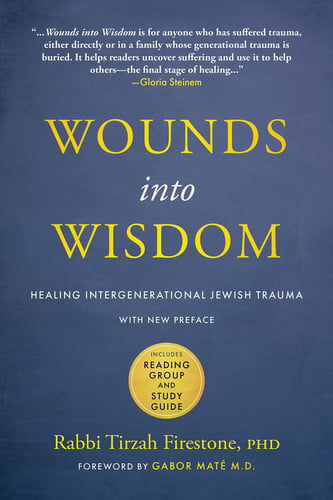
Wounds into wisdom: healing intergenerational Jewish trauma

Firestone, Tirzah
"Our past does not simply disappear. The painful history of our ancestors and their rich cultural wisdom intertwine within us to create the patterns of our future. Even when past trauma remains unspoken or has long been forgotten, it becomes part of us and our children-a legacy of both strength and woundedness that shapes our lives. In this book, Tirzah Firestone brings to life the profound impact of protracted historical trauma through the compelling narratives of those whose lives were marred by racial persecution and displacement. The tragic story of Firestone's own family lays the groundwork for these revealing testimonies of recovery, forgiveness, and moral leadership. Throughout, Firestone interweaves their voices with neuroscientific and psychological findings, as well as relevant and inspiring Jewish teachings. Seven principles emerge from these wise narratives-powerful prescriptive tools that speak to anyone dealing with the effects of past traumatic injury. At the broadest level, these principles are directives for staying morally awake in a world rife with terror"--
Monkfish Book Publishing Company 2022 258 pages

A chosen few: the resurrection of European Jewry

Kurlansky, Mark
A POWERFUL, DEEPLY MOVING NARRATIVE OF HOPE REBORN IN THE SHADOW OF DESPAIR Fifty years after it was bombed to rubble, Berlin is once again a city in which Jews gather for the Passover seder. Paris and Antwerp have recently emerged as important new centers of Jewish culture. Small but proud Jewish communities are revitalizing the ancient centers of Budapest, Prague, and Amsterdam. These brave, determined Jewish men and women have chosen to settle–or remain–in Europe after the devastation of the Holocaust, but they have paid a price. Among the unexpected dangers, they have had to cope with an alarming resurgence of Nazism in Europe, the spread of Arab terrorism, and the impact of the Jewish state on European life. Delving into the intimate stories of European Jews from all walks of life, Kurlansky weaves together a vivid tapestry of individuals sustaining their traditions, and flourishing, in the shadow of history. An inspiring story of a tenacious people who have rebuilt their lives in the face of incomprehensible horror, A Chosen Few is a testament to cultural survival and a celebration of the deep bonds that endure between Jews and European civilization. “Consistently absorbing . . . A Chosen Few investigates the relatively uncharted territory of an encouraging phenomenon.” –Los Angeles Times “I can think of no book that portrays with such intelligence, historical understanding, and journalistic flair what life has been like for Jews determined to build lives in Europe.” –SUSAN MIRON Forward
Ballantine 2002-03-26 407 pages

Masquerade: the incredible true story of how George Soros' father outsmarted the Gestapo

Soros, Tivadar
The Nazis came late to Hungary because, until early 1944, Germany and Hungary were allies. But when they did arrive, their orders were to put the "Final Solution" into effect with deliberate speed. Soros, a Jewish lawyer in Budapest, secured fake Christian identities for himself, his wife, and his two sons following the German invasion of Hungary on March 19, 1944. In a narrative reminiscent of the great Primo Levi, Soros recounts his experiences with a beguiling humor, deep humanity, and a wisdom that is humbling. Superbly translated by Humphrey Tonkin, Masquerade is.
Arcade Pub 2011-03-15 275 pages

Elie Wiesel: an extraordinary life and legacy

Nadine Epstein
Elie Wiesel (1928-2016) is best known as the author of Night, survivor of Auschwitz and a powerful, enduring voice of the Holocaust. A recipient of the Nobel Peace Prize and the Presidential Medal of Freedom, he was a hero of human rights, professor and author of more than 50 books. Among his accomplishments, Wiesel co-founded Moment Magazine with Leonard Fein in 1975 to be a place of conversation for America's Jews. For editor-in-chief Nadine Epstein, he became a mentor and friend after she took over the magazine in 2004. In this striking volume, Epstein shares her memories of Wiesel and brings together 36 interviews with friends, colleagues and others who knew him - including, his son Elisha, Michael Berenbaum, Wolf Blitzer, Father Patrick Debois, Ronald S. Lauder, Bernard Henri-Levi, Kati Marton, Natan Sharansky, Ben Kingsley, and Oprah Winfrey. The foreword is by British Rabbi Jonathan Sacks and the afterword is by broadcaster Ted Koppel. To celebrate this humanitarian and keep his inspiration alive, Epstein presents readers with a visual history of Wiesel's life and examines the influence of Night. This chilling story of the Holocaust has already gripped the souls of millions of readers. Epstein includes a selection of his speeches and writings, lively conversations with teenagers about Night and discussion questions. The book features more than 100 photos. Says Rabbi Jonathan Sacks: "This book of reflections is a fitting tribute to the legacy of Elie Wiesel. In its pages and through the words of its contributors, you will feel a promise, not just to the souls who perished, but also to Elie and all those who survived Europe's darkest night." From the Inside Flap "It is absolutely imperative for this legacy of Elie Wiesel's to continue. It has to, and if it doesn't, it is our loss, and it will be an unfathomable loss." ―Ben Kingsley "Wiesel taught us that we must not forget; that there is no greater sin than that of silence and indifference. In doing so he has not just illumined the past, he has illumined the future" ―Oprah Winfrey "There was something burning inside of Elie, a flame ignited by injustice and pain. He was willing to share that part of himself. Pain can make people retreat from life, but opened Elie to the world." ―Kathleen Kennedy Townsend "He performed the alchemy of converting pain, injustice and horror into love, compassion and tolerance. We remember him not so much because he so often succeeded but because he never stopped trying." ―Ted Koppel "I believe there is a risk of Elie Wiesel, the Holocaust, and other genocides being forgotten. Without a real effort to retain their memory, they may simply disappear from history. Elie Wiesel was a light in the night for the whole world, not just the Jewish one." ―Father Patrick Desbois About the Author Editor: Nadine Epstein, Editor-in-Chief of Moment Magazine, is the founder and executive director of the Center for Creative Change and founder of the Daniel Pearl Investigative Journalism Initiative. An award-winning journalist and author, she reported for the City News Bureau of Chicago and the Chicago Bureau of the New York Times and covered the U.S.-Mexico border. She was a Knight-Wallace Fellow at the University of Michigan, where she also taught journalism. She is also an artist and the creator of the iShadow Project. Foreword: Rabbi Lord Jonathan Sacks is the former Chief Rabbi of the United Kingdom. He is the author of more than 25 books, most recently Not in God's Name: Confronting Religious Violence. Ted Koppel was the anchor and managing editor of ABC News Nightline for 25 years. He is currently a contributor to CBS News Sunday Morning and author of Lights Out.
MomentBooks 2019 176 pages

Landscapes of memory: a Holocaust girlhood remembered

Kluger, Ruth
Ruth Kluger is one of the child-survivors of the Holocaust. In 1942, at the age of eleven, she was deported to the Nazi "family camp" Theresienstadt with her mother. They would move to two other camps (including Auschwitz-Birkenau) before the war ended. 'Landscapes of memory' is the story of Ruth's life. Of a childhood spent in the Nazi camps and her refusal to forget the past as an adult in America. 'It is not in our power to forgive: memory does that for us,' says Kluger. Not erasing a single detail, not even the inconvenient ones, she writes frankly about the troubled relationship with her mother even through their years of internment, and of her determination not to forgive and absolve the past. It is this memory, pure and harsh, this anger, savage and profound, that makes Kluger's memoir so unforgettable. A gripping narrative and a superb meditation on the relationship between private memory and history, on forgiveness and redemption, 'Landscapes of memory' will become a classic of our times.
Bloomsbury 2004 272 pages

Holocaust literature: a history and guide

Roskies, David G.,Diamant, Naomi
"What is Holocaust literature? When does it begin and how is it changing? Is there an essential core of diaries, eyewitness accounts of the concentration camps, tales of individual survival in hiding? Is it the same everywhere: in the West as in the East, in Australia as in the Americas, in poetry as in prose? Is this literature sacred and sui generis, or can it be studied in the light of other literatures? What of the perpetrators and bystanders, the hidden children, the children of Holocaust survivors: Do they speak with the same authority? What works of Holocaust literature will be read a hundred years from now--and why? Here, for the first time and told from beginning to end, is an historical survey of Holocaust literature in all genres, countries, and major languages. Beginning in wartime, it proceeds from the literature of mobilization and mourning in the Free World to the vast and varied literature produced in the Nazi-occupied ghettos, the bunkers and places of hiding, the transit and concentrations camps. Within weeks of the liberation, in displaced persons camps, a new memorial and testamentary literature begins to take shape. Moving from Europe to Israel, the U.S., and beyond, the authors situate the writings by real and proxy witnesses within three distinct postwar periods: a period of "communal memory," still internal and internecine; a period of "provisional memory" in the '60s and '70s that witnesses the birth of a self-conscious Holocaust genre; to the period of "authorized memory" in which we live today, following the collapse of the Soviet Union (1989-91), and the opening of the US Holocaust Museum (1993). Twenty book covers - first editions in their original languages - and an eminently readable guide to the "first hundred books" together show the multilingual scope, historical depth, the moral and artistic range of this extraordinary body of writing."--Publisher's website.
Brandeis University Press 2012 355 pages

'My dear ones': one family and the final solution

Wittenberg, Jonathan
A family's story of human tenacity, faith and a race for survival in the face of unspeakable horror and cruelty perpetrated by the Nazi regime against the Jewish people. Growing up in the safety of Britain, Jonathan Wittenberg was deeply aware of his legacy as the child of refugees from Nazi Germany. Yet, like so many others there is much he failed to ask while those who could have answered his questions were still alive. After burying their aunt Steffi in the ancient Jewish cemetery on the Mount of Olives, Jonathan, now a rabbi, accompanies his cousin Michal as she begins to clear the flat in Jerusalem where the family have lived since fleeing Germany in the 1930s. Inside an old suitcase abandoned on the balcony they discover a linen bag containing a bundle of letters left untouched for decades. Jonathan's attention is immediately captivated as he tries to decipher the faded writing on the long-forgotten letters. They eventually draw him into a profound and challenging quest to uncover the painful details of his father's family's history. Through the wartime correspondence of his great-grandmother Regina and his grandmother, aunts and uncles, Jonathan weaves together the strands of an ancient rabbinical family with the history of Europe during the Second World War and the unfolding policies of the Nazis, telling the moving story of a family whose lives are as fragile as the paper on which they write, but whose faith in God remains steadfast.
William Collins 2016 354 pages

Jews, Germans, and Allies: close encounters in occupied Germany

Grossmann, Atina
In the immediate aftermath of World War II, more than a quarter million Jewish survivors of the Holocaust lived among their defeated persecutors in the chaotic society of Allied-occupied Germany. Jews, Germans, and Allies draws upon the wealth of diary and memoir literature by the people who lived through postwar reconstruction to trace the conflicting ways Jews and Germans defined their own victimization and survival, comprehended the trauma of war and genocide, and struggled to rebuild their lives. In gripping and unforgettable detail, Atina Grossmann describes Berlin in the days following Germany's surrender--the mass rape of German women by the Red Army, the liberated slave laborers and homecoming soldiers, returning political exiles, Jews emerging from hiding, and ethnic German refugees fleeing the East. She chronicles the hunger, disease, and homelessness, the fraternization with Allied occupiers, and the complexities of navigating a world where the commonplace mingled with the horrific. Grossmann untangles the stories of Jewish survivors inside and outside the displaced-persons camps of the American zone as they built families and reconstructed identities while awaiting emigration to Palestine or the United States. She examines how Germans and Jews interacted and competed for Allied favor, benefits, and victim status, and how they sought to restore normality--in work, in their relationships, and in their everyday encounters. Jews, Germans, and Allies shows how Jews were integral participants in postwar Germany and bridges the divide that still exists today between German history and Jewish studies.
Princeton University Press 2007-09-24 393 pages

Hitler, Stalin and I: an oral history

Kovály, Heda,Třeštíková, Helena
The oral history of a renowned Czech writer, whose optimism and faith in people survived grueling experiences under authoritarian regimes. Heda Margolius Kovály (1919-2010) was a renowned Czech writer and translator born to Jewish parents. Her bestselling memoir, Under a Cruel Star: A Life in Prague, 1941-1968 has been translated into more than a dozen languages. Her crime novel Innocence; or, Murder on Steep Street --based on her own experiences living under Stalinist oppression--was named an NPR Best Book in 2015. In the tradition of Studs Terkel, Hitler, Stalin and I is based on interviews between Kovály and award-winning filmmaker Helena Trestíková. In it, Kovály recounts her family history in Czechoslovakia, starving in the deprivations of Lodz Ghetto, how she miraculously left Auschwitz, fled from a death march, failed to find sanctuary amongst former friends in Prague as a concentration camp escapee, and participated in the liberation of Prague. Later under Communist rule, she suffered extreme social isolation as a pariah after her first husband Rudolf Margolius was unjustly accused in the infamous Slánsky Trial and executed for treason. Remarkably, Kovály, exiled in the United States after the Warsaw Pact invasion in 1968, only had love for her country and continued to believe in its people. She returned to Prague in 1996. Heda had an enormous talent for expressing herself. She spoke with precision and was descriptive and witty in places. I admired her attitude and composure, even after she had such extremely difficult experiences. Nazism and Communism afflicted Heda's life directly with maximum intensity. Nevertheless, she remained an optimist. Helena Trestíková has made over fifty documentary films. Hitler, Stalin and I has garnered several awards in the Czech Republic and Japan.
DoppelHouse Press 2018 160 pages

A childhood under Hitler and Stalin: memoirs of a "certified" Jew

Wieck, Michael
A bestseller in Germany, Michael Wieck's account of his childhood in Königsberg recalls a German city obliterated by fire-bombing during the Second World War. As the child of a Jewish mother and Gentile father, Wieck was persecuted first as a "certified Jew" by the Nazis, then as a German by the Russian occupiers, including horrific internment in the Rothenstein concentration camp. His emigration to the West in 1948 marked the end of the 408-year history of the Jewish community in Königsberg. From the earliest delights of a childhood filled with music, family, and the smell of pines and the sea, Wieck retraces his life. He tells of his school days and their sudden end, the shock of Kristallnacht, his Aunt Fanny being sent by train to a destination unknown, the chemical factory where Jewish workers gradually disappeared, the bombs falling on Königsberg. The Russian occupation was anything but the expected delivery from the horrors of the war. In the midst of privation, savagery, and death, there were moments of absurdity, and Wieck powerfully depicts them in this unforgettable memoir.
the University of Wisconsin Press 2003 293 pages