75 results for "Jewish History"

Jews and words

Oz, Amos,Oz-Salzberger, Fania
Why are words so important to so many Jews? Novelist Amos Oz and historian Fania Oz-Salzberger roam the gamut of Jewish history to explain the integral relationship of Jews and words. Through a blend of storytelling and scholarship, conversation and argument, father and daughter tell the tales behind Judaism’s most enduring names, adages, disputes, texts, and quips. These words, they argue, compose the chain connecting Abraham with the Jews of every subsequent generation.Framing the discussion within such topics as continuity, women, timelessness, and individualism, Oz and Oz-Salzberger deftly engage Jewish personalities across the ages, from the unnamed, possibly female author of the Song of Songs through obscure Talmudists to contemporary writers. They suggest that Jewish continuity, even Jewish uniqueness, depends not on central places, monuments, heroic personalities, or rituals but rather on written words and an ongoing debate between the generations. Full of learning, lyricism, and humor, Jews and Words offers an extraordinary tour of the words at the heart of Jewish culture and extends a hand to the reader, any reader, to join the conversation.
Yale University Press 2012 232 pages

The burden of responsibility: Blum, Camus, Aron, and the French twentieth century

Judt, Tony
Using the lives of the three outstanding French intellectuals of the twentieth century, renowned historian Tony Judt offers a unique look at how intellectuals can ignore political pressures and demonstrate a heroic commitment to personal integrity and moral responsibility unfettered by the difficult political exigencies of their time. Through the prism of the lives of Leon Blum, Albert Camus, and Raymond Aron, Judt examines pivotal issues in the history of contemporary French society—antisemitism and the dilemma of Jewish identity, political and moral idealism in public life, the Marxist moment in French thought, the traumas of decolonization, the disaffection of the intelligentsia, and the insidious quarrels rending Right and Left. Judt focuses particularly on Blum's leadership of the Popular Front and his stern defiance of the Vichy governments, on Camus's part in the Resistance and Algerian War, and on Aron's cultural commentary and opposition to the facile acceptance by many French intellectuals of communism's utopian promise. Severely maligned by powerful critics and rivals, each of these exemplary figures stood fast in their principles and eventually won some measure of personal and public redemption. Judt constructs a compelling portrait of modern French intellectual life and politics. He challenges the conventional account of the role of intellectuals precisely because they mattered in France, because they could shape public opinion and influence policy. In Blum, Camus, and Aron, Judt finds three very different men who did not simply play the role, but evinced a courage and a responsibility in public life that far outshone their contemporaries. "An eloquent and instructive study of intellectual courage in the face of what the author persuasively describes as intellectual irresponsibility."—Richard Bernstein, New York Times
University of Chicago Press 1998-12-01 196 pages

Stars of David: Prominent Jews talk about being Jewish

Pogrebin, Abigail
Sixty-two of the most accomplished Jews in America speak intimately—most for the first time—about how they feel about being Jewish. In unusually candid interviews conducted by former 60 Minutes producer Abigail Pogrebin, celebrities ranging from Sarah Jessica Parker to Supreme Court Justice Ruth Bader Ginsburg, from Larry King to Mike Nichols, reveal how resonant, crucial or incidental being Jewish is in their lives. The connections they have to their Jewish heritage range from hours in synagogue to bagels and lox; but every person speaks to the weight and pride of their Jewish history, the burdens and pleasures of observance, the moments they’ve felt most Jewish (or not). This book of vivid, personal conversations uncovers how being Jewish fits into a public life, and also how the author’s evolving religious identity was changed by what she heard.
Broadway books 2005 385 pages

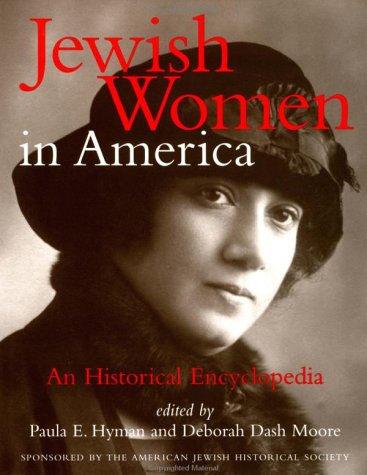
Jewish women in America: an historical encyclopedia

Paula Hyman,Deborah Dash Moore,Phyllis Holman Weisbard,American Jewish Historical Society
This encyclopedia provides the first standard reference work on the lives, history and activities of Jewish women in the United States. Covering a period which extends from the arrival of the first Jewish women in North America in 1654 to the present, this two-volume set presents the most comprehensive and detailed portrait of American Jewish women ever published, and brings together for the first time the wealth of recent scholarship on this subject. Includes: * Biographical entries on over 800 individual women. * 128 topical articles on organizations such as Hadassah, the National Council of Jewish Women, Mizrachi, and the Ladies' Garment Workers' Union. * Major essays on Jewish women's participation in the movement for women's suffrage, social reform, civil rights, and the recent women's movement. * The activities of Jewish women in politics, business, education, the arts, and religion. * A readable, inviting format with over 500 large photographs. * Bibliographies at the end of each entry which include overviews of major scholarship in the field, complete citations of more general works and citations of additional bibliographical and reference sources. * The comprehensive index includes citations to every substantive discussion in the entries as well as all proper names appearing in the text, such as organizations, book, song and film titles, schools, and individuals. The "Encyclopedia" provides information on American Jewish women in all fields of endeavor, and pays special attention to the work of women in the arts, academics, law, the labor movement, education, science, medicine, journalism and publishing, and on the lives of ordinary Jewish women during all time periods and in all regions of the United States.
Routledge 1997 1770 pages

The pity of it all: a history of the Jews in Germany, 1743-1933

Elon, Amos
Presents a cultural history of German Jewry from Moses Mendelssohn's arrival in Berlin until the end of the Weimar Republic. Refers to antisemitism in a number of contexts: Mendelssohn is hailed by German intellectuals as an exception among the Jews; acceptance of the Jew was sometimes soon followed by rejection; despite or because of disproportionate Jewish contributions to culture and society, Jews are viewed as foreigners; rights are granted only to rich and useful Jews; despite Jewish patriotism, Jews are often portrayed as traitors and subversives. Among the prominent Jews discussed are Heinrich Heine, whose ambivalence toward Germans reflected their ambivalence toward him, and Walther Rathenau who was assassinated by radical nationalists whose activities the Weimar Republic was unable to curb. The section devoted to the latter reveals how Weimar's weaknesses opened the door of power to the Nazis.
Metropolitan Books 2002-11 446 pages

Reactionary modernism: technology, culture, and politics in Weimar and the Third Reich

Herf, Jeffrey
Explores the paradox inherent in the German fascists' rejection of the rationalism of the Enlightenment while fully embracing modern technology. By associating technology with the Germans rather than the Jews, with beautiful form rather than the formlessness of the market, and with a strong state rather than a predominance of economic values and institutions, right-wing intellectuals reconciled Germany's strength with its romantic soul and national identity. Includes discussion on the transformation of anti-capitalist rhetoric to anti-Jewish rhetoric. See the index for references to antisemitism, and especially ch. 6, "Werner Sombart: Technology and the Jewish Question".
Cambridge University Press 1984 251 pages

The people of the book: philosemitism in England, from Cromwell to Churchill

Himmelfarb, Gertrude
The specific course of the Reformation in England in the 16th-17th centuries brought about interest in the Jewish Bible, i.e. the Old Testament, and the emergence of a self-image held by the British that they constitute a people of the Book, beside the Jews. This, in turn, gave rise to philosemitism, which marked British culture from the days of Cromwell to those of Churchill, being tinged in various tones, from millenarianism to philo-Zionism. However, the tradition of philosemitism in England was accompanied by manifestations of antisemitism; the same people who extolled the Jews opposed their admission to Parliament; people who defended Jewish rights in the 18th-19th centuries often shared anti-Jewish stereotypes of their time; and leaders who sympathized with Zionism could believe in a Jewish conspiracy against Christian civilization. Ch. 4 (pp. 83-117), "Fictional Heroes and Heroines", deals with 19th-century literature and shows how some writers (e.g. Walter Scott, Dickens, Trollope) could combine philosemitic and antisemitic motifs in their literary works.
Encounter Books 2011 183 pages

Jews and the American soul: human nature in the twentieth century

Heinze, Andrew R.
What do Joyce Brothers and Sigmund Freud, Rabbi Harold Kushner and philosopher Martin Buber have in common? They belong to a group of pivotal and highly influential Jewish thinkers who altered the face of modern America in ways few people recognize. So argues Andrew Heinze, who reveals in rich and unprecedented detail the extent to which Jewish values, often in tense interaction with an established Christian consensus, shaped the country's psychological and spiritual vocabulary. Jews and the American Soul is the first book to recognize the central role Jews and Jewish values have played in shaping American ideas of the inner life. It overturns the widely shared assumption that modern ideas of human nature derived simply from the nation's Protestant heritage. Heinze marshals a rich array of evidence to show how individuals ranging from Erich Fromm to Ann Landers changed the way Americans think about mind and soul. The book shows us the many ways that Jewish thinkers influenced everything from the human potential movement and pop psychology to secular spirituality. It also provides fascinating new interpretations of Sigmund Freud, Alfred Adler, and Western views of the psyche; the clash among Protestant, Catholic, and Jewish moral sensibilities in America; the origins and evolution of America's psychological and therapeutic culture; the role of Jewish women as American public moralists, and more. A must-read for anyone interested in the contribution of Jews and Jewish culture to modern America.
Princeton University Press 2007 438 pages

Jews and the American soul: human nature in the twentieth century

Heinze, Andrew R.
What do Joyce Brothers and Sigmund Freud, Rabbi Harold Kushner and philosopher Martin Buber have in common? They belong to a group of pivotal and highly influential Jewish thinkers who altered the face of modern America in ways few people recognize. So argues Andrew Heinze, who reveals in rich and unprecedented detail the extent to which Jewish values, often in tense interaction with an established Christian consensus, shaped the country's psychological and spiritual vocabulary. Jews and the American Soul is the first book to recognize the central role Jews and Jewish values have played in shaping American ideas of the inner life. It overturns the widely shared assumption that modern ideas of human nature derived simply from the nation's Protestant heritage. Heinze marshals a rich array of evidence to show how individuals ranging from Erich Fromm to Ann Landers changed the way Americans think about mind and soul. The book shows us the many ways that Jewish thinkers influenced everything from the human potential movement and pop psychology to secular spirituality. It also provides fascinating new interpretations of Sigmund Freud, Alfred Adler, and Western views of the psyche; the clash among Protestant, Catholic, and Jewish moral sensibilities in America; the origins and evolution of America's psychological and therapeutic culture; the role of Jewish women as American public moralists, and more. A must-read for anyone interested in the contribution of Jews and Jewish culture to modern America.
Princeton University Press 2004 438 pages

Rahel Varnhagen: the life of a Jewish woman

Arendt, Hannah
"Rahel Varnhagen: The Life of a Jewish Woman was Hannah Arendt's first book, largely completed when she went into exile from Germany in 1933, though it would not be published until the 1950s. It is the biography of a remarkable, complicated, troubled, passionate woman, an important figure in German romanticism, the person who in a sense founded the Goethe cult that would become central to German cutural life in the nineteenth century, as well as someone who confronted and bore the burden of being both a woman in a man's world and an assimilated Jew in Germany with unusual determination. Rahel Levin Varnhagen, was, Hannah Arendt writes, "neither beautiful nor attractive... and possessed no talents with which to employ her extraordinary intelligence and passionate originality." Arendt sets out to tell the story of Rahel's life as Rahel might have told it and, in doing so, to reveal the way in which intellectual and social assimilation works out in one person's destiny. On her deathbed Rahel is reported to have said, "The thing which all my life seemed to me the greatest shame, which was the misery and misfortune of my life--having been born a Jewess--this I should on no account now wish to have missed." Only because she had remained both a Jew and a pariah, Hannah Arendt observes, "did she find a place in the history of European humanity.""--
New York Review Books 2021 236 pages

Necessary angels: tradition and modernity in Kafka, Benjamin, and Scholem

Alter, Robert
In four elegant chapters, Robert Alter explains the prismlike radiance created by the association of three modern masters, Franz Kafka, Walter Benjamin, and Gershom Scholem. The volume pinpoints the intersections of these divergent witnesses to the modern condition of doubt, the no-man's-land between traditional religion and modern secular culture.Scholem, the devoted Zionist and master historian of Jewish mysticism, and Benjamin, the Marxist cultural critic, dedicated much of their thought and correspondence to Kafka, the explorer in fiction of radical alienation. Kafka's sense of spiritual complexities was an inspiration to both thinkers in their resistance to the murderous simplification of totalitarian ideology. In Necessary Angels Alter uncovers a moment when the future of modernism is revealed in its preoccupation with the past. The angel of the title is first Kafka's: on June 25, 1914, the writer recorded in his diary a dream vision of an angel that turned into the painted wooden figurehead of a ship. In 1940, at the end of his life, Walter Benjamin devoted the ninth of his Theses on the Philosophy of History to a meditation on an angel by the artist Paul Klee, first quoting a poem he had written on that painting. In Benjamin's vision, the figure from Klee becomes an angel of history, sucked into the future by the storm of progress, his face looking back to Eden. Benjamin bequeathed the Klee oil painting to Scholem, it hung in the living room of Scholem's home on Abarbanel Streetin Jerusalem until 1989, when his widow placed it in the Israel Museum. Alter's focus on the epiphanic force of memory on these three great modernists shows with sometimes startling, sometimes prophetic clarity that a complete break with tradition is not essential to modernism. Necessary Angels itself continues the necessary discovery of the future in the past. --
Harvard University Press 1991-01 131 pages

The culture of the Babylonian Talmud

Rubenstein, Jeffrey L.
This broad-ranging work explores the cultural world of Babylonian rabbis and their students through the prism of the stories they included in the Bavli, the primary interpretive text of rabbinic Judaism. The anonymous editors of the Bavli, known as the Stammaim, were part of a large institution with a distinctive culture. Jeffrey L. Rubenstein illustrates how their presentation of earlier rabbinic teachings was influenced by their own values and practices. Rubenstein examines the hierarchical structure of the rabbinic academy, the use of dialectics in teaching, the functions of violence and shame within the academy, the role of lineage in rabbinic leadership, the marital and family lives of the rabbis, and the relationship between the rabbis and the rest of the Jewish population.
Johns Hopkins University Press 2006 248 pages

Crisis, revolution, and Russian Jews

Frankel, Jonathan
This collection of essays examines the politicization and the politics of the Jewish people in the Russian empire during the late tsarist period. The focal point is the Russian revolution of 1905, when the political mobilization of the Jewish youth took on massive proportions, producing a cohort of radicalized activists - committed to socialism, nationalism, or both - who would exert an extraordinary influence on Jewish history in the twentieth-century in Eastern Europe, the United States, and Palestine. Frankel describes the dynamics of 1905 and the leading role of the intelligentsia as revolutionaries, ideologues, and observers. But, elsewhere, he also looks backwards to the emergent stage of modern Jewish politics in both Russia and the West and forward to the part played by the veterans of 1905 in Palestine and the United States.
Cambridge University Press 2010 324 pages

The Cambridge Companion to Jewish American literature

Hana Wirth-Nesher,Michael P. Kramer
This companion discusses Jewish American literature in relation to ethnicity, religion, politics, race, gender, ideology, history, and ethics, and places it in the contexts of both Jewish and American writing. With its chronology and guides to further reading, this volume will prove valuable to scholars and students alike. --
Cambridge University Press 2003-06-12 296 pages

Caviar and ashes: a Warsaw generation's life and death in Marxism, 1918-1968

Shore, Marci
"In the elegant capital city of Warsaw, the editor Mieczyslaw Grydzewski would come with his two dachshunds to a caf� called Ziemianska." Thus begins the history of a generation of Polish literati born at the fin de si�cle . They sat in Caf� Ziemianska and believed that the world moved on what they said there. Caviar and Ashes tells the story of the young avant-gardists of the early 1920s who became the radical Marxists of the late 1920s. They made the choice for Marxism before Stalinism, before socialist realism, before Marxism meant the imposition of Soviet communism in Poland. It ended tragically. Marci Shore begins with this generation’s coming of age after the First World War and narrates a half-century-long journey through futurist manifestos and proletarian poetry, Stalinist terror and Nazi genocide, a journey from the literary caf�s to the cells of prisons and the corridors of power. Using newly available archival materials from Poland and Russia, as well as from Ukraine and Israel, Shore explores what it meant to live Marxism as a European, an East European, and a Jewish intellectual in the twentieth century.
Yale University Press 2006 457 pages

Superman is Jewish? how comic book superheroes came to serve truth, justice, and the Jewish-American way

Brod, Harry
From a brilliant and witty comic book aficionado, this “scholarly but lively narrative” ( Kirkus Reviews ) reveals the links between Jews and the iconic superheroes of Jerry Siegel, Joe Shuster, Stan Lee, and Jack Kirby. Many of us know that the superheroes at the heart of the American comic book industry were created by Jews. But you’d be surprised to learn how much these beloved characters were shaped by the cultural and religious traditions of their makers. Superman Is Jewish? follows the “people of the book” as they become the people of the comic book. With great wit and compelling arguments, Harry Brod situates superheroes within the course of Jewish-American history: they are aliens in a foreign land, like Superman; figures plagued by guilt for abandoning their families, like Spider-Man; and outsiders persecuted for being different, like the X-Men. Brod blends humor and sharp observation as he considers the overt and discreet Jewish characteristics of these well-known figures and explores how their creators integrated their Jewish identities and their creativity. Captivating, poignant, and packed with historical insights, this guided tour travels from the Passover Haggadah’s exciting action scenes of Moses’s superpowers through the Yiddish humor of Mad magazine to two Pulitzer Prizes awarded in one decade to Jewish comic book guys Art Spiegelman and Michael Chabon. “A witty, insightful exposé” ( Publisher’s Weekly ), Superman Is Jewish? is an endlessly fascinating American saga about an immigrant group that used comic books to see itself in new, empowering—and laughable—ways. You don’t even have to be Jewish to get a kick out of it.
Free Press 2016-01-12 208 pages

The house of twenty thousand books

Abramsky, Sasha
"The House of Twenty Thousand Books is journalist Sasha Abramsky's elegy to the vanished intellectual world of his grandparents, Chimen and Miriam, and their vast library of socialist literature and Jewish history. A rare book dealer and self-educated polymath who would go on to teach at Oxford and consult for Sotheby's, Chimen Abramsky drew great writers and thinkers like Isaiah Berlin and Eric Hobsbawm to his north London home; his library grew from his abiding passion for books and his search for an enduring ideology. The books, documents, and manuscripts that covered every shelf at 5 Hillway were testaments to Chimen's quest -- from the Jewish orthodoxy of his boyhood, to the Communism of his youth, to the liberalism of his mature years. The House of Twenty Thousand Books is at once the story of a fascinating family and chronicle of the embattled twentieth century. The House of Twenty Thousand Books includes 43 photos. "--
New York Review Books 2015 359 pages

Emma Lazarus

Schor, Esther H.
"Emma Lazarus's most famous poem gave a voice to the Statue of Liberty, but her remarkable life has remained a mystery until now. She was a woman so far ahead of her time that we are still scrambling to catch up with her-a feminist, a Zionist, and an internationally famous Jewish American writer before thse categories even existed. Drawing upon a cache of personal letters undiscovered until the 1980, Esther Schor brings this vital woman to life in all her complexity. Born into a wealthy Sephardic family in 1849, Lazarus published her first volume of verse at seventeen and gained entree into New York's elite literary circles. Although she once referred to her family as "outlaw" Jews, she felt a deep attachment to Jewish history and peoplehood. Her compassion for the downtrodden Jews of Eastern Europe-refugees whose lives had little in common with her own-helped redefine the meaning of America itself. In this groundbreaking biography, Schor argues persuasively for Lazarus's place in history as a poet, an activist, and a prophet of the world we all inhabit today-a world that she helped to invent."--Publisher's website. A portrait of the iconoclastic poet and activist whose words are are set on the Statue of Liberty follows the complex life and times of Emma Lazarus, from her early literary success, to her roles as a feminist, Zionist, and renowned Jewish-American writer.
Nextbook 2006-09-05 347 pages

What is Jewish literature?

Wirth-Nesher, Hana
What Is Jewish Literature? is a richly thoughtful analysis and comprehensive overview of what defines Jewish literature. It is an international collection, featuring authors and scholars who write in different languages from different literary, spiritual, and personal perspectives.The book explores long-standing What are the criteria for identifying Jewish literature? Are they language, religious affiliation of the author, religious sensibility, a distinctive Jewish imagination, or literary tradition?If the writer is the criterion, do Sholem Aleichem and Nathanael West really inhabit a shared universe? Is a text by S.Y. Agnon part of the same literary tradition as a play by Arthur Miller?Is Yiddish or Hebrew or Ladino the defining element? If so, where do we place Franz Kafka, Primo Levi, Elie Weisel, Saul Bellow, Nellie Sachs?Is tradition the yardstick? Do we then classify Saul Bellow's Mr. Sammler's Planet as a Jewish novel... as Holocaust literature... as American fiction?What Is Jewish Literature? debates all these possibilities. It is a landmark collection that encourages the reader to participate in the quest for answers that defy simple responses.The contributors reflect the multilingual and multicultural nature of any discussion of Jewish literature. Their voices range from polemical to speculative, from scientific to lyrical.What Is Jewish Literature? is an enduring contribution to the literary resource for the scholar, the teacher, and the student and for any individual who strives to appreciate, evaluate, and understand the varied riches of Jewish writing.
Jewish Publication Society 1994 271 pages

Czernowitz at 100: the first Yiddish language conference in historical perspective

Joshua A. Fogel,Keith Weiser
Czernowitz at 100 represents a collection based on the proceedings of a 2008 international conference convened at York University in Toronto. Each chapter looks back at a portion over a long century, one marked with the mass migration of Ashkenazi Jews across the globe, two world wars, the Holocaust, the birth of Israel, and the rise and fall of the Soviet bloc. They assess the achievements and fate of those who participated in the 1908 Yiddish Language Conference that was held at Czernowitz, now known as Chernivtsi, Ukraine. Featuring contributions from a new generation of scholars re-examining eastern European Jewish life, the successes and failures of the Yiddishist movement are examined. The contributors discuss how Yiddishism-a fascinating example of language-based nationalism-shaped the political and cultural landscape of territorially dispersed Jews across Eastern Europe and the world during the twentieth century.
Lexington Books 2010-04-02 211 pages