12 results for "Jewish History"

Kosher Jesus

Boteach, Shmuel
Kosher Jesus is a project of more than six years research and writing. The book seeks to offer to Jews and Christians the real story of Jesus, a wholly observant, Pharisaic Rabbi who fought Roman paganism and oppression and was killed for it. While many Christians will be confused by its assertion that Jesus never claimed divinity and not only did not abrogate the Torah but observed every letter of the Law, they will find comfort in my tracing most of Jesus' principal teachings back to Jewish sources, this before he was stripped of his Jewishness by later writers who sought to portray him as an enemy of his people. This is especially true of Jesus' most famous oration, the Sermon on the Mount, which is a reformulation of the Torah he studied and to which he was committed. A small sampling: Jesus: (Matt 5:5) Blessed are the meek, for they shall inherit the earth. Hebrew Bible: (Psalms 37) The meek shall inherit the earth, and delight themselves in the abundance of peace. Jesus: (Matt 5:8) Blessed are the pure in heart, for they shall see G-d. Hebrew Bible: (Psalms 24) Who shall ascend the mount of the Lord - the pure-hearted. Jesus: (Matt 5:39) But if anyone strikes you on the right cheek, turn to him the other also. Hebrew Bible: (Lamentations 3:30) Let him offer his cheek to him who smites him.... Jesus: (Matt 6:33) But seek first his kingdom and his righteousness, and all these things shall be yours as well. Hebrew Bible: (Psalms 37:4) Delight yourself in the Lord, and He shall give you the desires of your heart. Jesus: (Matt 7:7) Ask, and it will be given you; search, and you will find; knock, and the door will be opened for you. Hebrew Bible: (Jer 29:13) When you search for me, you will find me; if you seek me with all your heart. Jesus: (Matt 7:23) Then I will declare to them, "I never knew you; go away from me, you evildoers." Hebrew Bible: (Psalms 6:9) Depart from me, all you workers of evil... The book is also for Jews who remain deeply uncomfortable with Jesus because of the Church's long history of anti-Semitism, the deification of Jesus, and the Jewish rejection of any Messiah who has not fulfilled the Messianic prophecies. We Jews will forever reject the divinity of any man, the single most emphatic prohibition of our Bible. And we can never accept the Messiahship of any personality, however noble or well-intended, who died without ushering in the age of physical redemption. But as Christians and Jews now come together to love and support the majestic and humane Jewish state, it's time that Christians rediscover the deep Jewishness and religious Jewish commitment of Jesus, while Jews reexamine a lost son who was murdered by a brutal Roman state who sought to impose Roman culture and rule upon a tiny yet stubborn nation who will never be severed from their eternal covenant with the G-d of Israel.
Gefen Books 2012 241 pages

Christian beginnings: from Nazareth to Nicaea, AD 30-325

Vermès, Géza
The creation of the Christian Church is one of the most important stories in the development of the world's history, but also one of the most enigmatic and little understood, shrouded in mystery and misunderstanding. With a forensic, brilliant re-examination of all the key surviving texts of early Christianity, Geza Vermes illuminates the origins of a faith and traces the evolution of the figure of Jesus from the man he was - a prophet fully recognisable as the successor to other Jewish holy men of the Old Testament - to what he came to represent: a mysterious, otherworldly being at the heart of a major new religion.
Penguin Books 2013-05-28 271 pages

Christian beginnings: from Nazareth to Nicaea

Vermès, Géza
The creation of the Christian Church is one of the most important stories in the development of the world's history, but also one of the most enigmatic and little understood, shrouded in mystery and misunderstanding. With a forensic, brilliant re-examination of all the key surviving texts of early Christianity, Geza Vermes illuminates the origins of a faith and traces the evolution of the figure of Jesus from the man he was - a prophet fully recognisable as the successor to other Jewish holy men of the Old Testament - to what he came to represent: a mysterious, otherworldly being at the heart of a major new religion.--
Yale University Press 2013 271 pages

What do Jewish people think about Jesus? and other questions Christians ask about Jewish beliefs, practices, and history

Brown, Michael L.
Written in an accessible style, What Do Jewish People Think about Jesus? answers sixty common questions about Jewish people and Jewish culture. Drawn from the steady stream of questions Michael L. Brown's ministry receives every month, the book's questions reflect the perennial Christian fascination with Jewish customs and beliefs. A Jewish believer himself, Brown provides clear answers to questions like "Are there Jewish denominations?" "What are the ten lost tribes of Israel?" "Do the Jewish people expect a literal Messiah?" and many more. The book also addresses questions Christians have about their own relationship to the Old Testament Law, such as "Should Christians observe the Sabbath on Saturday?" and "Are Gentile Christians spiritual Jews?"
Chosen Books 2007-10 303 pages

The resurrection

Vermès, Géza
Geza Vermes's The Resurrection presents a comprehensive account of exactly what the earliest Christian sources report about the aftermath of the crucifixion and burial of Jesus. The story of Christ's crucifixion and subsequent resurrection is the rock of faith on which Christianity is founded. But on what evidence is the most miraculous phenomenon in religious history based? World-famous biblical scholar Geza Vermes has studied all the evidence that still remains, over two thousand years after Jesus Christ was reported to have risen from the dead. Examining the Jewish Bible, the New Testament and other accounts left to us, as well as contemporary attitudes to the afterlife, he takes us through each episode with a historian's focus: the crucifixion, the treatment of the body, the statements of the women who found the empty tomb, and the visions of Christ by his disciples. Unravelling the true meaning conveyed in the Gospels, the Acts and St Paul, Vermes shines a new light on the developing faith in the risen Christ among the first followers of Jesus. 'The greatest Jesus scholar of his generation' Sunday Telegraph Geza Vermes is director of the Forum for Qumran Research at the Oxford Centre for Hebrew and Jewish Studies. His books, published by Penguin, include The Complete Dead Sea Scrolls in English , The Story of the Scrolls and The Changing Faces of Jesus as well as the 'Jesus' trilogy: Nativity , Passion and Resurrection .
Penguin 2008-03-06 167 pages

Jesus in the Jewish world

Vermès, Géza
Jesus in the Jewish Wold represents some of the seminal aspects of the lifelong research of Geza Vermes focused on the Dead Sea Scrolls, Jewish Bible interpretation and the historical study of Jesus and the New Testament. Taken together the fifteen essays, the oldest of which dates from 1970 and the most recent from 2010, constitute an evocative cross section of the contribution to scholarship by Vermes who is equally celebrated as a pioneering Jesus In The Jewish World represents a synopsis of the most significant and Scrolls expert and, according to the Sunday Telegraph, the greatest Jesus scholar of his generation. Readers of the present volume are offered lively and often humorous accounts of the impact of Jesus the Jew on Christian and Jewish readers; of the value of Josephus as a historical source regarding John the Baptist, James the brother of the Lord, and Jesus; the historical implications of ancient Jewish biblical exegesis; of the inside story of the monumental recasting by Vermes and his friends of Emil Schurer's History of the Jewish People; and of the sacrifice of Isaac and the story of the first-century Galilean rabbi, Hanina ben Dosa. The final two essays, written in 2007 and 2010, are particularly noteworthy, the first propounding a fresh and revolutionary approach to methodology in the study of the historical Jesus and the second restating and reinforcing Vermes's stance in the half -a-century long Son of Man debate. Geza Vermes is Professor Emeritus of Jewish Studies and Emeritus Fellow of Wolfson College, Oxford but continues to teach at the Oriental Institute in Oxford.
SMC Press 2010 268 pages

Future hope: a Jewish Christian look at the End of the World

Brickner, David
Everywhere you turn, people are wondering about the future and the end of the world as we know it. While conversations of doom and gloom are pervasive, what Christians have to offer is a message of a future and a hope. Future Hope by David Brickner, executive director of Jews for Jesus, is written in an easy to understand format and offers insights into the Bible prophecies. The book also includes helpful charts and appendices. Great for both Christians interested in a Jewish perspective on end time prophecy and Jewish people that are curious about what Christians have to say about the end of history.
Purple Pomegranate Productions 1999 153 pages

Fashioning Jewish identity in medieval western Christendom

Chazan, Robert
During the course of the twelfth century, increasing numbers of Jews migrated into western Christendom from Islamic lands. But western Christendom was both appealing and threatening to the Jewish immigrants. Indeed, western Christendom was entering a phase of intense missionizing activity, some of which was directed at the long-term Jewish residents of Europe and the Jewish newcomers. The writings of twelfth- and thirteenth-century leaders from southern France and northern Spain constitute the first evidence of Jewish anti-Christian polemics from within western Christendom. These leaders were fully cognizant of the core Christian thrusts, described them in detail for their co-religionists, and rebutted them carefully. This study recreates some of the clarification and rebuttal, and examines the techniques of persuasion adopted by the Jewish polemicists in order to reassure their Jewish readers of the truth of Judaism and the error of Christianity.
Cambridge University Press 2004 379 pages

Disputing Christianity: the 400-year-old debate over Rabbi Isaac ben Abraham of Troki's classic arguments

Popkin, Richard H.
Rabbi Isaac ben Abraham was a little-known scholar from the heretical Jewish group, the Karaites, who lived during the late 16th century in Troki, a suburb of Vilna (Vilnius), which by turns was in Poland or Lithuania. In 1593, the last year of his life, he wrote an incisive, cogent polemic against Christianity, which over the centuries has had an impact in Christian and Jewish circles that far exceeds what might have been predicted based on its obscure origins. A kind of underground, samizdat classic of religious criticism, Rabbi Isaac's critique of Christianity has been translated into Spanish, German, Latin, Yiddish, Ladino, and English, among other languages, and has influenced English deism, reform Judaism, the beginnings of Higher Criticism and the quest for the historical Jesus, and even Christian evangelical outreach programs that exist to this day. Now historian and philosopher Richard Popkin has edited a critique of Christianity, originally published in 1813 by a 19th-century Harvard graduate named George Bethune English, which includes the first publication in English of a central portion of Rabbi Isaac's text. The book was part of the discussion surrounding the founding of Unitarianism in New England. Popkin provides a fascinating commentary that notes many points of historical interest involving this unusual work. For example, Voltaire on a visit to England in 1724 learned of the work from an associate of the Reverend Anthony Collins, an English deist. The work was also used in debates about the merits of Christianity between Unitarian minister Joseph Priestly and Anglo-Jewish theologian David Levi. German scholars Hermann Samuel Reimarus and Ephraim Gotthold Lessing referred to the work in their early publications initiating the Higher Criticism movement examining the historical origins of Christianity. And the work also had an influence on Abraham Geiger, the founder of Reform Judaism; on David Deutsch, the defender of Orthodox Judaism; and on Evangelical Christian leader Hermann Strack of Berlin, whose use of excerpts from Rabbi Isaac's work can still be found in Evangelical Christian literature today.Anyone interested in philosophy of religion or the history of dialogue between Christians and Jews will find this work to be of great value.
Humanity Books 2007-10-23 246 pages

Contemporary Christologies: a Jewish response

Borowitz, Eugene B.
How should religions disagree with one another today? How might they properly engage in dialogue concerning theory central beliefs when these radically contradict concerning the faith of others? In this book for the first time in Jewish-Christian discussions, a Jewish theologian investigates contemporary Christian doctrines of the Christ and responds to them out of his faith in God's continuing covenant with the people of Israel. Under the guidance of Christian colleagues, he responds to a wide range of Christological theory - Catholic and Protestant, liberal, neo-orthodox, evangelical and post-liberal - and probes the meaning of the Christ not only for the salvation of individual Christians but for their ethics and relations to society as well. In this unique perspective, Judaism Christianity both emerge in a new light. By pointing out the often subtle agreement of the faiths exile not flinching from a direct confrontation with matters in dispute, the unique characteristics of each religion are laid bare. And in carrying out this new form of definition by negation, the logic of inter-religious disagreement is worked out.
Paulist Press 1980 203 pages

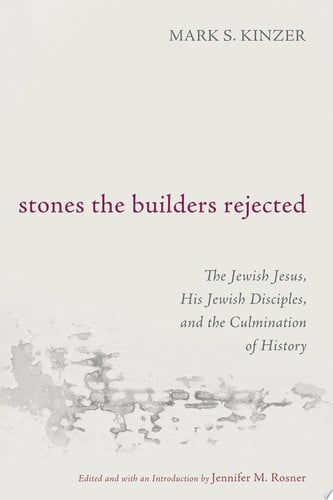
Stones the builders rejected: the Jewish Jesus, his Jewish disciples, and the culmination of history

Kinzer, Mark,Rosner, Jennifer M.
"Since the groundbreaking publication of Postmissionary Messianic Judaism (2005), Mark Kinzer has challenged theologians and religious leaders to consider the essential ecumenical vocation of Jewish disciples of Jesus. Proposing a bilateral ecclesiology in solidarity with Israel, he argued that the overcoming of Christian supersessionism required a robust affirmation of the distinctive calling of Jews within the community of Jesus the Messiah. In this way, Kinzer's work put the issue of Jewish followers of Jesus on the theological agenda for those seeking a reparative reconfiguration of the relationship between the church and the Jewish people. In recent years, Kinzer has attended to the theological implications of this perspective and has widened his focus to include not only the Messianic Jewish movement but also Jews within Catholic, Orthodox, and Protestant churches. The present collection of essays reflects this wider concern. According to Kinzer, the theological stones of contention are Christology conceived of as Messianology, ecclesiology understood as Israelology, and eschatology imagined as Zionology. Moreover, it is the presence of Jewish disciples of Jesus that concretizes these theological abstractions in the form of Jewish flesh and blood, summoning Jews and Christians to rethink their relationship to one another in ways that express their essential mutual dependence." --
Cascade Books 2024-06-04 217 pages