4 results for "Jewish History"

The Jewish King Lear A Comedy in America

Jacob Gordin
The Jewish King Lear , written by the Russian-Jewish writer Jacob Gordin, was first performed on the New York stage in 1892, during the height of a massive emigration of Jews from eastern Europe to America. This book presents the original play to the English-speaking reader for the first time in its history, along with substantive essays on the play’s literary and social context, Gordin’s life and influence on Yiddish theater, and the anomalous position of Yiddish culture vis-à-vis the treasures of the Western literary tradition. Gordin’s play was not a literal translation of Shakespeare’s play, but a modern evocation in which a Jewish merchant, rather than a king, plans to divide his fortune among his three daughters. Created to resonate with an audience of Jews making their way in America, Gordin’s King Lear reflects his confidence in rational secularism and ends on a note of joyful celebration.
Yale University Press 2011-06-23 192 pages

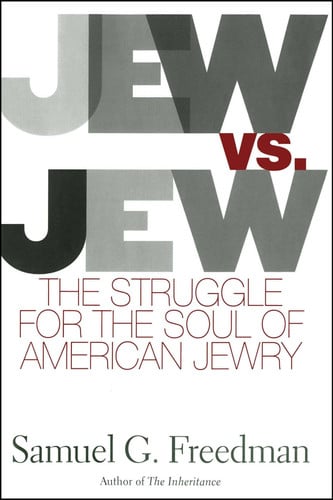
Jew Vs Jew The Struggle For The Soul Of American Jewry

Samuel G. Freedman
At a time when American Jews should feel more secure and cohesive than ever, civil war is tearing apart their community. Congregations, neighborhoods, even families are taking sides in battles about Jewish identity and Jewish authenticity. The conflict pits fundamentalist against secularist, denomination against denomination, even liberal against conservative within each branch of Jewry. Jew vs. Jew tells the story of how American Jewry has increasingly -- and perhaps terminally -- broken apart in the last forty years. Jew vs. Jew stretches in time from 1960 to 2000. It travels the country from Florida to New England, from Los Angeles to the Catskills in New York, from Cleveland to Denver, and it also crosses the ocean to Israel to show how tensions within the Jewish state inflame those among American Jews. The flash-points range from conversion standards to the role of women, from the peace process in Israel to the sexual climate on an Ivy League campus. But behind them all, as Samuel Freedman writes, lie common causes. First, far from unifying American Jews, Israel now divides them on both political and religious grounds. Second, neither America nor the larger world presents Jews with a single enemy against whom to coalesce. Third, and most important, nothing in the Jewish history of persecution, oppression, and exile prepared the Chosen People for the challenge posed by America, the challenge of being absorbed into a tolerant and diverse nation, being accepted so thoroughly that the intermarriage rate tops 50 percent. Jew vs. Jew introduces readers to memorable places and characters. Freedman describes one of the final summers at a Labor Zionist camp in the Catskills whose brand of secular Jewishness is becoming obsolete because Zionism succeeded in creating Israel. He tells the story of Orthodox and Reform Jews in a Cleveland suburb who are fighting about the construction of several synagogues -- and, on a deeper level, about whether unity or pluralism ought to be the goal of Jewish life. He portrays a Florida Jew so violently opposed to the Oslo peace accords that he planted a bomb in a synagogue where Shimon Peres was speaking. He tells about a Los Angeles congregation that spent three years debating whether or not to honor the Biblical matriarchs in its liturgy.We come to know the Long Island neighbors who cannot tolerate sharing even a property line because their versions of Jewish identity are so irreconcilably different. Jew vs. Jew is a work of vigorous reporting, lucid writing, and intellectual curiosity. And even as it chronicles an embittered and polarized community, it refuses to take sides or pass judgment. Instead, with compassion and acuity, Jew vs. Jew bears witness.
Simon & Schuster 2007-09-21 400 pages

Berlin! Berlin! Dispatches from the Weimar Republic

Kurt Tucholsky
Berlin! Berlin! is a satirical selection from the "man with the acid pen and the perfect pitch for hypocrisy," as New York author and Tucholsky-expert Peter Wortsman writes. This book os a complete collection of Tucholsky's news stories, features, satirical pieces, and poems about his hometown Berlin. It depicts Weimar Berlin, its cabarets, its policies, its follies, its ticks, and its celebrities, such as Pola Negri, Gussy Holl, Bert Brecht, Max Reinhardt, or Heinrich Zille. The book contains some of Tucholsky's most famous pieces, among them Berlin! Berlin!, a feature of the stereotypical Berliner on the phone, on vacation or doing "bizness", more than one satirical biography of the author himself, and some of his most famed stories such as where the holes in the cheese come from, or about the lion who escaped the Berlin zoo. Herr Wendriner, the chatty Berlin businessman makes an appearance, as well as Lottchen, the flapper, modelled after one of Tucholsky's real-life gilrfriends. Also Tucholsky's long-term friends Karlchen and Jakopp are part of this book. In Weimar Germany, Tucholsky was big, the most brilliant, prolific and witty cultural journalist of his time. He poured scorn on the reactionary institutions of the old regime, the follies of the Weimar Republic, and the peculiarities of the German character. - William Grimes, The New York Times Imagine a writer with the acid voice of Christopher Hitchens and the satirical whimsy of Jon Stewart. That's Tucholsky in a nutshell. - Anne Nelson, author of "The Red Orchestra" and "The Guys" Kurt Tucholsky was one of the most brilliant German-Jewish writers of his time. Today's Berliners adore him as one of their greatest sons. The world has yet to discover his genius. -Peter Schneider, author of "The Wall Jumper" and "Eduard's Homecoming" A selection from the man with the acid pen and the perfect pitch for hypocrisy, who was as much the voice of 1920s Berlin as Georg Grosz was its face. - Peter Wortsman, author of "Ghost Dance in Berlin" . . . a small, fat Berliner, who wanted to stop a catastrophe with his typewriter. -Erich Kästner, author of "Emil and the Detectives"
Berlinica 2017-05 202 pages

Testimony from the literary memoirs of Semyon Izrailevich Lipkin (1911-2003): translated by Yvonne Green

Green, Yvonne
The Jewish, Odesa-born poet, Semyon Izrailevich Lipkin (1911-2003), was a central figure in modern Russian literature, although until recently, he was best known in the West for his role in preserving the manuscript of Vasily Grossman's Life and Fate from the KGB. As a Soviet journalist in WW2, he witnessed and wrote about the horrors of Stalingrad, which led the Nobel Laureate Josef Brodsky to refer to him as 'Russia's war poet'. Later, during the years of Stalin's deportation of ethnic groups, Lipkin translated and preserved the language and writings of Tajiks, Uzbeks, and Tatars and, in doing so, became a living repository of their culture for which he risked censure and arrest from the Soviet authorities. In this memoir, Lipkin's humanity, civic courage, and friendship with many important Russian writers - Anna Akhmatova, Marina Tsvetaeva, Andrei Platonov, and of course, Grossman himself - shine through the reports of terror and oppression that characterized this most turbulent period of Russian history.
Hendon Press 2023-02-28 222 pages