11 results for "Jewish History"

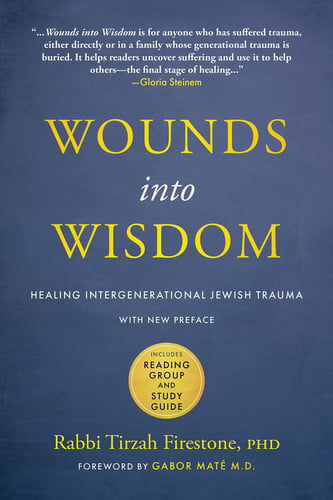
Wounds into wisdom: healing intergenerational Jewish trauma

Firestone, Tirzah
"Our past does not simply disappear. The painful history of our ancestors and their rich cultural wisdom intertwine within us to create the patterns of our future. Even when past trauma remains unspoken or has long been forgotten, it becomes part of us and our children-a legacy of both strength and woundedness that shapes our lives. In this book, Tirzah Firestone brings to life the profound impact of protracted historical trauma through the compelling narratives of those whose lives were marred by racial persecution and displacement. The tragic story of Firestone's own family lays the groundwork for these revealing testimonies of recovery, forgiveness, and moral leadership. Throughout, Firestone interweaves their voices with neuroscientific and psychological findings, as well as relevant and inspiring Jewish teachings. Seven principles emerge from these wise narratives-powerful prescriptive tools that speak to anyone dealing with the effects of past traumatic injury. At the broadest level, these principles are directives for staying morally awake in a world rife with terror"--
Monkfish Book Publishing Company 2022 258 pages

After such knowledge: memory, history, and the legacy of the Holocaust

Hoffman, Eva
Sixty years after the Holocaust, the author of Lost in Translation explores the difficult process of preserving an authentic version of its tragic events. As the Holocaust recedes in time, the guardianship of its legacy is being passed on from its survivors and witnesses to the next generation. How should they, in turn, convey its knowledge to others? What are the effects of a traumatic past on its inheritors? And what are the second generation's responsibilities to its received memories?In this meditation on the long aftermath of atrocity, Eva Hoffman -a child of Polish Jews who survived the Holocaust with the help of neighbors, but whose entire families perished -probes these questions through personal reflections, and through broader explorations of the historical, psychological, and moral implications of the second-generation experience. She examines the subterranean processes through which private memories of suffering are transmitted, and the more willful stratagems of collective memory. She traces the second generation's trajectory from childhood intimations of horror, through its struggles between allegiance and autonomy, and its complex transactions with children of per
Public Affairs 2004-01-07 301 pages

Howl

Jacobson, Howard
In the aftermath of October 7, Ferdinand Draxler walks the streets of London in despair. Everything has changed - the sights, the sound, the spirit. He too is not who he was. Is he at the crossroads of history or is it just a bend in the cul-de-sac of his own gloomy nature? The son of a Holocaust survivor who accuses him of cowardice and the father of a daughter who sees him as complicit in genocide, Draxler fixates on bad news. He shouts at the television. He carries his own tin of paint to cover up graffiti. The staffroom at the primary school of which he is headmaster has become a battlefield of inflamed opinion he does nothing to quiet. His wife, Charmian, is a beacon of calm, but even she isn't sure she can save Ferdie from himself. 'Don't worry about me,' he tells her. 'I don't have what it takes to go mad.' -- Source other than Library of Congress.
Jonathan Cape 2026-03-03 294 pages

The Holocaust is over, we must rise from its ashes

Burg, Avraham
Modern-day Israel, and the Jewish community, are strongly influenced by the memory and horrors of Hitler and the Holocaust. Burg argues that the Jewish nation has been traumatized and has lost the ability to trust itself, its neighbors or the world around it. He shows that this is one of the causes for the growing nationalism and violence that are plaguing Israeli society and reverberating through Jewish communities worldwide. Burg uses his own family history--his parents were Holocaust survivors--to inform his innovative views on what the Jewish people need to do to move on and eventually live in peace with their Arab neighbors and feel comfortable in the world at large. Thought-provoking, compelling, and original, this book is bound to spark a heated debate around the world.
Palgrave Macmillan 2010 253 pages

Surviving the camps: unity in adversity during the Holocaust

Bartrop, Paul R.
Based on accounts by survivors, disputes Bruno Bettelheim's psychoanalytic, individual-oriented theory about prisoners' submission to Nazi values. Attributes survival in concentration camps to social activity, which served individual needs without harming others. Argues that group bonding was not appreciated by Bettelheim due to his approach and his selectivity of survivor accounts. Draws on a more authoritative, representative sample. Chs. 1-2 present a history of the camps and discuss how they were administered; ch. 3 uses survivor testimony to explain camp life; chs. 4-5 discuss the views of Bettelheim and his opponents; chs. 6-8 explore the concentration camp experience through the eyes of prisoners; ch. 9 presents conclusions about surviving in the camps.
University Press of America 2000-04-12 209 pages

Haunted in the New World: Jewish American culture from Cahan to The Goldbergs

Weber, Donald
Discusses Jewish identity in America as reflected in the culture of immigrants and descendants of immigrants. Self-hatred or, at least, ambivalence about oneself in the face of native American values is one theme. Ch. 5 (pp. 98-125), "To Make 'a Jew': Projecting Antisemitism in Post-War America", analyzes two novels - Arthur Miller's "Focus" and Saul Bellow's "The Victim" - that explore the psychosocial dimensions of postwar antisemitism. They raise the question whether possibilities of Jewish-Gentile relations might lead to personal and social renovation. In "Focus", a crypto-fascist antisemite who has internalized racist stereotypes finally identifies symbolically as a Jew. In "The Victim", both Jew and Gentile partially overcome their mutual stereotyping. The main Jewish protagonist also overcomes some negative aspects of his self-image.
Indiana University Press 2005-06-08 250 pages

Clash of identities: explorations in Israeli and Palestinian societies

Kimmerling, Baruch
Taking a fresh look at the past hundred years of shared Palestinian and Jewish-Israeli history, Baruch Kimmerling reveals surprising relations of influence between a stateless indigenous society and the settler-immigrants who would later form the state of Israel. Shattering our assumptions about these two seemingly irreconcilable cultures, Kimmerling composes a sophisticated portrait of one sides behavior and characteristics and the way in which they irrevocably shaped those of the other." "By merging Israeli and Jewish studies with a wealth of scholarship on Palestinians and the Middle East, Kimmerling introduces a unique conceptual framework for analyzing the cultural, political, and material overlap of both societies. A must-read for those concerned with Israel and the relations between Jews and Arabs, Clash of Identities is an exploration of the ever-evolving, always-contending identities available to Israelis and Palestinians and the fascinating contexts in which they take form.
Columbia University Press 2008 431 pages

Awake in the dark: stories

Nayman, Shira
"Awake in the Dark is peopled by characters embarking on journeys of self-discovery; they unearth the past and the secrets that shaped them. In "The House on Kronenstrasse," a woman returns to Germany to find her childhood home; in "The Porcelain Monkey," the shocking origins of an Orthodox Jewish woman's faith are revealed; in "The Lamp," the harrowing experiences of a young woman leave her with the perfect daughter and a strange light; and in "Dark Urgings of the Blood," a patient is convinced that she shares a disturbing history with her psychiatrist"--Publisher website (December 2006).
Scribner 2007 290 pages

Co-memory and melancholia: Israelis memorialising the Palestinian Nakba

Lentin, Ronit
The 1948 war that led to the creation of the State of Israel also resulted in the destruction of Palestinian society when some 80 per cent of the Palestinians who lived in the major part of Palestine upon which Israel was established became refugees. Israelis call the 1948 war their 'War of Independence' and the Palestinians their 'Nakba', or catastrophe. After many years of Nakba denial, land appropriation, political discrimination against the Palestinians within Israel and the denial of rights to Palestinian refugees, the Nakba is beginning to penetrate Israeli public discourse. This book explores the construction of collective memory in Israeli society, where the memory of the trauma of the Holocaust and of Israel's war dead competes with the memory claims of the dispossessed Palestinians. Against a background of the Israeli resistance movement, Lentin's central argument is that commemorating the Nakba by Israeli Jews is motivated by an unresolved melancholia about the disappearance of Palestine and the dispossession of the Palestinians, a melancholia that shifts mourning from the lost object to the grieving subject. Lentin theorises Nakba co-memory as a politics of resistance, counterpoising commemorative practices by internally displaced Israeli Palestinians with Israeli Jewish discourses of the Palestinian right of return, and questions whether return narratives by Israeli Jews, courageous as they may seem, are ultimately about Israeli Jewish self-healing rather than justice for Palestine.
Manchester University Press 2010 191 pages