

11 results for "Jewish History"

Toward a Meaningful Life The Wisdom of the Rebbe Menachem Mendel Schneerson
Toward a Meaningful Life is a spiritual road map for living based on the teachings of one of the foremost religious leaders of our time: Rabbi Menachem Mendel Schneerson. Head of the Lubavitcher movement for forty-four years and recognized throughout the world simply as "the Rebbe," Menachem Mendel Schneerson, who passed away in June 1994, was a sage and a visionary of the highest order. Toward a Meaningful Life gives people of all backgrounds fresh perspectives on every aspect of their lives--from birth to death, youth to old a≥ marriage, love, intimacy, and family; the persistent issues of career, health, pain, and suffering; and education, faith, science, and government. We learn to bridge the divisions between accelerated technology and decelerated morality, between unprecedented worldwide unity and unparalleled personal disunity. Although the Rebbe's teachings are firmly anchored in more than three thousand years of scholarship, the urgent relevance of these old-age truths to contemporary life has never been more manifest. At the threshold of a new world where matter and spirit converge, the Rebbe proposes spiritual principles that unite people as opposed to the materialism that divides them. In doing so, he continues to lead us toward personal and universal redemption, toward a meaningful life, and toward God.

Moses and Monotheism
2010 Reprint of 1939 Edition. In Moses and Monotheism, Freud speculates that Moses was not Jewish, but actually born into Ancient Egyptian nobility and was perhaps a follower of Akhenaten, an ancient Egyptian monotheist. Freud further suggests that Moses led only his close followers into freedom during an unstable period in Egyptian history and that his followers subsequently killed Moses in rebellion afterward. Freud speculates that the guilt from the murder of Moses is inherited through the generations; this guilt then drives the Jews to religion to make them feel better.

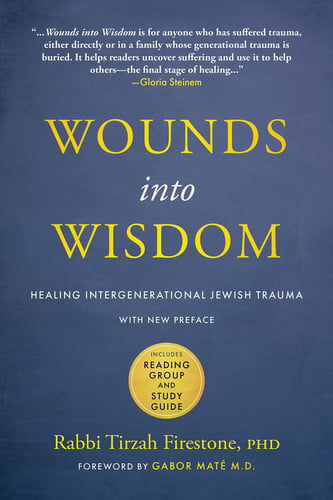
Wounds into wisdom: healing intergenerational Jewish trauma
"Our past does not simply disappear. The painful history of our ancestors and their rich cultural wisdom intertwine within us to create the patterns of our future. Even when past trauma remains unspoken or has long been forgotten, it becomes part of us and our children-a legacy of both strength and woundedness that shapes our lives. In this book, Tirzah Firestone brings to life the profound impact of protracted historical trauma through the compelling narratives of those whose lives were marred by racial persecution and displacement. The tragic story of Firestone's own family lays the groundwork for these revealing testimonies of recovery, forgiveness, and moral leadership. Throughout, Firestone interweaves their voices with neuroscientific and psychological findings, as well as relevant and inspiring Jewish teachings. Seven principles emerge from these wise narratives-powerful prescriptive tools that speak to anyone dealing with the effects of past traumatic injury. At the broadest level, these principles are directives for staying morally awake in a world rife with terror"--
Jews and the American soul: human nature in the twentieth century
What do Joyce Brothers and Sigmund Freud, Rabbi Harold Kushner and philosopher Martin Buber have in common? They belong to a group of pivotal and highly influential Jewish thinkers who altered the face of modern America in ways few people recognize. So argues Andrew Heinze, who reveals in rich and unprecedented detail the extent to which Jewish values, often in tense interaction with an established Christian consensus, shaped the country's psychological and spiritual vocabulary. Jews and the American Soul is the first book to recognize the central role Jews and Jewish values have played in shaping American ideas of the inner life. It overturns the widely shared assumption that modern ideas of human nature derived simply from the nation's Protestant heritage. Heinze marshals a rich array of evidence to show how individuals ranging from Erich Fromm to Ann Landers changed the way Americans think about mind and soul. The book shows us the many ways that Jewish thinkers influenced everything from the human potential movement and pop psychology to secular spirituality. It also provides fascinating new interpretations of Sigmund Freud, Alfred Adler, and Western views of the psyche; the clash among Protestant, Catholic, and Jewish moral sensibilities in America; the origins and evolution of America's psychological and therapeutic culture; the role of Jewish women as American public moralists, and more. A must-read for anyone interested in the contribution of Jews and Jewish culture to modern America.

The Jewish mind
A Landmark Exploration of Jewish History and Cultur e First published in 1977, The Jewish Mind provides a penetrating insight into the complex collective reality of the Jewish people. Raphael Patai examines how six great historical encounters, spanning three millennia, between the Jews and other cultures led to both change and continuity in Jewish communities throughout the global diaspora. A Timeless Analysis by a Prominent Scholar Patai, a noted cultural anthropologist and historian, drew on a lifetime of research and personal experience to explore the contemporary Jewish mind in its many manifestations, including an exploration of the notion of Jews as a race, an investigation into Jewish intelligence and talents, a discussion of Jewish self-hate, and a profile of Jewish personality and character. An Insightful New Foreword by Ari L. Goldman Bestselling author and journalist Ari L. Goldman places the book in the context of recent turbulent events, especially in the Middle East, and confirms Patai’s conclusion that Judaism remains of enormous value to humankind. Goldman calls the book “a brilliant and absorbing survey of everything poured into the Jewish mind over the millennia.” The Jewish Mind is a towering work of scholarship that remains relevant to anyone trying to understand Jewish culture and society around the world today.

The Question of Zion
Zionism is driven by the search for a homeland for the stateless and persecuted Jewish people. Yet it has infamously clashed with the rights of the Arabs in Palestine and become so controversial that deep understanding and reasoned public debate is increasingly difficult. Prominent British writer Jacqueline Rose uses her political and analytical skills to take an unprecedented look at Zionism--one of the most powerful ideologies of modern times. Rose enters the inner world of the movement and asks a new set of questions. How did Zionism take shape as an identity? And why does it seem so immutable? Rose argues that Zionism colours Israel's most profound self-image. In the most provocative part of her book, Rose proposes that the link between the Holocaust and the founding of the Jewish state--so often used to justify Israel's policies--needs to be rethought.

Hitler's bureaucrats: the Nazi Security Police and the banality of evil
For many, the name of Adolf Eichmann is synonymous with the Nazi murder of six million Jews. As a perpetuator of the Final Solution he stands alongside Adolf Hitler and Heinrich Himmler as one of history's most notorious murderers, yet ever since Hannah Arendt's seminal book, "Eichmann in Jerusalem: A Report on the Banality of Evil", there has been disagreement about the essence of Eichmann and by extension, about the definition of evil action. Was he a human monster or a petty bureaucrat? To what degree did the totalitarian organization to which he belonged absolve him and his staff from individual choice and responsibility for atrocities? This title looks at the words and actions of Eichmann and the bureaucrats he worked with in Berlin and throughout the more significant Gestapo offices in Western Europe. It claims that Hannah Arendt's thesis about the banality of evil was wrong. In chilling detail, it presents a group of people completely aware of what they were doing, people with high ideological motivation, people of initiative and dexterity who contributed far beyond what was necessary. While most of these bureaucrats sat behind desks rather than behind machine guns, there was nothing banal about the role they played in the destruction of European Jewry>

The Wisdom of Love
The Wisdom of Love examines the seemingly contradictory claims of universalism and partisanship for the ethnic or racial Other. In discussions of topics ranging from the work of the Jewish philosopher Emmanuel Lävinas to the Dreyfus Affair of the 1890s to the contending positions of Right and Left in the recent culture wars in Europe and the Americas, Finkielkraut cautions against both an unreflective universalism and an equally inflexible advocacy of the Other. He argues instead that genuine respect for the Other is inseparable from calls for universal justice and equality. Rather than being opposites, otherness and universalism are, for Finkielkraut, inextricably bound to one another.

Sex and Character
This book has been considered by academicians and scholars of great significance and value to literature. This forms a part of the knowledge base for future generations. So that the book is never forgotten we have represented this book in a print format as the same form as it was originally first published. Hence any marks or annotations seen are left intentionally to preserve its true nature.
