24 results for "Jewish History"

Up, up, and oy vey! how Jewish history, culture, and values shaped the comic book superhero

Weinstein, Simcha
From the birth of Krypton in Cleveland to the Caped Crusader, Captain America, the Incredible Hulk, Spider-Man, the X-Men, and more, Up, Up, and Oy Vey chronicles the uncanny story behind the story about the origins of the planet's most famous superheroes. While the Jewish contribution to film, theater, music, and comedy has been well-documented, the Jewish role in the creation of the All-American superhero has not been--until now! The official publication date of this book is June 27, 2006, which is two weeks after the 3rd X-Men movie is released and three days before Superman Returns hits the theaters. Additionally, Geppi's Entertainment Museum will be opening in Baltimore on July 4th as well, and this museum is being touted as a one-of-a-kind, fun, interactive museum. . .with a focus on pop culture in all media, toys, and comic characters.
Leviathan Press 2006-06-19 150 pages

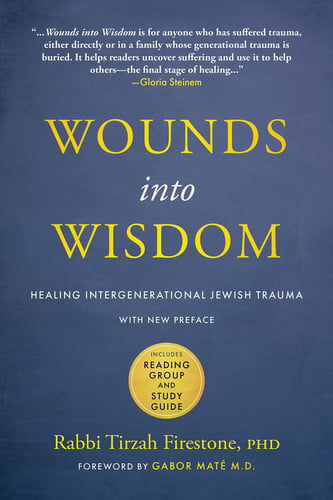
Wounds into wisdom: healing intergenerational Jewish trauma

Firestone, Tirzah
"Our past does not simply disappear. The painful history of our ancestors and their rich cultural wisdom intertwine within us to create the patterns of our future. Even when past trauma remains unspoken or has long been forgotten, it becomes part of us and our children-a legacy of both strength and woundedness that shapes our lives. In this book, Tirzah Firestone brings to life the profound impact of protracted historical trauma through the compelling narratives of those whose lives were marred by racial persecution and displacement. The tragic story of Firestone's own family lays the groundwork for these revealing testimonies of recovery, forgiveness, and moral leadership. Throughout, Firestone interweaves their voices with neuroscientific and psychological findings, as well as relevant and inspiring Jewish teachings. Seven principles emerge from these wise narratives-powerful prescriptive tools that speak to anyone dealing with the effects of past traumatic injury. At the broadest level, these principles are directives for staying morally awake in a world rife with terror"--
Monkfish Book Publishing Company 2022 258 pages

Out of left field: Jews and Black baseball

Alpert, Rebecca T.
Here is an eye-opening look at one of baseball's most intriguing and little known stories: the many-faceted relationship between Jews and black baseball in Jim Crow America. In Out of Left Field, Rebecca Alpert explores how Jewish sports entrepreneurs, political radicals, and a team of black Jews from Belleville, Virginia called the Belleville Grays--the only Jewish team in the history of black baseball--made their mark on the segregated world of the Negro Leagues. Through in-depth research, Alpert tells the stories of the Jewish businessmen who owned and promoted teams as they both acted out and fell victim to pervasive stereotypes of Jews as greedy middlemen and hucksters. Some Jewish owners produced a kind of comedy baseball, akin to basketball's Harlem Globetrotters--indeed, Globetrotters owner Abe Saperstein was very active in black baseball--that reaped financial benefits for both owners and players but also played upon the worst stereotypes of African Americans and prevented these black "showmen" from being taken seriously by the major leagues. But Alpert also shows how Jewish entrepreneurs, motivated in part by the traditional Jewish commitment to social justice, helped grow the business of black baseball in the face of the oppressive Jim Crow restrictions, and how radical journalists writing for the Communist Daily Worker argued passionately for an end to baseball's segregation. In fact, the campaign to convince manager Branch Rickey to integrate the Brooklyn Dodgers was initiated by Daily Worker sports writer Bill Mardo, in an open letter in the paper. Deftly written and meticulously researched, Out of Left Field offers a unique perspective on the economic and social negotiations between blacks and Jews in the first half of the 20th century, shedding new light on the intersection of race, religion, and sports in America.
Oxford University Press 2011 236 pages

Sacred landscape: the buried history of the Holy Land since 1948

Benvenisti, Meron
As a young man Meron Benvenisti often accompanied his father, a distinguished geographer, when the elder Benvenisti traveled through the Holy Land charting a Hebrew map that would rename Palestinian sites and villages with names linked to Israel's ancestral homeland. These experiences in Benvenisti's youth are central to this book, and the story that he tells helps explain how during this century an Arab landscape, physical and human, was transformed into an Israeli, Jewish state. Benvenisti first discusses the process by which new Hebrew nomenclature replaced the Arabic names of more than 9,000 natural features, villages, and ruins in Eretz Israel/Palestine (his name for the Holy Land, thereby defining it as a land of Jews and Arabs). He then explains how the Arab landscape has been transformed through war, destruction, and expulsion into a flourishing Jewish homeland accommodating millions of immigrants. The resulting encounters between two peoples who claim the same land have raised great moral and political dilemmas, which Benvenisti presents with candor and impartiality. Benvenisti points out that five hundred years after the Moors left Spain there are sufficient landmarks remaining to preserve the outlines of Muslim Spain. Even with sustained modern development, the ancient scale is still visible. Yet a Palestinian returning to his ancestral landscape after only fifty years would have difficulty identifying his home. Furthermore, Benvenisti says, the transformation of Arab cultural assets into Jewish holy sites has engendered a struggle over the "signposts of memory" essential to both peoples. Sacred Landscape raises troublesome questions that most writers on the Middle East avoid. The now-buried Palestinian landscape remains a symbol and a battle standard for Palestinians and Israelis. But it is Benvenisti's continuing belief that Eretz Israel/Palestine has enough historical and physical space for the people of both nations and that it can one day be a shared homeland.
University of California Press 2000 366 pages

Czernowitz at 100: the first Yiddish language conference in historical perspective

Joshua A. Fogel,Keith Weiser
Czernowitz at 100 represents a collection based on the proceedings of a 2008 international conference convened at York University in Toronto. Each chapter looks back at a portion over a long century, one marked with the mass migration of Ashkenazi Jews across the globe, two world wars, the Holocaust, the birth of Israel, and the rise and fall of the Soviet bloc. They assess the achievements and fate of those who participated in the 1908 Yiddish Language Conference that was held at Czernowitz, now known as Chernivtsi, Ukraine. Featuring contributions from a new generation of scholars re-examining eastern European Jewish life, the successes and failures of the Yiddishist movement are examined. The contributors discuss how Yiddishism-a fascinating example of language-based nationalism-shaped the political and cultural landscape of territorially dispersed Jews across Eastern Europe and the world during the twentieth century.
Lexington Books 2010-04-02 211 pages

Guilt, suffering, and memory: Germany remembers its dead of World War II

Margalit, Gilad
Germany's changing historical memory of World War II and its aftermath, as reflected in the official and public remembrance of the German war dead, exposes an unresolved tension between a discourse of guilt and a discourse of national suffering and victimization. In Germany, under the auspices of the Allied occupation, remembrance honored the victims of the Nazis and those who had fought against the regime. After the partition of Germany, a new culture emerged, memorializing the civilian dead and fallen German soldiers. Despite the fierce ideological rivalry between East and West Germany, however, certain similarities existed. The political leaderships who shaped these cultures ceased to confront their citizens with the question of guilt and instead depicted the German people as victims. In Guilt, Suffering, and Memory —whose Israeli edition was awarded the Jacob Bahat Prize for best original book—Gilad Margalit discusses the official remembrance ceremonies for the German war dead, the memorials erected to commemorate them, the public discussions of these disparate cultures, and their treatment in postwar German literature and film.
Indiana University Press 2010-01-11 387 pages

Paris in the Third Reich: a history of the German occupation, 1940-1944

Pryce-Jones, David
Pp. 75-87 describe the first Vichy and Nazi anti-Jewish administrative measures in Paris and the establishment of the first institutions which dealt with the "Jewish question". Ch. 8 (pp. 136-147), "Pitchipoi", relates the Nazi and Vichy anti-Jewish policies: introduction of the "Jewish star", the roundup of 16-17 July 1942, the deportation of Jews to camps, as well as antisemitic propaganda in Paris.
Collins 1981 294 pages

Nation and history: Israeli historiography and identity between Zionism and post-Zionism

Gelber, Yoav
During the last 20 years, Israel has reached unprecedented prosperity, yet it is haunted by existential fears for its future, identity, and survival. Israel's legitimacy is under assault from within and without by a coalition of left-wing radicals, Palestinians and their sympathizers, and Muslim fundamentalists. All these groups deny the existence of a Jewish nation and argue that Jews do not need a nation state. Hence, Israel should either disappear completely or become 'a state of all its citizens' devoid of any Jewish symbol or identity. The origins of this campaign are twofold. One derives from the traditional opposition that has accompanied Zionism from its inception. The second is contemporary, articulating the post-ist fads that swamped the West since the 1980s. The past occupies a prominent place in this crusade that aims at the present and future. Traditional historiography, scientific and pseudo-scientific, and the new vogue of memory and narrative, that claims to be the true history of human experience, are equally abused to delegitimize Israel. This book follows these two paths, while avoiding disputes over current political issues. First, it portrays the disciplinary background - the evolution of the modern history discipline. Subsequently, it focuses on the conflicting approaches to the cardinal issue of Zionism's essence: Is it a national liberation movement of European origin that offered a solution to the modern Jewish Question in a world of nationalities? Or is it a colonial movement that oppressed equally Arabs and oriental Jews?
Vallentine Mitchell 2011 337 pages

Catastrophe and meaning: the Holocaust and the twentieth century

Moishe Postone,Eric L. Santner
How should we understand the relation of the Holocaust to the broader historical processes of the century just ended? How do we explain the bearing of the Holocaust on problems of representation, memory, memorialization, and historical practice? These are some of the questions explored by an esteemed group of scholars in Catastrophe and Meaning, the most significant multiauthored book on the Holocaust in over a decade. This collection features essays that consider the role of anti-Semitism in the recounting of the Holocaust; the place of the catastrophe in the narrative of twentieth-century history; the questions of agency and victimhood that the Holocaust inspires; the afterlife of trauma in literature written about the tragedy; and the gaps in remembrance and comprehension that normal historical works fail to notice. --
University of Chicago Press 2003-11-15 274 pages

Religion as a public good: Jews and other Americans on religion in the public square

Alan Mittleman
Religion as a Public Good: Jews and Other Americans on Religion in the Public Square explores the often controversial topic of how religion ought to relate to American public life. The sixteen distinguished contributors, both Jewish and Christian, reflect on the topic out of their own disciplines-social ethics, political theory, philosophy, law, history, theology, and sociology. and take a stand based on their religious convictions and political beliefs. The volume is at once scholarly and committed, polemic and civil, reflective and activist. Written in the shadow of 9/11, it invites a new consideration of how religion enhances democratic public life with full awareness of the dangers that religion can sometimes pose. The volume is polemical, as befits the topic, but also civil, as befits a dialogue about an issue of profound significance for democratic citizenship.
Rowman & Littlefield 2003-12-09 336 pages

Aerograms across the ocean: a love story in letters

Biale, David,Biale, Rachel
"In August 1970, David Biale, a 21-year-old American Jewish student, arrived at Kibbutz Kfar Ruppin in Israel's Bet She'an Valley as a volunteer. There, he met Rachel Korati, nine days shy of her eighteenth birthday. They began an intense dialogue about how a secular Jew might be Jewish and what the role of Israel and kibbutz ought to be in modern Jewish life. They also found a common language in the counter-culture of the 1960s to which both were drawn. Upon David's return to university studies in Berkeley and Rachel's first steps into independent adulthood - living in a town near Tel Aviv and working as a youth movement counselor -- the two commenced a correspondence in which they continued their intellectual and ideological discussions from the summer, engaging Jewish sources on the one hand, and contemporary events on the other. Gradually, the letters became more intimate and so began an epistolary romance, which one might associate more with the nineteenth century and which would be inconceivable in today's world of texting and email. Over the next two years, the correspondence continued, often on a daily basis. Twice, David's plans to come to Israel were dashed. The two struggled to hold onto a relationship composed primarily of written words. In the fall of 1971, Rachel was drafted into the Israeli Army and David had his own brush with the American draft in the last phase of the Vietnam War. Aerograms Across the Ocean: A Love Story in Letters opens a rare window into the lives and thoughts of two passionate young people, trying to find their identities and life trajectories in the tumultuous early 1970s. By turns philosophical and playful, poetic and prosaic, idealistic and uncertain, pensive and erotic, this jointly-written memoir is a coming-of-age story in Israel after the Six Day War and in America in the shadow of the Vietnam War. The book is organized around the 258 letters the authors exchanged, a correspondence that takes readers back into a different age, half a century ago." --
Wildcat Books 2021-12-15 232 pages

And you shall know us by the trail of our vinyl: the Jewish past as told by the records we have loved and lost

Bennett, Roger
What started out as a mutual affinity for kitschy Jewish album covers-think Neil Diamond baring his chest hair on the cover of "Hot August Night "or Barbra Streisand in hot pants on the cover of "Streisand Superman"-soon became a quest for identity, history, and culture between the grooves of LPs. Together, Roger Bennett and Josh Kun embarked on a thrilling journey, scouring the world to collect thousands of vinyl LPs from attics, garage sales, and dusty archives. Pieced together, these scratched, once-loved and now-forgotten audio gems tell a vibrant tale: the story of Jews in America. "And You Shall Know Us by the Trail of Our Vinyl" spans the history of Jewish recorded music from the 1940s to the 1980s, weaving an account that begins with sacred songs and ends with the holy trinity of Neil, Barbra, and Barry. The LPs found here are also a love letter to forgotten moments in Jewish American pop history, celebrating well-dressed cantors singing Christmas tunes, Long Island suburbanites dancing the mambo, and Chassidic prog-rockers. The music, much of which is no longer available in any format, is brought to life through commentary from writers Aimee Bender, Etgar Keret, Michael Wex, and Shalom Auslander; performers Sandra Bernhard and Motown legend Lamont Dozier; music critics Oliver Wang and Anne Powers; and TV pioneer Norman Lear. A gateway to a forgotten kingdom of sound, the good, the bad, and the ugly of Jewish vinyl gives this aspect of Jewish culture the attention it so richly deserves.
Crown Publishers 2008 217 pages

Clash of identities: explorations in Israeli and Palestinian societies

Kimmerling, Baruch
Taking a fresh look at the past hundred years of shared Palestinian and Jewish-Israeli history, Baruch Kimmerling reveals surprising relations of influence between a stateless indigenous society and the settler-immigrants who would later form the state of Israel. Shattering our assumptions about these two seemingly irreconcilable cultures, Kimmerling composes a sophisticated portrait of one sides behavior and characteristics and the way in which they irrevocably shaped those of the other." "By merging Israeli and Jewish studies with a wealth of scholarship on Palestinians and the Middle East, Kimmerling introduces a unique conceptual framework for analyzing the cultural, political, and material overlap of both societies. A must-read for those concerned with Israel and the relations between Jews and Arabs, Clash of Identities is an exploration of the ever-evolving, always-contending identities available to Israelis and Palestinians and the fascinating contexts in which they take form.
Columbia University Press 2008 431 pages

Shaping losses: cultural memory and the Holocaust

Julia Epstein,Lori Hope Lefkovitz
Shaping Losses explores how traumatic loss affects identity and how those who are shaped by loss give shape, in turn, to the empty place where something--relationships, family, culture--was and is no longer. Taking the example of the decimation of European Jewry during the Nazi era, Shaping Losses confronts the problem of transforming trauma into cultural memory. This eloquent volume examines how memoirs, films, photographs, art, and literature, as well as family conversations and personal remembrances, embody the impulse to preserve what is destroyed. The contributors -- all distinguished women scholars, most of them survivors or daughters of survivors--examine classic memorializations such as Claude Lanzmann's film Shoah and Roman Vishniac's photographs of prewar Jews as well as several less-well-known works. They also address ways in which children of survivors of the Holocaust--and of other catastrophic traumas--struggle with inherited or vicarious memory, striving to come to terms with losses that centrally define them although they experience them only indirectly. Shaping Losses considers the limitations of Holocaust representations and testimonies that capture shards of the experience but are necessarily selective and reductive. Contributors discuss artistic efforts to "preserve the rawness" of memory, to resist redemptive closure in Holocaust narratives and public memorials, and to prevent the Holocaust from being sealed in "the cold storage of history." The authors probe the nature of memory and of trauma, studying the use of language within and outside a traumatic context such as Auschwitz and pinpointing the qualities that make traumatic memory ineffable, untransmittable, and perhaps unreliable. Within the "haunted terrain of traumatized memory" that all Holocaust testimonies inhabit, the impulse to give form to emptiness--to shape loss--emerges as a necessary betrayal, a vital effort to bridge the gap between history and memory.
University of Illinois Press 2001 239 pages

Israel and the daughters of the Shoah: reoccupying the territories of silence

Lenṭin, Ronit
The murder of a third of Europe's Jews by the Nazis is unquestionably the worst catastrophe in the history of contemporary Judaism and a formative event in the history of Zionism and the State of Israel. Understandably, therefore, the Shoah, written about, analyzed, and given various political interpretations, has shaped public discourse in the history of the State of Israel. The key element of Shoah in the Israeli context is victimhood and as such it has become a source of shame, shrouded in silence and subordinated to the dominant discourse which, resulting from the construction of a "new Hebrew" active subjectivity, taught the postwar generation of Israelis to reject diaspora Jewry and its alleged passivity in the face of catastrophe. This book is the culmination of years of preoccupation with the meaning of the Shoah for the author, an Israeli woman with a "split subjectivity: - that of a daughter of a family of Shoah survivors, and that of a daughter of the first Israeli-born generation; the culmination of her need to break the silence about the Shoah in a society which constructed itself as the Israeli antithesis to diaspora Jewry, and to excavate a "truth" from underneath the mountain of Zionist nation-building myths. These myths, the author argues, not only had deep implication for the formation of her generation but also a profound impact on the Israeli-Palestinian conflict. Moreover, they are shot through with images of the "masculine" Israeli, constrasted with those of the weak, passive, non-virile Jewish "Other" of the diaspora. This book offers the first gendered analysis of Israeli society and the Shoah. The author employs personal narratives of nine Israeli daughters of Shoah survivors, writers and film makers, and a feminist re-reading of official and unofficial Israeli and Zionist discourses to explore the ways in which the
Berghahn Books 2000 256 pages

A chosen calling: Jews in science in the twentieth century

Efron, Noah J.
Scholars have struggled for decades to explain why Jews have succeeded extravagantly in modern science. A variety of controversial theories from such intellects as C. P. Snow, Norbert Wiener, and Nathaniel Weyl have been promoted. Snow hypothesized an evolved genetic predisposition to scientific success. Wiener suggested that the breeding habits of Jews sustained hereditary qualities conducive for learning. Economist and eugenicist Weyl attributed Jewish intellectual eminence to "seventeen centuries of breeding for scholars." Rejecting the idea that Jews have done well in science because of uniquely Jewish traits, Jewish brains, and Jewish habits of mind, historian of science Noah J. Efron approaches the Jewish affinity for science through the geographic and cultural circumstances of Jews who were compelled to settle in new worlds in the early twentieth century. Seeking relief from religious persecution, millions of Jews resettled in the United States, Palestine, and the Soviet Union, with large concentrations of settlers in New York, Tel Aviv, and Moscow. Science played a large role in the lives and livelihoods of these immigrants: it was a universal force that transcended the arbitrary Old World orders that had long ensured the exclusion of all but a few Jews from the seats of power, wealth, and public esteem. Although the three destinations were far apart geographically, the links among the communities were enduring and spirited. This shared experience of facing the future in new worlds, both physical and conceptual provided a generation of Jews with opportunities unlike any their parents and grandparents had known. The tumultuous recent century of Jewish history, which saw both a methodical campaign to blot out Europe's Jews and the inexorable absorption of Western Jews into the societies in which they now live, is illuminated by the place of honor science held in Jewish imaginations. Science was central to their dreams of creating new worlds - welcoming worlds - for a persecuted people. This provocative work will appeal to historians of science as well as scholars of religion, Jewish studies, and Zionism
Johns Hopkins University Press 2014-06 149 pages

Jews and photography in Britain

Berkowitz, Michael
From the 1850s to the 1950s, photography was one of the most open avenues for Jews in Britain to make a living, as well as to contribute to mainstream culture. If one’s picture was snapped for a price in Britain, the person behind the lens was more than likely born a Jew. Through the 1970s, Jews were prime movers behind nearly all things photographic in Britain, including photojournalism, portrait studios, collecting, applications of photography to the fine arts, and the emergence of photography criticism and history as distinct fields. Yet despite Jews having played such remarkable roles, far out of proportion to their number and in all facets of photography, little attention has been paid to ethnic-religious difference in studies of British photography.Richly illustrated with both color and black-and-white images, Jews and Photography in Britain is the first-ever historical investigation of this topic, ranging from the mid-nineteenth century to Queen Elizabeth’s controversial photo shoot with Annie Leibovitz in 2007. Michael Berkowitz explores subjects such as the attempts of H. W. Barnett to unsettle portrait conventions, the spectacular photo editing of Stefan Lorant, the influence of Erich Salomon on Fleet Street, the inception of the “Gernsheim Corpus” (a seminal resource for art historical research) conceived by Walter and Gertrud Gernsheim, the innovative photography practices at London’s Warburg Institute under Fritz Saxl, and the pioneering efforts at collecting and publishing about photography as history and art by Helmut and Alison Gernsheim.
University of Texas Press 2015 358 pages