

5 results for "Leadership"

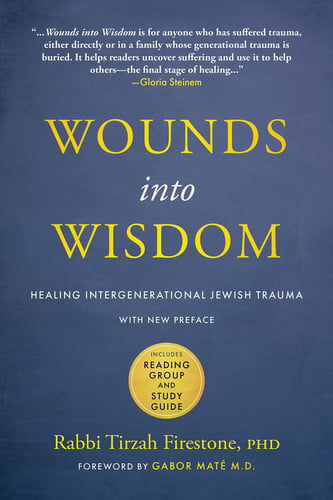
Wounds into wisdom: healing intergenerational Jewish trauma
"Our past does not simply disappear. The painful history of our ancestors and their rich cultural wisdom intertwine within us to create the patterns of our future. Even when past trauma remains unspoken or has long been forgotten, it becomes part of us and our children-a legacy of both strength and woundedness that shapes our lives. In this book, Tirzah Firestone brings to life the profound impact of protracted historical trauma through the compelling narratives of those whose lives were marred by racial persecution and displacement. The tragic story of Firestone's own family lays the groundwork for these revealing testimonies of recovery, forgiveness, and moral leadership. Throughout, Firestone interweaves their voices with neuroscientific and psychological findings, as well as relevant and inspiring Jewish teachings. Seven principles emerge from these wise narratives-powerful prescriptive tools that speak to anyone dealing with the effects of past traumatic injury. At the broadest level, these principles are directives for staying morally awake in a world rife with terror"--
Political leadership and charisma: Nehru, Ben-Gurion, and other 20th century political leaders
This book is unique in illuminating and comparing the charismatic role of two political leaders, Jawaharlal Nehru and David Ben-Gurion, along with assessments of many other 20th century political leaders. Its aim is to enrich our knowledge of an important dimension of global politics: charismatic leadership. The central role of political leaders in shaping the behavior of states has been universally recognized since the political systems of antiquity in East Asia, the Middle East, and Europe. With the massive increase of independent states since the end of World War II, from 55 initial members of the United Nations to more than 200 today, and especially the emergence of awesome weapons of mass destruction, the centrality of political leaders in the survival of the planet has grown exponentially. Both India and Israel have experienced the crucial role of charismatic leaders, Nehru and Ben Gurion, who dominated their states and societies for a near-identical formative period in their political independence, 1947-64 and 1948-63 respectively, as charismatic leaders. Their impact, Brecher shows, extended far beyond their states to both their geographic regions and global politics.

Research companion to emotion in organizations
The study of emotions and their effects in the workplace has become one of the 21st century's most exciting and burgeoning fields of organizational research. This unique work confirms that it has become increasingly clear that emotions are an essential element of our understanding of organizational life.This Companion brings together many leading scholars to address a wide range of topics in 38 chapters, across five levels of organizational analysis - including within-person, between-person (individual differences), relationships, groups, and the organization as a whole. Chapters tackle structure and measurement of emotion, antecedents and consequences of positive and negative emotions, including effects on work satisfaction and performance. The expression, recognition, and regulation of emotion and the propagation of mood and emotion in groups are also dealt with. The Companion explores contemporary issues including leadership, organizational climate and culture, as well as organizational change.With cutting edge research and comprehensive coverage of emotion in organizations this Companion will be of invaluable interest to postgraduate students and scholars in the fields of organizational behavior, organizational science, and industrial and organizational psychology.

Poison: modern manifestations of a blood libel
In March 1983 a mass poisoning was reported in the girls' middle school of Arrabeh, a village near Jenin in the West Bank. The malaise recurred in the following weeks in Jenin, Hebron, and other towns in the West Bank. All the sufferers, mainly young Arab women, were hospitalized, but soon released. The toxic agent which allegedly caused the malaise was not found; Israeli authorities concluded that the attacks were caused by mass hysteria. Nonetheless, both local Palestinian authorities and the PLO leadership accused Israel of an attempt of mass poisoning, aiming to affect the women's reproductive system and thus to tamper with the natural growth of the Palestinian population. The accusation was taken up by the media, not only Arab but also in the West (French, British, German, etc.). Once the hoax became apparent, the whole affair disappeared from the media. Compares the "poisoning affair" to blood libels in the past. Raises questions regarding the strange credulity of the Western press, otherwise very cautious in presenting similar affairs in other countries, its anti-Israeli disposition, and its disproportionally great interest in the Palestinian-Israeli conflict. Contends that the media's incrimination of Israel is a manifestation of its latent antisemitism. Where the Arabs incriminate the Jews as a people, the Westerners, reluctant to look ethnophobic, incriminate the Jewish state. Includes many quotes from the press.
