5 results for "Leadership"

Maxwell Daily Reader 365 Days of Insight to Develop the Leader Within You and Influence Those Around You

John C. Maxwell
Actively grow your leadership skills day-by-day with this timeless wisdom--comprised from fourteen of New York Times bestselling author John C. Maxwell's greatest leadership books. The Maxwell Daily Reader draws its unique power from an ageless truth: the heart of leadership is created by actions--big and small--put into practice one day at a time. Each person has inborn potential to be a great leader. Each day's message in this 365-day reader will equip you with the inspiration and advice to unlock your full leadership potential. Daily entries contain an excerpt from one of Maxwell's books that helps: Encourage and inspire you Teach you to lead Challenge you to be better Prompt you to grow The secret to your success can be found in your daily agenda. People who achieve their potential do so because they invest in themselves every day. They take the time to add value to themselves and because of that, they are also able to add value to others. Easily accessible and highly actionable, this is the very best of John C. Maxwell, and it will bring out the very best of the leader in everyone.
Thomas Nelson Inc 2011-04-18 432 pages

Minds wide shut: how the new fundamentalisms divide us

Morson, Gary Saul,Schapiro, Morton Owen
A timely exploration of intellectual dogmatism in politics, economics, religion, and literature—and what can be done to fight it Polarization may be pushing democracy to the breaking point. But few have explored the larger, interconnected forces that have set the stage for this crisis: namely, a rise in styles of thought, across a range of fields, that literary scholar Gary Saul Morson and economist Morton Schapiro call “fundamentalist.” In Minds Wide Shut , Morson and Schapiro examine how rigid adherence to ideological thinking has altered politics, economics, religion, and literature in ways that are mutually reinforcing and antithetical to the open-mindedness and readiness to compromise that animate democracy. In response, they propose alternatives that would again make serious dialogue possible. Fundamentalist thinking, Morson and Schapiro argue, is not limited to any one camp. It flourishes across the political spectrum, giving rise to dueling monologues of shouting and abuse between those who are certain that they can’t be wrong, that truth and justice are all on their side, and that there is nothing to learn from their opponents, who must be evil or deluded. But things don’t have to be this way. Drawing on thinkers and writers from across the humanities and social sciences, Morson and Schapiro show how we might begin to return to meaningful dialogue through case-based reasoning, objective analyses, lessons drawn from literature, and more. The result is a powerful invitation to leave behind simplification, rigidity, and extremism—and to move toward a future of greater open-mindedness, moderation, and, perhaps, even wisdom.
Princeton University Press 2023-01-31 307 pages

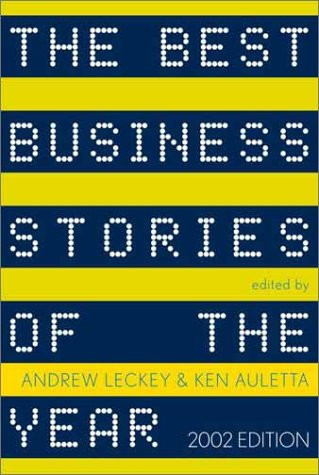
The Best Business Stories of the Year

Andrew Leckey,Ken Auletta
"[The editors] cast their net wide, picking up some excellent stories from nontraditional sources that even avid readers of the business press may have missed."-"USA Today," on the 2001 edition Series editor Andrew Leckey and guest editor Ken Auletta have scoured the print media, consulted with the editors of major business and general interest publications, and surveyed journalism school deans to find the best business stories from the last twelve months. Among those selected: Michael Lewis on teenage stock trader Jonathan Lebed, from "The New York Times Magazine"; James B. Stewart on the irrepressible Michael Milken, from "The New Yorker"; and many others from the pages of "The Wall Street Journal, Rolling Stone, Fortune, Rocky Mountain News, "and" Wired. " The second annual edition continues the excellence and comprehensive range of this fascinating anthology series.
Pantheon Books 2002 470 pages

How to Win a High School Election Advice and Ideas Collected from Over 1000 High School Seniors

Jeff Marx
High school elections may be popularity contests, but this guide to becoming a successful high school politician reveals that with the right strategy anyone can win. Collected from more than 1,000 students recently involved in winning campaigns, advice is presented for a wide range of campaign tactics from techniques for running against even the most popular and qualified opponents to the most effective means of publicizing a candidacy. Selections from successful high school speeches, posters, and handouts are provided, along with a large list of sample campaign slogans, and are accompanied by anecdotes from a nationwide group of students about the smarts, drive, and guile necessary to win a student government position. Battle-tested techniques for both overcoming and utilizing a major campaign obstacle adolescent political apathy are also included.
Jeff Marx 1999-08 169 pages

Monte Cassino in the Middle Ages

Bloch, Herbert
The monastery of Monte Cassino, founded by St. Benedict in the sixth century, was the cradle of Western monasticism. It became one of the vital centers of culture and learning in Europe. At the height of its influence, in the eleventh and early twelfth centuries, two of its abbots (including Desiderius) and one of its monks became popes, and it controlled a vast network of dependencies--churches, monasteries, villages, and farms--especially in central and southern Italy. Herbert Bloch's study, the product of forty years of research, takes as its starting point the twelfth-century bronze doors of the basilica of the abbey, the most significant relic of the medieval structure. The panels of these doors are inscribed with a list of more than 180 of the abbey's possessions. Mr. Bloch has supplemented this roster with lists found in papal and imperial privileges and other documents. The heart of the book is a detailed investigation of the nearly 700 dependencies of Monte Cassino from the sixth to the twelfth century and beyond. No comparable study of this or any other great medieval institution has ever before been undertaken. Ironically, it was the bombing of 1944, which destroyed the monastery, that led to an unexpected revelation: the discovery, on the reverse side of some panels of the doors, of magnificent engraved figures of patriarchs and apostles. These proved to be remnants of the church portal ordered from Constantinople by Desiderius in the eleventh century, which marked the beginning of the grandiose reconstruction of the abbey and its church, the latter to become a model for many other churches. In order to solve the riddle of the doors of Monte Cassino, Bloch has investigated other bronze doors of Byzantine origin in Italy and the doors of the great Italian master Oderisius of Benevento, as well as those of S. Clemente a Casauria and of the cathedral of Benevento. Also included is a study of the political and cultural impact of Byzantium on Monte Cassino and a chapter on Constantinus Africanus, Saracen turned monk, one of the most interesting figures in the history of medieval medicine. The text is sumptuously illustrated with 193 plates; most of the more than 300 illustrations have never before been published. This three-volume work, with its nine detailed indexes, offers a wealth of information for scholars in many different fields.
Harvard University Press 1986 1530 pages