16 results for "Leadership"

Maxwell Daily Reader 365 Days of Insight to Develop the Leader Within You and Influence Those Around You

John C. Maxwell
Actively grow your leadership skills day-by-day with this timeless wisdom--comprised from fourteen of New York Times bestselling author John C. Maxwell's greatest leadership books. The Maxwell Daily Reader draws its unique power from an ageless truth: the heart of leadership is created by actions--big and small--put into practice one day at a time. Each person has inborn potential to be a great leader. Each day's message in this 365-day reader will equip you with the inspiration and advice to unlock your full leadership potential. Daily entries contain an excerpt from one of Maxwell's books that helps: Encourage and inspire you Teach you to lead Challenge you to be better Prompt you to grow The secret to your success can be found in your daily agenda. People who achieve their potential do so because they invest in themselves every day. They take the time to add value to themselves and because of that, they are also able to add value to others. Easily accessible and highly actionable, this is the very best of John C. Maxwell, and it will bring out the very best of the leader in everyone.
Thomas Nelson Inc 2011-04-18 432 pages

Rebbe The Life and Teachings of Menachem M. Schneerson, the Most Influential Rabbi in Modern History

Joseph Telushkin
“One of the greatest religious biographies ever written.” – Dennis Prager In this enlightening biography, Joseph Telushkin offers a captivating portrait of the late Rabbi Menachem Mendel Schneerson, a towering figure who saw beyond conventional boundaries to turn his movement, Chabad-Lubavitch, into one of the most dynamic and widespread organizations ever seen in the Jewish world. At once an incisive work of history and a compendium of Rabbi Schneerson's teachings, Rebbe is the definitive guide to understanding one of the most vital, intriguing figures of the last centuries. From his modest headquarters in Crown Heights, Brooklyn, the Rebbe advised some of the world's greatest leaders and shaped matters of state and society. Statesmen and artists as diverse as Ronald Reagan, Robert F. Kennedy, Yitzchak Rabin, Menachem Begin, Elie Wiesel, and Bob Dylan span the spectrum of those who sought his counsel. Rebbe explores Schneerson's overarching philosophies against the backdrop of treacherous history, revealing his clandestine operations to rescue and sustain Jews in the Soviet Union, and his critical role in the expansion of the food stamp program throughout the United States. More broadly, it examines how he became in effect an ambassador for Jews globally, and how he came to be viewed by many as not only a spiritual archetype but a savior. Telushkin also delves deep into the more controversial aspects of the Rebbe's leadership, analyzing his views on modern science and territorial compromise in Israel, and how in the last years of his life, many of his followers believed that he would soon be revealed as the Messiah, a source of contention until this day.
HarperCollins 2016-06-14 672 pages

God Wants You to Be Rich

Paul Zane Pilzer
In God Wants You to Be Rich , bestselling author Paul Zane Pilzer provides an original, provocative view of how to accumulate wealth and why it is beneficial to all of humankind. A theology of economics, this book explores why God wants each of us to be rich in every way -- physically, emotionally, and financially -- and shows the way to prosperity, well-being, and peace of mind. Pilzer explains that the foundation of our economic system is based on our Judeo-Christian heritage and includes chapters on a variety of financial issues from outsourcing and unemployment to the rise of technology and real estate. Table of Contents 1. God Wants You to Be Rich 2. The Covenant 3. The Search for Camelot 4. Economic Alchemy 5. What's Happening to Our Jobs 6. The Workplace of the 21st Century 7. Money 8. Government 9. Leadership Appendix: The Principles and Six Laws of Economic Alchemy
Simon and Schuster 1997-03-27 288 pages

James the Brother of Jesus and the Dead Sea Scrolls II

Robert H. Eisenman
In this concluding volume of James the Brother of Jesus and the Dead Sea Scrolls II: The Damascus Code, the Tent of David, the New Covenant, and the Blood of Christ, renowned biblical scholar Robert Eisenman compresses in a more reader-friendly format the results of previous work, creating a more comprehensive picture of Jesus' brother James as "the pivotal Opposition Leader" of the time leading up to the War against Rome (66-70 CE). Is there an interconnecting code between the New Testament and the Dead Sea Scrolls? Eisenman - who broke the Scrolls monopoly and was the first to identify the so-called "James Ossuary" as fraudulent - shows that there is. Moreover, in this newly-revised volume, he 'decodes' many beloved and famous sayings of the Gospels, such as "Every plant which My Heavenly Father has not planted shall be uprooted," "A man shall not be known by what goes into his mouth but by what comes out of it," "Do not throw Holy Things to dogs," etc. including chapters like "The Dogs who Licked Poor Lazarus' Sores" or "Rabbi Eliezer's Bad Breath and Lazarus' Stinking Body." In identifying the Scrolls as the literature of "the Messianic Movement in Palestine"; he not only connects "James the Brother of Jesus" to the Leadership of 'Early Christianity' in Palestine, but also to "the Righteous Teacher" in the Scrolls. Offering a point-by-point analysis of James' relationship to the Habakkuk Commentary, The Damascus Document, The War Scroll, etc., he also illumines the subjects "the Pella Flight and raising the Fallen Tent of David," "Paul as an Herodian," "the Wilderness Camps," and "Peter"'s role as "a prototypical Essene" but in Acts as a mouthpiece for anti-Semitism. In doing so he, not only clarifies the true history of Palestine in the First Century, but deciphers the way 'the picture' of "Jesus" was put together in the Gospels and, as a consequence, what can be known about the real "Jesus." He also covers subjects like "the New Covenant in the Land of Damascus" and Paul's attack on James on the Temple steps, extending it to the competition between Paul and "the Party of James" over "Circumcision" in Antioch and the conversion of Queen Helen Adiabene and her sons in Northern Syria, who led the "famine relief" effort ascribed to Paul in Acts. Moreover, he will show the figure of James to have been so influential and highly-regarded in the Jerusalem of his day that his death was the capstone event leading up to the Jewish Revolt against Rome. In making these arguments and exposing actual 'overwrites', a crucial new point that emerges is his identification of the Qumran document called by scholars "MMT" as a 'Jamesian' Letter to "the Great King of the Peoples beyond the Euphrates." At the same time, he unravels the real "code" behind the pivotal New Testament allusion: "This is the Cup of the New Covenant in My Blood," connecting it to "the New Covenant in the Land of Damascus" and "giving the Cup of the Right Hand of the Lord ( "the Cup of Divine Wrath") to drink" in both the Damascus Document and Habakkuk Pesher in the Scrolls. Did Paul know the meaning of the famous Damascus Document (discovered in Cairo in the Nineteenth Century) "to set the Holy Things up according to their precise specifications" - or the reverse of it, as Peter is presented as being made to understand by "a Voice out of Heaven" and "a Tablecloth" descending out of it - "to make no distinctions between Holy and profane" - on a rooftop in Gaza? In this series, Eisenman's revelations will extend far beyond these examples. James the Brother of Jesus and the Dead Sea Scrolls, both I and II, will complete the task of rescuing James from the oblivion into which he was cast, either intentionally or via benign neglect. His conclusion will, therefore, definitively bear on the problem of "the Historical Jesus" "Who and whatever James was, so was Jesus." Eisenman's many readers will not be disappointed.
Grave Distractions Publications 2012-09 476 pages

Saudi Arabia in transition: insights on social, political, economic and religious change

Bernard Haykel,Thomas Hegghammer,Stéphane Lacroix
"Making sense of Saudi Arabia is crucially important today. The kingdom's western province contains the heart of Islam, and it is the United States' closest Arab ally and the largest producer of oil in the world. However, the country is undergoing rapid change: its aged leadership is ceding power to a new generation, and its society, dominated by young people, is restive. Saudi Arabia has long remained closed to foreign scholars, with a select few academics allowed into the kingdom over the past decade. This book presents the fruits of their research as well as those of the most prominent Saudi academics in the field. This volume focuses on different sectors of Saudi society and examines how the changes of the past few decades have affected each. It reflects new insights and provides the most up-to-date research on the country's social, cultural, economic and political dynamics"--
Cambridge University Press 2015-01-19 351 pages

Activating 5Q Understanding and Applying 5Q in Your Church Or Organization: a User's Guide

Alan Hirsch,Jessie Cruickshank
In 5Q, Alan Hirsch took a deep dive into the fivefold typology of ministry as articulated in Ephesians 4:1-16. Now in this User's Guide, Alan and Jessie challenge and equip you, your organization or church to live into a new way of seeing, thinking, and living. Summarizing and simplifying the key themes of 5Q, this practical guide is ideal for either individuals or groups. With practitioner examples, reflective questions, and training tools, Activating 5Q enables you to apply the principles to your particular context. "A new and brilliant understanding of how to unleash the latent capacity within you, the church and every group for the Jesus mission."--Dave Ferguson, lead pastor of Community Christian Church; lead visionary for NewThing; author "I believe that there are few topics more important for the renewal of Christ's people and the subsequent transforming of the world around us than what is addressed here." --Neil Cole, author of Organic Church, Primal Fire, and One Thing "Inspires, provokes and engages. It will be a catalyst for mission in the years to come!" --Danielle Strickland, international social justice advocate; author and speaker "Provides us with a clear model showing us how Jesus is active in and through the church. Wonderful!" --Brad Brisco, co-author of Missional Essentials and Next Door as It Is in Heaven "This book leads readers to live into 5Q so that the church might be the song, the poem sung to and for the world in order to bring all people into the dance of God." --JR Woodward, author of Creating a Missional Culture; co-author, The Church as Movement; national director, V3 movement "Activating 5Q offers powerful tools to help churches fire on all five cylinders as God intends."--Paul Harcourt, National Leader, New Wine England "Gives the whole church a place to see ourselves in the story of God in a way that invigorates passion and purpose. A must-read!"--Tammy Dunahoo, general supervisor, The Foursquare Church
100 Movements Publishing 2018-02-15 176 pages

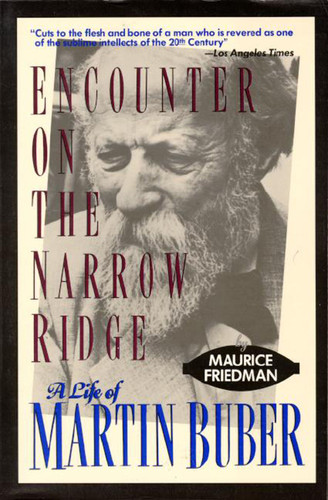
Encounter on the Narrow Ridge A Life of Martin Buber

Maurice Friedman
Martin Buber's stature as the most significant Jewish religious philosopher of the twentieth century is reinforced by his accomplishments and renown in areas as diverse as Hasidism, psychotherapy, education, folklore, and politics. His classic, I and Thou, is known and studied all over the world. In this complete and masterful biography, Maurice Friedman traces the interweaving of Buber's wholehearted engagement with world events and crises and the evolution of his unique and influential philosophy. We see the impact of World War I on the young thinker; his work in education, community, and politics between the wars; his leadership of the spiritual resistance to the Nazis in Hitler's Germany; and his more than forty years of fighting for Jewish-Arab understanding. In addition, we see Buber interact with Heidegger, Sartre, Jung, Ben Gurion, Hesse, Rosenzweig, and Hammarskjold. Through his close relationship with Buber and recent access to forty-five thousand unpublished letters, Maurice Friedman recreates Buber's vitality, his philosophy of dialogue, and his spirituality based on a personal relationship with God. Encounter on the Narrow Ridge delivers the essential spontaneity of a great man who saw in every encounter a focal point for human growth.
Paragon House 1998-06-15 496 pages

Metanoia How God Radically Transforms People, Churches, and Organizations From the Inside Out

Alan Hirsch,Rob Kelly
What if, instead of remaining stuck in unfruitful patterns and systems, we could experience the personal, church, and organizational transformation we so desperately desire? The answer lies in Jesus' first words as he began his public ministry: "metanoia." This profound concept encompasses repentance as a radical paradigm shift and reorientation, inviting us to perceive the world through God's eyes and bringing transformation in our own lives, the organizations we lead, and the world around us. In these pages, Alan Hirsch and Rob Kelly bring together their decades of experience helping countless organizational leaders to implement deep and significant change. Combining a theologically robust understanding of metanoia, along with best thinking from the social sciences, this book equips individuals and organizations to serve courageously and effectively in a complex and uncertain world.
100 Movements Publishing 2023-04-25 260 pages

Gay Children, Straight Parents A Plan for Family Healing

Richard Cohen
Hope and Healing for FamiliesOut of his own experience and the experience of many of those he has served in his counseling practice, Richard Cohen sets out a step-by-step plan that offers a path toward renewed family relationships grounded in love, faith and mutual respect."Richard is movingly candid about the brokenness in his own family life, and he's not afraid to get down in the trenches and cry, mourn and laugh with everyone else who struggles. This book offers sound practical advice for healing family relationships."Joseph Nicolosi, author of Reparative Therapy of Male Homosexuality and Preventing Homosexuality: A Parent's Guide"This book helped us go from shock and disbelief to an understanding of what happened to our son who experiences same-sex attractions. It showed us how to develop an action plan to help heal the wounds of his heart . . . and gave us real hope."Bob & Sue"We all want the best for our children. Please read this book and follow Richard's suggestions for building a healthy parent-child relationship, one based on unconditional love and mutual respect."Regina Griggs, national director, PFOX"I enthusiastically recommend Gay Children, Straight Parents as a must-read for every parent facing the difficult discovery of their child's homosexuality. Richard's compassionate approach relieves the stigma and shame often associated with a loved-one's homosexual struggle."Janelle M. Hallman, LPC"A helpful resource for parents who are intentional about loving their children well."Katherine M. Allen, LPC and director, Sought Out, Inc."It is with gratitude to Richard for filling so many voids in the world of healing same-sex attraction, and for his continuing leadership and distinctive insights, that I highly recommend this long-awaited text."Arthur Goldberg, codirector, JONAH, and president, PATH"Words cannot express the gratitude that we feel in our hearts for the incredible enlightenment that we have received from Gay Children, Straight Parents. This book has changed the life of our family and helped our daughter heal from same-sex attractions."Michael & Linda
Createspace Independent Publishing Platform 2016-02-19 226 pages

White Fire A Portrait of Women Spiritual Leaders in America

Malka Drucker
They struggled to clear a new path for women; these are the stories of modern spiritual pioneers. "I imagine this book as a dinner party where women have eagerly gathered for a conversation about being a woman, a person of faith, and a leader. While some know each other, many do not, but it doesn't matter. Listening to them in ensemble reveals that all their differences are less important than how much they share as women of faith. Since community and interconnection tend to be feminine traits, sisterhood is important, and I hope that upon finishing the book, the reader may feel that she or he has found a teacher that offers a new way to see women and the Divine." --from the Introduction There is an ancient mystical legend that the Bible was written with black fire on white fire. Now, we can only read the black fire (the letters), but someday we might be able to see the white fire. Today, with their voices and their presence growing ever stronger, women spiritual leaders in America are like white fire, and we can see the previously untapped power of female leadership. This remarkable book gives voice and image to the too often invisible, ignored, or overlooked narrative of women's spiritual leadership in America today. Revealed through insightful interviews and compelling photographic portraits, the women represent both diversity and sisterhood. They offer us new ways of relating to each other, and the Divine.
LongHill Partners, Incorporated 2002-12 296 pages

Coronaspection World Religious Leaders Reflect on Covid-19

Alon Goshen-Gottstein
Coronaspection is a groundbreaking series of forty video interviews concerning COVID-19 and its spiritual challenges, featuring major faith leaders worldwide. Coronaspection was created as a means of providing hope and inspiration to faithful of all religions, as humanity struggled, and as it continues to struggle, with the challenges posed by COVID-19. This volume seeks to answer questions that have emerged following the release of the video interviews: How is religion functioning during COVID-19? Do different religions respond to the crisis differently? These and similar questions require a synthetic view of the project, which in turn is based on an analysis of its themes and messages.
Wipf & Stock Publishers 2020-08-05 166 pages

Uncomfortable Questions for Comfortable Jews

Meir Kahane
Rabbi Meir Kahane is a member of the Israeli Knesset. According to public opinion polls, the movement he heads is gaining enormous power among Israelis, and particularly among the young. Kahane has long been a thorn in the buttocks of the wealthy and entrenched Jewish leadership. His founding of the Jewish Defense League, his demands for Jewish defense of poor and elderly Jews in the inner cities, his taking to the streets in the late '60s and his use of violence to draw international attention to the Soviet Jewish problem, have all gained him the hostility of so-called Jewish leaders. In Uncomfortable Questions for Comfortable Jews, Meir Kahane touches the most painful nerves and psyches of those Jewish liberals who would prefer to believe that Judaism and Zionism arc compatible with liberal concepts. He challenges us all with such agonizing questions as: If a Jewish and Zionist state was created in Israel to guarantee a homeland for Jews with a guaranteed permanent Jewish majority and Jewish sovereignty, will Arabs be allowed to peacefully and democratically become a majority and turn Israel into an Arab nation? * If the answer is "No," isn't that a contradiction of the western democratic thesis: "one person, one vote"'? * Is Zionism, which calls for a Jewish majority, not in total conflict with Western democracy, which insists on majority rule, no matter who constitutes the majority? * Can any Jewish leader or even an average Jew offer a young Jew any logical reason not to marry a non-Jew? Or even the slightest logical reason to insist on being a Jew rather than a "human being"? * Is Israel a Jewish state or is it a Hebrew-speaking gentilized one whose secular youth haven't the slightest idea of what Jewishness is and who dream of living in the fleshpots of the West? * How many Arabs will sit in the Knesset in ten years? In twenty years? Will they become a majority and vote Israel out of existence? * Does that matter? * Does anyone care? These are but a few of the challenging questions Kahane asks and it is the reason Jewish leaders have tried to build mountains of antagonism against him to insure that this book is buried and that Jews do not read it. Uncomfortable questions indeed-and Rabbi Kahane offers Jewish answers. The language and the ideas are not "polite" and "temperate." He isn't following the doctrine of phoniness to "be nice" because, in the end, he is talking about a single issue: Jewish survival.
Institute for Publication of the Writings of Rabbi Meir Kahane 2011 306 pages

Inspired Jewish Leadership Practical Approaches to Building Strong Communities

Erica Brown
Help sustain the Jewish tradition's legacy of community leadership by building strong leaders today. "Great Jewish leadership has helped us survive slavery, guided us to the Promised Land, given us hope through exile and oppression, helped us enjoy membership in a nation of overachievers and given birth to the State of Israel. Great Jewish leadership generates vision and, as a result, followers. It inspires us and helps us to stretch higher, see farther and reach deeper." --from the Introduction Drawing on the past and looking to the future, this practical guide provides the tools you need to work through important contemporary leadership issues. It takes a broad look at positions of leadership in the modern Jewish community and the qualities and skills you need in order to succeed in these positions. Real-life anecdotes, interviews and dialogue stimulate thinking about board development, ethical leadership, conflict resolution, change management and effective succession planning. Whether you are a professional or a volunteer, are looking to develop your own personal leadership skills or are part of a group, this inspiring book provides information, interactive exercises and questions for reflection to help you define leadership styles and theories, expose common myths and coach others on the importance of leading with meaning.
LongHill Partners, Incorporated 2008-08 256 pages

The Future of Religious Leadership World Religions in Conversation

Alon Goshen-Gottstein
The chapters collected in this book, prepared by a think tank of the Elijah Interfaith Academy, address the subject of religious leadership. The subject is of broad relevance in the training of religious leaders and in the practice of religious leadership. As such, it is also germane to religious thought, where reflections on religious leadership occupy an important place. What does it mean to be a religious leader in today’s world? To what degree are the challenges that confront religious leadership today the same perennial challenges that have arrested the attention of the faithful and their leaders for generations, and to what degree do we encounter challenges today that are unique to our day and age? One dimension is surely unique, and that is the very ability to explore these issues from an interreligious perspective and to consider challenges, opportunities, and strategies across religious traditions. Studying the theme across six faith traditions—Christianity, Islam, Judaism, Sikhism, Hinduism, and Buddhism— The Future of Religious Leadership: World Religions in Conversation recognizes the common challenges to present-day religious leadership. Contributors: Awet Andemicael, Timothy J. Gianotti, Alon Goshen-Gottstein, Anantanand Rambachan, Maria Reis Habito, Meir Sendor, Balwant Singh Dhillon, Miroslav Volf
Wipf and Stock Publishers 2018-08-08 218 pages

Due Process A Plea for Biblical Justice Among God's People

Daniel C. Juster Th. D.
We read of the Messiah in Isaiah 42-"He will bring forth justice for truth. He will not fail nor be discouraged, till He has established justice in the earth; and the coastlands shall wait for His law." If what these verses describe is the orientation of Jesus, it should be ours as well. If justice is to be established on the earth, His followers must be a community of love and justice. Since the first publication of this book in the early 1990s, we still have not seen a shift in the Body on the issues of character standards, congregational discipline, due process, and discipleship. Dallas Willard and others have written passionately about discipleship and its foundation in obeying the commandments of Jesus. Yet discipleship is rare, and the definition of love as indulgence is increasing. Love itself is wrongly defined, along with forgiveness, leading the indulging people into sin. May God use this book to make some contribution toward the path of righteousness.
Westbow Press 2015-12-18 152 pages

Dissenter in Zion From the Writings of Judah L. Magnes

Arthur A. Goren
For nearly half a century, until his death in October 1948, Judah Magnes occupied a singular place in Jewish public life. He won fame early as a preacher and communal leader, but abandoned these pursuits at the height of his influence for the roles of political dissenter and moral gadfly. During World War I he became an outspoken pacifist and supporter of radical causes. Settling permanently in Palestine in 1922, he was a founder and the first president of the Hebrew University. Increasingly, he viewed rapprochement with the Arabs as the practical and moral test of Zionism, and the formation of a bi-national state of Arabs and Jews became his chief political goal. His life interests thus focused on the core issues that confronted and still confront the Jewish people: group survival in democratic America, the direction and character of the return to Zion, and the reconciliation of universal ideals with Jewish aspirations and needs. Dissenter in Zion draws upon a rich corpus of private letters, personal journals, and diaries to offer a moving account of an eloquent and sensitive person grappling with the great questions of the day and of an activist striving to translate private moral feelings into public deeds through politics and diplomacy. We see Magnes disagreeing with Brandeis over the leadership and direction of American Zionism and with Weizmann and Ben-Gurion over ways to achieve peaceful relations with the Arabs; defending himself against charges by Einstein that he was mismanaging the affairs of the Hebrew University; and persistently negotiating with Arab leaders, trying to reach a compromise on the eve of the establishment of the State of Israel. Dissenter in Zion also contains a biographical essay on Magnes by Arthur Goren, assessing his ideas and motives and placing him in the context of his times. It shows Magnes's profundity without covering up his weaknesses, his lifelong tactic for courting repeated defeat in favor of long-term goals that could not come to pass in his lifetime.
Harvard University Press 1982-02-05 569 pages