351 results for "Literature"

The Postcard

Anne Berest
A BEST BOOK OF THE YEAR TIME Magazine・NPR・Library Journal・The Globe and Mail・Lilith・Forward Magazine・Toronto Star・The New Yorker "A testament to the power of imagination and an investigation of empathy."--Vogue "Stunning."--Leslie Camhi, The New Yorker "A can't-miss novel."--Chicago Review of Books "Compelling."--The Washington Examiner Anne Berest's The Postcard is among the most acclaimed and beloved French novels of recent years. It is at once a gripping investigation into family trauma, a poignant tale of mothers and daughters, and a vivid portrait of twentieth-century Parisian intellectual and artistic life. January, 2003. Together with the usual holiday cards, an anonymous postcard is delivered to the Berest family home. On the front, a photo of the Opéra Garnier in Paris. On the back, the names of Anne Berest's maternal great-grandparents, Ephraïm and Emma, and their children, Noémie and Jacques--all killed at Auschwitz. Years after the postcard is delivered, the heroine of this novel is moved to discover who sent it and why. What emerges is a moving saga of a family devastated by the travails of the twentieth century and partly restored through the power of storytelling.
Europa Editions 2024-05-07 480 pages

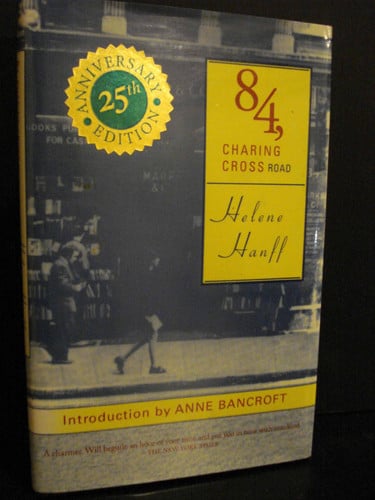
84 Charing Cross Road

Hanff, Helene
It all began with a letter enquiring about second-hand books, written by Helene Hanff in New York, and posted to a bookshop at 84 Charing Cross Road, London. As Helene's sarcastic and witty letters are responded to by the stodgy and proper Frank Doel of 84 Charing Cross Road, a relationship blossoms into a warm, charming, feisty love affair. We follow, in her subsequent letters and in the shop's responses, the trial of one woman;s idiosyncratic path through English literature. Along the way, as Anne Bancroft notes in her introduction, our enjoyment in sharing. Hanff's literary eduction is deepened by the human story her letters tell as she grows ever fonder of her bookselling friends across the ocean.
Moyer Bell 2015 97 pages

The work of art in the age of its technological reproducibility, and other writings on media

Benjamin, Walter
Walter Benjamin’s famous “Work of Art” essay sets out his boldest thoughts—on media and on culture in general—in their most realized form, while retaining an edge that gets under the skin of everyone who reads it. In this essay the visual arts of the machine age morph into literature and theory and then back again to images, gestures, and thought. This essay, however, is only the beginning of a vast collection of writings that the editors have assembled to demonstrate what was revolutionary about Benjamin’s explorations on media. Long before Marshall McLuhan, Benjamin saw that the way a bullet rips into its victim is exactly the way a movie or pop song lodges in the soul. This book contains the second, and most daring, of the four versions of the “Work of Art” essay—the one that addresses the utopian developments of the modern media. The collection tracks Benjamin’s observations on the media as they are revealed in essays on the production and reception of art; on film, radio, and photography; and on the modern transformations of literature and painting. The volume contains some of Benjamin’s best-known work alongside fascinating, little-known essays—some appearing for the first time in English. In the context of his passionate engagement with questions of aesthetics, the scope of Benjamin’s media theory can be fully appreciated.
Belknap Press of Harvard University Press 2008-05-31 426 pages

Franklin D. Roosevelt A Political Life

Robert Dallek
Named a Best Book of the Year by The Washington Post and NPR “We come to see in FDR the magisterial, central figure in the greatest and richest political tapestry of our nation’s entire history” —Nigel Hamilton, Boston Globe “Meticulously researched and authoritative” —Douglas Brinkley, The Washington Post “A workmanlike addition to the literature on Roosevelt.” —David Nasaw, The New York Times “Dallek offers an FDR relevant to our sharply divided nation” —Michael Kazin “Will rank among the standard biographies of its subject” — Publishers Weekly A one-volume biography of Roosevelt by the #1 New York Times bestselling biographer of JFK, focusing on his career as an incomparable politician, uniter, and deal maker In an era of such great national divisiveness, there could be no more timely biography of one of our greatest presidents than one that focuses on his unparalleled political ability as a uniter and consensus maker. Robert Dallek’s Franklin D. Roosevelt: A Political Life takes a fresh look at the many compelling questions that have attracted all his biographers: how did a man who came from so privileged a background become the greatest presidential champion of the country’s needy? How did someone who never won recognition for his intellect foster revolutionary changes in the country’s economic and social institutions? How did Roosevelt work such a profound change in the country’s foreign relations? For FDR, politics was a far more interesting and fulfilling pursuit than the management of family fortunes or the indulgence of personal pleasure, and by the time he became president, he had commanded the love and affection of millions of people. While all Roosevelt’s biographers agree that the onset of polio at the age of thirty-nine endowed him with a much greater sense of humanity, Dallek sees the affliction as an insufficient explanation for his transformation into a masterful politician who would win an unprecedented four presidential terms, initiate landmark reforms that changed the American industrial system, and transform an isolationist country into an international superpower. Dallek attributes FDR’s success to two remarkable political insights. First, unlike any other president, he understood that effectiveness in the American political system depended on building a national consensus and commanding stable long-term popular support. Second, he made the presidency the central, most influential institution in modern America’s political system. In addressing the country’s international and domestic problems, Roosevelt recognized the vital importance of remaining closely attentive to the full range of public sentiment around policy-making decisions—perhaps FDR’s most enduring lesson in effective leadership.
Penguin 2018-11-06 720 pages

A history of the twentieth century

Gilbert, Martin
Martin Gilbert brings readers up to date in this rich historical narrative of the contradictory events of the last fifty years. Volume II ended in 1951, as the world recovered from World War II, and the nuclear threat increased. In this volume, Gilbert recalls the Cold War and communism--including McCarthyism, the Soviet and Warsaw Pact, the Berlin Wall--and the wars, from Korea to Vietnam to Bosnia. He moves from Poland's Solidarity Movement to Ireland's Bloody Sunday, from Pol Pot and his killing fields to the dissolution of the Soviet Union. Mao began a cultural revolution, Martin Luther King, Jr. and John F. Kennedy were assassinated, and Beijing's Tiananamen Square shocked the world. Technology and medicine advanced in leaps and bounds as the society struggled to catch up. Art, literature, and music, as well as epidemics and natural disasters, all have their place here. Many of the events are described through the words of those who were present. As in the previous two volumes, Gi
W. Morrow 1997 1088 pages

The group

McCarthy, Mary
Written with a trenchant, sardonic edge, The Group is a dazzlingly outspoken novel and a captivating look at the social history of America between two world wars. "Juicy, shocking, witty, and almost continually brilliant."--CosmopolitanAward-winning Mary McCarthy's most celebrated novel follows the lives of eight Vassar graduates, known simply to their classmates as “the group.” An eclectic mix of personalities and upbringings, they meet a week after graduation to watch Kay Strong get married. After the ceremony, the women begin their adult lives -- traveling to Europe, tackling the worlds of nursing and publishing, and finding love and heartbreak in the streets of New York City. Through the years, some of the friends grow apart and some become entangled in each other's affairs, but all vow not to become like their mothers and fathers. It is only when one of them passes away that they all come back together again to mourn the loss of a friend, a confidante, and most importantly, a member of the group.
Harcourt Brace 2001 487 pages

The Volcano Lover A Romance

Susan Sontag
Set in 18th century Naples, based on the lives of Sir William Hamilton, his celebrated wife Emma, and Lord Nelson, and peopled with many of the great figures of the day, this unconventional, bestselling historical romance from the National Book Award-winning author of In America touches on themes of sex and revolution, the fate of nature, art and the collector's obsessions, and, above all, love.
Macmillan 1992 419 pages

Pablo Neruda: poet of the people

Brown, Monica
A stunning picture book biography from Monica Brown and illustrator Julie Paschkis about one of the world's most enduring and popular poets, Pablo Neruda Once there was a little boy named Neftalí who loved wild things wildly and quiet things quietly. From the moment he could talk, he surrounded himself with words. Neftalí discovered the magic between the pages of books. When he was sixteen, he began publishing his poems as Pablo Neruda. Pablo wrote poems about the things he loved—things made by his friends in the café, things found at the marketplace, and things he saw in nature. He wrote about the people of Chile and their stories of struggle. Because above all things and above all words, Pablo Neruda loved people.
Henry Holt and Co 2011-03-29 32 pages

Odd girls and twilight lovers: a history of lesbian life in twentieth-century America

Faderman, Lillian
This compelling story of lesbian life in the twentieth century traces the evolution of lesbian identity and subcultures from the early years of the century--when career opportunities first enabled women to support themselves and spend their lives in "romantic friendships" with other women--to the diversity of today's life styles. Faderman uses journals, unpublished manuscripts, songs, news accounts, novels, medical literature, and numerous personal interviews with lesbians of all races, ages, and classes, to uncover and relate this often surprising narrative of lesbian life in America. Lesbian identity could emerge, Faderman maintains, only during that time, with the sexual freedom of the 1920s and the 1960s, as well as the social freedom made possible by World War II, the education of women, and the civil rights and women's movements. The term "lesbian" did not become current until the late nineteenth century, when European sexologists began to explore female same-sex loving. Where close relationships between women had once been accepted--even encouraged--the sexologists stigmatized same-sex pairing as deviant, but at the same time fostered a lesbian consciousness which was necessary before lesbian communities could be formed. This book tells how women who accepted the label "lesbian" altered the sexologists' definitions, creating identities and ideologies for themselves.--Adapted from book jacket.
Columbia University Press 2011 373 pages

Lavender culture

Karla Jay,Allen Young
The influence of gays and lesbians on language, literature, theater, poetry, dance, music, and the arts is unmeasurable. In the era before AIDS, gay and lesbian culture had a defining, if unrecognized, influence on American life, an influence that is only now being acknowledged. This reissue of the classic anthology, Lavender Culture , serves as a provocative, dynamic, and wide-ranging reminder of American gay and lesbian culture in the days before the status of gay people received widespread attention in the media, religion, and politics, before Newsweek saw it fit to feature a cover story on LESBIANS, and before gays and lesbians took center stage in America's cultural landscape. Here we find the young, assertive voices of such activists, authors, and artists as Rita Mae Brown, Barbara Grier, John Stoltenberg, Julia Penelope, Andrea Dworkin, Andrew Kopkind, Jane Rule, Arthur Bell, Charlotte Bunche, and dozens more. Including essays on such diverse subjects as gay bath houses, the gay male image in classical ballet, images of gays in rock music, Judy Garland, lesbian humor, sports and machismo, the growing business of women's music, and the Cleveland bar scene in the 1940s, Lavender Culture, with new introductory essays by the editors and Cindy Patton, offers a panoply of gay and lesbian life, tracing the current influence and visibility of gay and lesbian culture back to its origins.
New York University Press 1994-11 498 pages

Zsa Zsa Gabor My Story

Gerold Frank
Zsa Zsa Gabor: My Story is an autobiography written by the legendary Hollywood actress and socialite, Zsa Zsa Gabor. The book, co-authored by Gerold Frank, chronicles Gabor's life from her childhood in Hungary to her rise to fame as a Hollywood starlet. Gabor's story is one of glamour, scandal, and tragedy. She was married nine times to some of the most famous men in the world, including Conrad Hilton, George Sanders, and Jack Ryan. She also had affairs with numerous other high-profile figures, including Frank Sinatra and Richard Burton. The book delves into Gabor's personal life, including her relationships with her family, her struggles with health issues, and her experiences with aging. It also provides a behind-the-scenes look at the Hollywood of the 1950s and 1960s, including Gabor's interactions with other stars such as Marilyn Monroe and Elizabeth Taylor.Overall, Zsa Zsa Gabor: My Story is a captivating and entertaining read that offers a glimpse into the life of one of Hollywood's most iconic figures.This scarce antiquarian book is a facsimile reprint of the old original and may contain some imperfections such as library marks and notations. Because we believe this work is culturally important, we have made it available as part of our commitment for protecting, preserving, and promoting the world's literature in affordable, high quality, modern editions, that are true to their original work.
Kessinger Publishing 2009-07 326 pages

Less than one: selected essays

Brodsky, Joseph
This collection of essays thrusts Brodsky--heretofore known more for his poetry and translations--into the forefront of the "Third Wave" of Russian emigre writers. His insights into the works of Dostoyevsky, Mandelstam, Platonov, as well as non-Russian poets Auden, Cavafy and Montale are brilliant. While the Western popularity of many other Third Wavers has been stunted by their inability to write in English, Brodsky consumed the language to attain a "closer proximity" to poets such as Auden. The book, which won a National Book Critics Circle Award, opens and closes with revealing autobiographical essay.
Farrar, Straus & Giroux 1986 501 pages

Shirley Jackson: a rather haunted life

Franklin, Ruth
"This long-awaited biography establishes Shirley Jackson as a towering figure in American literature and revives the life and work of a neglected master. Still known to millions only as the author of the "The Lottery," Shirley Jackson (1916-1965) remains curiously absent from the American literary canon. A genius of literary suspense, Jackson plumbed the cultural anxiety of postwar America better than anyone. Now, biographer Ruth Franklin reveals the tumultuous life and inner darkness of the author behind such classics as The Haunting of Hill House and We Have Always Lived in the Castle. Placing Jackson within an American Gothic tradition of Hawthorne and Poe, Franklin demonstrates how her unique contribution to this genre came from her focus on "domestic horror" drawn from an era hostile to women. Based on a wealth of previously undiscovered correspondence and dozens of new interviews, Shirley Jackson, with its exploration of astonishing talent shaped by a damaged childhood and a troubled marriage to literary critic Stanley Hyman, becomes the definitive biography of a generational avatar and an American literary giant."--
Liveright Publishing Corporation 2017-10-10 607 pages