29 results for "Literature"

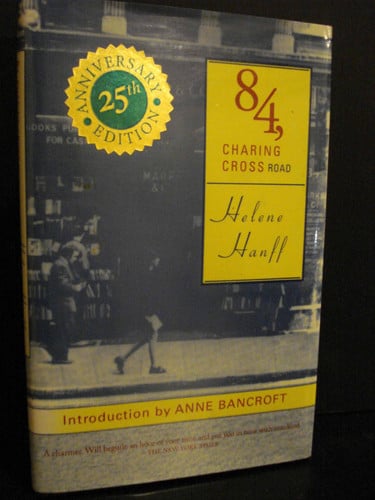
84 Charing Cross Road

Hanff, Helene
It all began with a letter enquiring about second-hand books, written by Helene Hanff in New York, and posted to a bookshop at 84 Charing Cross Road, London. As Helene's sarcastic and witty letters are responded to by the stodgy and proper Frank Doel of 84 Charing Cross Road, a relationship blossoms into a warm, charming, feisty love affair. We follow, in her subsequent letters and in the shop's responses, the trial of one woman;s idiosyncratic path through English literature. Along the way, as Anne Bancroft notes in her introduction, our enjoyment in sharing. Hanff's literary eduction is deepened by the human story her letters tell as she grows ever fonder of her bookselling friends across the ocean.
Moyer Bell 2015 97 pages

Hitch-22: a memoir

Hitchens, Christopher
Over the course of his 60 years, Christopher Hitchens has been a citizen of both the United States and the United Kingdom. He has been both a socialist opposed to the war in Vietnam and a supporter of the U.S. war against Islamic extremism in Iraq. He has been both a foreign correspondent in some of the world's most dangerous places and a legendary bon vivant with an unquenchable thirst for alcohol and literature. He is a fervent atheist, raised as a Christian, by a mother whose Jewish heritage was not revealed to him until her suicide. In other words, Christopher Hitchens contains multitudes. He sees all sides of an argument. And he believes the personal is political. This is the story of his life, lived large.
Twelve 2010-06-02 435 pages

Shirley Jackson: a rather haunted life

Franklin, Ruth
"This long-awaited biography establishes Shirley Jackson as a towering figure in American literature and revives the life and work of a neglected master. Still known to millions only as the author of the "The Lottery," Shirley Jackson (1916-1965) remains curiously absent from the American literary canon. A genius of literary suspense, Jackson plumbed the cultural anxiety of postwar America better than anyone. Now, biographer Ruth Franklin reveals the tumultuous life and inner darkness of the author behind such classics as The Haunting of Hill House and We Have Always Lived in the Castle. Placing Jackson within an American Gothic tradition of Hawthorne and Poe, Franklin demonstrates how her unique contribution to this genre came from her focus on "domestic horror" drawn from an era hostile to women. Based on a wealth of previously undiscovered correspondence and dozens of new interviews, Shirley Jackson, with its exploration of astonishing talent shaped by a damaged childhood and a troubled marriage to literary critic Stanley Hyman, becomes the definitive biography of a generational avatar and an American literary giant."--
Liveright Publishing Corporation 2017-10-10 607 pages

Wallace Stegner and the American West

Fradkin, Philip L.
Wallace Stegner was the premier chronicler of the twentieth-century western American experience, and his novels, the Pulitzer Prize–winning Angle of Repose and the National Book Award–winning The Spectator Bird, brought the life and landscapes of the West to national and international attention. Now, in this illuminating biography, Philip L. Fradkin goes beyond Stegner’s iconic literary status to give us, as well, the influential teacher and visionary conservationist, the man for whom the preservation and integrity of place was as important as his ability to render its qualities and character in his brilliantly crafted fiction and nonfiction. From his birth in 1909 until his death in 1993, Stegner witnessed nearly a century of change in the land that he loved and fought so hard to preserve. We learn of his hardscrabble youth on the Canadian frontier and in Utah, and of his painful relationship with his father, a bootlegger and gambler. We follow his intellectual awakening as a young man and his years as a Depression-era graduate student at the University of Iowa, during its earliest days as a literary center. We watch as he finds his home, with his wife, Mary, in the foothills above Palo Alto, which provided him with a long-awaited sense of belonging and a refuge in which he would write his most treasured works. And here are his years as the legendary founder of the Stanford Creative Writing Program, where his students included Ken Kesey, Edward Abbey, Robert Stone, and Wendell Berry. But the changes wrought by developers and industrialists were too much for Stegner, and he tirelessly fought the transformation of his Garden of Eden into Silicon Valley. His writings on the importance of establishing national parks and wilderness areas—not only for the preservation of untouched landscape but also for the enrichment of the human spirit—played a key role in the passage of historic legislation and comprise some of the most beautiful words ever written about the natural world. Here, too, is the story—told in full for the first time—of the accusations of plagiarism that followed the publication of Angle of Repose, and of the shadow they have cast on his greatest work. Rich in personal and literary detail, and in the sensual description of the country that shaped his work and his life—this is the definitive account of one of the most acclaimed and admired writers, teachers, and conservationists of our time.
Alfred A. Knopf 2008-02-12 369 pages

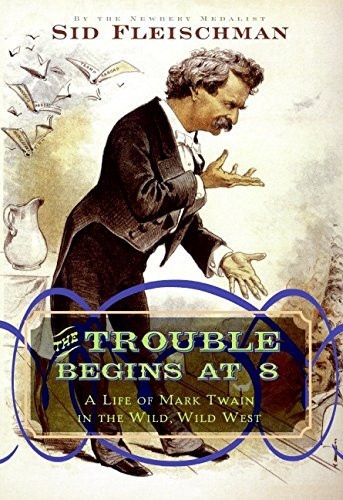
The trouble begins at 8: a life of Mark Twain in the wild, wild West

Fleischman, Sid
"Mark Twain was born fully grown, with a cheap cigar clamped between his teeth." So begins Sid Fleischman's ramble-scramble biography of the great American author and wit, who started life in a Missouri village as a barefoot boy named Samuel Clemens. Abandoning a career as a young steamboat pilot on the Mississippi River, Sam took a bumpy stagecoach to the Far West. In the gold and silver fields, he expected to get rich quick. Instead, he got poor fast, digging in the wrong places. His stint as a sagebrush newspaperman led to a duel with pistols. Had he not survived, the world would never have heard of Tom Sawyer or Huckleberry Finn—or red-headed Mark Twain. Samuel Clemens adopted his pen name in a hotel room in San Francisco and promptly made a jumping frog (and himself) famous. His celebrated novels followed at a leisurely pace; his quips at jet speed. "Don't let schooling interfere with your education," he wrote. Here, in high style, is the story of a wisecracking adventurer who came of age in the untamed West; an ink-stained rebel who surprised himself by becoming the most famous American of his time. Bountifully illustrated.
Greenwillow Books 2008 224 pages

Ex-friends

Podhoretz, Norman
Allen Ginsberg, Lionel and Diana Trilling, Lillian Hellman, Hannah Arendt, and Norman Mailer -- all are ex-friends of Norman Podhoretz, the renowned editor and critic and leading member of the group of New York intellectuals who came to be known as "the Family." As only a family member could, Podhoretz tells the story of these friendships, once central to his life, and shows how the political and cultural struggles of the past fifty years made them impossible to sustain. With wit, piercing insight, and startling honesty, we are introduced as never before to a type of person for whom ideas were often matters of life and death, and whose passing from the scene has left so large a gap in American culture. Podhoretz was the trailblazer of the now-famous journey of a number of his fellow intellectuals from radicalism to conservatism -- a journey through which they came to exercise both cultural and political influence far beyond their number. With this fascinating account of his once happy and finally troubled relations with these cultural icons, Podhoretz helps us understand why that journey was undertaken and just how consequential it became. In the process we get a brilliantly illuminating picture of the writers and intellectuals who have done so much to shape our world. Combining a personal memoir with literary, social, and political history, this unique gallery of stern and affectionate portraits is as entertaining as a novel and at the same time more instructive about postwar American culture than a formal scholarly study. Interwoven with these tales of some of the most quixotic and scintillating of contemporary American thinkers are themes that are introduced, developed, and redeveloped in a variety of contexts, with each appearance enriching the others, like a fugue in music. It is all here: the perversity of brilliance; the misuse of the mind; the benightedness of people usually considered especially enlightened; their human foibles and olympian detachment; the rigors to be endured and the prizes to be won and the prices to be paid for the reflective life. Most people live their lives in a very different way, and at one point, in a defiantly provocative defense of the indifference shown to the things by which intellectuals are obsessed, Norman Podhoretz says that Socrates' assertion that the unexamined life was not worth living was one of the biggest lies ever propagated by a philosopher. And yet, one comes away from Ex-Friends feeling wistful for a day when ideas really mattered and when there were people around who cared more deeply about them than about anything else. Reading of a time when the finest minds of a generation regularly gathered in New York living rooms to debate one another with an articulateness, a passion, and a level of erudition almost extinct, we come to realize how enviable it can be to live a life as poignantly and purposefully examined as Norman Podhoretz's is in Ex-Friends.
Free Press 1999-02-21 244 pages

Philip Roth: stung by life

Zipperstein, Steven J.
"Philip Roth (1933-2018) is one of the most celebrated American writers of his age. Born in Newark, New Jersey -- where his short stories and thirty-one books were often set -- he wrote with immense ambition and drive, along with a keen awareness of what must be done to produce great literature. Yet despite rubbing shoulders with the Kennedys and engaging in a spate of famous and infamous romances, he viewed himself as socially withdrawn, living much like an "unchaste monk" (his words). In this original and lucid biography, Steven J. Zipperstein captures Roth's complex life and the astonishing range of his self-reflective writings-from "Goodbye, Columbus" and "Portnoy's complaint" to the Pulitzer Prize-winning "American pastoral" and "The plot against America." Employing extensive archival research and well over one hundred interviews, including conversations with Roth himself, Zipperstein provides an intimate and probing look at one of the twentieth century's most influential authors, placing his work in the context of Jewishness, freedom, and sexuality in America"-- Provided by publisher.
Yale University Press 2025-10-14 346 pages

Jerzy

Charyn, Jerome
"Jerzy Kosinski was a great enigma of post-World War II literature. When he exploded onto the American literary scene in 1965 with his best-selling novel The Painted Bird, he was revered as a Holocaust survivor and refugee from the world hidden behind the Soviet Iron Curtain. He won major literary awards, befriended actor Peter Sellers (who appeared in the screen adaptation of his novel Being There), and was a guest on talk shows and at the Oscars. But soon the facade began to crack, and behind the public persona emerged a ruthless social climber, sexual libertine, and pathological liar who may have plagiarized his greatest works. Jerome Charyn lends his unmistakable style to this most American story of personal disintegration, told through the voices of multiple narrators--a homicidal actor, a dominatrix, and Joseph Stalin's daughter--who each provide insights into the shifting facets of Kosinski's personality. The story unfolds like a Russian nesting doll, eventually revealing the lost child beneath layers of trauma, while touching on the nature of authenticity, the atrocities of WWII, the allure of sadomasochism, and the fickleness of celebrity."-- Page [4] of cover.
Bellevue Literary Press 2017 237 pages

Many subtle channels: in praise of potential literature

Levin Becker, Daniel
What sort of society could bind together Jacques Roubaud, Italo Calvino, Marcel Duchamp, and Raymond Queneau—and Daniel Levin Becker, a young American obsessed with language play? Only the Oulipo, the Paris-based experimental collective founded in 1960 and fated to become one of literature’s quirkiest movements. An international organization of writers, artists, and scientists who embrace formal and procedural constraints to achieve literature’s possibilities, the Oulipo (the French acronym stands for “workshop for potential literature”) is perhaps best known as the cradle of Georges Perec’s novel A Void, which does not contain the letter e. Drawn to the Oulipo’s mystique, Levin Becker secured a Fulbright grant to study the organization and traveled to Paris. He was eventually offered membership, becoming only the second American to be admitted to the group. From the perspective of a young initiate, the Oulipians and their projects are at once bizarre and utterly compelling. Levin Becker’s love for games, puzzles, and language play is infectious, calling to mind Elif Batuman’s delight in Russian literature in The Possessed. In recent years, the Oulipo has inspired the creation of numerous other collectives: the OuMuPo (a collective of DJs), the OuMaPo (marionette players), the OuBaPo (comic strip artists), the OuFlarfPo (poets who generate poetry with the aid of search engines), and a menagerie of other Ou-X-Pos (workshops for potential something ). Levin Becker discusses these and other intriguing developments in this history and personal appreciation of an iconic—and iconoclastic—group.
Harvard University Press 2012-04-30 338 pages

The art of fiction

Salter, James
James Salter's exalted place in American letters is based largely on the intense admiration of other writers, but his work resonates far beyond the realm of fellow craftsmen, addressing themes--youth, war, erotic love, marriage, life abroad, friendship--that speak to us all. Following the publication of his first novel, Salter left behind a military career of great promise to write full-time and--through decades of searching, exacting work--became one of American literature's master stylists. Only months before he died, at the age of eighty-nine, he agreed to serve as the first Kapnick Writer-in-Residence at the University of Virginia, where he composed and delivered the three lectures presented in this book and introduced by his friend and fellow novelist, National Book Award-winning author John Casey. Salter speaks to us here with an easy intimacy, sharing his unceasing enchantment with the books that made up his reading life, including works by Balzac, Flaubert, Babel (whose prose is "like a handful of radium"), Dreiser, Celine, Faulkner. These talks provide an invaluable opportunity to see the way in which a great writer reads. They also offer a candid look at the writing life--the rejection letters, not one but two negative reviews in the New York Times for the same book, writing in the morning or at night and worrying about money during the long afternoons. Salter raises the question, Why does one write? For wealth? For admiration, or a sense of "importance"? Confronting a blank sheet that always offers too many choices, practicing a vocation that often demands one write instead of live, the answer for Salter was creating a style that captured experience, in a world where anything not written down fades away. -- Amazon.com.
University of Virginia Press 2016 77 pages

Conversations with James Salter

Salter, James
"James Salter (born James Horowitz in 1925) has been known throughout his career as a "writer's writer," acclaimed by such literary greats as Susan Sontag, Richard Ford, John Banville, and Peter Matthiessen for his lyrical prose, his insightful and daring explorations of sex, and his examinations of the inner lives of women and men. Conversations with James Salter collects interviews published from 1972 to 2014 with the award-winning author of The Hunters, A Sport and a Pastime, Light Years, and All That Is. Gathered here are his earliest interviews following acclaimed but moderately selling novels, conversations covering his work as a screenwriter and award-winning director, and interviews charting his explosive popularity after publishing All That Is, his first novel after a gap of thirty-four years. These conversations chart Salter's progression as a writer, his love affair with France, his military past as a fighter pilot, and his lyrical explorations of gender relations.The collection contains interviews from Sweden, Chile, France, and Argentina appearing for the first time in English. Included as well are published conversations from the United States, Canada, and Australia, some of which are significantly extended versions, giving this collection an international scope of Salter's wide-ranging career and his place in world literature"--
University Press of Mississippi 2015 236 pages

Forever fat: essays by the Godfather

Gutkind, Lee
Dubbed-some would say drubbed-the "godfather behind creative nonfiction" by Vanity Fair, Lee Gutkind takes the opportunity of these essays, and the rich material of his own life, to define, defend, and further expand the genre he has done so much to shape. The result is an explosive and hilarious memoir of Gutkind's colorful life as a motorcyclist, a medical insider, a sailor, a college professor, an over-aged insecure father, and a literary whipping boy. In Forever Fat Gutkind battles his weight, his ex-wives, his father, his rabbi, his psychiatrist, and his critics in a lifelong cross-country, cross-cultural search for stability and identity. And from Gutkind's battles, the reader emerges a winner, treated to a sometimes poignant, sometimes harrowing, sometimes uproarious, and always engrossing story of the simultaneous awakening of a man and his mission, and of the constant struggle, in literature and in life, to sort out memory and imagination. Here, enacted in technicolor terms, is the universal, symbolic truth that no matter how far you travel, over how many years, you will never completely shed the weighty baggage of adolescence. Yet, as Gutkind proves again and again, he has learned to describe his burden with an ever-lightening brilliance. Lee Gutkind is the founder and editor of the journal Creative Nonfiction. The author and editor of a dozen books, including the award-winning Many Sleepless Nights: The World of Organ Transplantation, he is a professor of English at the University of Pittsburgh and the director of the Mid-Atlantic Creative Nonfiction Writers' Conference at Goucher College.
University of Nebraska Press 2003 177 pages

The damned don't cry -- they just disappear: the life and works of Harry Hervey

Greene, Harlan
"In The Damned Don't Cry -- They Just Disappear, literary historian and Lamba Award--winning novelist Harlan Greene has created a portrait of a nearly forgotten Southern writer, unearthing information from archives, rare books, film libraries, and small-town newspapers. Greene brings Harry Hervey (1900-1951) to life and explicates his works to reveal him as a hardworking writer and master of many genres, bravely unwilling to conform to conventional values. As Greene illustrates, Hervey's novels, short stories, nonfiction books, and film scripts contain complex mixtures of history and thinly disguised homoerotic situations and themes. They blend local color, naturalism, melodrama, and psychological and sexual truths that provide a view of the circles in which he moved. Living openly with his male lover in Savannah, Georgia, and Charleston, South Carolina, Hervey set novels in these cities that scandalized the locals and critics as well. He challenged the sexual mores of his day, sometimes subtly and at other times brazenly presenting texts that told one story to gay male readers, while still courting a mainstream audience. His novels and nonfiction may have been coded and thus escaped detection in their day, but twenty-first-century readers can decipher them easily" --
University of South Carolina Press 2017 184 pages