3 results for "Literature"

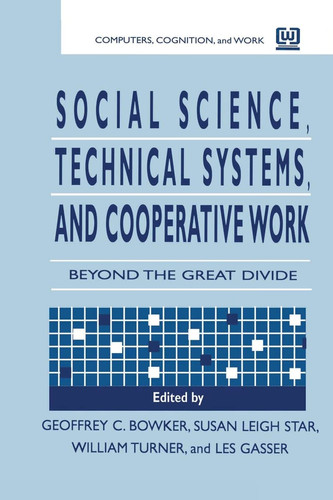
Social science, technical systems, and cooperative work: beyond the great divide

Geoffrey C. Bowker,Les Gasser,Susan Leigh Star,William Turner
This book is the first to directly address the question of how to bridge what has been termed the ""great divide"" between the approaches of systems developers and those of social scientists to computer supported cooperative work--a question that has been vigorously debated in the systems development literature. Traditionally, developers have been trained in formal methods and oriented to engineering and formal theoretical problems; many social scientists in the CSCW field come from humanistic traditions in which results are reported in a narrative mode. In spite of their differences in style,
Lawrence Erlbaum Associates 1997 470 pages

Integral Operators in the Theory of Linear Partial Differential Equations

Bergman, Stefan
The present book deals with the construction of solutions of linear partial differential equations by means of integral operators which transform analytic functions of a complex variable into such solutions. The theory of analytic functions has achieved a high degree of deve lopment and simplicity, and the operator method permits us to exploit this theory in the study of differential equations. Although the study of existence and uniqueness of solutions has been highly developed, much less attention has been paid to the investigation of function theo retical properties and to the explicit construction of regular and singular solutions using a unified general procedure. This book attempts to fill in the gap in this direction. Integral operators of various types have been used for a long time in the mathematical literature. In this connection one needs only to mention Euler and Laplace. The author has not attempted to give a complete account of all known operators, but rather has aimed at developing a unified approach. For this purpose he uses special operators which preserve various function theoretical properties of analytic functions, such as domains of regularity, validity of series development, connection between the coefficients of these developments and location and character of singularities, etc. However, all efforts were made to give a complete bibliography to help the reader to find more detailed information.
Springer 2014-10-09 156 pages

SpecLab: digital aesthetics and projects in speculative computing

Drucker, Johanna
Nearly a decade ago, Johanna Drucker cofounded the University of Virginia’s SpecLab, a digital humanities laboratory dedicated to risky projects with serious aims. In SpecLab she explores the implications of these radical efforts to use critical practices and aesthetic principles against the authority of technology based on analytic models of knowledge. Inspired by the imaginative frontiers of graphic arts and experimental literature and the technical possibilities of computation and information management, the projects Drucker engages range from Subjective Meteorology to Artists’ Books Online to the as yet unrealized ’Patacritical Demon, an interactive tool for exposing the structures that underlie our interpretations of text. Illuminating the kind of future such experiments could enable, SpecLab functions as more than a set of case studies at the intersection of computers and humanistic inquiry. It also exemplifies Drucker’s contention that humanists must play a role in designing models of knowledge for the digital age—models that will determine how our culture will function in years to come.
University of Chicago Press 2009-06-01 241 pages