51 results for "Literature"

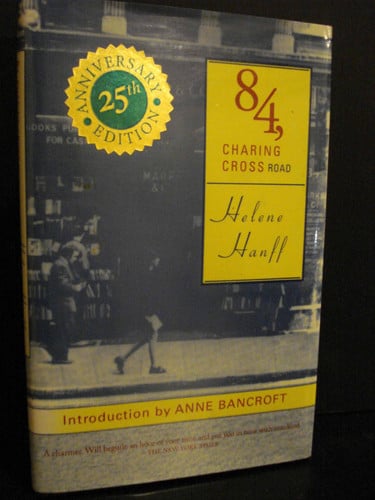
84 Charing Cross Road

Hanff, Helene
It all began with a letter enquiring about second-hand books, written by Helene Hanff in New York, and posted to a bookshop at 84 Charing Cross Road, London. As Helene's sarcastic and witty letters are responded to by the stodgy and proper Frank Doel of 84 Charing Cross Road, a relationship blossoms into a warm, charming, feisty love affair. We follow, in her subsequent letters and in the shop's responses, the trial of one woman;s idiosyncratic path through English literature. Along the way, as Anne Bancroft notes in her introduction, our enjoyment in sharing. Hanff's literary eduction is deepened by the human story her letters tell as she grows ever fonder of her bookselling friends across the ocean.
Moyer Bell 2015 97 pages

The other Victorians: a study of sexuality and pornography in mid-nineteenth-century England

Marcus, Steven
"Taking as his point of departure the authors, the audience, and the texts of Victorian writings on sex in general and of Victorian pornography in particular, Steven Marcus offers a startling and revolutionary perspective on the underside of Victorian culture. The way these subjects were regarded--and the way our notions of the Victorians continue to change, as the efforts of contemporary scholarship restore them to their full historical dimensions--are matters today of some surprise and wonder. Marcus first examines the writings of Dr. William Acton, who may be said to represent the "official views" of sexuality held by Victorian society, and Henry Spencer Ashby, the first and most important bibliographer-scholar of pornography. He then turns to the most significant work of its kind from the period, the eleven-volume anonymous autobiography My Secret Life. There follows an analysis of four pornographic Victorian novels--an analysis that throws an oblique but fascinating light on the classics of Victorian literature--and a review of the odd flood of Victorian publications devoted to flagellation. The books concludes with a chapter propounding a general theory of pornography as a sociological phenomenon. Most of the writers and writing being discussed by Marcus belong to Victorian sub-literature rather than to literature proper; in this way the work remains connected to a consideration of the exotic sub-literature. A brilliantly written book in its own right, this work transformed the study of the Victorian period as did no other." -- Provided by publisher
Transaction Publishers 2009 292 pages

The Holocaust on trial: history, justice, and the David Irving libel case

Guttenplan, D. D.
A journalist's account of the London trial of David Irving vs. Penguin Books and Deborah Lipstadt, held in January-April 2000, interspersed with reflections on Holocaust memory and denial. The case became a Holocaust trial, albeit without perpetrators and victims. It did not generate a new narrative of the Holocaust, a revisionist one, as Irving had hoped. Without endorsing Irving's views, defends his right to historical dissent and regrets that his reputation as an outstanding historian was undermined. Contends that the critics of Irving's views, including Lipstadt, misinterpreted his writing as an outgrowth of postmodern deconstruction; what Irving assaulted was not rationalism and history as a science, but the Jews. His main motive was antisemitism. Contends that the depoliticized myth of the "Nazi war against the Jews", characteristic of some historiographic works, made the deniers' task easier. Believes that the Jews are not immune to critical analysis of their history; however, Irving crossed the divide between legitimate criticism and prejudiced vilification of the Jews as a people.
Granta 2002 334 pages

The English German girl

Simons, Jake Wallis
"This powerful, meticulously researched novel is a moving tale of one girl's struggle against a world in turmoil. In 1930s Berlin, choked by the tightening of Hitler's fist, the Klein family are gradually losing everything that is precious to them. Their fifteen-year-old daughter, Rosa, slips out of Germany on a Kindertransport train to begin a new life in England. Charged with the task of securing a safe passage for her family, she vows that she will not rest until they are safe. But as war breaks out and she loses contact with her parents, Rosa finds herself wondering if there are some vows that can't be kept ...A sweeping tale of love and loss, with the poignant story of the Kindertransport at its heart, this is an exceptional accomplishment from one of Britain's bravest and most vibrant young writers."
Polygon 2011 377 pages

The novels of Virginia Woolf

Lee, Hermione
This is a reissue of a critical introduction to the novels of Virginia Woolf, first published in 1977. It makes close, illuminating readings of her nine novels, placing Woolf in her literary context and providing an accessible, clear and valuable guide for students starting out on a study of Woolf as a novelist, and for general readers seeking a fresh, helpful entry-point to the challenge of reading Woolf. Twenty years later, Hermione Lee wrote a prize-winning and acclaimed biography of Virginia Woolf: this critical study represented an early stage in this biographer-criticâe(tm)s life-long interest and involvement with Woolfâe(tm)s life and work.
Routledge 2010 237 pages

The Cambridge companion to Mary Shelley

Esther Schor
In The Cambridge Companion to Mary Shelley, leading scholars discuss her work in several fascinating contexts: literary history, aesthetic and literary culture, the legacies of her parents William Godwin and Mary Wollstonecraft, and of course the life and afterlife of her most famous work Frankenstein. Other topics covered include Mary Shelley as a biographer and cultural critic and her travel writing. The contributions are sophisticated but accessible, challenging but lucid, and are complemented by a chronology, a guide to further reading and a select filmography.
Cambridge University Press 2003-11-20 289 pages

Identity crisis

Elton, Ben
"Why are we all so hostile? So quick to take offence? Truly we are living in the age of outrage. A series of apparently random murders draws amiable, old-school Detective Mick Matlock into a world of sex, politics, reality TV and a bewildering kaleidoscope of opposing identity groups. Lost in a blizzard of hashtags, his already complex investigation is further impeded by the fact that he simply doesn't 'get' a single thing about anything anymore. Meanwhile, each day another public figure confesses to having 'misspoken' and prostrates themselves before the judgement of Twitter. Begging for forgiveness, assuring the public 'that is not who I am'. But if nobody is who they are anymore - then who the f**k are we? Ben Elton returns with a blistering comic satire of the world as it fractures around us. Get ready for a roller-coaster thriller, where nothing - and no one - is off limits."--Provided by publisher.
Bantam Press 2019 377 pages

The house of twenty thousand books

Abramsky, Sasha
"The House of Twenty Thousand Books is journalist Sasha Abramsky's elegy to the vanished intellectual world of his grandparents, Chimen and Miriam, and their vast library of socialist literature and Jewish history. A rare book dealer and self-educated polymath who would go on to teach at Oxford and consult for Sotheby's, Chimen Abramsky drew great writers and thinkers like Isaiah Berlin and Eric Hobsbawm to his north London home; his library grew from his abiding passion for books and his search for an enduring ideology. The books, documents, and manuscripts that covered every shelf at 5 Hillway were testaments to Chimen's quest -- from the Jewish orthodoxy of his boyhood, to the Communism of his youth, to the liberalism of his mature years. The House of Twenty Thousand Books is at once the story of a fascinating family and chronicle of the embattled twentieth century. The House of Twenty Thousand Books includes 43 photos. "--
New York Review Books 2015 359 pages

Trials of the diaspora: a history of anti-semitism in England

Julius, Anthony
Argues that antisemitism in England has always been either disregarded, underestimated, or misunderstood. England has seen four forms of antisemitism during its history: a radical antisemitism, which ended with the expulsion of the Jews in 1290; a literary antisemitism; a quotidian antisemitism of insult and partial exclusion that has existed since the mid-17th century; and an emergent, antisemitic anti-Zionism. Various forms and motifs of antisemitism were invented in England (e.g. expulsion) and others were adapted and extended - e.g. it was in England that the blood libel arose in its canonic medieval form, and where its first literary representation appeared, written by Thomas of Monmouth. Dwells on antisemitic motifs in English literature, from the 13th century ballad "Sir Hugh, or the Jew's Daughter" to Tom Paulin's poem "Killed in Crossfire" (2001). Since the 17th century, the antisemitism has been weak and mainly verbal; antisemitic zealots have been few in number and marginal in their influence. Nonetheless, it existed and was widespread amongst the populace. Modern political antisemitism emerged in the 1860s and continued into the 20th century, when the Jews came to be perceived as a challenge to British security. Dwells on the English antisemitic mentality, as well as on antisemitic anti-Zionism. Discerns two forms of the latter: secular anti-Zionism, supported by the left and post-left; and confessional anti-Zionism, either Muslim, Jewish, or Christian conservative.
Oxford University Press 2010-02-25 811 pages

Shakespearean negotiations: the circulation of social energy in Renaissance England

Greenblatt, Stephen J.
Stephen Greenblatt has been at the center of a major shift in literary interpretation toward a critical method that situates cultural creation in history. Shakespearean Negotiations is a sustained and powerful exemplification of this innovative method, offering a new way of understanding the power of Shakespeare's achievement and, beyond this, an original analysis of cultural process.
University of California Press 1988 205 pages

Hamlet in purgatory

Greenblatt, Stephen J.
Stephen Greenblatt sets out to explain his longtime fascination with the ghost of Hamlet's father, and his daring and ultimately gratifying journey takes him through surprising intellectual territory. It yields an extraordinary account of the rise and fall of Purgatory as both a belief and a lucrative institution--as well as a capacious new reading of the power of Hamlet. In the mid-sixteenth century, English authorities abruptly changed the relationship between the living and dead. Declaring that Purgatory was a false "poem," they abolished the institutions and banned the practices that Christians relied on to ease the passage to Heaven for themselves and their dead loved ones. Greenblatt explores the fantastic adventure narratives, ghost stories, pilgrimages, and imagery by which a belief in a grisly "prison house of souls" had been shaped and reinforced in the Middle Ages. He probes the psychological benefits as well as the high costs of this belief and of its demolition. With the doctrine of Purgatory and the elaborate practices that grew up around it, the church had provided a powerful method of negotiating with the dead. The Protestant attack on Purgatory destroyed this method for most people in England, but it did not eradicate the longings and fears that Catholic doctrine had for centuries focused and exploited. In his strikingly original interpretation, Greenblatt argues that the human desires to commune with, assist, and be rid of the dead were transformed by Shakespeare--consummate conjurer that he was--into the substance of several of his plays, above all the weirdly powerful Hamlet. Thus, the space of Purgatory became the stage haunted by literature's most famous ghost. This book constitutes an extraordinary feat that could have been accomplished by only Stephen Greenblatt. It is at once a deeply satisfying reading of medieval religion, an innovative interpretation of the apparitions that trouble Shakespeare's tragic heroes, and an exploration of how a culture can be inhabited by its own spectral leftovers.
Princeton University Press 2002-09-15 322 pages

Billy and girl

Levy, Deborah
In this brilliant, inventive, tragic farce, Deborah Levy creates the ultimate dysfunctional kids, Billy and his sister Girl. Apparently abandoned years ago by their parents, they now live alone somewhere in England. Girl spends much of her time trying to find their mother, going to strangers' doors and addressing whatever Prozac woman who answers as "Mom." Billy spends his time fantasizing a future in which he will be famous, perhaps in the United States as a movie star, or as a psychiatrist, or as a doctor to blondes with breast enlargements, or as the author of "Billy England's Book of Pain." Together they both support and torture each other, barely able to remember their pasts but intent on forging a future that will bring them happiness and reunite them with the ever-elusive Mom. Billy and Girl are every boy and girl reeling from the pain of their childhoods, forgetting what they need to forget, inventing worlds they think will be better, but usually just prolonging nightmares as they begin to create--or so it seems--alternative personalities that will allow them to survive and conquer and punish. In the end, the reader is as bewildered as Billy and Girl--have they found Mom and a semblance of family, or are they completely out of control and ready to explode?
Dalkey Archive Press 2023 192 pages

Peter Owen, not a nice Jewish boy: memoirs of a Maverick publisher

Owen, Peter,Nye, James
In this wry, candid, and sometimes poignant memoir, Peter Owen recalls his lonely Jewish boyhood in Nazi Germany and migration to England where he survived the London Blitz, a teenage dalliance with aspiring actress Fenella Fielding, and working with a motley variety of book publishers. He founded his eponymous publishing firm in 1951, becoming one of the youngest publishers in Britain. A pioneer of books on social themes, gay and lesbian writing, and literature in translation, Owen's authors included ten Nobel laureates and brought Hermann Hesse, Ezra Pound, and Anaïs Nin to a wider audience. Enjoying their success, he and his wife Wendy were memorably stylish and eccentric figures at the literary parties of the 1960s and 1970s. Owen describes his often hilarious encounters with many of those he published, including John Lennon, Yoko Ono, and Salvador Dalí, his adventures in Japan with Yukio Mishima and Shūsaku Endō, and in Morocco with Tennessee Williams and Paul and Jane Bowles. As one of the last of the great émigré publishers, his death in 2016 aged 89 signalled the end of a literary era.
Fonthill Media 2021 255 pages