11 results for "Literature"

French dressing: women, men, and Ancien Régime fiction

Miller, Nancy K.
French Dressing looks at the ancien régime's scenarios of libertine seduction--unsafe sex and its consequences for women's lives. It places the gender performances of male and female-authored novels in dialogue in order to recover the complexity of a century obsessed, as we are today, with writing and living plots of desire. French Dressing exposes the erotic anxieties behind a national culture of sexual self-display--French undressing.
Routledge 1995 240 pages

Missing person

Modiano, Patrick
An intoxicating noir masterpiece from the winner of the Nobel Prize in Literature. One man hunts for his lost identity in this combination of psychological suspense and literary elegance. Missing Person crafts an unforgettable journey into the heart of memory, loss, and the fictions we live. Guy Roland has lived for a decade without a past. His current self was crafted by his employer, Hutte, who originally met Guy as a client before welcoming him into his detective agency. Set against the backdrop of 1950s Paris, Modiano pulls the reader into a world where identity is always just out of reach.
David R. Godine 2005 167 pages

Palestine

Haddad, Hubert
Somewhere in the West Bank, an Israeli patrol is assaulted by a Palestinian commando. One Israeli soldier is killed and another is kidnapped. Wounded, in a state of shock, the hostage loses hold of reality and forgets everything, even his own name. Eventually he is rescued, taken in by two Palestinian women and his wounds heal. He becomes Nessim, brother of Falast?n, an anorexic Law student; and son of Asmahane, the blind widow of an official who was shot dead in an ambush. Nessim passes through the looking glass, suffering the daily anguish of the inhabitants of the colonized West Bank. In this poignant novel, Hubert Haddad makes Falast?n a modern Antigone: proud, untamed and the victim of man's cruelty. Reflecting the beauty of the setting in his style, he models a modern tragedy in all its horror and absurdity.
Guernica 2014 147 pages

Novel gazing: queer readings in fiction

Eve Kosofsky Sedgwick
Novel Gazing is the first collection of queer criticism on the history of the novel. The contributors to this volume navigate new territory in literary theory with essays that implicitly challenge the "hermeneutic of suspicion" widespread in current critical theory. In a stunning introductory essay, Eve Kosofsky Sedgwick delineates the possibilities for a criticism that would be "reparative" rather than cynical or paranoid. The startlingly imaginative essays in the volume explore new critical practices that can weave the pleasures and disorientations of reading into the fabric of queer analyses. Through discussions of a diverse array of British, French, and American novels—including major canonical novels, best-sellers, children’s fiction, and science fiction—these essays explore queer worlds of taste, texture, joy, and ennui, focusing on such subjects as flogging, wizardry, exorcism, dance, Zionist desire, and Internet sexuality. Interpreting the works of authors as diverse as Benjamin Constant, Toni Morrison, T. H. White, and William Gibson, along with canonical queer modernists such as James, Proust, Woolf, and Cather, contributors reveal the wealth of ways in which selves and communities succeed in extracting sustenance from the objects of a culture whose avowed desire has often been not to sustain them. The dramatic reframing that these essays perform will make the significance of Novel Gazing extend beyond the scope of queer studies to literary criticism in general. Contributors . Stephen Barber, Renu Bora, Anne Chandler, James Creech, Tyler Curtain, Jonathan Goldberg, Joseph Litvak, Michael Lucey, Jeff Nunokawa, Cindy Patton, Jacob Press, Robert F. Reid-Pharr, Eve Kosofsky Sedgwick, Melissa Solomon, Kathryn Bond Stockton, John Vincent, Maurice Wallace, Barry Weller
Duke University Press 1997-12-15 518 pages

Zipporah

Halter, Marek
More than three thousand years ago, a black child was found on the shore of the Red Sea. She was given the name Zipporah, 'the bird'. But because of the colour of her skin, her fate was sealed: in the tribal lands where she lived, no man would want her as a wife. But one day, as she was drawing water at a well, Zipporah met a man like no other she'd met before. An outcast like herself, his name was Moses and he was a fugitive from Egypt.A passionate lover and a generous wife, Zipporah the Black, the stranger, the non-Jew, was to share Moses' destiny. Thanks to her, he would forget his fears and hear the message of God, bequeathing to mankind laws that, even today, protect the weak against the strong.But alas for Zipporah, her love for Moses would condemn her: for among the Hebrews of the Exodus her status as a black woman was to have catastrophic consequences ...A forgotten protagonist of the Old Testament, Zipporah was the embodiment of intelligence and love. potential of the role given to Moses, her emotional bravery and strength in adversity making her, like Sarah, an astonishing modern heroine: a woman for her - and our - troubled times.
Bantam Press 2005 271 pages

The pen and the brush: how passion for art shaped nineteenth-century French novels

Muhlstein, Anka
"With the wit and penetration well known to readers of Balzac's Omelette and Monsieur Proust's Library, Anka Muhlstein's PEN AND BRUSH revisits the delights of the French novel. This time she focuses on late 19th- and 20th-century writers--Balzac, Zola, Proust, Huysmans, and Maupassant--through the lens of their passionate involvement with the fine arts. She delves into the crucial role that painters play as characters in their novels, which she pairs with an exploration of the profound influence that painting exercised on the novelists' techniques, offering an intimate view of the intertwined worlds of painters and writers at the time. Muhlstein's deftly chosen vignettes bring to life a portrait of the nineteenth century's tight-knit artistic community, where Cezanne and Zola befriended each other as boys and Balzac yearned for the approval of Delacroix. She leads the reader on a journey of spontaneous discovery as she explores how a great painting can open a mind and spark creative fire"--
Other Press 2017-01-31 228 pages

Wishes

Perec, Georges
"In the beginning was the pun," Samuel Beckett once wrote. And so it was that Georges Perec brought the good word to his friends and acquaintances on a yearly basis, as an expression of his best wishes for the New Year. Wishes gathers together these ten pamphlets of homophonic wordplay that Perec sent out from 1970 until his death in 1982, printed at his own expense in limited quantities. This paean to the pun consists of a series of short prose pieces, each concluding with a list of the everyday bits of language lying at their root. English proverbs, Latin phrases, the names of musicians, filmmakers, novelists and book titles are all fodder for Perec's homophonic translations: John Coltrane turns into an anecdote about a wanderer with a severe ring around the collar; Antonioni's first movie transforms into a prophecy of a murderous holiday; the phrase "All's well that ends well" becomes a pregnant cow named Alice hailed by a drunk Satan; and Maurice Ravel proves to be a warning against corpses with a predilection for root vegetables. These texts and their marriage of sound to meaning present a challenge to any translation, and bring into stark relief the choices translators are often forced to make. This English edition sidesteps such choices, offering two alternate translations: a traditional one focused on the literal content of Perec's texts, and another focused on their formal phonological play."--Page 4 of cover.
Wakefield Press 2018 229 pages

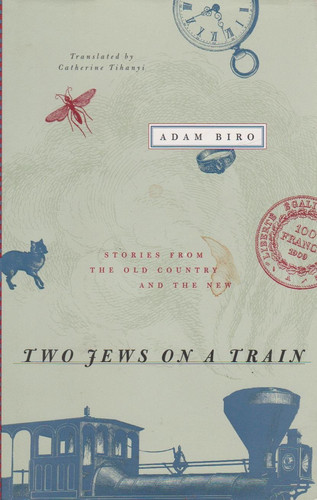
Two Jews on a train

Biro, Adam
"Two Jews were traveling on a train. . . . " Many Eastern European jokes—and several of the charming and often hilarious conversations in this book—begin this way. From all regions of the world and from all walks of life, the characters are young and full of life and old and ugly; they are rabbis, matchmakers, students, and immigrants. They gossip and speak about everything from the banalities of the world to the unspeakable evils of existence all for a single purpose: to laugh and to celebrate the good luck of being alive. As Biro recounts these tales, we hear not only his voice and the voice of his father, but those of generations of storytellers who have used humor to teach about the truly important issues in life—the delicacy of love, the fragility of friendship, the pitfalls of self-righteousness, the costs of narrow-mindedness, and the unpredictability of life itself. Biro artfully spins each story, lingering on the details, guiding the reader to the inevitable—yet always unexpected—punchline. Taken individually, these stories will make you laugh out loud; taken as a whole, they form an invaluable record of the sensibilities of an entire people. Biro writes: "These Jewish stories of which not a single one happened to me, and of which I did not invent a single one, do describe me, do characterize me, do explain me. They are always my own story. And yours."
University of Chicago Press 2001-05 128 pages