
2 results for "Literature"

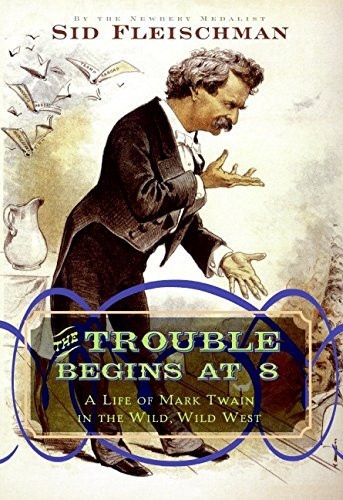
The trouble begins at 8: a life of Mark Twain in the wild, wild West

Fleischman, Sid
"Mark Twain was born fully grown, with a cheap cigar clamped between his teeth." So begins Sid Fleischman's ramble-scramble biography of the great American author and wit, who started life in a Missouri village as a barefoot boy named Samuel Clemens. Abandoning a career as a young steamboat pilot on the Mississippi River, Sam took a bumpy stagecoach to the Far West. In the gold and silver fields, he expected to get rich quick. Instead, he got poor fast, digging in the wrong places. His stint as a sagebrush newspaperman led to a duel with pistols. Had he not survived, the world would never have heard of Tom Sawyer or Huckleberry Finn—or red-headed Mark Twain. Samuel Clemens adopted his pen name in a hotel room in San Francisco and promptly made a jumping frog (and himself) famous. His celebrated novels followed at a leisurely pace; his quips at jet speed. "Don't let schooling interfere with your education," he wrote. Here, in high style, is the story of a wisecracking adventurer who came of age in the untamed West; an ink-stained rebel who surprised himself by becoming the most famous American of his time. Bountifully illustrated.
Greenwillow Books 2008 224 pages

American Palestine: Melville, Twain, and the Holy Land mania

Obenzinger, Hilton
In the nineteenth century, American tourists, scholars, evangelists, writers, and artists flocked to Palestine as part of a "Holy Land mania." Many saw America as a New Israel, a modern nation chosen to do God's work on Earth, and produced a rich variety of inspirational art and literature about their travels in the original promised land, which was then part of Ottoman-controlled Palestine. In American Palestine, Hilton Obenzinger explores two "infidel texts" in this tradition: Herman Melville's Clarel: A Poem and Pilgrimage to the Holy Land (1876) and Mark Twain's The Innocents Abroad: or, The New Pilgrims' Progress (1869). As he shows, these works undermined in very different ways conventional assumptions about America's divine mission.In the darkly philosophical Clarel, Melville found echoes of Palestine's apparent desolation and ruin in his own spiritual doubts and in America's materialism and corruption. Twain's satiric travelogue, by contrast, mocked the romantic naiveté of Americans abroad, noting the incongruity of a "fantastic mob" of "Yanks" in the Holy Land and contrasting their exalted notions of Palestine with its prosaic reality. Obenzinger demonstrates, however, that Melville and Twain nevertheless shared many colonialist and orientalist assumptions of the day, revealed most clearly in their ideas about Arabs, Jews, and Native Americans.Combining keen literary and historical insights and careful attention to the context of other American writings about Palestine, this book throws new light on the construction of American identity in the nineteenth century.
Princeton University Press 1999 316 pages