7 results for "Love"

Bridges to Cuba: Puentes a Cuba

Ruth Behar
Through personal essays and poetry, short fiction and painting, book reviews, interviews, performance pieces, and hybrid creations of text and image, Bridges to Cuba/Puentes a Cuba opens a window onto the meaning of nationality, transnationalism, and homeland in our time. For more than thirty-five years U.S.-Cuban relations have been couched in terms of the Cold War, often pitting Cubans in the diaspora against Cubans who remain in their homeland. Bridges to Cuba/Puentes a Cuba celebrates the informal networks that Cubans in both countries have maintained through artistic, academic, family, and other ties. The book brings together for the first time in English Cuban voices of the second generation, both on the island and in the diaspora. The multivocal and multigenre collection includes both scholarly and creative writing and an impressive range of visual art. The participants are earnest, angry, witty, and hopeful. They are sometimes visionaries, but they are not deluded about Cuban or North American realities. Their voices offer testimony to the continuing efforts of Cubans and Cuban-Americans to look beyond the animosities and failings of their respective societies and find possibilities for personal and international reconciliation, dialogue, and renewal. "Ruth Behar, as editor of Bridges to Cuba/Puentes a Cuba, leaps across conventional intellectual boundaries in an effort to show the complexity of nationhood, exile, and revolution in the Cuban experience of the last thirty years. An important book about the possibility and impossibility of building cultural and political bridges."--Arcadio Díaz-Quiñones, Princeton University "Behar narrows the straits of Florida with a richly textured dialogue of voices in and out of Cuba. Bridges to Cuba is sure to make history."--Liz Balmaseda, Miami Herald "A vital and interesting anthology about contemporary Cuba."--Oscar Hijuelos, author of The Mambo Kings Play Songs of Love " Bridges to Cuba is the first U.S. anthology that looks at Cuban creativity from an integrated perspective, refusing to kneel before the painful and often arbitrary divisions that have split the voices of this passionate culture into forever separate bands. The results are magnificent. Read this book and get a long overdue understanding of contemporary Cuban literature and art."--Margaret Randall, author of Women in Cuba: Twenty Years Later "In order for memory to be recovered, there must be a community that remembers and tells the story. . . . Bridges to Cuba displays a wealth of insights that leave the reader with a sense of having experienced first hand the intricate web of thought and feeling that is Cuban life."--Latino Review of Books "Ruth Behar's anthology represents one of the most important and moving bridges yet published on contemporary Cuba and its condition as the island that is still absent from the Western world. Bridges to Cuba is an extraordinary example of the faith and ability of Latin American intellectuals to cross true bridges, bridges of solidarity."--Marjorie Agosín, Wellesley College Ruth Behar is author of Translated Woman: Crossing the Border with Esperanza's Story and coeditor, with Deborah Gordon, of Women Writing Culture. She has been the recipient of awards from the MacArthur and Guggenheim foundations.
University of Michigan Press 1995 421 pages

The Paul Goodman reader

Goodman, Paul
A one-man think-tank for the New Left, Paul Goodman wrote over thirty books, most of them before his decade of fame as a social critic in the Sixties. A Paul Goodman Reader that does him justice must be a compendious volume, with excerpts not only from best-sellers like Growing Up Absurd, but also from his landmark books on education, community planning, anarchism, psychotherapy, language theory, and poetics. Samples as well from The Empire City, a comic novel reviewers compared to Don Quixote, prize-winning short stories, and scores of poems that led America's most respected poetry reviewer, Hayden Carruth, to exclaim, "Not one dull page. It's almost unbelievable." Goodman called himself as an old-fashioned man of letters, which meant that all these various disciplines and occasions added up to a single abiding concern for the human plight in perilous times, and for human promise and achieved grandeur, love and hope.
PM 2010 479 pages

Out of Brownsville: encounters with Nobel laureates and other Jewish writers : a cultural memoir

Chametzky, Jules
In this volume, Jules Chametzky has gathered his very personable stories and reminiscences of some of the many writers he has met or known as he writes, some fleetingly, a few more intensely over the course of his more than half a century in the business of reading, writing, and talking about literature, of teaching and editing. Not only do those writers emerge as the complicated and fascinating human beings they are, but we also come to know Jules himself, a warm and gracious storyteller. Praise for Out of Brownsville: NO STUDENT of American Jewish writing needs to be reminded that Jules Chametzky is one of its pioneers. A founding editor of the influential Massachusetts Review, he is perhaps especially noted for his study of the fiction of Abraham Cahan. He now caps a distinguished career as critic, editor, and teacher with this delightful volume of memoirs. It is astonishing to know how many of the shapers of literature in America Chametzky knew not merely as subjects met in passing but understood as artists. Readers and scholars will, of course, find their own favorites among the individual memoirs, but beyond the perceptiveness of the recollections and the shrewd assessments in them, there emerges Jules himself, warm, gracious, accepting, modest about his own achievements, which he scarcely mentions. One closes the book with a sense of regret that it has ended and with a feeling how good it was for those who met Jules and enjoyed, however briefly, his friendship. Joseph C. Landis, Editor, Yiddish-Modern Jewish Studies, Professor Emeritus of English, Queens College, CUNY WOVEN INTO these lively portraits and reminiscences of others are not only sudden illuminations of the characters portrayed and of the fleeting moments captured here, but also insights into the fragility of life, the power to create, and the strange magic of human encounters that make Jules Chametzky s memoir so touchingly social and pleasurable to read. Werner Sollors, Henry B. and Anne M. Cabot Professor of English Literature and Professor of African and African American Studies, Harvard University LEGENDARY EDITOR Jules Chametzky s book is autobiography at its cleanest: one s life through the eyes of others. His astute, personable dispatches are a map of Jewish intellectual trends in the United States in the second half of the twentieth century. Ilan Stavans, Lewis-Sebring Professor in Latin American and Latino Culture (Spanish), Amherst College ACCORDING TO the Jewish Midrash, the Book and the Sword came wrapped together, with a message: Regard what is written in the book, or be delivered to the sword. Jules Chametzky s love of books and their very human creators is expressed in this cultural memoir with affection and marvelous charm, yet there is also a tone of urgency, from a man who has dedicated his life to keeping the book open and the sword sheathed. Lawrence Bush, Editor, Jewish Currents About the Author: Jules Chametzky is Professor of English, emeritus, at the University of Massachusetts Amherst, where he taught from 1958 until 2004. He was a founder of The Massachusetts Review, of which he is Editor, emeritus, after 27 years as senior co-Editor. Chametzky has published numerous articles and reviews on Jewish American and American literature in popular and academic journals. His major publications include From the Ghetto: The Fiction of Abraham Cahan; Our Decentralized Literature: Cultural Mediations in Selected Jewish and Southern Writers; the Penguin edition of Abraham Cahan s The Rise of David Levinsky. He co-edited Black and White in American Culture: Ten Years of The Massachusetts Review; and Jewish American Literature: A Norton Anthology. Chametzky is the father of three sons and was married for 52 years to the late poet Anne Halley.
Meredith Winter Press 2012 155 pages

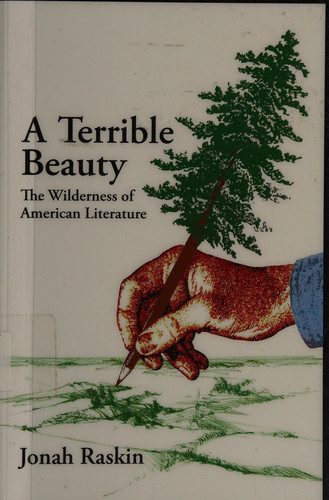
A terrible beauty: the wilderness of American literature

Raskin, Jonah
ABOUT THE BOOK Shortly before he published Walden; or Life in the Woods, Henry David Thoreau called ¿The library a wilderness of books.¿ He also noted that while Americans were ¿clearing the forest in our westward progress, we are accumulating a forest of books in our rear, as wild and unexplored as any of nature¿s primitive wildernesses.¿ In "A Terrible Beauty: the Wilderness of American Literature," Jonah Raskin takes a long close look at the forest of books that poets, novelists and essayists mapped and explored before and after Thoreau. The first work of cultural criticism to look back at writing in the United States from the perspective of the contemporary environmental crisis, Raskin offers insights for students, teachers and lovers of literature as well as for backpackers and hikers who have trekked across untrammeled forests, deserts and mountains. ABOUT THE AUTHOR Jonah Raskin, Phd, has taught American literature at Sonoma State University, the State University of New York at Stony Brook and as a Fulbright professor at the University of Antwerp and the University of Ghent in Belgium. The author of fifteen books, he earned his B.A. at Columbia College in New York, his M.A. at Columbia University and his Ph.D. at the University of Manchester, Manchester, England. He lives in northern California and has written for The San Francisco Chronicle, The L.A. Times, The Nation, The Redwood Coast Review and Catamaran.
Regent Press 2014 366 pages

A critic's journey

Stavans, Ilan
Ilan Stavans has been a lightning rod for cultural discussion and criticism his entire career. In A Critic's Journey , he takes on his own Jewish and Hispanic upbringing with an autobiographical focus and his typical flair with words, exploring the relationship between the two cultures from his own and also from others' experiences. Stavans has been hailed as a voice for Latino culture thanks to his Hispanic upbringing, but as a Jew and a Caucasian, he's also an outsider to that culture---something that's sharpened his perspective (and some of his critics' swords). In this book of essays, he looks at the creative process from that point of view, exploring everything from the translation of Don Quixote to the Hispanic anti-Semitism and the Holocaust in Latin America. Ilan Stavans is Lewis-Sebring Professor in Latin American and Latino Culture and Five College Fortieth Anniversary Professor at Amherst College. A native of Mexico, he received his doctorate in Latin American Literature from Columbia University. Stavans's books include The Hispanic Condition, On Borrowed Words, Spanglish, Dictionary Days, The Disappearance, Love & Language (with Verónica Albin), Resurrecting Hebrew , and Mr. Spic Goes to Washington , and he has edited books including The Oxford Book of Jewish Stories and the upcoming Norton Anthology of Latino Literature . His story "Morirse está en Hebreo" was made into the award-winning movie My Mexican Shivah . Stavans has received numerous awards, among them a Guggenheim Fellowship, the National Jewish Book Award, an Emmy nomination, the Latino Book Award, Chile's Presidential Medal, the Rubén Darío Distinction, and the Cátedra Roberto Bolaño. His work has been translated into a dozen languages.
University of Michigan Press 2010 200 pages

The men in my life

Gornick, Vivian
Gornick on V. S. Naipaul, James Baldwin, George Gissing, Randall Jarrell, H. G. Wells, Loren Eiseley, Allen Ginsberg, Hayden Carruth, Saul Bellow, and Philip Roth and the intimate relationship between emotional damage and great literature. Vivian Gornick, one of our finest critics, tackled the theme of love and marriage in her last collection of essays, The End of the Novel of Love , a National Book Critics Circle Award finalist. In this new collection, she turns her attention to another large theme in literature: the struggle for the semblance of inner freedom. Great literature, she believes, is not the record of the achievement, but of the effort. Gornick, who emerged as a major writer during the second-wave feminist movement, came to realize that “ideology alone could not purge one of the pathological self-doubt that seemed every woman's bitter birthright.” Or, as Anton Chekhov put it so memorably: “Others made me a slave, but I must squeeze the slave out of myself, drop by drop.” Perhaps surprisingly, Gornick found particular inspiration for this challenge in the work of male writers—talented, but locked in perpetual rage, self-doubt, or social exile. From these men—who had infinitely more permission to do and be than women had ever known—she learned what it really meant to wrestle with demons. In the essays collected here, she explores the work of V. S. Naipaul, James Baldwin, George Gissing, Randall Jarrell, H. G. Wells, Loren Eiseley, Allen Ginsberg, Hayden Carruth, Saul Bellow, and Philip Roth. Throughout the book, Gornick is at her best: interpreting the intimate interrelationship of emotional damage, social history, and great literature.
MIT Press 2008-08-22 194 pages