36 results for "Love"

Sontag: her life

Moser, Benjamin
No writer is as emblematic of the American twentieth century as Susan Sontag (1933-2004). Mythologized and misunderstood, lauded and loathed, a girl from the suburbs who became a proud symbol of cosmopolitanism, Sontag left a legacy of writing on art and politics, feminism and homosexuality, celebrity and style, medicine and drugs, radicalism and Fascism and Freudianism and Communism and Americanism, that forms an indispensable key to modern culture. She was there when the Cuban Revolution began, and when the Berlin Wall came down; in Vietnam under American bombardment, in wartime Israel, in besieged Sarajevo. She was in New York when artists tried to resist the tug of money?and when many gave in. No writer negotiated as many worlds; no serious writer had as many glamorous lovers. Sontag tells these stories and examines the work upon which her reputation was based. It explores the agonizing insecurity behind the formidable public face: the broken relationships, the struggles with her sexuality, that animated?and undermined?her writing. And it shows her attempts to respond to the cruelties and absurdities of a country that had lost its way, and her conviction that fidelity to high culture was an activism of its own. Utilizing hundreds of interviews conducted from Maui to Stockholm and from London to Sarajevo - and featuring nearly one hundred images - Sontag is the first book based on the writer's restricted archives, and on access to many people who have never before spoken about Sontag, including Annie Leibovitz.
Allen Lane 2019 816 pages

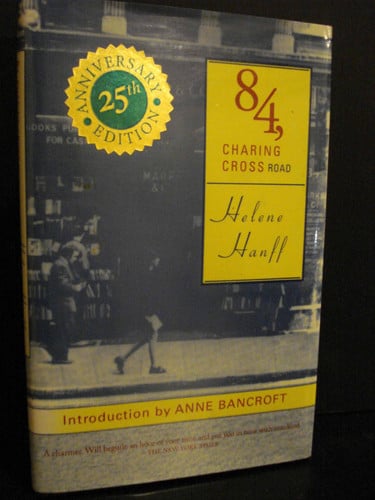
84 Charing Cross Road

Hanff, Helene
It all began with a letter enquiring about second-hand books, written by Helene Hanff in New York, and posted to a bookshop at 84 Charing Cross Road, London. As Helene's sarcastic and witty letters are responded to by the stodgy and proper Frank Doel of 84 Charing Cross Road, a relationship blossoms into a warm, charming, feisty love affair. We follow, in her subsequent letters and in the shop's responses, the trial of one woman;s idiosyncratic path through English literature. Along the way, as Anne Bancroft notes in her introduction, our enjoyment in sharing. Hanff's literary eduction is deepened by the human story her letters tell as she grows ever fonder of her bookselling friends across the ocean.
Moyer Bell 2015 97 pages

Left on Tenth: a second chance at life : a memoir

Ephron, Delia
The bestselling, beloved writer of romantic comedies like You've Got Mail tells her own late-in-life love story in her "resplendent memoir," complete with a tragic second act and joyous resolution. Delia Ephron had struggled through several years of heartbreak. She'd lost her sister, Nora, and then her husband, Jerry, both to cancer. Several months after Jerry's death, she decided to make one small change in her life -- she shut down his landline, which crashed her internet. She ended up in Verizon hell. She channeled her grief the best way she knew: by writing a New York Times op-ed. The piece caught the attention of Peter, a Bay Area psychiatrist, who emailed her to commiserate. Recently widowed himself, he reminded her that they had shared a few dates fifty-four years before, set up by Nora. Delia did not remember him, but after several weeks of exchanging emails and sixties folk songs, he flew east to see her. They were crazy, utterly, in love. But this was not a rom-com: four months later she was diagnosed with AML, a fierce leukemia. In Left on Tenth, Delia Ephron enchants as she seesaws us between tears and laughter, navigating the suicidal lows of enduring cutting-edge treatment and the giddy highs of a second chance at love. With Peter and her close girlfriends by her side, with startling clarity, warmth, and honesty about facing death, Ephron invites us to join her team of warriors and become believers ourselves.
Little, Brown and Company 2022 291 pages

It's been a good life

Asimov, Isaac
New one-volume autobiography spans Asimov's life for the first time!As one of the most gifted and prolific writers of the twentieth century, Isaac Asimov became legendary for his inexhaustible creativity, wide-ranging intellectual curiosity, and talent for explaining complex subjects in clear, concise prose. While regaling his readers with an incredible opus of almost five hundred entertaining and illuminating science fiction and nonfiction books, he also found time to write a three-volume autobiography. Now these volumes have been condensed into one by Asimov's wife, Janet, who also shares excerpts from letters he wrote to her. Together these writings provide an intimate portrait of a creative genius whose love of learning and playing with ideas is evident on every page. Reading this autobiography is like sitting down with Isaac Asimov and experiencing his witty, engaging, and brilliant personality firsthand. We are treated to many marvelous stories about his upbringing in Depression-era Brooklyn, his early fascination with the new science fiction pulp magazines, the thrill of his first published story, the creation of his well-known story "Nightfall," the genesis of the Foundation series, and the evolution of his creative life as a writer. He also reveals his inner thoughts about and experiences with various luminaries in science and science fiction. Above all, Asimov's autobiography conveys unbounded enthusiasm for his craft, the infectious joy of learning and creating, complete intellectual honesty, his strong humanist convictions, and his infinite fund of good humor and optimism even at the end of his life - all told in the lively clear writing style that was his trademark. Although Janet Jeppson Asimov concludes this work with a shocking revelation about her husband's death, the volume is clearly intended as a celebration - as the title suggests - of a wonderful, creative life. As a poignant coda to this work, Janet has appended one short story that was Isaac's favorite, and his 400th essay on this thoughts about science.
Prometheus Books 2002 309 pages

Wallace Stegner and the American West

Fradkin, Philip L.
Wallace Stegner was the premier chronicler of the twentieth-century western American experience, and his novels, the Pulitzer Prize–winning Angle of Repose and the National Book Award–winning The Spectator Bird, brought the life and landscapes of the West to national and international attention. Now, in this illuminating biography, Philip L. Fradkin goes beyond Stegner’s iconic literary status to give us, as well, the influential teacher and visionary conservationist, the man for whom the preservation and integrity of place was as important as his ability to render its qualities and character in his brilliantly crafted fiction and nonfiction. From his birth in 1909 until his death in 1993, Stegner witnessed nearly a century of change in the land that he loved and fought so hard to preserve. We learn of his hardscrabble youth on the Canadian frontier and in Utah, and of his painful relationship with his father, a bootlegger and gambler. We follow his intellectual awakening as a young man and his years as a Depression-era graduate student at the University of Iowa, during its earliest days as a literary center. We watch as he finds his home, with his wife, Mary, in the foothills above Palo Alto, which provided him with a long-awaited sense of belonging and a refuge in which he would write his most treasured works. And here are his years as the legendary founder of the Stanford Creative Writing Program, where his students included Ken Kesey, Edward Abbey, Robert Stone, and Wendell Berry. But the changes wrought by developers and industrialists were too much for Stegner, and he tirelessly fought the transformation of his Garden of Eden into Silicon Valley. His writings on the importance of establishing national parks and wilderness areas—not only for the preservation of untouched landscape but also for the enrichment of the human spirit—played a key role in the passage of historic legislation and comprise some of the most beautiful words ever written about the natural world. Here, too, is the story—told in full for the first time—of the accusations of plagiarism that followed the publication of Angle of Repose, and of the shadow they have cast on his greatest work. Rich in personal and literary detail, and in the sensual description of the country that shaped his work and his life—this is the definitive account of one of the most acclaimed and admired writers, teachers, and conservationists of our time.
Alfred A. Knopf 2008-02-12 369 pages

The best of us: a memoir

Maynard, Joyce
In 2011, when she was in her late fifties, beloved author and journalist Joyce Maynard met the first true partner she had ever known. Then, just after their one-year wedding anniversary, her new husband was diagnosed with pancreatic cancer. During the nineteen months that followed, as they battled his illness together, she discovered for the first time what it really meant to be a couple - to be a true partner and to have one. This is their story. Charting the course through their whirlwind romance, a marriage cut short by tragedy, and Joyce's return to singleness on new terms, 'The Best of Us' is a heart-wrenching, ultimately life-affirming reflection on coming to understand true love
Bloomsbury 2017 437 pages

Burning the days: recollection

Salter, James
In this brilliant book of recollection, one of America's finest writers re-creates people, places, and events spanning some fifty years, bringing to life an entire era through one man's sensibility. Scenes of love and desire, friendship, ambition, life in foreign cities and New York, are unforgettably rendered here in the unique style for which James Salter is widely admired. Burning the Days captures a singular life, beginning with a Manhattan boyhood and then, satisfying his father's wishes, graduation from West Point, followed by service in the Air Force as a pilot. In some of the most evocative pages ever written about flying, Salter describes the exhilaration and terror of combat as a fighter pilot in the Korean War, scenes that are balanced by haunting pages of love and a young man's passion for women. After resigning from the Air Force, Salter begins a second life, becoming a writer in the New York of the 1960s. Soon films beckon. There are vivid portraits of actors, directors, and producers--Polanski, Robert Redford, and others. Here also, more important, are writers who were influential, some by their character, like Irwin Shaw, others because of their taste and knowledge. Ultimately Burning the Days is an illumination of what it is to be a man, and what it means to become a writer. Only once in a long while--Vladimir Nabokov's Speak, Memory or Isak Dinesen's Out of Africa--does a memoir of such extraordinary clarity and power appear. Unconventional in form, Burning the Days is a stunning achievement by the writer The Washington Post Book World said "inhabits the same rarefied heights as Flannery O'Connor, Paul Bowles, Tennessee Williams and John Cheever" --a rare and unforgettable book.
Random House 1997-08-19 365 pages

Sailor and fiddler: reflections of a 100-year-old author

Wouk, Herman
"In an unprecedented literary accomplishment, Herman Wouk, one of America's most beloved and enduring authors, reflects on his life and times from the remarkable vantage point of 100 years old. Many years ago, the great British philosopher Sir Isaiah Berlin urged Herman Wouk to write his autobiography. Wouk responded, "Why me? I'm nobody." Berlin answered, "No, no. You've traveled. You've known many people. You have interesting ideas. It would do a lot of good." Now, in the same year he has celebrated his hundredth birthday, Herman Wouk finally reflects on the life experiences that inspired his most beloved novels. Among those experiences are his days writing for comedian Fred Allen's radio show, one of the most popular shows in the history of the medium; enlisting in the US Navy during World War II; falling in love with Betty Sarah Brown, the woman who would become his wife (and literary agent) for sixty-six years; writing his Pulitzer Prize-winning novel, The Caine Mutiny; as well as a big hit Broadway play The Caine Mutiny Court Martial; and the surprising inspirations and people behind such masterpieces as The Winds of War, War and Remembrance, Marjorie Morningstar, and Youngblood Hawke. Written with the wisdom of a man who has lived through two centuries and the wit of someone who began his career as professional comedy writer, the first part of Wouk's memoir ("Sailor") refers to his Navy experience and writing career, the second ("Fiddler") to what he's learned from living a life of faith. Ultimately, Sailor and Fiddler is an unprecedented reflection from a vantage point few people have lived to experience"-- Provided by publisher.
Simon & Schuster 2016-10-18 137 pages

Saul Bellow: letters

Bellow, Saul
"Saul Bellow wrote marvelously acute, unsparing, tender, ferocious, hilarious, and wise letters throughout his long life (1915-2005). Friends, lovers, wives, colleagues, and fans all cross these pages.This self-portrait shows the influences at work in the man and illuminates his enduring legacy: the novels and stories that earned him a Nobel Prize and the admiration of readers the world over."-Back cover.
Viking 2010 571 pages

Freud's blind spot: 23 original essays on cherished, estranged, lost, hurtful, hopeful, complicated siblings

Elisa Albert
Relationships with our siblings stretch, as an old saying has it, all the way from the cradle to the grave. Few bonds in life are as significant, as formative, as lasting, and as frequently overlooked as those we share with our brothers and sisters. In this stellar, first-of-its-kind anthology, contemporary writers explore the rich and varied landscape of sibling experience, illuminating the essential, occasionally wonderful, often difficult ways our brothers and sisters—or lack thereof—shape us. There are those who love and cherish their siblings, those who abhor and avoid them, and everyone in between. Contributors include the following: Steve Almond, Daphne Beal, Nat Bennett, Miranda Beverly-Whittemore, James Cañón, T Cooper, Lauren Grodstein, Nellie Hermann, Joanna Hershon, Nalini Jones, Etgar Keret, Victor LaValle, Vestal McIntyre, Jay Baron Nicorvo, Mary Norris, Eric Orner, Peter Orner, Angela Pneuman, Margo Rabb, Edward Schwarzschild, Robert Anthony Siegel, Faith Soloway, Jill Soloway, and Rebecca Wolff
Free Press 2010-11-16 273 pages

As consciousness is harnessed to flesh: diaries 1964-1980

Sontag, Susan
As Consciousness is Harnessed to Flesh reveals the inner life of Susan Sontag.Providing a unique insight into the mind of one of the leading intellectuals of the modern age, Susan Sontag's As Conscious is Harnessed to Flesh chronicles the cultural, moral, and political journeys of this renowned critic and artist at the height of her powers.As Consciousness Is Harnessed to Flesh follows Sontag through the turbulent years of the late 1960s - from her trip to Hanoi at the peak of the Vietnam War to her time making films in Sweden - up to 1980, just before the beginning of the Reagan era. This is an invaluable record of the inner workings of one of the most inquisitive and analytical thinkers of the twentieth century at the height of her power. It is also a remarkable document of on individual's political and moral awakening.'More true to life, both intellectual and emotional, than the most artful novel or careful biography' Sunday Telegraph'Gold dust' Sunday Times'A powerful self-portrait emerges. In its fragmentation . . . and passion, its combination of the erudite and the everyday, it is more true to life, both intellectual and emotional, than the most artful novel or careful biography. It may well be that Sontag's diaries will come to be seen as just as brilliant and important as anything she wrote' Sunday Telegraph'Mesmerising, fascinating' Guardian'Express the fullness and diversity of her intellectual curiosity. Revelatory in the most profound sense: they are existential fragments, self-selected thoughts, emotions, reactions . . . arising in one of the most remarkable minds of the twentieth century' The TimesOne of America's best-known and most admired writers, Susan Sontag was also a leading commentator on contemporary culture until her death in December 2004. Her books include four novels and numerous works of non-fiction, among them Regarding the Pain of Others, On Photography, Illness as Metaphor, At the Same Time, Against Interpretation and Other Essays and Reborn: Early Diaries 1947-1963, all of which are published by Penguin. A further eight books, including the collections of essays Under the Sign of Saturn and Where the Stress Falls, and the novels The Volcano Lover and The Benefactor, are available from Penguin Modern Classics.
Hamish Hamilton 2012 523 pages

Tiny ladies in shiny pants: based on a true story

Soloway, Jill
From the creator and director of Transparent and Emmy-nominated writer for Six Feet Under comes a hilarious and unforgettable memoir. When Jill Soloway was just thirteen, she and her best friend donned the tightest satin pants they could find, poufed up their hair and squeezed into Candies heels, then headed to downtown Chicago in search of their one-and-only true loves forever: the members of whichever rock band was touring through town. Never mind that both girls still had braces, coke-bottle-thick glasses and had only just bought their first bras—they were fabulous, they felt beautiful, they were tiny ladies in shiny pants . Now that Jill is all grown up and a successful writer and producer, she can look back on her tiny self and share her shiny tales with fondness, absurdity, and obsessive-compulsive attention to even the most embarrassing details. From the highly personal (conflating her own loss of virginity and the Kobe Bryant accusations), to the political (what she has in common with Monica and Chandra), to the outrageously Los Angelean (why women wear huge diamonds and what they must do to get them), Tiny Ladies in Shiny Pants is a genre-defying combination of personal essay and memoir, or a hilarious, unruly and unapologetic evaluation of society, religion, sex, love, and—best of all—Jill.
Free Press 2006-10-17 258 pages

Rereadings

Anne Fadiman
Is a book the same book-or a reader the same reader-the second time around? The seventeen authors in this witty and poignant collection of essays all agree on the answer: Never. The editor of "Rereadings" is Anne Fadiman, and readers of her bestselling book "Ex Libris" (FSG, 1998) will find this volume especially satisfying. Her chosen authors include Sven Birkerts, Allegra Goodman, Vivian Gornick, Patricia Hampl, Phillip Lopate, and Luc Sante; the objects of their literary affections range from "Pride and Prejudice" to "Sue Barton, Student Nurse." Each has selected a book or a story or a poem--or even, in one case, the lyrics on the back of the Sgt. Pepper album--that made a deep impression in his or her youth, and reread it to see how it has changed in the interim. (Of course, what has really changed is the reader.) These essays are not conventional literary criticism; they are about relationships. The relationship between reader and book is a powerful one, and as these writers attest, it evolves over time. Rereadings reveals at least as much about the reader as about the book: each is a miniature memoir that focuses on that most interesting of topics, the protean nature of love. And as every bibliophile knows, no love is more life-changing than the love of a book.
Farrar, Straus, and Giroux 2005 244 pages

They went another way: a Hollywood memoir

Kaplan, Bruce Eric
"A darkly comic memoir about being a working creative person in a world that is growing ever more dysfunctional, by acclaimed New Yorker cartoonist and television writer Bruce Eric Kaplan In January of 2022, Bruce Eric Kaplan found himself confused and upset by the state of the world and the state of his life as a television writer in Los Angeles. He started a journal to keep from going mad. That journal is now They Went Another Way. The book's through line traces his trying to get a television project set up in the increasingly Byzantine world of Hollywood. But as he details the project's ups and downs, Kaplan finds himself not only ruminating on show business, but also on today's political and social issues, on old movies and TV shows and music, on his family, on his friends, on his past, on his failing heating system, and on all the dead birds that kept showing up in his backyard. This hilarious and surprisingly moving book is about life-about art, about love, about alienation, about connection, about ugliness and beauty, about disappointment and wonder and hope. In short, it is about everything. And if it's not, it almost is"--
Henry Holt and Company 2024-10-22 261 pages

The art of fiction

Salter, James
James Salter's exalted place in American letters is based largely on the intense admiration of other writers, but his work resonates far beyond the realm of fellow craftsmen, addressing themes--youth, war, erotic love, marriage, life abroad, friendship--that speak to us all. Following the publication of his first novel, Salter left behind a military career of great promise to write full-time and--through decades of searching, exacting work--became one of American literature's master stylists. Only months before he died, at the age of eighty-nine, he agreed to serve as the first Kapnick Writer-in-Residence at the University of Virginia, where he composed and delivered the three lectures presented in this book and introduced by his friend and fellow novelist, National Book Award-winning author John Casey. Salter speaks to us here with an easy intimacy, sharing his unceasing enchantment with the books that made up his reading life, including works by Balzac, Flaubert, Babel (whose prose is "like a handful of radium"), Dreiser, Celine, Faulkner. These talks provide an invaluable opportunity to see the way in which a great writer reads. They also offer a candid look at the writing life--the rejection letters, not one but two negative reviews in the New York Times for the same book, writing in the morning or at night and worrying about money during the long afternoons. Salter raises the question, Why does one write? For wealth? For admiration, or a sense of "importance"? Confronting a blank sheet that always offers too many choices, practicing a vocation that often demands one write instead of live, the answer for Salter was creating a style that captured experience, in a world where anything not written down fades away. -- Amazon.com.
University of Virginia Press 2016 77 pages

Many subtle channels: in praise of potential literature

Levin Becker, Daniel
What sort of society could bind together Jacques Roubaud, Italo Calvino, Marcel Duchamp, and Raymond Queneau—and Daniel Levin Becker, a young American obsessed with language play? Only the Oulipo, the Paris-based experimental collective founded in 1960 and fated to become one of literature’s quirkiest movements. An international organization of writers, artists, and scientists who embrace formal and procedural constraints to achieve literature’s possibilities, the Oulipo (the French acronym stands for “workshop for potential literature”) is perhaps best known as the cradle of Georges Perec’s novel A Void, which does not contain the letter e. Drawn to the Oulipo’s mystique, Levin Becker secured a Fulbright grant to study the organization and traveled to Paris. He was eventually offered membership, becoming only the second American to be admitted to the group. From the perspective of a young initiate, the Oulipians and their projects are at once bizarre and utterly compelling. Levin Becker’s love for games, puzzles, and language play is infectious, calling to mind Elif Batuman’s delight in Russian literature in The Possessed. In recent years, the Oulipo has inspired the creation of numerous other collectives: the OuMuPo (a collective of DJs), the OuMaPo (marionette players), the OuBaPo (comic strip artists), the OuFlarfPo (poets who generate poetry with the aid of search engines), and a menagerie of other Ou-X-Pos (workshops for potential something ). Levin Becker discusses these and other intriguing developments in this history and personal appreciation of an iconic—and iconoclastic—group.
Harvard University Press 2012-04-30 338 pages