20 results for "Love"

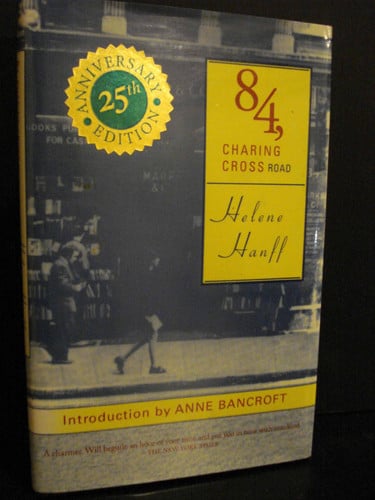
84 Charing Cross Road

Hanff, Helene
It all began with a letter enquiring about second-hand books, written by Helene Hanff in New York, and posted to a bookshop at 84 Charing Cross Road, London. As Helene's sarcastic and witty letters are responded to by the stodgy and proper Frank Doel of 84 Charing Cross Road, a relationship blossoms into a warm, charming, feisty love affair. We follow, in her subsequent letters and in the shop's responses, the trial of one woman;s idiosyncratic path through English literature. Along the way, as Anne Bancroft notes in her introduction, our enjoyment in sharing. Hanff's literary eduction is deepened by the human story her letters tell as she grows ever fonder of her bookselling friends across the ocean.
Moyer Bell 2015 97 pages

Waiting for God

Weil, Simone
"Emerging from the thought-provoking discussions and correspondence Simone Weil had with the Reverend Father Perrin, this classic collection of essays contains the renowned philosopher and social activist's most profound meditations on the relationship of human life to the realm of the transcendent. An enduring masterwork and 'one of the most neglected resources of our century' (Adrienne Rich), 'Waiting for God' will continue to influence spiritual and political thought for centuries to come."--Back cover.
Harper Perennial Modern Classics 2001 22 pages

Saul Bellow: letters

Bellow, Saul
"Saul Bellow wrote marvelously acute, unsparing, tender, ferocious, hilarious, and wise letters throughout his long life (1915-2005). Friends, lovers, wives, colleagues, and fans all cross these pages.This self-portrait shows the influences at work in the man and illuminates his enduring legacy: the novels and stories that earned him a Nobel Prize and the admiration of readers the world over."-Back cover.
Viking 2010 571 pages

The hours after: letters of love and longing in the war's aftermath

Klein, Gerda Weissmann
The love letters of Gerda and Kurt Klein, revealing one of the greatest love stories ever told. Over fifty years ago, Gerda Weissmann was barely alive at the end of a 350-mile death march that took her from a slave labor camp in Germany to the Czech border. On May 7, 1945, the American military stormed the area, and the first soldier to approach Gerda was Kurt Klein. She guided him to her fellow prisoners who lay sick and dying on the ground, and quoted Goethe: "Noble be man, merciful and good." Perhaps it was her irony, her composure, her evident compassion in the face of tragedy, that struck Kurt Klein. A great love had begun. Forced to separate just weeks after liberation and hours after their engagement, Gerda and Kurt began a correspondence that lasted until their reunion and wedding in Paris a year later. Their poignant letters reflect upon the horrors of war and genocide, but above all, upon the rapture and salvation of true love.
St. Martin's Press 2000-02-19 276 pages

Alan Jay Lerner: a lyricist's letters

Lerner, Alan Jay
The man behind "I Could Have Danced all Night" and "Almost Like Being in Love", lyricist Alan Jay Lerner (1918-1986) is widely regarded as one of the most important figures of the American musical stage. In penning the lyrics to some of the most well-known and beloved Broadway shows, including Brigadoon, Paint Your Wagon, My Fair Lady, and Camelot, Lerner worked and corresponded with some of the greatest luminaries of popular entertainment over a career which spanned four decades, from performers like Rex Harrison and Julie Andrews to composers like André Previn, Leonard Bernstein, Charles Strouse, Andrew Lloyd Webber, and especially Frederick Loewe. In this rich collection of correspondence, most of it published for the first time, author Dominic McHugh sheds new light on Lerner's working relationships with these legendary figures. McHugh's extensive commentary reveals Lerner's turbulent partnerships with Loewe and Lane, his affection for Harrison, and his reverence for Burton. Particular emphasis is placed on Lerner's aborted projects with composers like Richard Rodgers and Arthur Schwartz. Especially valuable is the correspondence from his final years, in which he worked on a movie version of The Merry Widow, a BBC TV series about musicals, and a musical version of My Man Godfrey, none of which came to fruition. The collection ends with a poignant final exchange between Lerner and Andrew Lloyd Webber, with whom he was to have written The Phantom of the Opera. Overall, this important and lively book reveals the highs and lows of the career of one of America's wittiest and most romantic lyricists.
Oxford University Press 2014 314 pages

Kirk and Anne: letters of love, laughter, and a lifetime in Hollywood

Douglas, Kirk,Douglas, Anne
"Film legend Kirk Douglas and his wife Anne look back on a lifetime filled with love and drama both on and off the screen. Sharing priceless correspondence with each other as well as the celebrities and world leaders they called friends, Kirk and Anne is a candid portrayal of the pleasures and pitfalls of a Hollywood life. Compiled from Anne's private archive of letters and photographs, this is an intimate glimpse into the Douglases' courtship and marriage set against the backdrop of Kirk's screen triumphs, including The Vikings, Lust For Life, Paths of Glory, and Spartacus. The letters themselves, as well as Kirk and Anne's vivid descriptions of their experiences, reveal remarkable insight and anecdotes about the legendary figures they knew so well, including Lauren Bacall, Frank Sinatra, Burt Lancaster, Elizabeth Taylor, John Wayne, the Kennedys, and the Reagans. Filled with photos from film sets, private moments, and public events, Kirk and Anne details the adventurous, oftentimes comic, and poignant reality behind the glamour of a Hollywood life--as only a couple of over six decades could tell it."--Jacket.
Running Press 2017-05-02 222 pages

Letters to his parents, 1939-1951

Adorno, Theodor W.
'My dears: this is but a brief note to welcome you to the new world, where you are now no longer all too far away from us. ‘ So begins Adorno’s letter to his parents in May 1939, welcoming them to Cuba where they had just arrived after fleeing from Nazi Germany at the last minute. At the end of 1939 his parents moved again to Florida and then to New York, where they lived from August 1940 until the end of their lives. It is only with Adorno’s move to California at the end of 1941 that his letters to his parents start arriving once more, reporting on work and living conditions as well as on friends, acquaintances and the Hollywood stars of his time. One finds reports of his collaborations with Max Horkheimer, Thomas Mann and Hanns Eisler alongside accounts of parties, clowning around with Charlie Chaplin, and ill-fated love affairs. But the letters also show his constant longing for Europe: Adorno already began to think about his return as soon as the USA entered the war. Adorno’s letters to his parents – surely the most open and direct letters he ever wrote – not only afford the reader a glimpse of the experiences that gave rise to the famous Minima Moralia, but also show Adorno from a previously unknown, very personal side. They end with the first reports from the ravaged Frankfurt to his mother – who remained in New York – and from Amorbach, Adorno’s childhood paradise
Polity 2006 397 pages

Last post

Raphael, Frederic
"Last Post has a double life; it both sounds for the gallant fallen and recalls what spurred freelance journalists, in all those yesterdays before e-mail, to get their copy in the pillar-box by deadline time. Frederic Raphaels compendium, written in the lively equivalent of the French epistolary second person singular, is a rare mixture of loud salutes, occasional raspberries and affectionate farewells. Its intimacy delivers frankness that formal biography, however plumped with proper sources, seldom achieves. To John Schlesinger, "Fuck em all dear," you used to say. And God knows, you did your best.; Ludwig Wittgenstein saying What do you know about philosophy, Russell, what have you ever known?; Cyril Connolly to William Somerset Maugham who was complaining about his lack of true lovers, ...then although the room was chilly, no one cared to poke poor Willie; You bloody fool, the first words said by a venerable professor to George Steiner. As the parade goes by, Last Post becomes what classicists call a prosopography. Raphaels own versatility shows up in the varieties of tone and vocabulary in long letters of tribute to the two Stanleys Kubrick and Donen, Ken Tynan, Leslie Bricusse, Tom Maschler, Dorothy Nimmo the known and the less known but no less valued; finally, above all, in farewell to his beloved daughter Sarah."--Back cover.
Lives and Letters 2023-07-27 522 pages

Aerograms across the ocean: a love story in letters

Biale, David,Biale, Rachel
"In August 1970, David Biale, a 21-year-old American Jewish student, arrived at Kibbutz Kfar Ruppin in Israel's Bet She'an Valley as a volunteer. There, he met Rachel Korati, nine days shy of her eighteenth birthday. They began an intense dialogue about how a secular Jew might be Jewish and what the role of Israel and kibbutz ought to be in modern Jewish life. They also found a common language in the counter-culture of the 1960s to which both were drawn. Upon David's return to university studies in Berkeley and Rachel's first steps into independent adulthood - living in a town near Tel Aviv and working as a youth movement counselor -- the two commenced a correspondence in which they continued their intellectual and ideological discussions from the summer, engaging Jewish sources on the one hand, and contemporary events on the other. Gradually, the letters became more intimate and so began an epistolary romance, which one might associate more with the nineteenth century and which would be inconceivable in today's world of texting and email. Over the next two years, the correspondence continued, often on a daily basis. Twice, David's plans to come to Israel were dashed. The two struggled to hold onto a relationship composed primarily of written words. In the fall of 1971, Rachel was drafted into the Israeli Army and David had his own brush with the American draft in the last phase of the Vietnam War. Aerograms Across the Ocean: A Love Story in Letters opens a rare window into the lives and thoughts of two passionate young people, trying to find their identities and life trajectories in the tumultuous early 1970s. By turns philosophical and playful, poetic and prosaic, idealistic and uncertain, pensive and erotic, this jointly-written memoir is a coming-of-age story in Israel after the Six Day War and in America in the shadow of the Vietnam War. The book is organized around the 258 letters the authors exchanged, a correspondence that takes readers back into a different age, half a century ago." --
Wildcat Books 2021-12-15 232 pages

Marc Chagall and his times: a documentary narrative

Harshav, Benjamin
This book presents a new and comprehensive biography of one of the most prominent artists of the twentieth century in dialogue with the events and ideologies of his time. It encompasses the 98 years of Chagall's life (1887-1985) in Russia, France, the US, as well as Germany and Israel, his deep roots in folk culture, his personal relationships and loves, his involvement with the art of the Russian Revolution, with Surrealism, Communism, Zionism, Yiddish literature and the state of Israel. The book exposes the complex relationships between Chagall's three cultural identities: Jewish-Russian-French. Indeed, it is a biography of the turbulent times of the twentieth century and the transformations of a Jew in it, his meteoric rise from the "ghetto" of the Russian Pale of Settlement to the centers of modern culture. -- Back cover.
Stanford University Press 2004 1026 pages

Love letters

Woolf, Leonard
Trekkie Ritchie Parsons, a painter and book illustrator, was married to the publisher Ian Parsons. When she met and fell in love with Leonard Woolf, rather than splitting with Ian, convinced both men that life would be best if Leonard moved in next door. Trekkie spent the weekends with Ian and the week with Leonard, living this way for 25 years. When Trekkie and Leonard were not together they talked through quick letters, which she then sealed up, and were opened after her death. Linked by excerpts from her diary, the letters shine with details of daily life and tell the story of two contrasting personalities, their love for one another, and their unusual and creative domestic arrangement.
Chatto and Windus 2001-03-01 312 pages

Where were we? the conversation continues

Raphael, Frederic
"Frederic Raphael, the English novelist, screenwriter, and man of letters, and Joseph Epstein, the American essayist, short-story writer, and literary critic, exchanged e-mails sporadically over the years, usually commenting on each other's various writings. Then one day in 2009, Raphael wrote to Epstein to suggest that, since they enjoyed a benevolence toward each other unusual among literary men, they begin an exchange of e-mail correspondence on a regular basis. His thought was that, at the end of a year or so, the result might be an interesting book. Epstein, who had long admired Raphael's writing, agreed. The two men had never met, nor had they even spoken over the phone. Their friendship was conducted entirely online. Each week they exchanged e-mails of roughly 2,000 words. They discovered a great many things about each other they hadn't previously known. They shared, for example, a common birthplace in Chicago, where Raphael was born, though his family moved to England in 1938, and his education after that was exclusively English. Each man belongs to that dolorous fraternity of those who have buried a child. Their literary tastes vary, though not widely, since both grew up admiring the great modernist writers and both had an enduring love for Greek and Roman culture. Both men share a fundamental agreement about what, in artistic and intellectual realms, is serious. Raphael and Epstein are artists who happen also to be intellectuals. The result is that few subjects are off limits to them. They are of an age when they have long ceased to worry about their reputations. Wherever else they may look, it is not over their shoulders. Candor reinforced by comedy is the reigning note of Where Were We? as it was of Distant Intimacy, their earlier volume of e-mail correspondence. Writing about other writers, actors, politics, the movies, intellectual fashions, the writing life, and much else, both men say precisely what they think, and say it in high style. Readers may or may not agree with their strong views, but they will never find their thoughts other than fascinating. "--
St. Augustines Press 2017 408 pages

Beyond psychology: letters and journals, 1934-1939

Reich, Wilhelm
"In August 1934, without warning or explanation, Wilhelm Reich was expelled from the International Psychoanalytic Association. Political expediency and the organization's growing adherence to Freud's death instinct theory had prevailed over Reich's scientific efforts to understand the functioning of what Freud had termed "libido."" "The provocative originality of Reich's work in the years to follow would inevitably distance him from Freudian psychology. But the result was an extraordinary widening of his scientific interests, scrupulously documented in these journals and letters. They record his pioneering laboratory experiments to verify the reality of the pleasure function and his discovery of an unknown energy that exists in all living matter. They record, too, the anguish of a man unafraid to speak his truth in the face of attack and defamation, even though it cost him his profession, his homeland and his adopted country, his wife, his two children, and his lover." "In her introduction to the volume, Mary Boyd Higgins of the Wilhelm Reich Infant Trust considers key events and themes of Reich's life and work during the years leading up to 1934."--BOOK JACKET.Title Summary field provided by Blackwell North America, Inc. All Rights Reserved
Farrar Straus Giroux 1994 256 pages

Dear wizard: the letters of Nicholas Delbanco and Jon Manchip White

Delbanco, Nicholas
Dear Wizard is a carefully selected, highly crafted gathering of letters from over three decades of correspondence between authors Nicholas Delbanco and Jon Manchip White. This correspondence, in part a contest to outdo one another with exotic and outlandish letterhead, ranges in tone from carefree to grave and covers topics as diverse as the art and practice of writing, the state of the writer’s profession, and age, illness, love, and loss.
University Of Michigan Press 2014-10-17 732 pages