
9 results for "Love"

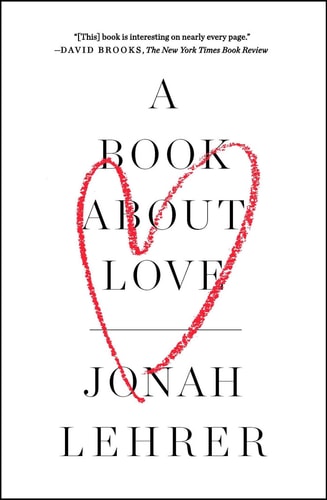
A Book About Love

Jonah Lehrer
Number one bestselling science writer Jonah Lehrer explores the “only happiness that lasts”—love—in a book that “is interesting on nearly every page” (David Brooks, The New York Times Book Review ). Weaving together scientific studies from clinical psychologists, longitudinal studies of health and happiness, historical accounts and literary depictions, child-rearing manuals, and the language of online dating sites, Jonah Lehrer’s A Book About Love plumbs the most mysterious, most formative, most important impulse governing our lives. Love confuses and compels us—and it can destroy and define us. It has inspired our greatest poetry, defined our societies and our beliefs, and governs our biology. From the way infants attach to their parents, to the way we fall in love with another person, to the way some find a love for God or their pets, to the way we remember and mourn love after it expires, this book focuses on research that attempts, even in glancing ways, to deal with the long-term and the everyday. The most dangerous myth of love is that it’s easy, that we fall into the feeling and then the feeling takes care of itself. While we can easily measure the dopamine that causes the initial feelings of “falling” in love, the partnerships and devotions that last decades or longer remain a mystery. “Lehrer uses scores of detailed vignettes to traverse a complicated intellectual landscape, eventually arriving at modern theories of love…He is a talent” ( USA TODAY ), and A Book About Love decodes the set of skills necessary to cultivate a lifetime of love. Love, Lehrer argues, is not built solely on overwhelming passion, but, fascinatingly, on a set of skills to be cultivated over a lifetime.
Simon and Schuster 2017-07-25 304 pages

Enchanted Love

Williamson, Marianne
'Marianne Williamson reveals, with elegant simplicity, that love is not a mere sentiment of emotion, but the ultimate truth at the heart of creation' Deepak Chopra For millians of Westerners, the quest for material gain has led to increasing frustration and unhappiness. Now, says spiritual philosopher Marianne Williamson, our hunger for worldly gain has been transformed, for many of us, into hunger for spiritual renewal. What we deeply long for most is the experience of paradise. In this inspiring new work, Williamson explores different aspects of the power of that vision - the possibility of the highest love made manifest on Earth - in a series of reflective essays accompanied by prayers and meditations. Topics include the power of faith, innocence, being seen, forgiveness, blamelessness, healing, surrender, serenity, beauty and unity. For people seeking to enhance their lives, Williamson's insights lay the groundwork for spiritual evolution and fulfillment. Her practical advice will guide readers towards a place where passion, creativity and freedom - most important, the freedom to express and infinite love - are recognised not only as the soul's most potent desire, but also as the ultimate destiny of the human race.
Rider & Co 2014-03-24 288 pages

Passion and reason: making sense of our emotions

Lazarus, Richard S.
When Oxford published Emotion and Adaptation, the landmark 1991 book on the psychology of emotion by internationally acclaimed stress and coping expert Richard Lazarus, Contemporary Psychology welcomed it as "a brightly shining star in the galaxy of such volumes." Psychiatrists, psychologists and researchers hailed it as a masterpiece, a major breakthrough in our understanding of the emotional process and its central role in our adaptation as individuals and as a species. What was still needed, however, was a book for general readers and health care practitioners that would dispel the myths still surrounding cultural beliefs about emotion and systematically explain the relevance of the new research to the emotional dramas of our everyday lives. Now, in Passion and Reason, Lazarus draws on his four decades of pioneering research to bring readers the first book to move beyond both clinical jargon and "feel-good" popular psychology to really explain, in plain, accessible language, how emotions are aroused, how they are managed, and how they critically shape our views of ourselves and the world around us. With his co-author writer Bernice Lazarus, Dr. Lazarus explores the latest findings on the short and long-term causes and effects of various emotions, including the often conflicting research on stress management and links between negative emotions and heart disease, cancer, and other aspects of physical and psychological health. Lazarus makes a strong case that contrary to common assumption, emotions are not irrational--our emotions and our analytical thought processes are inextricably linked. While not a "how-to" book, Passion and Reason does describe how readers can interpret what lies behind their own emotions and those of their families, friends, and co-workers, and how to manage them more effectively. Exploring fifteen emotions in depth, from love to jealousy, the authors show how the personal meaning we give to the events and conditions of our lives trigger such emotions as anger, anxiety, guilt, and pride. They provide fascinating vignettes to frame a "biography" of each emotion. Some are composite case histories drawn from Dr. Lazarus's long career, but most are stories of people the Lazaruses have known over the years--people whose emotional fears, conflicts, and desires mirror readers' own. The Lazaruses also offer a special chapter on the diverse strategies of coping people use in managing their emotions, and another, "When Coping Fails," on psychotherapy and its approaches to emotional stress and dysfunction, from traditional Freudian psychoanalysis to continuing research into relaxation techniques, meditation, hypnosis, and biofeedback. Packed with insight and compellingly readable, Passion and Reason will enrich all readers fascinated by our emotional lives.
Oxford University Press 1996 321 pages

Cold intimacies: the making of emotional capitalism

Illouz, Eva
It is commonly assumed that capitalism has created an a-emotional world dominated by bureaucratic rationality; that economic behavior conflicts with intimate, authentic relationships; that the public and private spheres are irremediably opposed to each other; and that true love is opposed to calculation and self-interest. Eva Illouz rejects these conventional ideas and argues that the culture of capitalism has fostered an intensely emotional culture in the workplace, in the family, and in our own relationship to ourselves. She argues that economic relations have become deeply emotional, while close, intimate relationships have become increasingly defined by economic and political models of bargaining, exchange, and equity. This dual process by which emotional and economic relationships come to define and shape each other is called emotional capitalism. Illouz finds evidence of this process of emotional capitalism in various social sites: self-help literature, women's magazines, talk shows, support groups, and the Internet dating sites. How did this happen? What are the social consequences of the current preoccupation with emotions? How did the public sphere become saturated with the exposure of private life? Why does suffering occupy a central place in contemporary identity? How has emotional capitalism transformed our romantic choices and experiences? Building on and revising the intellectual legacy of critical theory, this book addresses these questions and offers a new interpretation of the reasons why the public and the private, the economic and the emotional spheres have become inextricably intertwined.
Polity Press 2007-02-12 134 pages

The Emotional Revolution Harnessing the Power of Your Emotions for a More Positive Life

Norman E. Rosenthal
Feel Better. . .Live Better Scientific discoveries are unlocking the mysteries of our emotional lives. Every week brings us new information on the environmental, hormonal, genetic, and chemical factors that affect our feelings, and an ever-expanding repertoire of methods to manage specific emotional conditions. But how can we apply this cutting-edge research to our own lives? In The Emotional Revolution, Norman E. Rosenthal, psychiatrist, researcher, and specialist in the fields of psychopharmacology and psychobiology, offers a comprehensive guide to these exciting breakthroughs. He explores the latest findings about the body mechanisms that create emotions--and why our feelings can sometimes go out of control. He also offers simple self-help strategies and evaluates dozens of the newest treatments--both traditional and alternative--that can help with everything from depression and addiction to anxiety and excessive anger. Here is fascinating, up-to-the-minute information you won't find in any other single resource, including: * Clues to the biological basis of monogamy * A new link between depression and heart disease, and what this means for the treatment of both conditions * How simple patterns of eye movements can help alleviate painful memories * How taking a commonly-used blood pressure medication can help you cope with trauma * How lying in the dark releases a hormone that can alleviate anxiety and craving * The surprising health benefits of friendship and religion * The deadly dangers of anger * The health-promoting powers of love The first book to combine scientific research with prescriptive guidelines for the general reader, The Emotional Revolution is your guide to understanding the complexities of human feelings--and improving your life. "A well-researched, clearly-written, and absorbing book. Highly recommended for anyone who's ever seen a psychiatrist--or who hasn't!" --Dean Hamer, Ph.D., author of The Science of Desire Norman E. Rosenthal, M.D., is Clinical Professor of Psychiatry at Georgetown University. A practicing psychiatrist, Dr. Rosenthal has been listed in The Best Doctors in the U.S. For twenty years, he was a senior researcher in psychiatry and psychobiology at the National Institute of Mental Health. He has appeared on 20/20, CNN, National Public Radio, The Today Show, CBS Morning News, and Good Morning, America . Dr. Rosenthal lives and practices in Rockville, Maryland. Visit his Web site at www.normanrosenthal.com.
Citadel Press 2003 491 pages

Emotional Literacy Intelligence with a Heart

Claude Steiner
This step-by-step program opens the door to achieving emotional power. Instructions are given on how emotional literacy -- intelligence with a heart -- can be learned through practising specific exercises that foster the awareness of emotion in oneself and others, by increasing capacities to love others and oneself while developing honesty, and by taking responsibility for one's actions. Provided are instructions on how to reverse the dangerous self-destructive emotional patterns that can rule a person's life. This program shows individuals how to open their hearts and minds to honest and effective communication, how to survey the emotional landscape, and ultimately how to take responsibility for their emotional lives.
Personhood Press 2003 275 pages

Happiness - Facts and Myths

MICHAEL W. EYSENCK
First published in 1990, Happiness is based fairly and squarely on scientific evidence and provides realistic insights into the following questions: What is happiness? How can you tell if you are happy? How important are love, sex, money, and family relationships? Can happiness last? Is there a blueprint for happiness? Is unhappiness a terminal illness? Is there a 'happiness gone'? This book will be of interest to students of psychology and other mental health experts.
Taylor & Francis 2026-01-19 144 pages

Feeling Matters

Eigen, Michael
As long as feelings are second-class citizens, people will be second class citizens. Experience is an endangered species. An important function of psychotherapy is to make time for experiencing. Psychic taste buds really exist and rarely rest. They feed us each other, gauge states of being, states of spirit. We taste each other's feelings and intentions. An important aim of this book is to build psychic taste buds, not put them down or pretend they don't exist. A positive feeling runs through this book, a love of life, an affirmation. Yet we discover many feel they do not have an impact. A sense of helplessness and impotence in face of awesome forces seems to be increasing. Health is a broad term with many dark threads. A creeping annihilating sense varies from pockets we try not to notice to soul murder that must be addressed. Yet individuals do try, in their private struggles and in the larger social sphere.
Taylor & Francis Group 2019-06-14 224 pages

Love A Somatic View

Stanley Keleman
El amor tal como se trata en este libro va más allá de atracciones sexuales, imágenes o ideas. Tiene que ver con la biología, con la sangre. Keleman habla del amor desde un punto de vista evolutivo, psicobiológico, somático. El amor es ante todo una verdad del cuerpo, una realidad somática. La intimidad se basa en compartir la excitación vital interna. El deseo y el altruismo están profundamente enraizados en la vida celular. Aprendemos o ignoramos qué es el amor en nuestro entorno familiar. Aprendemos a amar de niñ amamos como nos amaron y como nos enseñaron a hacerlo. Una respuesta de amor escasa, excesiva o equivocada durante las cuatro etapas básicas de la crianza, el cuidado infantil, el compartir adolescente y la cooperación juvenil, puede alterar la experiencia somática de la personalidad en cuanto a la forma de ser amado y originar en la etapa adulta un carácter rígido, denso, hinchado o colapsado. Estas alteraciones características de la forma natural de amar y ser amado, se reflejan de forma muy precisa en la relación de pareja y en todo caso pueden ser trabajadas en el recinto seguro de la psicoterapia corporal. Stanley Keleman (Brooklyn, Nueva York, 1931) es un psicoterapeuta estadounidense, pionero del estudio del cuerpo y su conexión con los aspectos emocionales, psicológicos, sexuales e imaginativos de la experiencia humana. Ha estado desarrollando la psicología somática desde los años 60. Vive en Berkeley, California, donde trabaja individualmente y con grupos en el Center for Energetic Studies, del cual es director. A través de sus escritos y de la práctica, impartiendo numerosos cursos también cada año en Europa, ha desarrollado una metodología y un marco de referencia conceptual para la vida del cuerpo.
Center Press 1994 90 pages