23 results for "Love"

Conversations with RBG: Ruth Bader Ginsburg on life, love, liberty, and law

Rosen, Jeffrey
"This remarkable book presents a unique portrait of Justice Ruth Bader Ginsburg, drawing on more than twenty years of conversations with Jeffrey Rosen, starting in the 1990s and continuing through the Trump era. Rosen, a veteran legal journalist, scholar, and president of the National Constitution Center, shares with us the justice's observations on a variety of topics, and her intellect, compassion, sense of humor, and humanity shine through. The affection they have for each other as friends is apparent in their banter and in their shared love for the Constitution--and for opera. In Conversations with RBG, Justice Ginsburg discusses the future of Roe v. Wade, her favorite dissents, the cases she would most like to see overruled, the #MeToo movement, how to be a good listener, how to lead a productive and compassionate life, and of course the future of the Supreme Court itself. These frank exchanges illuminate the steely determination, self-mastery, and wit that have inspired Americans of all ages to embrace the woman known to all as "Notorious RBG." Whatever the topic, Justice Ginsburg always has something interesting--and often surprising--to say. And while few of us will ever have the opportunity to chat with her face-to-face, Jeffrey Rosen brings us by her side as never before. Conversations with RBG is a deeply felt portrait of an American hero"--
Thorndike Press, a part of Gale, a Cengage Company 2019 319 pages

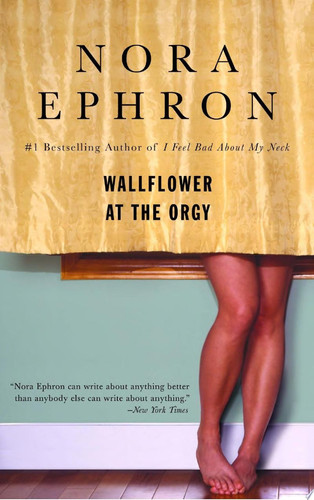
Wallflower at the orgy

Ephron, Nora
A bitingly funny, provocative, and revealing look at our foibles, passions, and pastimes—from one of the most creative minds of our time. “Nora Ephron can write about anything better than anybody else can write about anything.”— The New York Times From her Academy Award–nominated screenplays to her bestselling fiction and essays, Nora Ephron is one of America’s most gifted, prolific, and versatile writers. In this classic collection of magazine articles, Ephron does what she does best: embrace American culture with love, cynicism, and unmatched wit. From tracking down the beginnings of the self-help movement to dressing down the fashion world’s most powerful publication to capturing a glimpse of a legendary movie in the making, these timeless pieces tap into our enduring obsessions with celebrity, food, romance, clothes, entertainment, and sex. Whether casting her ingenious eye on renowned director Mike Nichols, Cosmopolitan magazine founder Helen Gurley Brown—or herself, as she chronicles her own beauty makeover—Ephron deftly weaves her journalistic skill with the intimate style of an essayist and the incomparable talent of a great storyteller.
Bantam Books 2007-06-26 187 pages

Hooked on Hollywood: discoveries from a lifetime of film fandom

Maltin, Leonard
"In Hooked on Hollywood, Maltin opens up his personal archive to take readers on a fascinating journey through film history. He first interviewed greats of Hollywood as a precocious teenager in 1960s New York City. Early Maltin interviews had literally been stored in his garage for more than 40 years until GoodKnight Books brought them to light for the first time in this volume to entertain readers and inform future film scholars. In addition, key feature articles from Maltin's newsletter Movie Crazy are published here for the first time, providing new perspectives on the Warner Bros. classics Casablanca and Gold Diggers of 1933 as well as many other masterpieces--and bombs--from Hollywood history. Finally, Maltin looks back at what he considers Hollywood's "overlooked" studio, RKO Radio Pictures, which gave us such classics as King Kong and the many dance musicals of Astaire and Rogers. In Leonard's unique and witty style, he looks at dozens of obscure RKO features from the 1930s, including saucy pre-Codes, musicals, comedies, and mysteries. Leonard Maltin's love of movies and vast knowledge about their history shines through from the first page to the last in this unique volume, which includes 150 rare photos and a comprehensive index."--
GoodKnight Books 2018 384 pages

Ties that bind: stories of love and gratitude from the first ten years of StoryCorps

David Isay
A celebration of the relationships that bring us strength, purpose, and joy Ties That Bind honors the people who nourish and strengthen us. StoryCorps founder Dave Isay draws from ten years of the revolutionary oral history project’s rich archives, collecting conversations that celebrate the power of the human bond and capture the moment at which individuals become family. Between blood relations, friends, coworkers, and neighbors, in the most trying circumstances and in the unlikeliest of places, enduring connections are formed and lives are forever changed. The stories shared in Ties That Bind reveal our need to reach out, to support, and to share life’s burdens and joys. We meet two brothers, separately cast out by their parents, who reconnect and rebuild a new family around each other. We encounter unexpected joy: A gay woman reveals to her beloved granddaughter that she grew up believing that family was a happiness she would never be able to experience. We witness lifechanging friendship: An Iraq war veteran recalls his wartime bond with two local children and how his relationship with his wife helped him overcome the trauma of losing them. Against unspeakable odds, at their most desperate moments, the individuals we meet in Ties That Bind find their way to one another, discovering hope and healing. Commemorating ten years of StoryCorps, the conversations collected in Ties That Bind are testament to the transformational power of listening.
The Penguin Press 2013 202 pages

The Coen brothers: interviews

Coen, Joel,Coen, Ethan
Joel and Ethan Coen (b. 1954, 1957) started their careers in obscurity on a shoestring budget cajoled from family and friends in Minneapolis. Working entirely outside the studio system, the Coen brothers scored an unlikely first success in 1984 with their postmodern noir film Blood Simple. Two decades and nearly a dozen movies later, the Coens are now among the best-known writer/directors in Hollywood, turning out major studio releases featuring such stars as George Clooney, Catherine Zeta-Jones, and Tom Hanks. The Coens' films all share a distinctive, quirky ambience that critics have come to identify as "that Coen brothers feeling." Tricky moving camera work, frequent use of the voiceover, homages to directors and cinematic genres, a fascination with unexpected and off-kilter violence, and omnipresent black humor are all defining elements of the Coens' cinematic world. From such highly stylized movies as Barton Fink and The Man Who Wasn't There to more mainstream but dark comedies such as Raising Arizona, Intolerable Cruelty, and O Brother, Where Art Thou?, the Coens are equally at home with existential despair and comic exuberance and are known for scripts packed with an obvious love for language. This collection of their most important interviews spans twenty years and is the most comprehensive published on the brothers. William Rodney Allen teaches at Louisiana School for Math, Science, and the Arts. He is the author of Walker Percy: A Southern Wayfarer and the editor of Conversations with Kurt Vonnegut, both published by University Press of Mississippi.
University Press of Mississippi 2006 208 pages

Mom: a celebration of mothers from StoryCorps

David Isay
Dave Isay--StoryCorps's founder and the editor of the project's bestselling collection, "Listening Is an Act of Love"--Presents a celebration of American mothers. Selecting StoryCorps's most revelatory stories on the subject, "Mom" looks across a diversity of experience--from the Bronx to the rural South and beyond--to present an entirely original portrait of motherhood.
Penguin Press 2010 186 pages

Directors close up: interviews with directors nominated for best film by the Directors Guild of America

Jeremy Kagan
Directors: Barry Levinson (Bugsy), Oliver Stone (JFK), Barbra Streisand (The Prince of Tides), Clint Eastwood (Unforgiven), Neil Jordan (The Crying Game), Rob Reiner (A Few Good Men), Andrew Davis (The Fugitive), Frank Darabont (The Shawshank Redemption), Mike Newell (Four Weddings and a Funeral), Quentin Tarantino (Pulp Fiction), Robert Zemeckis (Forrest Gump), Mel Gibson (Braveheart), Michael Radford (Il Postino), Cameron Crowe (Jerry Maguire), Scott Hicks (Shine), Mike Leigh (Secrets & Lies), Anthony Minghella (The English Patient), Steven Spielberg (Amistad), James L. Brooks (As Good As It Gets), James Cameron (Titanic), Curtis Hanson (L.A. Confidential), Gus Van Sant (Good Will Hunting), Roberto Benigni (Life Is Beautiful), John Madden (Shakespeare in Love), Steven Spielberg (Saving Private Ryan), Peter Weir (The Truman Show), Frank Darabont (The Green Mile), Spike Jonze (Being John Malkovich), Michael Mann (The Insider), Sam Mendes (American Beauty), M. Night Shyamalan (The Sixth Sense), Ang Lee (Crouching Tiger, Hidden Dragon), Steven Soderbergh (Erin Brockovich and Traffic), Ron Howard (A Beautiful Mind), Peter Jackson (The Lord of the Rings: The Fellowship of the Ring), Baz Luhrmann (Moulin Rouge), Christopher Nolan (Memento), Ridley Scott (Black Hawk Down), Stephen Daldry (The Hours), Peter Jackson (The Lord of the Rings: The Two Towers), Rob Marshall (Chicago), Roman Polanski (The Pianist), Martin Scorsese (Gangs of New York), Sofia Coppola (Lost in Translation), Clint Eastwood (Mystic River), Peter Jackson (The Lord of the Rings: The Return of the King), Gary Ross (Seabiscuit), Peter Weir (Master and Commander: The Far Side of the World), Clint Eastwood (Million Dollar Baby), Marc Forster (Finding Neverland), Taylor Hackford (Ray), Alexander Payne (Sideways), Martin Scorsese (The Aviator).
Scarecrow Press 2006 341 pages

Makin' toons: inside the most popular animated TV shows and movies

Neuwirth, Allan
From the first drawing board sketch to wriggling TV character, Makin’ Toons illustrates the thrills and challenges of making animated cartoon movies as told by the industry’s most successful creators. Cartoon lovers everywhere will be treated to 47 personal interviews with animation artists and industry leaders ranging from Shrek director Andrew Adamson to Rugrats producer Gabor Csupo. These and dozens of other fascinating firsthand accounts chronicle the behind-the-scene antics and commercial dynamics behind such blockbusters as The Simpsons, South Park, Beauty and the Beast, and Dragon Tales, to name just a few. Author Allan Neuwirth—an accomplished animation artist and writer himself—spices the book with insightful comments, hilarious anecdotes, and a true “toon artist’s” sense of humor. He also includes 75 never-before-published concept drawings, character designs, storyboards, and much more. Allworth Press, an imprint of Skyhorse Publishing, publishes a broad range of books on the visual and performing arts, with emphasis on the business of art. Our titles cover subjects such as graphic design, theater, branding, fine art, photography, interior design, writing, acting, film, how to start careers, business and legal forms, business practices, and more. While we don't aspire to publish a New York Times bestseller or a national bestseller, we are deeply committed to quality books that help creative professionals succeed and thrive. We often publish in areas overlooked by other publishers and welcome the author whose expertise can help our audience of readers.
Allworth Press 2003-04-01 272 pages

Isaac Bashevis Singer: conversations

Singer, Isaac Bashevis
Isaac Bashevis Singer (1902-1991) loved to give interviews. He was famous for encouraging interruptions of the solitary task of writing. These twenty-four welcomed interruptions are representative of the many he allowed over a twenty-five-year period. Included here are his conversations with such interviewers as Irving Howe, Laurie Colwin, Richard Burgin, and Herbert R. Lottman. In these talks Singer discusses the nature of his writing, its ethnic roots, his demonology, the importance of free will, and the place of storytelling in human life. The interviews with Singer reveal both his impish sense of humor and a determination that sustained him through many years of limited acclaim and comparative neglect by critics. Yiddishists often faulted him for refusing to use his talent as a force for change in the world, Jewish readers often deplored his use of pre-Enlightenment folk material, and academics could not take too seriously a writer who insisted on telling stories that emphasized plot and character. Yet he was not deterred from his astonishing and beloved work, for which he was awarded the Nobel Prize.
University Press of Mississippi 1992 259 pages

Conversations with Isaac Bashevis Singer

Singer, Isaac Bashevis
Isaac Bashevis Singer loved to give interviews. He was famous for encouraging interruptions of the solitary task of writing. These twenty-four welcomed interruptions are representative of the many he allowed over a twenty-five-year period. Included here are his conversations with such interviewers as Irving Howe, Laurie Colwin, Richard Burgin, and Herbert R. Lottman. In these talks Singer discusses the nature of his writing, its ethnic roots, his demonology, the importance of free will, and the place of storytelling in human life. The interviews with Singer reveal both his impish sense of humor and a determination that sustained him through many years of limited acclaim and comparative neglect by critics. Yiddishists often faulted him for refusing to use his talent as a force for change in the world, Jewish readers often deplored his use of pre-Enlightenment folk material, and academics could not take too seriously a writer who insisted on telling stories that emphasized plot and character. Yet he was not deterred from his astonishing and beloved work, for which he was awarded the Nobel Prize.
Farrar, Straus, and Giroux 1986 178 pages

The joy of playing, the joy of thinking: conversations about art and performance

Rosen, Charles
"The Joy of Playing, the Joy of Thinking is a masterclass for music lovers. In interviews originally conducted and published in French, Rosen's friend Catherine Temerson asks carefully crafted questions to elicit his insights on the evolution of music-not to mention painting, theater, science, and modernism. Rosen touches on the usefulness of aesthetic reflection, the pleasure of overcoming stage fright, and the drama of conquering a technically difficult passage. He tells vivid stories on composers from Chopin and Wagner to Stravinsky and Elliott Carter. In Temerson's questions and Rosen's responses arise conundrums both practical and metaphysical. Is it possible to understand a work without analyzing it? Does music exist if it isn't played? Rosen takes readers to the heart of the musical matter. 'Music is a way of instructing the soul, making it more sensitive,' he says, 'but it is useful only insofar as it is pleasurable. This pleasure is manifest to anyone who experiences music as an inexorable need of body and mind.'"--
The Belknap Press of Harvard University Press 2020 138 pages

Conversations with James Salter

Salter, James
"James Salter (born James Horowitz in 1925) has been known throughout his career as a "writer's writer," acclaimed by such literary greats as Susan Sontag, Richard Ford, John Banville, and Peter Matthiessen for his lyrical prose, his insightful and daring explorations of sex, and his examinations of the inner lives of women and men. Conversations with James Salter collects interviews published from 1972 to 2014 with the award-winning author of The Hunters, A Sport and a Pastime, Light Years, and All That Is. Gathered here are his earliest interviews following acclaimed but moderately selling novels, conversations covering his work as a screenwriter and award-winning director, and interviews charting his explosive popularity after publishing All That Is, his first novel after a gap of thirty-four years. These conversations chart Salter's progression as a writer, his love affair with France, his military past as a fighter pilot, and his lyrical explorations of gender relations.The collection contains interviews from Sweden, Chile, France, and Argentina appearing for the first time in English. Included as well are published conversations from the United States, Canada, and Australia, some of which are significantly extended versions, giving this collection an international scope of Salter's wide-ranging career and his place in world literature"--
University Press of Mississippi 2015 236 pages

Fritz Lang: interviews

Lang, Fritz
The films of Fritz Lang depict an entrapping, claustrophobic world in which people are controlled by larger forces. His overriding theme is the struggle against fate and against the traits of human nature that doom us. His life and work spanned six decades of film history-from the silent era through the golden age of German Expressionism of the 1920s and the classic studio system in Hollywood to the rise of the international co-production. In Hollywood he worked for every major studio except Disney. He made blockbusters, modest B movies, and everything in between. Among his films are classics of German cinema-including Metropolis and M . In America he made some of the most notable crime movies ( Fury ), noir films ( The Big Heat ), and Westerns ( The Return of Frank James ) of the studio era. Despite the different time periods, nations, and genres in which he worked, his films remain stylistically consistent. Lang (1890-1976), a notoriously difficult interviewee, granted relatively few interviews apart from short publicity exchanges in the promotion of his films. Fully aware of his public persona, he was a canny self-promoter who carefully constructed half-truths and myths about himself. This fascinating collection covers his conversations about his life and his works over a period of forty years. They reveal how cinema for Lang was an intensely personal art. "For me," he said, "cinema is a vice. I love it intimately. I've often written that it is the art form of our century."
University Press of Mississippi 2003 195 pages

George Cukor: interviews

Cukor, George
For investing movies with an image of style and glamour George Cukor (1899--1983) is considered one of the founding fathers of the Golden Age of Hollywood. The roll call of the great films he made and the stars he directed validates his rank as one of cinema's greatest moviemakers. "The only really important thing I have to say about George Cukor," Katharine Hepburn proclaimed, "is that all the other directors I have worked with starred themselves. But George 'starred' the actor. He didn't want people to say, 'this great director.' He wanted them to say 'this great actor.' " Along with introducing Hepburn and Greta Garbo to American audiences, he worked with many of the most acclaimed movie actresses of his day, including Vivien Leigh, Olivia de Havilland, Jean Harlow, Elizabeth Taylor, Joan Crawford, Ingrid Bergman, Ava Gardner, Claudette Colbert, Angela Lansbury, Judy Holliday, Audrey Hepburn, and Marilyn Monroe. These interviews are a pleasure to read because Cukor is so immersed in his subject and so forthright in his observations. He comes to life immediately with disarming candor and infectious enthusiasm for cinema and the people who make it. In addition to discussing his romantic comedies, Cukor talks about his famous screen adaptations of classic novels and plays, including Little Women (1933) and David Copperfield (1935). His experience of being fired by producer David O. Selznick partway through the shooting of Gone With the Wind (1939) surfaces in nearly every interview. Instead of having his career derailed by this dismissal, however, he continued his rise as one of America's premier directors. In his cornucopia of films are Holiday (1938), The Philadelphia Story (1940), Adam's Rib (1949), Born Yesterday (1950), A Star Is Born (1954), Let's Make Love (1960), and My Fair Lady (1964). Cukor was a man of myriad dimensions. In his last years he opened up about his private life and his previously undisclosed homosexuality. He was ardent in his friendships and single-minded in his devotion to making quality movies for a popular audience. Robert Emmet Long, a literature and film scholar and writer living in Fulton, New York, is the author or editor of more than forty books, including John Huston: Interviews (University Press of Mississippi).
University Press of Mississippi 2001 191 pages

Oliver Stone: interviews

Stone, Oliver
Throughout his career Oliver Stone (b. 1946) has broken traditions and challenged audiences with a series of daring, angry, violent, and often confrontational films. Politically charged movies such as Nixon (1995), JFK (1991), and Wall Street (1987), and his Vietnam trilogy of Platoon (1986), Born on the 4th of July (1989), and Heaven and Earth (1993) provoke and enrage critics and audiences from all ideological walks. In a short time, Stone has established himself as one of the most admired and most reviled directors in American cinema. Ranging from 1981 to 1997, the fifteen conversations featured in Oliver Stone: Interviews reveal a man frustrated by what he sees as the hypocrisies of American politics, of conservatism, and of the Hollywood film industry. But the conflicts and tensions these issues generate spellbind him. In the interviews, Stone comes off as a man as brash, outspoken, confident, and complicated as his movies. His obsessions--the 1960s, the ways in which Vietnam shaped the country, the nature of violence, and the role of the media in shaping it--resurface again and again, no matter what film Stone is discussing. Though the subjects of Nixon , JFK , Born on the 4th of July , The Doors (1991), and Heaven and Earth are rooted in the turbulent 1960s, Stone as interviewee and filmmaker is firmly entrenched in the present. He fiercely discusses how the attitudes and political effects of the 1960s have defined later decades and generations, as he talks about his satire of the stock market ( Wall Street , 1987) and media exposure ( Natural Born Killers , 1994). Bolts of the director's raw wit and enthusiasm for the cinema shine through all of Stone's ferocious rage. Stone loves writing as well as directing. Whether discussing his screenplays written for other directors -- which include Scarface (1983), Midnight Express (1978), or Conan the Barbarian (1982, with director John Milius)--or his own films, Stone emphasizes how crucial screenwriting is to making great movies. "Directing is a natural extension of writing," he says in a 1987 interview with Michel Ciment. "A director can always pull through with noise everywhere and his colleagues around. I don't think a good director can make a good film with a bad screenplay, but a bad director can deliver an acceptable film if he has a good screenplay. So for me, that's the number one priority."
University Press of Mississippi 2001 206 pages

Mind, life, and universe: conversations with great scientists of our time

Margulis, Lynn,Punset, Eduard
Nearly forty of the world's most esteemed scientists discuss the big questions that drive their illustrious careers. Co-editor Eduardo Punset—one of Spain's most loved personages for his popularization of the sciences—interviews an impressive collection of characters drawing out the seldom seen personalities of the world's most important men and woman of science. In Mind, Life and Universe they describe in their own words the most important and fascinating aspects of their research. Frank and often irreverent, these interviews will keep even the most casual reader of science books rapt for hours. Can brain science explain feelings of happiness and despair? Is it true that chimpanzees are just like us when it comes to sexual innuendo? Is there any hard evidence that life exists anywhere other than on the Earth? Through Punset's skillful questioning, readers will meet one scientist who is passionate about the genetic control of everything and another who spends her every waking hour making sure African ecosystems stay intact. The men and women assembled here by Lynn Margulis and Eduardo Punset will provide a source of endless interest. In captivating conversations with such science luminaries as Jane Goodall, James E. Lovelock, Oliver Sachs, and E. O. Wilson, Punset reveals a hidden world of intellectual interests, verve, and humor. Science enthusiasts and general readers alike will devour Mind, Life and Universe, breathless and enchanted by its truths.
Chelsea Green Pub 2007 358 pages