19 results for "Management"

Living nonviolent communication: practical tools to connect and communicate skillfully in every situation

Rosenberg, Marshall B.
You’re about to have an uncomfortable meeting with your boss. The principal just called about your middle-schooler. You had a fight with your partner and it’s an hour before bed. You know your next move will go a long way toward defining your relationships with these individuals. So what do you do?We all find ourselves in situations similar to these and too often resort to the same old patterns of[Bokinfo]
Sounds True 2012-06 170 pages

Conflict is not abuse: overstating harm, community responsibility, and the duty of repair

Schulman, Sarah
From intimate relationships to global politics, Sarah Schulman observes a continuum: that inflated accusations of harm are used to avoid accountability. Illuminating the difference between Conflict and Abuse, Schulman directly addresses our contemporary culture of scapegoating. This deep, brave, and bold work reveals how punishment replaces personal and collective self-criticism, and shows why difference is so often used to justify cruelty and shunning. Rooting the problem of escalation in negative group relationships, Schulman illuminates the ways cliques, communities, families, and religious, racial, and national groups bond through the refusal to change their self-concept. She illustrates how Supremacy behavior and Traumatized behavior resemble each other, through a shared inability to tolerate difference. This important and sure to be controversial book illuminates such contemporary and historical issues of personal, racial, and geo-political difference as tools of escalation towards injustice, exclusion, and punishment, whether the objects of dehumanization are other individuals in our families or communities, people with HIV, African Americans, or Palestinians. Conflict Is Not Abuse is a searing rejection of the cultural phenomenon of blame, cruelty, and scapegoating, and how those in positions of power exacerbate and manipulate fear of the "other" to achieve their goals. Sarah Schulman is a novelist, nonfiction writer, playwright, screenwriter, journalist and AIDS historian, and the author of eighteen books. A Guggenheim and Fulbright Fellow, Sarah is a Distinguished Professor of the Humanities at the City University of New York, College of Staten Island. Her novels published by Arsenal include Rat Bohemia , Empathy , After Delores , and The Mere Future . She lives in New York.
Arsenal Pulp Press 2016 299 pages

It's not luck

Goldratt, Eliyahu M.
In this sequel to Goldratt's great business novel "The Goal," Alex and his team have all been promoted into the key positions in the faltering Diversified Businesses group in their conglomerate. The whole company is faltering, and great pressure is put on Alex and the team to turn their businesses around. The story emphasizes the Thinking Processes from "The Goal," and he devotes much of his attention to demonstrating the relevance of the theory of constraints to marketing, sales, inventory control, distribution channels, strategic alliances, and conflict resolution.
The North River Press 1994 283 pages

The handbook of conflict resolution: theory and practice

Deutsch, Morton, ed
The Handbook of Conflict Resolution, Second Edition is written for both the seasoned professional and the student who wants to deepen their understanding of the processes involved in conflicts and their knowledge of how to manage them constructively. It provides the theoretical underpinnings that throw light on the fundamental social psychological processes involved in understanding and managing conflicts at all levels—interpersonal, intergroup, organizational, and international. The Handbook covers a broad range of topics including information on cooperation and competition, justice, trust development and repair, resolving intractable conflict, and working with culture and conflict. Comprehensive in scope, this new edition includes chapters that deal with language, emotion, gender, and personal implicit theories as they relate to conflict.
Jossey-Bass 2006-09-18 940 pages

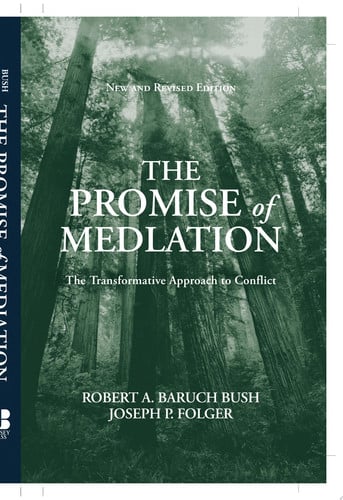
The promise of mediation: the transformative approach to conflict

Bush, Robert A. Baruch
The award-winning first edition of The Promise of Mediation, published ten years ago, is a landmark classic that changed the field's understanding of the theory and practice of conflict intervention. That volume first articulated the "transformative model" of mediation, which greatly humanized the vision of how the mediation process could help parties in conflict. In the past decade, the transformative model has proved itself and gained increasing acceptance. It is now being used in such diverse arenas as workplace, community, family, organizational, and public policy conflicts, among others. In this new edition, the authors draw on a decade of work in theory development, training, practice, research, and assessment to present a thoroughly revised and updated account of the transformative model of mediation and its practical application, including a compelling description of how the field has moved toward increasing acceptance of the transformative modela new and clearer presentation of the theory and practices of transformative mediation, with many concrete examplesa new case study that provides a vivid picture of the model in practice, with a commentary full of new information about how to use it effectively clarifications of common misconceptions about the model a vision for the future that shows how the model can coexist with other approaches and where the "market" for transformative mediation is emerging. This volume is a foundational resource on transformative practice, for both readers of the first edition and new readers - including mediators, facilitators, lawyers, administrators, human resource professionals, policymakers, and conflict resolution researchers and educators. More generally, this book will strike a chord with anyone interested in humanizing our social institutions and building on a relational vision of society.
Jossey-Bass 2005 287 pages

The resolution of conflict: constructive and destructive processes

Deutsch, Morton
The basic question to which this book is addressed is not how to eliminate or prevent conflict but rather how to make it productive, or minimally, how to prevent it from being destructive. I shall not deal with situations of "pure" conflict in which inevitably one side loses what the other gains. My interest is in conflict where there is a mixture of cooperative and competitive interests, where a variety of outcomes is possible; mutual loss, gain for one and loss of the other, and mutual gain. Thus my query can be restated, as an investigation of the conditions under which the participants will evolve a cooperative relationship or a competitive relationship in a situation which permits either. -- from the introduction.
Yale University Press 1973-01 420 pages

Nationalism and conflict management

Eric Taylor Woods,Robert S. Schertzer,Eric Kaufmann
Ethno-national conflict is one of the central issues of modern politics. Despite the emergence of approaches to managing it, from nation-building to territorial autonomy, in recent years, the application of these approaches has been uneven. Old conflicts persist and new ones continually emerge. The authors of this book contend that what is needed to drive forward the theory and practice of ethno-national conflict management is a more nuanced understanding of ethnicity and nationalism. The book addresses this issue by linking theories of ethnicity and nationalism to theories of conflict management. Its contributors share a common goal of demonstrating that a nuanced understanding of ethnicity and nationalism can beneficially inform conflict management in theory and practice. To do so, they analyse both hot and cold conflict zones, as well as cases that have been important in the development of the most widely-used conflict management models. The book is aimed at those interested in the theory and practice of ethno-national conflict management as well as the study of ethnicity and nationalism. It is well-suited for undergraduate and advanced research students, experts and policy-makers. This book was originally published as a special issue of Commonwealth and Comparative Politics.
Routledge 2013 127 pages

The fog of peace: the human face of conflict resolution

Rifkind, Gabrielle,Picco, Giandomenico
This book is written by two individuals with very different experiences in international relations, one, a career diplomat with some results to show at the UN, the other a practising therapist, and both concerned to develop the links between the psychological and the political worlds. The book focuses on the possibility of change in both the structure and process of current international relations in the hope of making contribution to the resolution of conflict. The book is about life and not theory, and part of the narrative is about the authors own experiences of sitting with the enemy and sometimes solving issues with them. Together, the authors explore what lies behind the hostile facade of the other, what alienates us, and how, in spite of the aggression, there is sometimes the potential for shared mutual interests. Conflict resolution is a vital subject in international relations, both in theory and in practical politics. This book does not claim to be a free-standing study of international relations and its theory and practice but of the underlying factors making up the mindsets of those involved in conflict resolution, and this will be the books unique contribution. It is conceived as a collection of studies of conflict resolution that examine how the psychological issues are affected by history and culture, and how we construct identity. These are all fundamental elements underlying the basic East-West division and mutual miscomprehension which are set out in detail in the accounts of negotiations in the book.
I.B. Tauris 2014-03-06 266 pages

The limits of social cohesion: conflict and mediation in pluralist societies : a report of the Bertelsmann Foundation to the Club of Rome

Peter L. Berger
"Normative conflicts center on fundamental disagreements over issues of public morality and the identity of a society. In thinking about normative conflicts on a global scale, two principal questions arise. First, are there common characteristics of such conflicts worldwide? Second, which institutions polarize such conflicts and which can serve to mediate them? This pathbreaking book, edited by renowned sociologist Peter Berger, examines both questions through findings gained from a study of normative conflicts in eleven societies located in different parts of the world and at different levels of economic development."--BOOK JACKET.
Westview Press 1998 396 pages

Making Early Medieval Societies: Conflict and Belonging in the Latin West, 300-1200

Kate Cooper,Conrad Leyser
Making Early Medieval Societies explores a fundamental question: what held the small- and large-scale communities of the late Roman and early medieval West together, at a time when the world seemed to be falling apart? Historians and anthropologists have traditionally asked parallel questions about the rise and fall of empires and how societies create a sense of belonging and social order in the absence of strong governmental institutions. This book draws on classic and more recent anthropologists' work to consider dispute settlement and conflict management during and after the end of the Roman Empire. Contributions range across the internecine rivalries of late Roman bishops, the marital disputes of warrior kings, and the tension between religious leaders and the unruly crowds in western Europe after the first millennium - all considering the mechanisms through which conflict could be harnessed as a force for social stability or an engine for social change.
Cambridge University Press 2016 281 pages

International political earthquakes

Brecher, Michael
International Political Earthquakes is the masterwork of the preeminent scholar Michael Brecher. Brecher, who came of age before World War II, has witnessed more than seven decades of conflict and has spent his career studying the dynamics of relations among nations throughout the world. When terrorism, ethnic conflict, military buildup, or other local tensions spark an international crisis, Brecher argues that the structure of global politics determines its potential to develop into open conflict. That conflict, in turn, may then generate worldwide political upheaval. Comparing international crises to earthquakes, Brecher proposes a scale analogous to the Richter scale to measure the severity and scope of the impact of a crisis on the landscape of international politics. Brecher's conclusions about the causes of international conflict and its consequences for global stability make a convincing case for gradual, nonviolent approaches to crisis resolution. Michael Brecher is R. B. Angus Professor of Political Science at McGill University.
University of Michigan Press 2008-08-25 335 pages

Resolving structural conflicts: how violent systems can be transformed

Rubenstein, Richard E.
This book analyses how certain types of social systems generate violent conflict and discusses how these systems can be transformed in order to create the conditions for positive peace. Resolving Structural Conflicts addresses a key issue in the field of conflict studies: what to do about violent conflicts that are not the results of misunderstanding, prejudice, or malice, but the products of a social system that generates violent conflict as part of its normal operations. This question poses enormous challenges to those interested in conflict resolution, since the solution to this problem involves restructuring social, political, and cultural systems rather than just calling in a mediator to help people arrive at an agreement. This study breaks new ground in showing how local conflicts involving crime, police, and prisons; transnational conflicts involving religious terrorism by groups like ISIS; and international conflicts involving Great Power clashes are all produced in large part by elite-driven, exploitative or oppressive social structures. It also presents new ideas about the implications of this 'structural turn' for the practice of conflict resolution, emphasizing the need for conflict resolvers to embrace a new politics and to broaden their methods far beyond traditional forms of facilitation. Written by a leading scholar, this book will be of much interest to students of conflict resolution, peace studies, war and conflict studies, sociology, political science and international relations in general.
New York : Routledge, Taylor & Francis Group 2017 159 pages

Mending a fractured church: how to seek unity with integrity

Michael Bird,Brian Rosner
What does it really mean for the church to have unity? When Jesus prayed for his followers to be one, he prayed that this unity would demonstrate the truth of his claims to an unbelieving world. Sadly, the world often sees a church that is divided. Some of our divisions are based on legitimate theological concerns, yet many others are simply matters of opinion. To the world, it's all another reason to doubt God. What are the differences worth dividing over? How should we handle diversity? Mending a Fractured Church , edited by Michael Bird and Brian Rosner, seeks to answer such questions, looking to the Bible for examples of how to behave when Christians differ. Speaking to pastors, churches, and seminary students, the contributors provide a guide to maintaining unity without compromise.
Lexham Press 2015 149 pages

United we stand? divide-and-conquer politics and the logic of international hostility

Belkin, Aaron
It has long been assumed that leaders engage in international conflict to unify their followers—what is often called the “rally ’round the flag” hypothesis. Despite its intuitive appeal, however, this hypothesis does not always provide a compelling explanation of the relationship between domestic politics and international conflict. In United We Stand? Aaron Belkin shows that in one important realm, civil-military relations, leaders often prefer divisiveness over cohesion. When they feel domestically vulnerable, leaders use international conflict in order to create and exacerbate rivalries among their own military forces to lower the risk of a coup and to contribute to the consolidation and stability of the political order. Case studies include post-Soviet Georgia and Syria.
State University of New York Press 2005-01-01 161 pages

Conflict resolution after the pandemic: building peace, pursuing justice

Richard E. Rubenstein,Solon Simmons
"In this edited volume, experts on conflict resolution examine the impact of the crises triggered by the coronavirus and official responses to it. The pandemic has clearly exacerbated existing social and political conflicts, but, as the book argues, its longer-term effects open the door to both further conflict escalation and dramatic new opportunities for building peace. In a series of short essays combining social analysis with informed speculation, the contributors examine the impact of the coronavirus crisis on a wide variety of issues, including nationality, social class, race, gender, ethnicity, and religion. They conclude that the period of the pandemic may well constitute a historic turning point, since the overall impact of the crisis is to destabilize existing social and political systems. Not only does this systemic shakeup produce the possibility of more intense and violent conflicts, but also presents new opportunities for advancing the related causes of social justice and civic peace"--
Routledge 2021 139 pages

The origins of violence: approaches to the study of conflict

Rapoport, Anatol
In this fundamental analysis, Rapoport asks: Why do we have wars? Doesn't humanity always seem on the verge of self-annihilation? Is there something in human genetic structure that makes people want to kill each other? Perhaps this impulse is a matter of good versus evil, or just plain human nature. Rapoport moves beyond cliches by claiming that the sources of modern violence reside in the imbalance between a lag in the system of values inherited from the past and the structure of science and technology that awaits no revision of values to move ahead. As a result, Rapoport argues that the study of war and peace should be considered a science, just like biology or, for that matter, political science. The same rules of empirical engagement and experimentation should apply. Before we can have a theory of peace, we need a methodology of conflict. Using the writings of thinkers who have made significant contributions to the predominant ideas and ideals of our society, Rapoport weaves together the strands of independent thought and research into a single, thought-provoking work. After investigating the whys of violence, using ideological, psychological, strategic, and systemic perspective, Rapoport moves to an in-depth analysis of possible varieties of conflict resolution. He explores such mechanisms as mediation, education, and applying the results of scientific research. He documents the impact of ideologies countervailing dominant ones that place obstacles in the way of peacemaking. Rapoport argues that conciliation and game theories can be utilized to replace the concept of winner take all or total victory. The Origins of Violence is a needed contribution to our understanding of warfare, and provides a forward-looking perspective that can be of wide use to each of the policy sciences, starting with military strategy and ending with international development.
Transaction Publishers 1995 620 pages

The war game: studies of the new civilian militarists

Horowitz, Irving Louis
War gaming has become a characteristic feature of modern life. From amateur clubs to professional academicians playing the war game in the company of military circles, we have come up against the phenomenon of the "robotization" of human life. Irving Louis Horowitz argues that those who protest the idea that war is a game do so on moral grounds that leave unanswered tough questions: What is the alternative to playing the game? What will become of us if we allow the opponent to become the better "player" in an all-or-nothing game of extinction? Horowitz provides answers in a logical manner while focusing on facts and ethical alternatives to risky ethics. The work is divided into three sections: The New Civilian Militarists, Thermonuclear Peace and Its Political Equivalents, and General Theory of Conflict and Conflict Resolution. Included are such topics as arms, policies, and games; morals, missiles, and militarism; and conflict, consensus, and cooperation. Horowitz concludes that it is time to register the fact that the basic option to destructive uses of science is not traditional morality, but better science--a science of survival. With a new introduction by Howard Schneiderman along with a major essay and other materials not included in the original edition, this classic work is a worthy contribution to intellectual debate in the twenty-first century and a must read for military strategists, sociologists, and historians.
Transaction Publishers 2013 195 pages