
3 results for "Management"

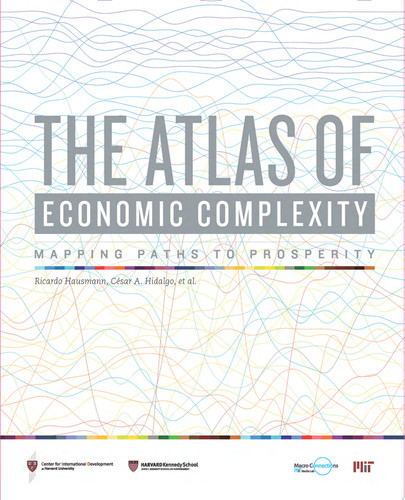
The atlas of economic complexity: mapping paths to prosperity

Ricardo Hausmann,Cesar A. Hidalgo,Sebastian Bustos,Michele Coscia,Alexander Simoes
Maps capture data expressing the economic complexity of countries from Albania to Zimbabwe, offering current economic measures and as well as a guide to achieving prosperity Why do some countries grow and others do not? The authors of The Atlas of Economic Complexity offer readers an explanation based on "Economic Complexity," a measure of a society's productive knowledge. Prosperous societies are those that have the knowledge to make a larger variety of more complex products. The Atlas of Economic Complexity attempts to measure the amount of productive knowledge countries hold and how they can move to accumulate more of it by making more complex products. Through the graphical representation of the "Product Space," the authors are able to identify each country's "adjacent possible," or potential new products, making it easier to find paths to economic diversification and growth. In addition, they argue that a country's economic complexity and its position in the product space are better predictors of economic growth than many other well-known development indicators, including measures of competitiveness, governance, finance, and schooling. Using innovative visualizations, the book locates each country in the product space, provides complexity and growth potential rankings for 128 countries, and offers individual country pages with detailed information about a country's current capabilities and its diversification options. The maps and visualizations included in the Atlas can be used to find more viable paths to greater productive knowledge and prosperity.
The MIT Press 2013 367 pages

The shifts and the shocks: what we've learned -- and have still to learn -- from the financial crisis

Wolf, Martin
"From the chief economic commentator for the Financial Times, a brilliant tour d'horizon of the new global economy and its trajectory There have been many books that have sought to explain the causes and courses of the financial and economic crisis which began in 2007-8. The Shifts and the Shocks is not another detailed history of the crisis, but the most persuasive and complete account yet published of what the crisis should teach us about modern economies and economics. The book identifies the origin of the crisis in the complex interaction between globalization, hugely destabilizing global imbalances and our dangerously fragile financial system. In the eurozone, these sources of instability were multiplied by the tragically defective architecture of the monetary union. It also shows how much of the orthodoxy that shaped monetary and financial policy before the crisis occurred was complacent and wrong. In doing so, it mercilessly reveals the failures of the financial, political and intellectual elites who ran the system. The book also examines what has been done to reform the financial and monetary systems since the worst of the crisis passed. "Are we now on a sustainable course?" Wolf asks. "The answer is no." He explains with great clarity why "further crises seem certain" and why the management of the eurozone in particular "guarantees a huge political crisis at some point in the future." Wolf provides far more ambitious and comprehensive plans for reform than any currently being implemented. Written with all the intellectual command and trenchant judgment that have made Martin Wolf one of the world's most influential economic commentators, The Shifts and the Shocks matches impressive analysis with no-holds-barred criticism and persuasive prescription for a more stable future. It is a book no one with an interest in global affairs will want to neglect. "--
Penguin Press 2015 503 pages

Economics of Worldwide Stagflation

Michael Bruno,Jeffrey D. Sachs
This book sets forth both a theory and a comparative empirical analysis of stagflation, that peculiar combination of high unemployment, slow growth, and spurts of high inflation bedeviling the advanced industrial nations during the past fifteen years. The authors first construct a small macroeconomic model that takes full account of aggregate demand and supply forces in the determination of output, employment, and the price level, in both a single-economy and a multi-economy setting. They then apply the model to provide an understanding of comparative performance of industrial countries in the areas of unemployment, inflation, productivity, and investment growth. They argue convincingly that the decay of the major economies during this period resulted from the supply shocks of the 1970s, such as the two major OPEC oil-price increases, and from the consequent policy-induced decrease in demand in response to inflationary pressures. Their analysis differs markedly from similar studies in that it takes specific account of institutional differences in the labor markets of the various economies. This helps to explain in particular the divergent adjustment profiles of the United States and Europe. Bruno and Sachs make several key recommendations for the mix of demand management and incomes policies necessary to combat stagflation in individual countries as well as for the coordination of macroeconomic policies among the major industrial nations.
Harvard University Press 2013-10 336 pages