7 results for "Management"

Globalization and its discontents

Stiglitz, Joseph E.
Our world is changing. Globalisation is not working. It is hurting those it was meant to help. And now, the tide is turning . . .Explosive and shocking, Globalization and Its Discontents is the bestselling expose of the all-powerful organisations that control our lives - from the man who has seen them at work first hand. As chief economist at the World Bank, Nobel Prize-winner Joseph Stiglitz had a unique insider's view into the management of globalisation. Now he speaks out against it- how the IMF and WTO preach fair trade yet impose crippling economic policies on developing nations; how free market 'shock therapy' made millions in East Asia and Russia worse off than they were before; and how the West has driven the global agenda to further its own financial interests. Globalisation can still be a force for good, Stiglitz argues. But the balance of power has to change. Here he offers real, tough solutions for the future.
Penguin 2002 288 pages

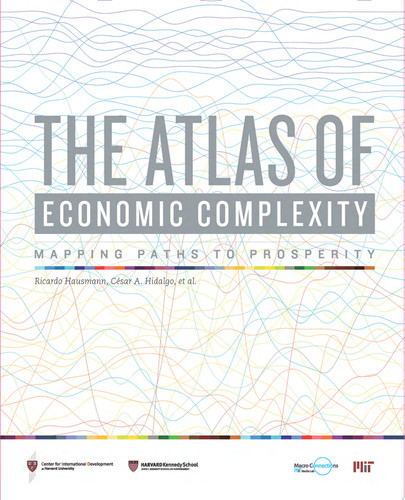
The atlas of economic complexity: mapping paths to prosperity

Ricardo Hausmann,Cesar A. Hidalgo,Sebastian Bustos,Michele Coscia,Alexander Simoes
Maps capture data expressing the economic complexity of countries from Albania to Zimbabwe, offering current economic measures and as well as a guide to achieving prosperity Why do some countries grow and others do not? The authors of The Atlas of Economic Complexity offer readers an explanation based on "Economic Complexity," a measure of a society's productive knowledge. Prosperous societies are those that have the knowledge to make a larger variety of more complex products. The Atlas of Economic Complexity attempts to measure the amount of productive knowledge countries hold and how they can move to accumulate more of it by making more complex products. Through the graphical representation of the "Product Space," the authors are able to identify each country's "adjacent possible," or potential new products, making it easier to find paths to economic diversification and growth. In addition, they argue that a country's economic complexity and its position in the product space are better predictors of economic growth than many other well-known development indicators, including measures of competitiveness, governance, finance, and schooling. Using innovative visualizations, the book locates each country in the product space, provides complexity and growth potential rankings for 128 countries, and offers individual country pages with detailed information about a country's current capabilities and its diversification options. The maps and visualizations included in the Atlas can be used to find more viable paths to greater productive knowledge and prosperity.
The MIT Press 2013 367 pages

Climate shock: the economic consequences of a hotter planet

Wagner, Gernot,Weitzman, Martin L.
If you had a 10 percent chance of having a fatal car accident, you'd take necessary precautions. If your finances had a 10 percent chance of suffering a severe loss, you'd reevaluate your assets. So if we know the world is warming and there's a 10 percent chance this might eventually lead to a catastrophe beyond anything we could imagine, why aren't we doing more about climate change right now? We insure our lives against an uncertain future--why not our planet? In Climate Shock, Gernot Wagner and Martin Weitzman explore in lively, clear terms the likely repercussions of a hotter planet, drawing on and expanding from work previously unavailable to general audiences. They show that the longer we wait to act, the more likely an extreme event will happen. A city might go underwater. A rogue nation might shoot particles into the Earth's atmosphere, geoengineering cooler temperatures. Zeroing in on the unknown extreme risks that may yet dwarf all else, the authors look at how economic forces that make sensible climate policies difficult to enact, make radical would-be fixes like geoengineering all the more probable. What we know about climate change is alarming enough. What we don't know about the extreme risks could be far more dangerous. Wagner and Weitzman help readers understand that we need to think about climate change in the same way that we think about insurance--as a risk management problem, only here on a global scale. With a new preface addressing recent developments Wagner and Weitzman demonstrate that climate change can and should be dealt with--and what could happen if we don't do so--tackling the defining environmental and public policy issue of our time.
Princeton University Press 2016 250 pages

Linked labor histories: New England, Colombia, and the making of a global working class

Chomsky, Aviva
Exploring globalization from a labor history perspective, Aviva Chomsky provides historically grounded analyses of migration, labor-management collaboration, and the mobility of capital. She illuminates the dynamics of these movements through case studies set mostly in New England and Colombia. Taken together, the case studies offer an intricate portrait of two regions, their industries and workers, and the myriad links between them over the long twentieth century, as well as a new way to conceptualize globalization as a long-term process. Chomsky examines labor and management at two early-twentieth-century Massachusetts factories: one that transformed the global textile industry by exporting looms around the world, and another that was the site of a model program of labor-management collaboration in the 1920s. She follows the path of the textile industry from New England, first to the U.S. South, and then to Puerto Rico, Japan, Mexico, Central America, the Caribbean, and Colombia. She considers how towns in Rhode Island and Massachusetts began to import Colombian workers as they struggled to keep their remaining textile factories going. Most of the workers eventually landed in service jobs: cleaning houses, caring for elders, washing dishes. Focusing on Colombia between the 1960s and the present, Chomsky looks at the Urabá banana export region, where violence against organized labor has been particularly acute, and, through a discussion of the AFL-CIO’s activities in Colombia, she explores the thorny question of U.S. union involvement in foreign policy. In the 1980s, two U.S. coal mining companies began to shift their operations to Colombia, where they opened two of the largest open-pit coal mines in the world. Chomsky assesses how different groups, especially labor unions in both countries, were affected. Linked Labor Histories suggests that economic integration among regions often exacerbates regional inequalities rather than ameliorating them.
Duke University Press 2008-04 397 pages

The technology, business, and economics of streaming video: the next generation of media emerges

Noam, Eli M.
"Along with its interrelated companion volume, The Content, Impact, and Regulation of Streaming Video, this book covers the next generation of TV-streaming online video, with details about its present and a broad perspective on the future. It reviews the new technical elements that are emerging, both in hardware and software, their long-term trend, and the implications, and discusses the emerging 'media cloud' of video and infrastructure platforms, and the organizational form of such TV. What kind of companies? What kind of business models? What kind of industries? What kind of impact on existing media? And what kind of market power in media industries, around the world? The author addresses these questions with facts and figures, ranging across technology, economics, communications studies, business, policy, and law. Media professionals in academia, management, technology, policy and creative production will appreciate the non-jargony yet thorough exploration of streaming online video in The Technology, Business, and Economics of Streaming Video."--
Edward Elgar Publishing 2021 414 pages

The content, impact, and regulation of streaming video: the next generation of media emerges

Noam, Eli M.
Long with its interrelated companion volume, The Technology, Business, and Economics of Streaming Video, this book examines the next generation of TV--online video. It reviews the elements that lead to online platforms and video clouds and analyzes the software and hardware elements of content creation and interaction, and how these elements lead to different styles of video content. What are the models of this new content? What kind of cultural and societal acceleration can we expect? What are the public implications of the next-generation media system? What problems are arising? What kind of market power is emerging in media industries around the world? And how can one deal with them? The author addresses these questions with facts and figures, ranging across technology, economics, communications studies, business, policy, and law. He reviews the regulatory options, and recommends a new approach for video media. Media professionals in academia, management, technology, policy, and creative production will value the approachable yet thorough information presented in The Content, Impact, and Regulation of Streaming Video. --
Edward Elgar Publishing 2021 412 pages