6 results for "Marketing"

The Terror Dream Myth and Misogyny in an Insecure America

Susan Faludi
It has become clear over the years that the reaction of America's politicians and media to the attacks of 9/11 was bizarrely misdirected and dangerous to our national security. But no one has fully probed its cultural roots. Until now. Pulitzer Prize–winning journalist and bestselling author Susan Faludi brilliantly demonstrates how our culture's seemingly inexplicable response was actually a reflex set centuries deep in the American grain. Her analysis of what went on in the months and years after 9/11 will shock even those who thought they knew the full measure of that tragedy (as her account of the post-9/11 media marketing of flight-suit superheroes, cowering "security moms," Jessica-Lynchesque helpless "girls," and Daniel Boone–wannabe politicians will outrage and amuse). A masterwork of historical interpretation and a Rosetta stone for deciphering the ongoing spectacle of American politics, journalism, and culture, The Terror Dream flushes from hiding a forceful dynamic that disfigures our lives even in times of normalcy, and that, unless it is confronted, will send us reeling in a wrong direction the next time tragedy strikes.
Picador 2008-09-02 480 pages

World Without Mind

Franklin Foer
Over the past few decades there has been a revolution in terms of who controls knowledge and information. This rapid change has imperilled the way we think. Without pausing to consider the cost, the world has rushed to embrace the products and services of four titanic corporations. We shop with Amazon; socialise on Facebook; turn to Apple for entertainment; and rely on Google for information. These firms sell their efficiency and purport to make the world a better place, but what they have done instead is to enable an intoxicating level of daily convenience. As these companies have expanded, marketing themselves as champions of individuality and pluralism, their algorithms have pressed us into conformity and laid waste to privacy. They have produced an unstable and narrow culture of misinformation, and put us on a path to a world without private contemplation, autonomous thought, or solitary introspection - a world without mind. In order to restore our inner lives, we must avoid being co-opted by these gigantic companies, and understand the ideas that underpin their success. Elegantly tracing the intellectual history of computer science - from the Descartes and the enlightenment to Alan Turing to Stuart Brand and the hippie origins of today's Silicon Valley - Foer exposes the dark underpinnings of our most idealistic dreams for technology. The corporate ambitions of Google, Facebook, Apple, and Amazon, he argues, are trampling longstanding liberal values, especially intellectual property and privacy. This is a nascent stage in the total automation and homogenization of social, political, and intellectual life. By reclaiming our private authority over how we intellectually engage with the world, we have the power to stem the tide. At stake is nothing less than who we are, and what we will become. There have been monopolists in the past but today's corporate giants have far more nefarious aims. They're monopolists who want access to every facet of our identities and influence over every corner of our decision-making. Until now few have grasped the sheer scale of the threat. Foer explains not just the looming existential crisis but the imperative of resistance.
Jonathan Cape Ltd 2017-09-28 272 pages

Cross Cultural Design: Communicating in the Global Marketplace

Henry Steiner,Ken Haas
Cross-Cultural Design is the first book to examine the challenges and rewards experienced by the world's leading communication professionals when handling assignments outside their own cultures. The solutions to these marketing problems are documented here in 309 stunning full-colour images, accompanied by the creators' provocative descriptions of their setbacks, triumphs and discoveries.The works shown range from designs for advertisements, corporate identity programmes, annual reports, films, packages, books, magazines, posters and signage to currency, postage stamps and environmental graphics. Among clients represented are banks, print media, software companies, airlines, governments and manufacturing firms.This anthology is introduced by Henry Steiner's stimulating essay "Spam Sushi and Chameleons", which articulates the issues and provides conceptual ideas for succeeding in the global marketplace. In the pages that follow, the work of such outstanding professionals as Saul Bass, Walter Bernard, Ken Cato, Ivan Chermayeff, Joe Duffy, Alan Fletcher, Dan Friedman, Milton Glaser, Eiko Ishioka, Tibor Kalman, Clement Mok, Erik Spiekermann and Henry Wolf is illustrated and discussed. This unique volume also includes much practical information, a contributors' directory, an extensive bibliography and a thorough index.Cross-Cultural Design will be welcomed as both a thought-provoking exploration of international design and an invaluable reference source for designers, advertising agencies, marketing professionals, business corporations, scholars and students.
Van Nostrand Reinhold 1990-05

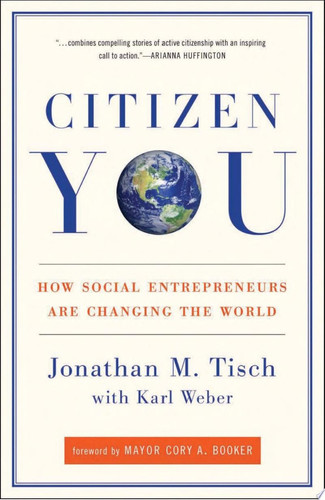
Citizen You How Social Entrepreneurs Are Changing the World

Jonathan Tisch,Karl Weber
Just when the world needs it most, a new style of social engagement is emerging: Active Citizenship. A key member of one of New York’s most civic-minded families—one that has supported many of America’s notable institutions and deserving programs—Jonathan Tisch has devoted a lifetime to “active citizenship.” It’s an idea that uses the power of practical creativity and grassroots participation to solve seemingly intractable problems. In Citizen You , Tisch challenges readers to join this movement and points the way toward making our world a better place, one person and one neighborhood at a time. Tisch has filled Citizen You with accounts of people who you’ll meet, such inspirational individuals as: Scott Harrison, who has used the networking and marketing skills he developed as a night club promoter to help over a million people in the developing world get access for the first time to clean, safe drinking water. Steffi Coplan, whose Broadway2Broadway project brought out the hidden musical talents of kids at an inner city school. Eric Schwarz, who decided to do something about America’s under-performing schools, and parlayed a single classroom mentoring project into the nationwide Citizens Schools movement. Chris Swan, who is training a new generation of “citizen engineers” to make sure that the projects they build aren’t just structurally sound but also environmentally and socially sustainable. Dave Nelson, who traded his role as an executive at IBM for a job at a struggling nonprofit that teaches kids about the power of entrepreneurship—and discovered a host of new challenges and rewards in the process. Through these and many other remarkable stories, you’ll learn how today’s active citizens are transforming thinking about social change. Rather than short-term fixes and hand-me-down charity, they’re striving to build sustainable, systemic solutions to our most challenging problems, building and empowering communities rather than fostering dependency. And they’re using a host of new tools, from online networking and private-public partnerships to corporate engagement and social entrepreneurship, to redefine how change can happen. Citizen You is a potent antidote to pessimism. At a time of unprecedented challenges on the national and world stage, when active citizenship is not a choice but a necessity, Citizen You dares us to reshape the social, political, and intellectual structures that have long confined us, and offers fresh thinking that redefines the very concept of activism. For more information and ideas about how to be an active citizen go to www.citizenyou.org
Crown 2011-05-03 288 pages

Hothouse Kids How the Pressure to Succeed Threatens Childhood

Alissa Quart
A devastating indictment of the “gifted child” myth The effort to produce “gifted” children through an exhausting regimen of early (and ever-earlier) training has grown into a troubling national phenomenon. With less free playtime and overwhelming pressure to achieve, the kids are the ones who suffer. Investigative journalist Alissa Quart knows the terrain firsthand, having herself negotiated the gifted-child label. With phenomenal research and sharp insight, she takes a damning look at the industry that profits from marketing educational products to enhance giftedness and questions the correlation between rigorous early enrichment and higher achievement. A thoughtful, sometimes critical look at the excessive ambition foisted upon children, Hothouse Kids is essential reading for parents, teachers, and anyone concerned about education.
Penguin 2007 260 pages