47 results for "Mathematics"

A Briefer History of Time

Stephen Hawking,Leonard Mlodinow
Stephen Hawking’s worldwide bestseller, A Brief History of Time , has been a landmark volume in scientific writing. Its author’s engaging voice is one reason, and the compelling subjects he addresses is another: the nature of space and time, the role of God in creation, the history and future of the universe. But it is also true that in the years since its publication, readers have repeatedly told Professor Hawking of their great difficulty in understanding some of the book’s most important concepts. This is the origin of and the reason for A Briefer History of Time : its author’s wish to make its content more accessible to readers—as well as to bring it up-to-date with the latest scientific observations and findings. Although this book is literally somewhat “briefer,” it actually expands on the great subjects of the original. Purely technical concepts, such as the mathematics of chaotic boundary conditions, are gone. Conversely, subjects of wide interest that were difficult to follow because they were interspersed throughout the book have now been given entire chapters of their own, including relativity, curved space, and quantum theory. This reorganization has allowed the authors to expand areas of special interest and recent progress, from the latest developments in string theory to exciting developments in the search for a complete unified theory of all the forces of physics. Like prior editions of the book—but even more so— A Briefer History of Time will guide nonscientists everywhere in the ongoing search for the tantalizing secrets at the heart of time and space.
Random House Large Print 2005 260 pages

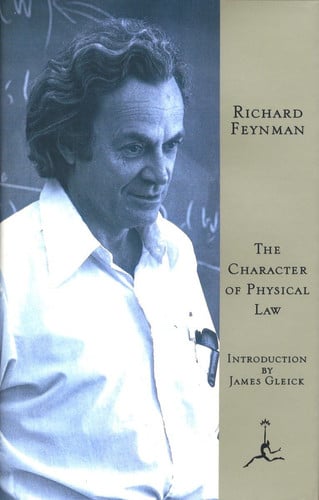
The character of physical law

Feynman, Richard P.
Like any set of oral reflections, The Character of Physical Law has special value as a demonstration of the mind in action. The reader is particularly lucky in Richard Feynman - one of the most eminent and imaginative modern physicists. In these Messenger Lectures, originally delivered at Cornell University and recorded for television by the BBC, Richard Feynman offers an overview of selected physical laws and gathers their common features into one broad principle of invariance. He maintains at the outset that the importance of a physical law is not ''how clever we are to have found it out - but . . . how clever nature is to pay attention to it'' and steers his discussions toward a final exposition of the elegance and simplicity of all scientific laws. Rather than an essay on the most significant achievements in modern science, The Character of Physical Law is a statement of what is most remarkable in nature. Feynman's enlightened approach, his wit, and his enthusiasm make this a memorable exposition of the scientist's craft. The law of gravitation is the author's principal example. Relating the details of its discovery and stressing its mathematical character, he uses it to demonstrate the essential interaction of mathematics and physics. He views mathematics as the key to any system of scientific laws, suggesting that if it were possible to fill out the structure of scientific theory completely, the result would be an integrated set of mathematical axioms. The principles of conservation, symmetry, and time irreversibility are then considered in relation to developments in classical and modern physics, and in his final lecture, Feynman develops his own analysis of the process and future of scientific discovery.
Modern Library 1994-11-08 167 pages

The Nature of Mathematical Modeling (Cambridge Series on Information and the Natural Sciences)

Gershenfeld, Neil
This book first covers exact and approximate analytical techniques (ordinary differential and difference equations, partial differential equations, variational principles, stochastic processes); numerical methods (finite differences for ODE's and PDE's, finite elements, cellular automata); model inference based on observations (function fitting, data transforms, network architectures, search techniques, density estimation); as well as the special role of time in modeling (filtering and state estimation, hidden Markov processes, linear and nonlinear time series). Each of the topics in the book would be the worthy subject of a dedicated text, but only by presenting the material in this way is it possible to make so much material accessible to so many people. Each chapter presents a concise summary of the core results in an area, providing an orientation to what they can (and cannot) do, enough background to use them to solve typical problems, and pointers to access the literature for particular applications.
Cambridge University Press 2011-09-30

A project to find the fundamental theory of physics

Wolfram, Stephen
'In many ways it s the ultimate question in natural science: How does our universe work? Is there a fundamental theory? An incredible amount has been figured out about physics over the past few hundred years. But even with everything that s been done and it's very impressive - we still, after all this time, don t have a truly fundamental theory of physics.' The Wolfram Physics Project is a bold effort to find the fundamental theory of physics. It combines new ideas with the latest research in physics, mathematics and computation in the push to achieve this ultimate goal of science. Written with Stephen Wolfram's characteristic expository flair, this book provides a unique opportunity to learn about a historic initiative in science right as it is happening. A Project to Find the Fundamental Theory of Physics includes: The announcement of the project; A technical introduction; A history section that outlines the backstory which led Wolfram to this point; Background information from computational essays published by the author in 2015 and 2017; Foundational information, including historical notes and an excerpt from Wolfram's; 2002 New York Times Best Seller A New Kind of Science; Hundreds of beautiful full-colour visualisations. Stephen Wolfram is a distinguished scientist and best-selling author, and the creator of some of the world's most respected software systems, including Mathematica, Wolfram|Alpha and Wolfram Language. For more than 30 years he has been the CEO of the global technology company Wolfram Research.
Wolfram Media 2020 778 pages

Special Relativity and Classical Field Theory The Theoretical Minimum

Leonard Susskind,Art Friedman
A funny, insightful, and self-contained guide to Einstein's relativity theory and classical field theories--including electromagnetism Physicist Leonard Susskind and data engineer Art Friedman are back. This time, they introduce readers to Einstein's special relativity and Maxwell's classical field theory. Using their typical brand of real math, enlightening drawings, and humor, Susskind and Friedman walk us through the complexities of waves, forces, and particles by exploring special relativity and electromagnetism. It's a must-read for both devotees of the series and any armchair physicist who wants to improve their knowledge of physics' deepest truths.
Basic Books 2019-05-07 448 pages

Physics for Entertainment

Yakov Perelman
Published in 1913, a best-seller in the 1930s and long out of print, Physics for Entertainment was translated from Russian into many languages and influenced science students around the world. Among them was Grigori Yakovlevich Perelman, the Russian mathematician (unrelated to the author), who solved the Poincaré conjecture, and who was awarded and rejected the Fields Medal. Grigori's father, an electrical engineer, gave him Physics for Entertainment to encourage his son's interest in mathematics. In the foreword, the book's author describes the contents as "conundrums, brain-teasers, entertaining anecdotes, and unexpected comparisons," adding, "I have quoted extensively from Jules Verne, H. G. Wells, Mark Twain and other writers, because, besides providing entertainment, the fantastic experiments these writers describe may well serve as instructive illustrations at physics classes." The book's topics included how to jump from a moving car, and why, "according to the law of buoyancy, we would never drown in the Dead Sea." Ideas from this book are still used by science teachers today.
Amazon Digital Services LLC - Kdp 2011 270 pages

Doing physics: how physicists take hold of the world

Krieger, Martin H.
Doing Physics makes concepts of physics easier to grasp by relating them to everyday knowledge. Addressing some of the models and metaphors that physicists use to explain the physical world, Martin H. Krieger describes the conceptual world of physics by means of analogies to economics, anthropology, theater, carpentry, mechanisms such as clockworks, and machine tool design. The interaction of elementary particles or chemical species, for example, can be related to the theory of kinship—who can marry whom is like what can interact with what. Likewise, the description of physical situations in terms of interdependent particles and fields is analogous to the design of a factory with its division of labor among specialists. For the new edition, Krieger has revised the text and added a chapter on the role of mathematics and formal models in physics. Doing Physics will be of special interest to economists, political theorists, anthropologists, and sociologists as well as philosophers of science.
Indiana University Press 2012-11-19 218 pages

The Interpretation of Nature and the Psyche

Carl Gustav Jung,Wolfgang Ernst Pauli
Carl Gustav Jung (1875-1961) and Wolfgang Ernst Pauli (1900 - 1958) were two of the greatest thinkers of modern times. Jung is the founder of Analytical Psychology and is one of the best known researchers in the field of Dream Interpretation and Symbolization. Pauli was one of the pioneers of Quantum Physics. In 1945, Pauli received the Nobel Prize in Physics after being nominated by Albert Einstein for his "decisive contribution through his discovery of a new law of Nature, the exclusion principle" involving spin theory underpinning the structure of matter and the whole of chemistry. Together they collaborated on this book that was First published in 1952 in German as Naturerklarung und Psyche. C. G. Jung: Synchronizitat als ein Prinzip akausaler Zusammenhange. W. Pauli: Der Einfluss archetypischer Vorstellungen auf die Bildung naturwissenschaftlicher Theorien bei Kepler. However, our reviewer, himself an eminent professor of mathematics, concludes, "After thoroughly studying their writings for many months now, I have come to see clearly that they are both utterly mad.""
Ishi Press International 2012-02 280 pages

Aerodynamics

Theodore Von Karman
Aerodynamics by Theodore Von Karman is a classic textbook that provides a comprehensive introduction to the principles of aerodynamics. The book covers the fundamental concepts of fluid dynamics, including the behavior of gases and liquids, the equations of motion, and the principles of conservation of mass, momentum, and energy. It also explores the physics of aerodynamic forces, such as lift and drag, and the role of viscosity and turbulence in the flow of fluids. The book includes detailed discussions of various aerodynamic phenomena, such as boundary layers, shock waves, and vortices, and their impact on aircraft design and performance. It also covers the design and analysis of airfoils, wings, and other aerodynamic components, as well as the principles of aircraft stability and control. Written by one of the most renowned figures in the field of aerodynamics, this book is an essential resource for students and professionals in the aerospace industry, as well as anyone interested in the science of flight. With its clear explanations, extensive illustrations, and practical examples, Aerodynamics is a valuable reference for anyone seeking a deeper understanding of the principles that govern the behavior of fluids in motion.Selected Topics In The Light Of Their Historical Development.This scarce antiquarian book is a facsimile reprint of the old original and may contain some imperfections such as library marks and notations. Because we believe this work is culturally important, we have made it available as part of our commitment for protecting, preserving, and promoting the world's literature in affordable, high quality, modern editions, that are true to their original work.
Literary Licensing, LLC 2013-10 214 pages

Understanding Understanding Essays on Cybernetics and Cognition

Heinz von Foerster
In these essays Heinz von Foerster discusses some of the fundamental principles that govern how we know the world and how we process the information from which we derive that knowledge. Included are path- breaking articles concerning the principles of computation in neural nets (1967), the definition of self-organizing systems (1960), the nature of cognition (1970), as well as recent expansions on these themes (e.g. "How recursive is communication," 1993). Working with Norbert Wiener, Warren McCullough, and others in the 1960s and 1970s, von Foerster was one of the founders of the science of cybernetics, which has had profound effects both on modern systems theory and on the philosophy of cognition. At the Biological Computer Laboratory at the University of Illinois he produced the first parallel computers and contributed to many other developments in the theory of computation and cognition.
Springer New York 2010-10-15 362 pages

Mathematics for the physical sciences.

Schwartz, Laurent
This exploration of the mathematical methods of physics takes a careful look at mathematical entities and explains their elementary properties. Its examples, drawn from the physical sciences, illustrate the application of concepts. The theory of distributions is introduced early and employed throughout the text. Concise rather than comprehensive, this text states only essential results in its proofs. Topics include preliminary results in the integral calculus, elementary theory of distributions, convolution, Fourier series and the Fourier transform, the Laplace transform, wave and heat conduction equations, the gamma function, and Bessel functions. Prerequisites include a familiarity with linear algebra and functions of a complex variable.
Addison-Wesley 1966 358 pages

Symmetries and reflections

Wigner, Eugene Paul
This volume contains some of Professor Wigner's more popular papers, which, in their diversity of subject and clarity of style, reflect the author's deep analytical powers and the remarkable scope of his interests. Included are articles on the nature of physical symmetry, invariance and conservation principles, the structure of solid bodies and of the compound nucleus, the theory of nuclear fission, the effects of radiation on solids, and epistemological problems of quantum mechanics. Other articles deal with the story of the first man-made nuclear chain reaction, the long-term prospects of nuclear energy, the problems of Big Science, and the role of mathematics in the natural sciences. In addition, the book contains statements of Wigner's convictions and beliefs, as well as memoirs of his friends, Enrico Fermi and John von Neumann.
M.I.T. Press 1970 280 pages

Supersonic Flow and Shock Waves

Richard Courant,K.O. Friedrichs
The Springer edition of this book is an unchanged reprint of Courant and Friedrich's classical treatise which was first published in 1948. The basic research for it took place during World War II, but there are many aspects which still make the book interesting as a text and as a reference. It treats basic aspects of the dynamics of compressible fluids in mathematical form, and attempts to present a systematic theory of nonlinear wave propagation, particularly in relation to gas dynamics. Written in the form of an advanced textbook, it accounts for classical as well as some fairly recent developments. The authors intend their audience to be engineers, physicists and mathematicians alike.
Springer New York 2012-11-17 464 pages

Physics: the first science

Lindenfeld, Peter
Today's physics textbooks have become encyclopedic, offering students dry discussions, rote formulas, and exercises with little relation to the real world. Physics: The First Science takes a different approach by offering uniquely accessible, student-friendly explanations, historical and philosophical perspectives and mathematics in easy-to-comprehend dialogue. It emphasizes the unity of physics and its place as the basis for all science. Examples and worked solutions are scattered throughout the narrative to help increase understanding. Students are tested and challenged at the end of each chapter with questions ranging from a guided-review designed to mirror the examples, to problems, reasoning skill building exercises that encourage students to analyze unfamiliar situations, and interactive simulations developed at the University of Colorado. With their experience instructing both students and teachers of physics for decades, Peter Lindenfeld and Suzanne White Brahmia have developed an algebra-based physics book with features to help readers see the physics in their lives. Students will welcome the engaging style, condensed format, and economical price.
Rutgers University Press 2011 366 pages

Heat and Thermodynamics

Mark W. Zemansky
This respected text deals with large-scale, easily known thermal phenomena and then proceeds to small-scale, less accessible phenomena. The wide range of mathematics used in Dittman and Zemansky's text simultaneously challenges students who have completed a course in impartial differential calculus without alienating those students who have only taken a calculus-based general physics course. Examples of calculations are presented shortly after important formulas are derived. Students see the solutions of problems related to the formulas. Actual thermodynamic experiments are explained in detail. The student sees the applicability of abstract thermodynamic concepts and formulas to real situations.
McGraw-Hill Education 1997 487 pages

Isoperimetric Inequalities in Mathematical Physics

George Polya,G. Szegö
Pólya and Szegö’s classic treatment of isoperimetric inequalities in mathematical physics from the acclaimed Annals of Mathematics Studies series Princeton University Press is proud to have published the Annals of Mathematics Studies since 1940. One of the oldest and most respected series in science publishing, it has included many of the most important and influential mathematical works of the twentieth century. The series continues this tradition as Princeton University Press publishes the major works of the twenty-first century. To mark the continued success of the series, all books are available in paperback and as ebooks.
Princeton University Press 1951-08-21 279 pages

Philosophical Reflections and Syntheses

Wigner, Eugene Paul
Among the founding fathers of modern quantum physics few have contributed to our basic understanding of its concepts as much as E.P. Wigner. His articles on the epistemology of quantum mechanics and the measurement problem, and the basic role of symmetries were of fundamental importance for all subsequent work. He was also the first to discuss the concept of consciousness from the point of view of modern physics. G.G. Emch edited most of those papers and wrote a very helpful introduction into Wigner's contributions to Natural Philosophy. The book should be a gem for all those interested in the history and philosophy of science.
Springer 2012-02-12 650 pages

Real Algebraic Geometry

Vladimir I. Arnold
This book is concerned with one of the most fundamental questions of mathematics: the relationship between algebraic formulas and geometric images. At one of the first international mathematical congresses (in Paris in 1900), Hilbert stated a special case of this question in the form of his 16th problem (from his list of 23 problems left over from the nineteenth century as a legacy for the twentieth century). In spite of the simplicity and importance of this problem (including its numerous applications), it remains unsolved to this day (although, as you will now see, many remarkable results have been discovered).
Springer 2013-04-18 120 pages