7 results for "Mathematics"

Mathematics without apologies: portrait of a problematic vocation

Harris, Michael
What do pure mathematicians do, and why do they do it? Looking beyond the conventional answers--for the sake of truth, beauty, and practical applications--this book offers an eclectic panorama of the lives and values and hopes and fears of mathematicians in the twenty-first century, assembling material from a startlingly diverse assortment of scholarly, journalistic, and pop culture sources.
Princeton University Press 2017-05-30 438 pages

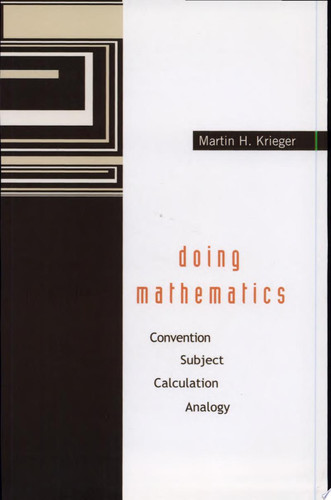
Doing mathematics: convention, subject, calculation, analogy

Krieger, Martin H.
This book discusses some ways of doing mathematical work and the subject matter that is being worked upon and created. It argues that the conventions we adopt, the subject areas we delimit, what we can prove and calculate about the physical world, and the analogies that work for mathematicians--all depend on mathematics, what will work out and what won't. And the mathematics, as it is done, is shaped and supported, or not, by convention, subject matter, calculation, and analogy. The causes studied include the central limit theorem of statistics, the sound of the shape of a drum, the connection between algebra and topology, the stability of matter, the Ising model, and the Langlands Program in number theory and representation theory. Contents: Convention: How Means and Variances are Entrenched as Statistics; Subject: The Fields of Topology; Appendix: The Two-Dimensional Ising Model of a Ferromagner; Calculation: Strategy, Structure, and Tactics in Applying Classical Analysis; Analogy; A Syzygy Between a research Program in Mathematics and a Research Program in Physics, Each of Which is Itself an Analogy; Mathematics in Concreto. Readership: Mathematicians, Physicists, philosophers and historians of science.
World Scientific 2003 454 pages

The Gini Methodology A Primer on a Statistical Methodology

Shlomo Yitzhaki,Edna Schechtman
Gini's mean difference (GMD) was first introduced by Corrado Gini in 1912 as an alternative measure of variability. GMD and the parameters which are derived from it (such as the Gini coefficient or the concentration ratio) have been in use in the area of income distribution for almost a century. In practice, the use of GMD as a measure of variability is justified whenever the investigator is not ready to impose, without questioning, the convenient world of normality. This makes the GMD of critical importance in the complex research of statisticians, economists, econometricians, and policy makers. This book focuses on imitating analyses that are based on variance by replacing variance with the GMD and its variants. In this way, the text showcases how almost everything that can be done with the variance as a measure of variability, can be replicated by using Gini. Beyond this, there are marked benefits to utilizing Gini as opposed to other methods. One of the advantages of using Gini methodology is that it provides a unified system that enables the user to learn about various aspects of the underlying distribution. It also provides a systematic method and a unified terminology. Using Gini methodology can reduce the risk of imposing assumptions that are not supported by the data on the model. With these benefits in mind the text uses the covariance-based approach, though applications to other approaches are mentioned as well.
Springer New York 2014-12-13 548 pages

The Quantum Theory

James Zimmerhoff,Fritz Reiche
THE old saying that small causes give rise to great effects has been confirmed more than once in the history of physics. For, very frequently, inconspicuous differences be- tween theory and experiment (which did not, however, escape the vigilant eye of the investigator) have become starting- points of new and important researches. Out of the well-known Michelson-Morley experiment, which, in spite of the application of the most powerful methods of exact optical measurement, failed to show an influence of the earth's movement on the propagation of light as was predicted by classical theory, there arose the great structure of Einstein's Theory of Eelativity. In the same way the trifling difference between the measured and calculated values of black-body radiation gave rise to the Quantum Theory which, formulated by Max Planck, was destined to revolutionise in the course of time almost all departments of physics. The quantum theory is yet comparatively young. It is therefore not surprising that we are confronted with an unfinished theory still in process of development which, changing constantly in many directions, must often destroy what it has built up a short time before. But under such circumstances as these, in which the theory is continually deriving new nourishment from a fresh stream of ideas and suggestions, there is a peculiar fascination in attempting to review the life-history of the quantum theory to the present time and in disclosing the kernel which will certainly out- last changes of form, 1 CHAPTER I The Origin of the Quantum Hypothesis § I. Black-Body Radiation and its Realisation in Practice THE Quantum Theory &st saw light in 1900. When, in the years immediately preceding (1897-1899), Lummer and Pringsheim made their fundamental measurements ' of black-body radiation at the Beichsanstalt, they could ba.ve had no premonition that their careful experiments would become the starting-point of a revolution such as has seldom occurred in physics. In the field of heat radiation chief interest at that time was centred in the radiation of a black body (briefly called " black- body " radiation), that is, of a body which absorbs completely all radiation which falls on it and which thus reflects, trans- mits, and scatters 2 none. We may shortly call to mind the following facts. It is known that any body at a given temperature sends out energy in the form of radiation into the surrounding space. This radiation is not energy in a single simple form but is made up of a number of single radiations of different colours, i.e. of different wave-lengths X or of different frequencies s v. In other words, it forms in general a spectrum in which radiations of all frequencies between v = and v = oo are represented. Further, these radiations are present in varying " intensities." We define this term thus. Consider the radiation emitted from unit surface of the body per second in a certain direction ; break it up spectrally and cut out of the spectrum a small frequency interval dv such that it contains all frequencies between v and V + dv. The energy of radiation E^ thus sliced out (namely, the emissivity of the body for the frequency v)
Independently Published 2017-09-16 185 pages

Mathematics, science and epistemology

Lakatos, Imre
EditorsG++ introduction Part I Philosophy of Mathematics 1 Infinite regress and foundations of mathematics 2 A renaissance of empiricism in the recent philosophy of mathematics? 3 Cauchy and the continuum: the significance of non-standard analysis for the history and philosophy of mathematics 4 What does a mathematical proof prove? 5 The method of analysis-synthesis Part II Critical Papers 6 The problem of appraising scientific theories: three approaches 7 Necessity, Kineale and Popper 8 Changes in the problem of inductive logic 9 On Popperian historiography 10 Anomalies versus G++crucial experimentsG++ 11 Understanding Toulmin Part III Science and Education 12 A letter to the director of the London School of Economics 13 The teaching of the history of science 14 The social responsibility of science References Lakatos bibliography Indexes.
Cambridge University Press 1978 285 pages