83 results for "Medical Ethics"

The immortal life of Henrietta Lacks

Skloot, Rebecca
Her name was Henrietta Lacks, but scientists know her as HeLa. She was a poor Southern tobacco farmer, yet her cells--taken without her knowledge--became one of the most important tools in medicine. The first "immortal" human cells grown in culture, they are still alive today, though she has been dead for more than sixty years. HeLa cells were vital for developing the polio vaccine; uncovered secrets of cancer and viruses; helped lead to in vitro fertilization, cloning, and gene mapping; and have been bought and sold by the billions. Yet Henrietta Lacks is buried in an unmarked grave. Her family did not learn of her "immortality" until more than twenty years after her death, when scientists began using her husband and children in research without informed consent. The story of the Lacks family is inextricably connected to the dark history of experimentation on African Americans, the birth of bioethics, and the legal battles over whether we control the stuff we are made of--From publisher description.
Broadway Paperbacks 2011-03-08 381 pages

Inheritance A Memoir of Genealogy, Paternity, and Love

Dani Shapiro
NEW YORK TIMES BESTSELLER • From the acclaimed author of Signal Fires and host of the hit podcast Family Secrets : a memoir about the staggering family secret uncovered by a genealogy test, an exploration of the urgent ethical questions surrounding fertility treatments and DNA testing, and a profound inquiry of paternity, identity, and love. “Memoir gold: a profound and exquisitely rendered exploration of identity and the true meaning of family.” — People In the spring of 2016, through a genealogy website to which she had casually submitted her DNA for analysis, Dani Shapiro received the stunning news that her beloved deceased father was not her biological father. Over the course of a single day, her entire history—the life she had lived—crumbled beneath her. Inheritance is a book about secrets. It is the story of a woman's urgent quest to unlock the story of her own identity, a story that had been scrupulously hidden from her for more than fifty years. It is a book about the extraordinary moment we live in, a moment in which science and technology have outpaced not only medical ethics but also the capacities of the human heart to contend with the consequences of what we discover. Dani Shapiro’s memoir unfolds at a breakneck pace—part mystery, part real-time investigation, part rumination on the ineffable combination of memory, history, biology, and experience that makes us who we are. Inheritance is a devastating and haunting interrogation of the meaning of kinship and identity, written with stunning intensity and precision.
Knopf Doubleday Publishing Group 2020-01-28 272 pages

Oxford textbook of psychotherapy

Glen O. Gabbard,Judith S. Beck,Jeremy Holmes
With the publication of this book psychotherapy finally arrives at the mainstream of mental health practice. This volume is an essential companion for every practising psychiatrist, clinical psychologist, psychotherapy counsellor, mental health nurse, psychotherapist, and mental healthpractitioner. It is integrative in spirit, with chapters written by an international panel of experts who combine theory and research with practical treatment guidelines and illustrative case examples to produce an invaluable book.Part One gives a comprehensive account of all the major psychotherapeutic approaches. Parts Two and Three systematically describe psychotherapeutic approaches to the major psychiatric disorders and personality disorders. Many chapters are multi-authored and describe the psychodynamic, cognitivebehavioural and other approaches for treating these illnesses. Part Four examines applications and modifications of psychotherapy across the lifecycle. Part Five describes psychotherapy with specific populations such as medical patients and those where gender is an issue, and finally Part Sixtackles some of the special topics of concern to psychotherapists including ethics, legal issues, and psychotherapy and neuroscience. The first of its kind, this is a 'must have' volume for all trainee and practising psychological therapists, whatever their background - psychiatry, psychology,social work, or nursing.
Oxford University Press 2005 534 pages

The Point of It All A Lifetime of Great Loves and Endeavors

Charles Krauthammer
NEW YORK TIMES BESTSELLER - A powerful collection of the influential columnist's most important works--featuring rare speeches and a major new essay about today's populist movements and the future of global democracy "Charles will be remembered as one of the greatest public intellects of his generation."--John McCain In his decades of work as America's preeminent political commentator, whether writing about statecraft and foreign policy or reflecting on more esoteric topics such as baseball, spaceflight and medical ethics, Charles Krauthammer elevated the opinion column to a form of art. This collection features the columns, speeches and unpublished writings that showcase the best of his original thought and his last, enduring words on the state of American politics, the nature of liberal democracy and the course of world history. The book also includes a deeply personal section offering insight into Krauthammer's beliefs about what mattered most to him: friendship, family and the principles he lived by. The Point of It All is a timely demonstration of what made Charles Krauthammer the most celebrated American columnist and political thinker of his generation, a revealing look at the man behind the words and a lasting testament to his belief that anyone with an open and honest mind can grapple deeply with the most urgent questions in politics and in life.
Diversified Publishing 2018 544 pages

The New York Times book of medicine

Gina Bari Kolata
Today we live longer, healthier lives than ever before in history--a transformation due almost entirely to tremendous advances in medicine. This change is so profound, with many major illnesses nearly wiped out, that it's hard now to imagine what the world was like in 1851, when the New York Times began publishing. Treatments for depression, blood pressure, heart disease, ulcers, and diabetes came later; antibiotics were nonexistent, viruses unheard of, and no one realized yet that DNA carried blueprints for life or the importance of stem cells. Edited by award-winning writer Gina Kolata, this eye-opening collection of 150 articles from the New York Times archive charts the developing scientific insights and breakthroughs into diagnosing and treating conditions like typhoid, tuberculosis, cancer, diabetes, Alzheimer's, and AIDS, and chronicles the struggles to treat mental illness and the enormous success of vaccines. It also reveals medical mistakes, lapses in ethics, and wrong paths taken in hopes of curing disease. Every illness, every landmark has a tale, and the newspaper's top reporters tell each one with perceptiveness and skill.
Sterling Publishing Co 2015 535 pages

Bioethics: an anthology

Udo Schüklenk,Peter Singer
"The second edition sold a total of 19k copies since release in 2006, with strong sales (at least 1300 ) every year since release. The third edition has sold 6k copies since coming to market in December 2015. Solid 5-star reviews on Amazon, and #1 result when searching for 'Bioethics'. Will includes several new additions, including important historical readings and new contemporary material published since release of last edition in 2015"--
Wiley-Blackwell 2021-09-08 920 pages

Who shall live? health, economics and social choice

Fuchs, Victor R,Eggleston, Karen
"Since the first edition of Who Shall Live? (1974), over 100,000 students, teachers, physicians, and general readers from more than a dozen fields have found this book to be a reader-friendly, authoritative introduction to economic concepts applied to health and medical care. Health care is by far the largest industry in the United States. It is three times larger than education and five times as large as national defense. In 2001, Americans spent over 12,500 per person for hospitals, physicians, drugs and other health care services and goods. Other high-income democracies spend one third less, enjoy three more years of life expectancy, and have more equal access to medical care. In this book, each of the chapters of the original edition is followed by supplementary readings on such subjects as: "Social Determinants of Health: Caveats and Nuances", "The Structure of Medical Education - It's Time For a Change", and "How to Save 1 Trillion Out of Health Care". The ten years following publication of the 2nd expanded edition in 2011 were arguably more turbulent for US health and health care than any other ten-year period since World War II. They span the implementation of the Affordable Care Act, the deepening opioid epidemic, and the physical, psychological, and socio-economic traumas of the Covid-19 pandemic. An important new contribution to this book is to describe and analyze the changes in five sections: "The Affordable Care Act and the Uninsured", "Health care Expenditures", Health Outcomes", "The Covid-19 Pandemic", and "Health and Politics". This part includes 24 tables and figures. This book will be welcomed by students, professionals, and life-long learners to gain increased understanding of the relation between health, economics, and social choice"--
World Scientific 2024 271 pages

The origins of Nazi genocide: from euthanasia to the final solution

Friedlander, Henry
A history of the T4 program, or "euthanasia program", in Nazi Germany - that is, the murder of handicapped persons by the Nazis. This program was preceded by the politicization of science, which incorporated popular prejudices into "scientific" theories and declared some individuals and even "racial" groups, like Jews and Gypsies, to be "valueless"; by the eugenic movement; and by the misuse of scientific hypotheses by politicians. The policy of exclusion of the "racially inferior" stood at the center of the Nazi utopia. The "euthanasia program", implemented in 1939-40, paved the way for the mass extermination of Jews and Gypsies in 1942-44. Many of those involved in the T4 program (e.g. Franz Stangl) were later involved in the operation of the death camps. Special attention is devoted to the murder of handicapped Jews. These, progressively excluded from the public welfare system and from the medical institutions, were concentrated in 1939-40 in special Jewish hospitals and later killed in the course of the "euthanasia program".
University of North Carolina Press 1995-01-01 421 pages

Embryo experimentation

Peter Singer
New developments in reproductive technology have made headlines since the birth of the world's first in vitro fertilization baby in 1978. But is embryo experimentation ethically acceptable? What is the moral status of the early human embryo? And how should a democratic society deal with so controversial an issue, where conflicting views are based on differing religious and philosophical positions? These controversial questions are the subject of this book, which, as a current compendium of ideas and arguments on the subject, makes an original contribution of major importance to this debate. Peter Singer is the author of many books, including Practical Ethics (CUP, 1979), Marx (Hill & Wang, 1980), and Should the Baby Live? (co-authored with Helga Kuhse, Oxford U.P., 1986).
Cambridge University Press 1990-07-27 263 pages

Mortal questions

Nagel, Thomas
Thomas Nagel's Mortal Questions explores some fundamental issues concerning the meaning, nature and value of human life. Questions about our attitudes to death, sexual behaviour, social inequality, war and political power are shown to lead to more obviously philosophical problems about personal identity, consciousness, freedom, and value. This original and illuminating book aims at a form of understanding that is both theoretical and personal in its lively engagement with what are literally issues of life and death.
Cambridge University Press 1993 213 pages

Who says you're dead? medical & ethical dilemmas for the curious and concerned

Appel, Jacob M.
“An original, compelling, and provocative exploration of ethical issues in our society, with thoughtful and balanced commentary. I have not seen anything like it.” —Alan Lightman, author of Einstein’s Dreams Drawing upon the author’s two decades teaching medical ethics, as well as his work as a practicing psychiatrist, this profound and addictive little book offers up challenging ethical dilemmas and asks readers, What would you do? A daughter gets tested to see if she’s a match to donate a kidney to her father. The test reveals that she is not the man’s biological daughter. Should the doctor tell the father? Or the daughter? A deaf couple prefers a deaf baby. Should they be allowed to use medical technology to ensure they have a child who can’t hear? Who should get custody of an embryo created through IVF when a couple divorces? Or, when you or a loved one is on life support, Who says you’re dead? In short, engaging scenarios, Dr. Appel takes on hot-button issues that many of us will confront: genetic screening, sexuality, privacy, doctor-patient confidentiality. He unpacks each hypothetical with a brief reflection drawing from science, philosophy, and history, explaining how others have approached these controversies in real-world cases. Who Says You’re Dead? is designed to defy easy answers and to stimulate thought and even debate among professionals and armchair ethicists alike.
Algonquin Books of Chapel Hill 2019-10-08 327 pages

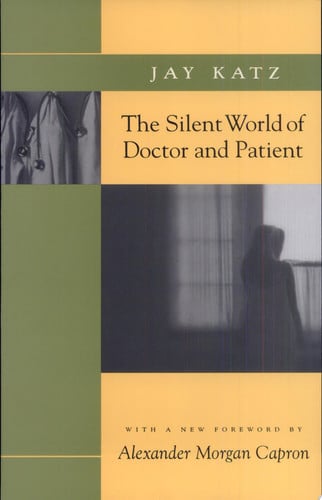
The silent world of doctor and patient

Katz, Jay
In this eye-opening look at the doctor-patient decision-making process, physician and law professor Jay Katz examines the time-honored belief in the virtue of silent care and patient compliance. Historically, the doctor-patient relationship has been based on a one-way trust—despite recent judicial attempts to give patients a greater voice through the doctrine of informed consent. Katz criticizes doctors for encouraging patients to relinquish their autonomy, and demonstrates the detrimental effect their silence has on good patient care. Seeing a growing need in this age of medical science and sophisticated technology for more honest and complete communication between physician and patients, he advocates a new, informed dialogue that respects the rights and needs of both sides. In a new foreword to this edition of The Silent World of Doctor and Patient , Alexander Morgan Capron outlines the changes in medical ethics practice that have occurred since the book was first published in 1984, paying particular attention to the hotly debated issues of physician-assisted suicide and informed consent in managed care.
Johns Hopkins University Press 2002-11 263 pages

Sex in an age of technological reproduction: ICSI and Taboos

Djerassi, Carl
Carl Djerassi is one of "the fathers of the Pill"--he was awarded the National Medal of Science for the first synthesis of a steroid oral contraceptive--and has had a prolific additional career as a writer of fiction, plays, and dialogues about science. In these two plays, ICSI and Taboos , he dramatizes the social transformations and contested viewpoints created by advances in reproductive science and technology. Two of the most startling developments in contemporary science have radically disrupted the historical connection between sex and reproduction: in vitro fertilization and intracytoplasmic sperm injection (ICSI)--an assisted reproductive technique that directly injects a single sperm into an egg. The word play ICSI --designed for classroom readings--presents, in the format of a contentious talk-show dialogue, the science of direct-injection fertilization and the ethical issues connected with it. A DVD included in the book provides video of the ICSI injection process as viewed through a microscope, to be used in performances of the ICSI one-act dialogue. Taboos, a full-length play, turns the screws on characters that reflect a polarized America. Two couples--lesbian partners and a conservative husband and wife struggling with infertility--must make choices in a drama that examines the disjunction of sexual reproduction and the physical act of sex.
University of Wisconsin Press 2008 115 pages

Virtually human: the promise - and the peril - of digital immortality

Rothblatt, Martine Aliana
"Virtually Human explores what the not-too-distant future will look like when cyberconsciousness--simulation of the human brain via software and computer technology--becomes part of our daily lives. Meet Bina48, the world's most sentient robot, commissioned by Martine Rothblatt and created by Hanson Robotics. Bina48 is a nascent Mindclone of Martine's wife that can engage in conversation, answer questions, and even have spontaneous thoughts that are derived from multimedia data in a Mindfile created by the real Bina. If you're active on Twitter or Facebook, share photos through Instagram, or blogging regularly, you're already on your way to creating a Mindfile--a digital database of your thoughts, memories, feelings, and opinions that is essentially a back-up copy of your mind. Soon, this Mindfile can be made conscious with special software--Mindware--that mimics the way human brains organize information, create emotions and achieve self-awareness. This may sound like science-fiction, but the nascent technology already exists. Thousands of software engineers across the globe are working to create cyberconsciousness based on human consciousness and the Obama administration recently announced plans to invest in a decade-long Brain Activity Map project. Virtually Human is the only book to examine the ethical issues relating to cyberconsciousness and Rothblatt, with a Ph. D. in medical ethics, is uniquely qualified to lead the dialogue"--
Picador 2015-10-06 350 pages

Encyclopedia of medicine in the Bible and the Talmud

Rosner, Fred.
Since the first systematic treatises on medicine in the Bible and Talmud were published in the seventeenth century, a great number of people, Jews and non-Jews, physicians, scientists, historians, clergy, and laymen have contributed, in varying degrees, to this field. The extraordinarily high number of Jews among Nobel Prize winners for medicine and physiology during the twentieth century attests to the age-old interest and expertise in medicine among Jews. Jewish medicine has recently been enriched by the addition of an entirely new rubric-Jewish medical ethics. Though deeply embedded in early biblical and rabbinic literature, Jewish medical ethics as a distinct discipline is only about forty years old and continues to flourish in response to the growing demand for ethical guidelines consonant with classic Jewish sources. The Encyclopedia of Medicine in the Bible and the Talmud includes many items related to Jewish medical ethics and serves as an important tool for those who wish to read about or research medical and related topics as found in traditional biblical and talmudic sources. The classic book on biblical and talmudic medicine, Biblisch-Talmudische Medizin (originally published in 1911), was translated into English by Dr. Fred Rosner This book gathers the medical and hygienic references found in the Jewish sacred, historical, and legal literatures. Dr. Rosner presents an extension and expansion on Preuss' book.
Jason Aronson 2000-08 361 pages

Everybody Wants to Go to Heaven but Nobody Wants to Die Bioethics and the Transformation of Health Care in America

Amy Gutmann,Jonathan D Moreno
NOW FEATURING A NEW AFTERWORD, "PANDEMIC ETHICS" From two eminent scholars comes a provocative examination of bioethics and our culture’s obsession with having it all without paying the price. Shockingly, the United States has among the lowest life expectancies and highest infant mortality rates of any high-income nation, yet, as Amy Gutmann and Jonathan D. Moreno show, we spend twice as much per capita on medical care without insuring everyone. A “remarkable, highly readable journey” (Judy Woodruff ) sure to become a classic on bioethics, Everybody Wants to Go to Heaven but Nobody Wants to Die explores the troubling contradictions between expanding medical research and neglecting human rights, from testing anthrax vaccines on children to using brain science for marketing campaigns. Providing “a clear and compassionate presentation” ( Library Journal ) of such complex topics as radical changes in doctor-patient relations, legal controversies over in vitro babies, experiments on humans, unaffordable new drugs, and limited access to hospice care, this urgent and incisive history is “required reading for anyone with a heartbeat” (Andrea Mitchell).
National Geographic Books 2020-11-23 272 pages