20 results for "Memoir"

Stephen Hawking

Mlodinow, Leonard
An icon of the last fifty years, Stephen Hawking seems to encapsulate genius- not since Albert Einstein has a scientific figure held such a position in popular consciousness. In this enthralling memoir, writer and physicist Leonard Mlodinow tells the story of his friend and their friendship, offering an intimate account of this giant of science. The two met in 2003, when Stephen asked Leonard if he would consider writing a book with him, the follow up to the bestselling A Brief History of Time. As they spent years working on a second book, The Grand Design, they forged a deep connection and Leonard gained a much better understanding of Stephen's daily life and struggles, as well as his compassion and good humour. Together they obsessed over the perfect sentence, debated the physics, and occasionally punted on Cambridge's waterways with champagne and strawberries. In time, Leonard was able to finish Stephen's jokes, chide his sporadic mischief, and learn how the hardships of his illness helped forge that unique perspective on the universe. By weaving together their shared story with a clear-sighted portrayal of Hawking's scientific achievements, Mlodinow creates a beautiful portrait of Stephen Hawking as a brilliant, impish and generous man whose life was not only exceptional but also genuinely inspiring.
Allen Lane 2020 219 pages

Dinners with Ruth: a memoir on the power of friendships

Totenberg, Nina
"Celebrated NPR correspondent Nina Totenberg delivers an extraordinary memoir of her personal successes, struggles, and life-affirming relationships, including her remarkable friendship of nearly fifty years with Supreme Court Justice Ruth Bader Ginsburg. Four years before Nina Totenberg started working at NPR, where she cemented her legacy as a prize-winning reporter, and nearly twenty-two years before Ruth Bader Ginsburg was appointed to the Supreme Court, Nina called Ruth. A reporter for The National Observer, Nina was curious about Ruth's legal brief, asking the Supreme Court to do something revolutionary: declare a law that discriminated "on the basis of sex" to be unconstitutional. In a time when women were fired for becoming pregnant and often could not apply for credit cards or get a mortgage, Ruth patiently explained her argument. That call launched a nearly fifty-year friendship. Dinners with Ruth is an extraordinary account of two women who paved the way for future generations by tearing down professional and legal barriers. It is also an intimate memoir of the power of friendships as women began to pry open career doors and transform the workplace. At the story's heart is one, special relationship: Ruth and Nina saw each other not only through personal joys, but also illness, loss, and widowhood. Ruth drew Nina out of grief during the devastating illness and eventual death of Nina's first husband; twelve years later, Nina would reciprocate when Ruth's beloved husband died. They shared a love of opera and shopping, as they instinctively understood that clothes were armor for women who wanted to be taken seriously in a workplace dominated by men. During Ruth's last year, they shared so many small dinners that Saturdays were "reserved for Ruth" in Nina's house. Dinners with Ruth also weaves together personal portraits of other fascinating women and men from Nina's life, including her cherished NPR colleagues Cokie Roberts and Linda Wertheimer; her beloved husbands; her friendships with multiple Supreme Court Justices, including Lewis Powell, William Brennan, and Antonin Scalia, and Nina's own family--her father, the legendary violinist Roman Totenberg, and her "best friends," her sisters. Inspiring and revelatory, Dinners with Ruth is a moving story of the joy of friendship" --
Simon & Schuster 2024-03-05 304 pages

The best minds: a story of friendship, madness, and the tragedy of good intentions

Rosen, Jonathan
"When the Rosens moved to New Rochelle in 1973, Jonathan Rosen and Michael Laudor seemed destined to become inseparable. The boys, both children of college professors, grew up on the same street in intellectually vibrant homes shaped by ideas, liberal Jewish culture, the trauma of the Holocaust, and a shared love of basketball and standup comedy. But the two best friends were also keen competitors bearing the same great expectations, and when Michael and Jonathan both got into Yale, they seemed set to ascend to the heights of the American meritocratic elite. Leaving Jonathan behind, Michael blazed through college in three years, graduating summa cum laude and landing a top-flight consulting job for far more money than their parents had ever made. But all wasn't as it seemed. One day, Jonathan received the fateful call: Michael had suffered a serious psychotic break and was institutionalized at a New York City psychiatric hospital where he was diagnosed with paranoid schizophrenia. He would stay there for nine months before transitioning to a halfway house. Facing the prospect of a life spent bagging groceries, Michael decided to play the one card left to him: just before his break, he had been accepted to Yale Law School, and now, against all odds, he planned to enroll. Still struggling mightily with schizophrenia, Michael made it through the top law school in the country. His extraordinary story soon made the front page of the New York Times; an agent sold his memoir to a major publisher for a large sum; Ron Howard swept in to acquire film rights, with Brad Pitt set to star. It was all a dream come true for Michael and his tirelessly supportive girlfriend Carrie. But then, the unimaginable happened: in the grip of an unshakable paranoid fantasy, Michael stabbed Carrie to death with a kitchen knife. To this day, Michael Laudor remains confined to a maximum-security forensic hospital in upstate New York. The Best Minds is Jonathan Rosen's brilliant and heartbreaking account of what happened to Michael Laudor, and why. Exploring the dramatic transformation of American culture and of society's relationship to mental illness in the second half of the twentieth century, this is a story about the power and limits of the bonds of family, friendship, and community, the lure of the American dream and the promise of academic achievement. At times tender and hilarious, and at times harrowing and almost unbearably sad, The Best Minds is an extreme version of a story that is tragically familiar to all too many. In the hands of a writer of Jonathan Rosen's gifts and dedication, its significance will echo widely"--
Penguin Press 2024-04-16 562 pages

Thanks, Obama: my hopey changey White House years

Litt, David
"A different kind of White House memoir, presidential speechwriter David Litt's comic account of his years spent working with Barack Obama and his reflection on Obama's legacy in the age of Trump. Like many twentysomethings, David Litt frequently embarrassed himself in front of his boss's boss. Unlike many twentysomethings, Litt's boss's boss was President Obama. At age twenty-four, Litt became one of the youngest White House speechwriters in history. Along with remarks on issues like climate change and criminal justice reform, he was the president's go-to writer for comedy. As the lead on the White House Correspondents' Dinner speech (the "State of the Union of jokes"), he was responsible for some of President Obama's most memorable moments, including Keegan-Michael Key's appearance as Luther, Obama's "anger translator." With a humorist's eye for detail and a convert's zeal, Litt takes us inside his eight years on the front lines of Obamaworld. In his political coming-of-age story, he goes from starry-eyed college student--a self-described "Obamabot"--to nervous junior speechwriter to White House senior staff. His behind-the-scenes anecdotes answer questions you never knew you had: What's the classiest White House men's room? What's the social scene like on Air Force One? How do you force the National Security Council to stop hitting reply-all on every e-mail? In between lighthearted observations, Litt uses his experience to address one of today's most important issues: the legacy and future of the Obama movement in the age of Donald Trump"--
Ecco 2017-09-19 310 pages

Thanks, Obama: my hopey changey White House years

Litt, David
"A different kind of White House memoir, presidential speechwriter David Litt's comic account of his years spent working with Barack Obama and his reflection on Obama's legacy in the age of Trump. Like many twentysomethings, David Litt frequently embarrassed himself in front of his boss's boss. Unlike many twentysomethings, Litt's boss's boss was President Obama. At age twenty-four, Litt became one of the youngest White House speechwriters in history. Along with remarks on issues like climate change and criminal justice reform, he was the president's go-to writer for comedy. As the lead on the White House Correspondents' Dinner speech (the "State of the Union of jokes"), he was responsible for some of President Obama's most memorable moments, including Keegan-Michael Key's appearance as Luther, Obama's "anger translator." With a humorist's eye for detail and a convert's zeal, Litt takes us inside his eight years on the front lines of Obamaworld. In his political coming-of-age story, he goes from starry-eyed college student--a self-described "Obamabot"--to nervous junior speechwriter to White House senior staff. His behind-the-scenes anecdotes answer questions you never knew you had: What's the classiest White House men's room? What's the social scene like on Air Force One? How do you force the National Security Council to stop hitting reply-all on every e-mail? In between lighthearted observations, Litt uses his experience to address one of today's most important issues: the legacy and future of the Obama movement in the age of Donald Trump"--
Ecco 2018-09-04 310 pages

She made me laugh: my friend Nora Ephron

Cohen, Richard M.
“A very personal remembrance of Nora Ephron’s life and loves, and her ups and downs” ( USA TODAY ) by her long-time and dear friend Richard Cohen in a hilarious, blunt, raucous, and poignant recollection of their decades-long friendship. Nora Ephron (1941–2012) was a phenomenal personality, journalist, essayist, novelist, playwright, Oscar-nominated screenwriter, and movie director ( Sleepless in Seattle ; You’ve Got Mail ; When Harry Met Sally ; Heartburn ; Julie & Julia ). She wrote a slew of bestsellers ( I Feel Bad About My Neck: And Other Thoughts on Being a Woman ; I Remember Nothing: And Other Reflections ; Scribble, Scribble: Notes on the Media ; Crazy Salad : Some Things About Women ). She was celebrated by Hollywood, embraced by literary New York, and adored by legions of fans throughout the world. Award-winning journalist Richard Cohen, wrote this about She Made Me Laugh : “I call this book a third-person memoir. It is about my closest friend, Nora Ephron, and the lives we lived together and how her life got to be bigger until, finally, she wrote her last work, the play, Lucky Guy , about a newspaper columnist dying of cancer while she herself was dying of cancer. I have interviewed many of her other friends—Mike Nichols, Tom Hanks, Steven Spielberg, Meryl Streep, Arianna Huffington—but the book is not a name-dropping star turn, but an attempt to capture a remarkable woman who meant so much to so many other women.” With “the nuanced perspective of a confidant” ( The Washington Post ), She Made Me Laugh “is a fine tribute to a fascinating woman” ( Houston Chronicle ): “Nora would be pleased” ( People , “Book of the Week”).
Simon & Schuster 2016-09 299 pages

Counselor: a life at the edge of history

Sorensen, Theodore C.
In this gripping memoir, John F. Kennedy's closest advisor recounts in full for the first time his experience counseling Kennedy through the most dramatic moments in American history.... from the decision to go to the moon to the Cuban Missile Crisis, when JFK requested that the thirty-four-year-old Sorensen draft the key letter to Khrushchev at the most critical point of the world's first nuclear confrontation. After Kennedy was assassinated, Sorensen stayed with President Johnson for a few months before leaving to write a biography of JFK. In 1968 he returned to Washington to help run Robert Kennedy's presidential campaign. Through it all, Sorensen never lost sight of the ideals that brought him to Washington and to the White House, working tirelessly to promote and defend free, peaceful societies.--From publisher's description.
Harper 2008-05-06 556 pages

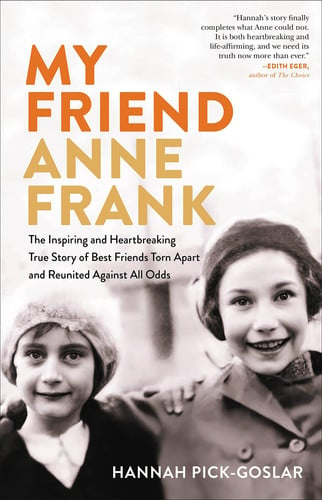
My friend Anne Frank: the inspiring and heartbreaking true story of best friends torn apart and reunited against all odds

Pick-Goslar, Hannah,Kraft, Dina
"In 1933, Hannah Pick-Goslar and her family fled Nazi Germany to live in Amsterdam, where she struck up a close friendship with her next-door neighbor, an outspoken and fun-loving young girl named Anne Frank. For several years, the inseparable pair enjoyed a carefree childhood of games, sleepovers, and treats with the other children in their neighborhood of Rivierenbuurt. But in 1942, Hannah and Anne's lives abruptly changed forever. As the Nazi occupation of Amsterdam progressed, Anne and the Frank family seemingly vanished, leaving behind unmade beds and dishes in the sink--but no trace of Anne's precious diary. Torn from her dear friend without warning, Hannah spent the next two years tormented by questions about Anne's fate, wondering if she had, by some miracle, managed to escape danger. In this long-awaited memoir, Hannah shares the story of her childhood during the Holocaust, from the introduction of anti-Jewish laws in Amsterdam to the gradual disappearance of classmates and, eventually, the Frank family, to Hannah and her family's imprisonment in the Bergen-Belsen concentration camp. As Hannah chronicles the experiences of her own life during and after the war, she provides a searing look at what countless children endured at the hands of the Nazi regime, as well as an intimate, never-before-seen portrait of the most recognizable victim of the Holocaust. Culminating in an astonishing fateful reunion, My Friend Anne Frank is the profoundly moving story of childhood and friendship during one of the darkest periods in the world's history"--Dust jacket flap.
Little, Brown Spark 2023 313 pages

Hemingway and me: letters, anecdotes, and memories of a life-changing friendship

Lyons, Jeffrey
"When Ernest Hemingway died on July 2, 1961, Mary Hemingway asked the Hemingway's good friend, journalist Leonard Lyons, to announce the death of the Nobel Prize-winner to stunned readers and admirer everywhere. Both Hemingways admired Lyons for his fidelity to the truth, that "he would get the story right." (As it turns out the "truth" was not quite what it seemed, since Mary initially denied that her husband's death was suicide.) This memoir recounts the quarter-century long friendship between Hemingway and Leonard Lyons, which eventually came to include Lyons's wife and three sons. In this short book Jeffrey Lyons recounts visits to Hemingway in Cuba (where "Papa" first taught him how to shoot a gun) as well as nights out with the great writer at such popular New York watering holes as the Stork Club and Toots Shor's. Throughout the book Hemingway comes across as a hard-working, generous, and thoughtful man of letters, and not the gruff, hard drinking beast perpetually looking for a fight that he was often perceived as. This is a book about friendship, loyalty, and trust between a famed novelist and a working journalist and his family"--
Lyons Press 2021-05-01 140 pages

My name is Anne, she said, Anne Frank

Maarsen, Jacqueline van
A touching and intimate autobiography, this account recalls the author's remarkable childhood friendship with Anne Frank while attending a special school for Jewish children in Amsterdam during the late 1930s. With the story of her initial meeting and bonding with Anne Frank, Jacqueline van Maarsen's memoir recollects her family's near escape from the Netherlands only months after the Frank family went into hiding-or moved to Switzerland, as van Maarsen was lead to believe-and provides a revealing look into life under Nazi occupation. Written by a one-time friend who only discovered the truth about Anne's fate after the war ended, this memoir is a moving, firsthand recollection of a youthful friendship in the foreboding days of World War II.
Arcadia 2008-03-28 176 pages

Ex-friends

Podhoretz, Norman
Allen Ginsberg, Lionel and Diana Trilling, Lillian Hellman, Hannah Arendt, and Norman Mailer -- all are ex-friends of Norman Podhoretz, the renowned editor and critic and leading member of the group of New York intellectuals who came to be known as "the Family." As only a family member could, Podhoretz tells the story of these friendships, once central to his life, and shows how the political and cultural struggles of the past fifty years made them impossible to sustain. With wit, piercing insight, and startling honesty, we are introduced as never before to a type of person for whom ideas were often matters of life and death, and whose passing from the scene has left so large a gap in American culture. Podhoretz was the trailblazer of the now-famous journey of a number of his fellow intellectuals from radicalism to conservatism -- a journey through which they came to exercise both cultural and political influence far beyond their number. With this fascinating account of his once happy and finally troubled relations with these cultural icons, Podhoretz helps us understand why that journey was undertaken and just how consequential it became. In the process we get a brilliantly illuminating picture of the writers and intellectuals who have done so much to shape our world. Combining a personal memoir with literary, social, and political history, this unique gallery of stern and affectionate portraits is as entertaining as a novel and at the same time more instructive about postwar American culture than a formal scholarly study. Interwoven with these tales of some of the most quixotic and scintillating of contemporary American thinkers are themes that are introduced, developed, and redeveloped in a variety of contexts, with each appearance enriching the others, like a fugue in music. It is all here: the perversity of brilliance; the misuse of the mind; the benightedness of people usually considered especially enlightened; their human foibles and olympian detachment; the rigors to be endured and the prizes to be won and the prices to be paid for the reflective life. Most people live their lives in a very different way, and at one point, in a defiantly provocative defense of the indifference shown to the things by which intellectuals are obsessed, Norman Podhoretz says that Socrates' assertion that the unexamined life was not worth living was one of the biggest lies ever propagated by a philosopher. And yet, one comes away from Ex-Friends feeling wistful for a day when ideas really mattered and when there were people around who cared more deeply about them than about anything else. Reading of a time when the finest minds of a generation regularly gathered in New York living rooms to debate one another with an articulateness, a passion, and a level of erudition almost extinct, we come to realize how enviable it can be to live a life as poignantly and purposefully examined as Norman Podhoretz's is in Ex-Friends.
Free Press 1999-02-21 244 pages

Adventures of a bystander

Drucker, Peter F.
"It is [a] belief in diversity and pluralism and the uniqueness of each person that underlies all my writings . . . " -from the Preface. Regarded as the most influential and widely read thinker on modern organizations and their management, Peter Drucker has also established himself as an unorthodox and independent analyst of politics, the economy, and society. A man of impressive scope and expertise, he has paved significant inroads in a number of key areas, sharing his knowledge and keen insight on everything from the plight of the employee and the effects of technology to the vicissitudes of the markets and the future of the new world order. Adventures of a Bystander is Drucker's rich collection of autobiographical stories and vignettes, in which this legendary figure paints a portrait of his remarkable life, and of the larger historical realities of his time. In a style that is both unique and engaging, Drucker conveys his life story -from his early teen years in Vienna through the interwar years in Europe, the New Deal era, World War II, and the postwar period in America-through intimate profiles of a host of fascinating people he's known through the years. Their personal histories are, as Drucker tells us, the beads for which his own life serves as the string. A colorful group, these diverse, often unpredictable, always multidimensional individuals were chosen "because each of them, in his or her own highly personal way, reflects and refracts the thirty crucial years from the end of World War I to the first post-World War II decade-the thirty years that largely formed the world in which we now live." An amazing pageant of characters, both famous and otherwise, springs from these pages, illuminating and defining one of the most tumultuous periods in world history. Along with bankers and courtesans, artists, aristocrats, prophets, and empire-builders, we meet members of Drucker's own family and close circle of friends, among them such prominent figures as Sigmund Freud, Henry Luce, Alfred Sloan, John Lewis, and Buckminster Fuller. Playing to perfection their roles as those who "reflect and refract" the customs, beliefs, and attitudes of the times, these singular personalities lend Adventures of a Bystander a striking "you-are-there" feel. A brief encounter with Freud becomes the catalyst for an absorbing, multidimensional description of the economics, politics, and social psychology of pre-World War II Europe. Drucker introduces us to Fritz Kraemer, a brilliant, monocle-wearing eccentric who became an influential mentor to the young Henry Kissinger. His personal memoir of Henry Luce documents the development of modern journalism, while in "The Indian Summer of Innocence," he rescues and preserves the very heart of the American experience during the last New Deal years before World War II. Shedding light on a turbulent and important era, Adventures of a Bystander also reflects Peter Drucker himself as a man of imaginative sympathy and enormous interest in people, ideas, and history. These enthralling stories complement and complete the groundbreaking analytical writing for which he is so revered. Luminous autobiographical stories by one of the greatest thinkers of our time "The cast of characters among whom Drucker moves is superbly rich, and the informed glimpse he provides of a vanished social and political universe is an education in itself. Adventures of a Bystander is better than a novel, more lively than an essay, and as thoughtful as both at their best." -The Harvard Business Review. "Adventures of a Bystander is a virtuoso performance in which Drucker displays a dazzling diversity of personal interests and knowledge, an awesome power of recall, and a crisp, highly readable writing style." -BusinessWeek. "Adventures of a Bystander appears in a stroke to have restored the art of the memoir and of the essay. It will doubtless be a while before its like comes round again." -The Washington Post.
Wiley 1997 344 pages

After Woodstock: the true story of a Belgian movie, an Israeli wedding, & a Manhattan breakdown

Tiber, Elliot
During the summer of '69, Elliot Tiber first helped start the Gay Liberation Movement and then saved the Woodstock Festival from cancellation. However, the best and most significant of Tiber's life adventures did not happen until after Woodstock. In this third and final memoir, following the critically acclaimed, Palm Trees on the Hudson, and his break-out bestseller, Taking Woodstock, Tiber chron[Bokinfo]
Square One 2014 462 pages

My lost poets: a life in poetry

Levine, Philip
"Essays, speeches, and journal entries from one of our most admired and best-loved poets that illuminate how he came to understand himself as a poet, the events and people that he wrote about, and the older poets who influenced him. In prose both as superbly rendered as his poetry and as down-to-earth and easy as speaking, Levine reveals the things that made him the poet he became. In the title essay, originally the final speech of his poet laureate year, he recounts how as a boy he composed little speeches walking in the night woods near his house and how he later realized these were his first poems. He wittily takes on the poets he studied with in the Iowa Writing Program: John Berryman, who was his great teacher and lifelong friend, and Robert Lowell, who was neither. His deepest influences--jazz, Spain, the working people of Detroit--are reflected in many of the pieces. There are essays on Spanish poets he admires, William Carlos Williams, Wordsworth, Keats, and others. A wonderful, moving collection of writings that add to our knowledge and appreciation of Philip Levine--both the man and the poet"--
Alfred A. Knopf 2016 210 pages

A disgraceful affair: Simone de Beauvoir, Jean-Paul Sartre, & Bianca Lamblin

Lamblin, Bianca
Bianca Bienenfeld was a seventeen-year-old lycee student when she was seduced both intellectually and sexually by her philosophy professor, Simone de Beauvoir, in 1938. The following year de Beauvoir passed Bianca on to her "essential partner", Jean-Paul Sartre. The three formed a menage a trois until 1940, when Bianca was suddenly abandoned by her dual mentors and lovers. Their lack of concern for Bianca's fate as a Jew in occupied France made the abrupt break even more shattering for her. She began to suffer periodic bouts of severe depression linked not only to the Nazi horrors, but to the betrayal by de Beauvoir and Sartre. After World War II, Bianca Bienenfeld (now married to Bernard Lamblin) resumed a platonic friendship with de Beauvoir that lasted more than forty years, but the pain of the old, perturbing affair flooded back when, in 1990, she read de Beauvoir's posthumously published Letters to Sartre and War Journal. The intimate content of these books referred directly to Bianca in a tone of ridicule and contempt, and she finally discovered the full extent of de Beauvoir's deception. Now Bianca explodes with the true story behind her earlier relationship with the high priests of existentialism. Published here in English for the first time, her memoir reveals what it was like to be a third party in the "contingent" affairs of de Beauvoir and Sartre. Bianca's compelling narrative is not written out of revenge or retaliation. Rather, it is an eloquent, candid account of how de Beauvoir and Sartre influenced the shape of her life and how she survived a disgraceful affair that, when broken, almost broke her. Bianca's unique perspective on de Beauvoir and Sartre is the centralfocus of the book, but not the sole one. She writes about her love for her husband Bernard, who helped her recover. She also describes life during the dark times of German occupation, and recounts witnessing the battle of Vercors during the French Resistance. Her well-crafted and poignant memoir will appeal to scholars and general readers alike.
Northeastern University Press 1996 184 pages

Tripping: a memoir of Timothy Leary & co

Friedman, B. H.
In the 1960s, amid political upheaval and anti-war protests, a growing number of young Americans were creating their own visionary revolution by "tuning in, turning on, and dropping out." Cannabis was king, and the sacred mushrooms "psilocybin" and LSD were "tripping" the minds of thousands, led by psychologist/guru/pitchman Dr. Timothy Leary, the pied piper of the psychedelic drug scene.
Provincetown Arts Press 2006 169 pages

The man who would marry Susan Sontag and other intimate literary portraits of the Bohemian era

Field, Edward
Long before Stonewall, young Air Force veteran Edward Field, fresh from combat in WWII, threw himself into New York’s literary bohemia, searching for fulfillment as a gay man and poet. In this vivid account of his avant-garde years in Greenwich Village and the bohemian outposts of Paris’s Left Bank and Tangier—where you could write poetry, be radical, and be openly gay—Field opens the closet door to reveal, as never been seen before, some of the most important writers of his time. Here are young, beautiful Susan Sontag sitting at the feet of her idol Alfred Chester, who shrewdly plotted to marry her; May Swenson and her two loves; Paul and Jane Bowles in their ambiguous marriage; Frank O’Hara in and out of bed; Fritz Peters, the anointed son of Gurdjieff; and James Baldwin, Isabel Miller (Patience and Sarah), Tobias Schneebaum, Robert Friend, and many others. With its intimate portraits, Field’s memoir brings back a forgotten era—postwar bohemia—bawdy, comical, romantic, sad, and heroic.
University of Wisconsin Press 2005-12-09 284 pages

Namedropping: mostly literary memoirs

Elman, Richard M.
In the course of the same old race I find myself writing about knowing some people--how fame seems to set some people apart from us, once known: I was astonished by Ernest Hemingway's small, weak handshake when we were introduced at Scribners by John Hall Wheelock and by the jolt of force with which Elie Wiesel squeezed my hand. How long ago seems knowing, too: when I first meet Isaac Singer he asks me, "Who is Mr. Saul Bellow?" We're on the Upper West Side in his apartment next to the funeral parlor. A yellow parakeet hops around on Singer's bald forehead. Singer's great comic story of faith, "Gimpel the Fool," has only recently been published from Yiddish into English in a translation by Saul Bellow. They're both still a long way from Stockholm. "Do you know him? Can you tell me who this Mr. Bellow is?" he asks. It was not always possible to guess Singer's motives in acting as though he was not impressed with worldly reputations. His features of a medieval Polish saint, even to a faint white-haired tonsure effect around the crown of his skull, were backlit by the glowing monitor from his mischievous incubus.--from the Preface These are Richard Elman's candid snapshots in prose of the various, mostly literary celebrities he encountered during his four decades as a working writer and journalist--among them Isaac Bashevis Singer, Tillie Olsen, Bernard Malamud, Faye Dunaway, Hunter S. Thompson, and other important artists and writers who were Elman's teachers and, occasionally, adversaries. Engagingly written and never superficial, these portraits and anecdotes in many cases strike to the center of each subject's art. To many readers, these persons are just "names"; Elman brings them to life while never simplifying or overdramatizing their work.
State University of New York Press 1998-01-01 277 pages

An almost English life

Gross, Miriam
Miriam Gross, as a journalist and editor, has worked with some of the most influential figures of the 20th century poets, philosophers, playwrights and politicians. This book offers recollections from 40 years at the heart of English cultural life. Brought up in wartime Jerusalem, she was deposited by her parents, speaking no English, at the bohemian Dartington Hall School; and then continued her education at Oxford where eschewing her quiet, tea-drinking contemporaries at St Anne s she found her way into more glamorous academic circles. From there it was a short hop to pre-spell-check Fleet Street. Her descriptions whether she is having to mend her boss's bra on her first day at work, or rewriting Angus Wilson's slapdash book reviews, or being asked to make the women s pages of the Observer more raunchy show a merciless eye for the bogus and the absurd. Alongside reflections on everything from feminism and motherhood to education and anti-semitism, she recounts her numerous infatuations, both requited and unrequited, with the sort of self-deprecating candour that makes this memoir a classic of its kind.
Short Books 2012 200 pages