132 results for "Memoir"

Out of Egypt: a memoir

Aciman, André
From the New York Times bestselling author of Call Me By Your Name , Out of Egypt is a richly colored memoir chronicling the exploits of a flamboyant Jewish family, from its bold arrival in cosmopolitan Alexandria to its defeated exodus three generations later. In elegant and witty prose, André Aciman introduces us to the marvelous eccentrics who shaped his life--Uncle Vili, the strutting daredevil, soldier, salesman, and spy; the two grandmothers, the Princess and the Saint, who gossip in six languages; Aunt Flora, the German refugee who warns that Jews lose everything "at least twice in their lives." And through it all, we come to know a boy who, even as he longs for a wider world, does not want to be led, forever, out of Egypt.
Picador/Farrar, Straus and Giroux 2007-01-23 339 pages

The Holocaust years: the Nazi destruction of European Jewry, 1933-1945

Levin, Nora
Covered here are the events involved in the preparation and implementation of the planned annihilation of Europe's Jews by the Nazis. Part I is a compact history of preparatory steps leading to the decision to destroy the Jews physically, including Western anti-Semitic practices and doctrines, the collapse of the Weimar Republic leading to the rise of Nazism and Hitler's rise to power, the early anti-Jewish laws and the crucial events of 1938, including Kristallnacht. The text also deals with the German invasion of Russia and the mass executions of Jews by mobile killing units that accompanied the army, forced ghettoization of Jews in German-occupied Europe, Jewish resistance efforts, deportations from western, central, and southeastern Europe, and rescue efforts and failures. Part II includes 100 readings that document and elucidate these events and include first-hand testimony, official Nazi and Allied documents, eyewitness accounts, and diary and memoir excerpts.
R.E. Krieger 1990 373 pages

What they saved: pieces of a Jewish past

Miller, Nancy K.
Winner of the 2012 Jewish Journal Book Prize After her father?s death, Nancy K. Miller discovered a minuscule family archive: a handful of photographs, an unexplained land deed, a postcard from Argentina, unidentified locks of hair. These items had been passed down again and again, but what did they mean? Miller follows their traces from one distant relative to another, across the country, and across an ocean. Her story, unlike the many family memoirs focused on the Holocaust, takes us back earlier in history to the world of pogroms and mass emigrations at the turn of the twentieth century. Searching for roots as a middle-aged orphan and an assimilated Jewish New Yorker, Miller finds herself asking unexpected questions: Why do I know so little about my family? How can I understand myself when I don?t know my past? The answers lead her to a carpenter in the Ukraine, a stationery peddler on the Lower East Side, and a gangster hanger-on in the Bronx. As a third-generation descendant of Eastern European Jews, Miller learns that the hidden lives of her ancestors reveal as much about the present as they do about the past. In the end, an odyssey to uncover the origins of her lost family becomes a memoir of renewal.
University of Nebraska Press 2011-09-01 238 pages

When memory comes

Friedländer, Saul
"Four months before Hitler came to power, Saul Friedländer was born in Prague to a middle-class Jewish family. In 1939, seven-year-old Saul and his family were forced to flee to France, where they lived through the German Occupation, until his parents' ill-fated attempt to flee to Switzerland. They were able to hide their son in a Roman Catholic seminary before being sent to Auschwitz where they were killed. After an imposed religious conversion, young Saul began training for priesthood. The birth of Israel prompted his discovery of his Jewish past and his true identity. Friedländer brings his story movingly to life, shifting between his Israeli present and his European past with grace and restraint. His keen eye spares nothing, not even himself, as he explores the ways in which the loss of his parents, his conversion to Catholicism, and his deep-seated Jewish roots combined to shape him into the man he is today. Friedländer's retrospective view of his journey of grief and self-discovery provides readers with a rare experience: a memoir of feeling with intellectual backbone, in equal measure tender and insightful,"--Baker & Taylor.
Other Press 2016 176 pages

Still alive: a Holocaust girlhood remembered

Klüger, Ruth
Swept up as a child in the events of Nazi-era Europe, Ruth Kluger saw her family's comfortable Vienna existence systematically undermined and destroyed. By age eleven, she had been deported, along with her mother, to Theresienstadt, the first in a series of concentration camps which would become the setting for her precarious childhood. Kluger's story of her years in the camps and her struggle to establish a life after the war as a refugee survivor in New York, has emerged as one of the most powerful accounts of the Holocaust. Interwoven with blunt, unsparing observations of childhood and nuanced reflections of an adult who has spent a lifetime thinking about the Holocaust, Still Alive rejects all easy assumptions about history, both political and personal. Whether describing the abuse she met at her own mother's hand, the life-saving generosity of a woman SS aide in Auschwitz, the foibles and prejudices of Allied liberators, or the cold shoulder offered by her relatives when she and her mother arrived as refugees in New York, Kluger sees and names an unexpected reality which has little to do with conventional wisdom or morality tales. Still Alive is a memoir of the pursuit of selfhood against all odds, a fiercely bittersweet coming-of-age story in which the protagonist must learn never to rely on comforting assumptions, but always to seek her own truth.
Feminist Press at the City University of New York 2001 216 pages

Finding my father: his century-long journey from World War I Warsaw and my quest to follow

Tannen, Deborah
"A New York Times bestselling author traces her father's life from turn-of-the-century Warsaw to bustling New York City in an intimate memoir about family, memory, and the stories we tell. Long before she was the acclaimed author of a groundbreaking book about women and men, and praised by Oliver Sacks as having "a novelist's ear for the way people speak," Deborah Tannen was a little girl who adored her father. Though he was often absent during her childhood, Deborah was profoundly influenced by his love of language and gift for writing and storytelling. As she grew up and he grew old, she spent untold hours with her father, recording their conversations and taking notes. He handed her a journal he kept when he was young--and showed her another he said she could have after his death, all for the account of his life she promised him she'd write. In this memoir, Deborah fulfills her promise to her father, embarking on the poignant, yet perilous, quest to piece together the puzzle of her father's life. Beginning with his astonishingly vivid memories of the Hasidic community in Warsaw that he was born into in 1908, she traces his journey: arriving in New York City in 1920, he quit high school at fourteen to become sole support of his mother and sister, yet attended law school at night and eventually established the largest workmen's compensation practice in New York. In the intervening years, he became active in the Communist Party, then New York's Liberal Party, running for Congress on its ticket. As Deborah comes to better understand her father's--and her own--relationship to Judaism, she also uncovers aspects of her father's life she would never have imagined. When she discovers letters from another woman he might have married, she is forced to rethink her assumptions about her parents' marriage. Finding My Father is a memoir of Eli Tannen's life and the ways it reflects the near century that he lived. But even more than that, it's about a daughter's struggle to see her father clearly, to know him more deeply, and to tell a more truthful story about her family and herself."--
Ballantine Books 2020 251 pages

Tehran children: a Holocaust refugee odyssey

Dekel, Mikhal
"The extraordinary true story of Polish-Jewish child refugees who escaped the Nazis and found refuge in Iran. More than a million Jews escaped east from Nazi occupied Poland to Soviet occupied Poland. There they suffered extreme deprivation in Siberian gulags and "Special Settlements" and then, once "liberated," journeyed to the Soviet Central Asian Republics. The majority of Polish Jews who survived the Nazis outlived the war in Uzbekistan and Kazakhstan; some of them continued on to Iran. The story of their suffering, both those who died and those who survived, has rarely been told. Following the footsteps of her father, one of a thousand refugee children who traveled to Iran and later to Palestine, Dekel fuses memoir with historical investigation in this account of the all-but-unknown Jewish refuge in Muslim lands. Along the way, Dekel reveals the complex global politics behind this journey, discusses refugee aid and hospitality, and traces the making of collective identities that have shaped the postwar world--the histories nations tell and those they forget"--
W.W. Norton & Company 2019 417 pages

Shores beyond shores: from Holocaust to hope : my true story

Butter, Irene H.,Bidwell, John,Holloway, Kris
As Irene's Pappi fights to save his family during the Holocaust, Irene's childhood is lost. Play is restricted. Family and friends disappear. Finally, with the Dutch police at their door comes the reality that Irene's father has not moved his family far enough from Hitler's Germany. By January 1945, the family is struggling to survive a death camp. Irene tends her ailing parents, cares for starving kids, and even helps bring clothes to her Amsterdam neighbor Anne Frank, before her family is offered a singular chance for freedom...providing the Nazi doctor says they are healthy enough. After two weeks of heart-lifting miracles and heart-breaking tragedies, Irene arrives in the Algerian desert to journey into redemption and womanhood, without her parents or brother. Irene's first person memoir, Shores Beyond Shores, is an account of how the heart keeps its common humanity in the most inhumane and turbulent of times. Irene's hard-earned lessons are a timeless inspiration. ______________________________________________________________________________________________________________________ Following publication of an article on the Holocaust on April 13, 2018, Irene wrote a letter to the Editor which was published April 17, 2018 in The New York Times: Holocaust Survivors 'Have Voices That Matter' April 17, 2018 Re "Getting Facts Wrong on the Holocaust" (news article, April 13): More than four decades passed before I could break the silence about my traumatic experiences during the Holocaust. It is a formidable challenge for survivors to speak and for others to listen. The number of survivors is dwindling; they are getting quite old and their memories are fading. Yet it is ever more important that the signs of authoritarian regimes and how they evolved are brought into the consciousness of youths and adults, as warning signals of what must be prevented from happening again. Survivors, when able, have the responsibility to bear witness and provide evidence so that the six million Jews who were murdered are not forgotten, so that perpetrators are not pardoned for their crimes, and so that deniers don't have a leg to stand on. While the voices of the victims have been silenced forever, we the survivors have voices that matter. After four decades of not speaking, I realized that silence was no longer an option. I told my stories to my children and grandchildren as well as to many students in many schools over a 30-year period. Schools and other organizations should take advantage of every opportunity to engage survivors to tell their stories. IRENE BUTTER, ANN ARBOR, MICH. The writer survived two concentration camps, Westerbork and Bergen-Belsen. She recently published her memoir, "Shores Beyond Shores: From Holocaust to Hope."
White River Press 2018 273 pages

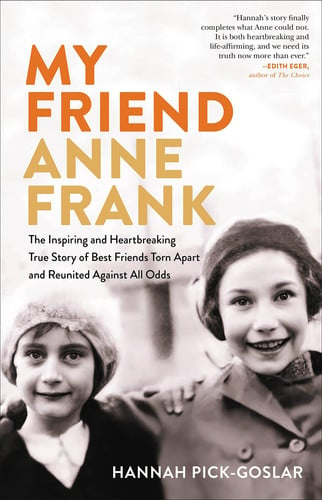
My friend Anne Frank: the inspiring and heartbreaking true story of best friends torn apart and reunited against all odds

Pick-Goslar, Hannah,Kraft, Dina
"In 1933, Hannah Pick-Goslar and her family fled Nazi Germany to live in Amsterdam, where she struck up a close friendship with her next-door neighbor, an outspoken and fun-loving young girl named Anne Frank. For several years, the inseparable pair enjoyed a carefree childhood of games, sleepovers, and treats with the other children in their neighborhood of Rivierenbuurt. But in 1942, Hannah and Anne's lives abruptly changed forever. As the Nazi occupation of Amsterdam progressed, Anne and the Frank family seemingly vanished, leaving behind unmade beds and dishes in the sink--but no trace of Anne's precious diary. Torn from her dear friend without warning, Hannah spent the next two years tormented by questions about Anne's fate, wondering if she had, by some miracle, managed to escape danger. In this long-awaited memoir, Hannah shares the story of her childhood during the Holocaust, from the introduction of anti-Jewish laws in Amsterdam to the gradual disappearance of classmates and, eventually, the Frank family, to Hannah and her family's imprisonment in the Bergen-Belsen concentration camp. As Hannah chronicles the experiences of her own life during and after the war, she provides a searing look at what countless children endured at the hands of the Nazi regime, as well as an intimate, never-before-seen portrait of the most recognizable victim of the Holocaust. Culminating in an astonishing fateful reunion, My Friend Anne Frank is the profoundly moving story of childhood and friendship during one of the darkest periods in the world's history"--Dust jacket flap.
Little, Brown Spark 2023 313 pages

The pianist: the extraordinary story of one man's survival in Warsaw, 1939-45

Szpilman, Władysław
Memoirs of a Jew from Warsaw (1911-2000). He studied music in Berlin, and from 1933 worked as a pianist for the Polish radio. Describes the Nazi occupation of Warsaw and the anti-Jewish laws. In the early period of the ghetto, Szpilman worked as a pianist in one of the ghetto's cafés. In summer 1942, during the mass deportation, he was saved by a member of the Jewish police. After the abortive ghetto uprising in January 1943, he went over to the "Aryan side" and was helped by Poles, mainly prewar acquaintances. During the Warsaw uprising in summer-fall 1944, he was rescued by a German officer, Wilm Hosenfeld. Pp. 191-208 contain excerpts from Hosenfeld's diary, in which he describes the genocide of Jews in Warsaw. Pp. 209-222 contain an epilogue by Wolf Biermann, relating the story of Hosenfeld - he had saved a number of Poles and Jews even before he met Szpilman; he died in Soviet captivity.
Gollancz 1999 222 pages