5 results for "Mental Health"

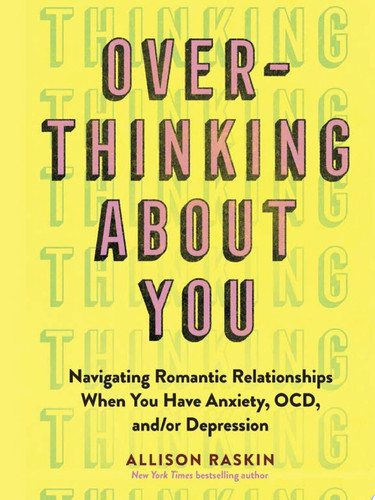
Overthinking about you: navigating romantic relationships when you have anxiety, OCD, and/or depression

Raskin, Allison
"Dating is hard-but when you live with anxiety, OCD, and/or depression, dating can feel like a minefield. At last, a book that focuses solely on mental health and dating-an intersection that demands attention, given that one in five Americans will experience a mental illness in a given year. Overthinking About You is a memoir-driven self-help book that explores the complex connection between brain and heart, for an engaging, useful, and relatable read for anyone whose mental health has gotten in the way of successful romantic relationships"--
Workman Publishing 2022-05-03 197 pages

Same time next week: true stories of working through mental illness

Lee Gutkind,Peter D. Kramer,Karen Wolk Feinstein
In any given year, one in four Americans suffers from a diagnosable mental illness--and yet there is still a significant stigma attached to being labeled as "mentally ill." We hear about worst-case scenarios, but in many--maybe even most--cases, there is much room for hope. These frank, often intimate stories reflect the writers' struggles to overcome--both as professionals and as individuals, as current therapists and as former patients--the challenges presented by depression, bipolar disorder, OCD, and other mental disorders. These dramatic narratives communicate clearly the rewards of helping patients move forward with their lives, often through a combination of medication, talk therapy, and common sense. Collectively, these true stories highlight the need for empathy and compassion between therapist and patient, and argue for a system that encourages human connection rather than diagnosis by checklist.
In Fact Books 2015 304 pages

Show me all your scars: true stories of living with mental illness

Lee Gutkind
Every year, one in four American adults suffers from a diagnosable mental health disorder. In these true stories, writers and their loved ones struggle as their worlds are upended. What do you do when your father kills himself, or your mother is committed to a psych ward, or your daughter starts hearing voices telling her to harm herself--or when you yourself hear such voices? Addressing bipolar disorder, OCD, trichillomania, self-harm, PTSD, and other diagnoses, these stories vividly depict the difficulties and sorrows--and sometimes, too, the unexpected and surprising rewards--of living with mental illness.
In Fact Books 2016 257 pages

Liberation by oppression: a comparative study of slavery and psychiatry

Szasz, Thomas
"The book is readable and challenging; readers will never see psychiatry in the same way again." -- Choice Reviews Originally called mad-doctoring, psychiatry began in the seventeenth century with the establishing of madhouses and the legal empowering of doctors to incarcerate persons denominated as insane. Until the end of the nineteenth century, every relationship between psychiatrist and patient was based on domination and coercion, as between master and slave. Psychiatry, its emblem the state mental hospital, was a part of the public sphere, the sphere of coercion. The advent of private psychotherapy, at the end of the nineteenth century, split psychiatry in two: some patients continued to be the involuntary inmates of state hospitals; others became the voluntary patients of privately practicing psychotherapists. Psychotherapy was officially defined as a type of medical treatment, but actually was a secular-medical version of the cure of souls. Relationships between therapist and patient, Thomas Szasz argues, was based on cooperation and contract, as is relationships between employer and employee, or, between clergyman and parishioner. Psychotherapy, its emblem the therapist's office, was a part of the private sphere, the contract. Through most of the twentieth century, psychiatry was a house divided-half-slave, and half-free. During the past few decades, psychiatry became united again: all relations between psychiatrists and patients, regardless of the nature of the interaction between them, are now based on actual or potential coercion. This situation is the result of two major "reforms" that deprive therapist and patient alike of the freedom to contract with one another: Therapists now have a double duty: they must protect all mental patients-involuntary and voluntary, hospitalized or outpatient, incompetent or competent-from themselves. They must also protect the public from all patients. Persons designated as mental patients may be exempted from responsibility for the deleterious consequences of their own behavior if it is attributed to mental illness. The radical differences between the coercive character of mental hospital practices in the public sphere, and the consensual character of psychotherapeutic practices in the private sphere, are thus destroyed. At the same time, as the scope of psychiatric coercion expands from the mental hospital to the psychiatrist's office, its reach extends into every part of society, from early childhood to old age. Thomas Szasz is professor of psychiatry emeritus at the State University of New York Health Science Center in Syracuse, New York and Adjunct Scholar at the Cato Institute, Washington, DC. He is the author of over two dozen books in fifteen languages, including The Myth of Mental Illness and most recently, Pharmacracy: Medicine and Politics in America . "The book is readable and challenging; readers will never see psychiatry in the same way again."-- Choice "Szasz now appears to have been transformed into an ally rather than an enemy of the National Health Service general adult psychiatrist. Szasz's project has always been to argue passionately for a boundry of demarcation around the responsibility and power of psychiatry....But what saves this book from being just another mugging of psychiatry is that Szasz does raise a fundamental question at the core of our discipline. If we restricted our attention only to those clients who wanted to see a psychiatrist, and disengaged from all those who really didn't, how different might our professional practice and experience be?"-- The British Journal of Psychiatry
Transaction Publishers 2002 237 pages

The case of Jason Mitchell: report of the independent panel of inquiry

Louis Blom-Cooper
On sentencing Jason Mitchell to three terms of life imprisonment for the manslaughter in December 1994 of three people--first a retired couple and subsequently his father, whose body he dismembered--the judge at Ipswich Crown Court on 5 July 1995 expressed the view that it was difficult to understand why Jason, a restricted patient, had been allowed back into the community. Were the doctors at fault in their diagnosis of Jason's psychotic symptoms? Were they wrong in thinking that he was fit to return to the community so soon after becoming mentally ill and being hospitalized in 1990? Did the Mental Health Review Tribunals in 1991 and 1993, which sanctioned Jason's conditional discharge, act in error? What happened to Jason's prison medical records of 1988-9, which disclosed signs of oncoming schizophrenia while he was serving a sentence of two years' youth custody? Were doctors, probation officers and social workers handicapped by the absence of these records? These and other pertinent questions relating to the management of Jason's case by mental health services, and the care and treatment he received from doctors and nurses, are fully explored in this report of the independent panel of inquiry set up in 1995 by Suffolk Health Authority.
Duckworth 1996 304 pages