7 results for "Mental Health"

My age of anxiety: fear, hope, dread, and the search for peace of mind

Stossel, Scott
The author recounts his lifelong battle with anxiety, showing the many manifestations of the disorder as well as the countless treatments that have been developed to counteract it, and provides a history of the efforts of scientists, philosophers, and writers to understand this common form of mental illness. He reports on famous individuals who struggled with anxiety, as well as on the afflicted generations of his own family. This portrait of anxiety reveals the anguish it produces, and describes anxiety's human toll, it's crippling impact, its devasting power to paralyze, while at the same time exploring how those who suffer from it find ways to manage and control it. Here the author guides us across the terrain of an affliction that is pervasive (it is the most common form of officially classified mental illness), yet too often misunderstood. -- From book jacket.
Alfred A. Knopf 2013 400 pages

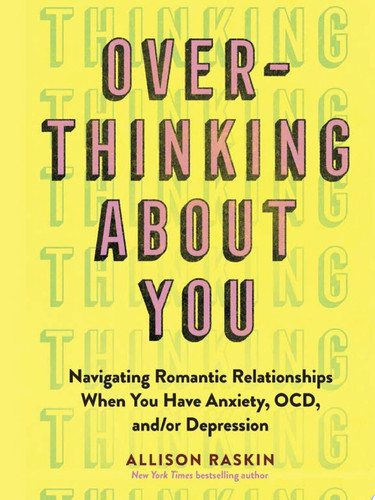
Overthinking about you: navigating romantic relationships when you have anxiety, OCD, and/or depression

Raskin, Allison
"Dating is hard-but when you live with anxiety, OCD, and/or depression, dating can feel like a minefield. At last, a book that focuses solely on mental health and dating-an intersection that demands attention, given that one in five Americans will experience a mental illness in a given year. Overthinking About You is a memoir-driven self-help book that explores the complex connection between brain and heart, for an engaging, useful, and relatable read for anyone whose mental health has gotten in the way of successful romantic relationships"--
Workman Publishing 2022-05-03 197 pages

Fully connected: social health in an age of overload

Hobsbawm, Julia
In 1946, the World Health Organization defined health as: "a state of complete physical, mental, and social well-being, and not merely the absence of disease or infirmity." Until now, no one has defined this third dimension to health, or described strategies to deliver it. This ground-breaking book is the first to do so. Twenty-five years after the arrival of the Internet, we are drowning in data and deadlines; we can never have imagined that our daily intake of information and achieving a healthy balance in our personal and professional lives could feel so complex and so unhealthy. In recent years, organizations have come a long way towards promoting health literacy (on obesity, smoking, diet, and exercise) and some way in acknowledging mental health issues. But acknowledging the challenges of the Internet and social media on employee and workplace health is the social element, and most have not yet begun to offer solutions around either better information and knowledge management, or developing better and more sustaining relationships. The challenges, threats, and opportunities of a "perma-connected" global economy and society could not be greater-and they will only increase. This is the first book to define what social health means in both society and the modern workplace. Here, Julia Hobsbawm argues that developing social health will help employees become more efficiently engaged with each other and their work, and help employers to create workplaces that support social health and thus greater productivity.
Bloomsbury Business 2018-06-19 323 pages

International handbook of human response to trauma

Arieh Y. Shalev,Rachel Yehuda,Alexander McFarlane
In 1996, representatives from 27 different countries met in Jerusalem to share ideas about traumatic stress and its impact. For many, this represented the first dialogue that they had ever had with a mental health professional from another country. Many of the attendees had themselves been exposed to either personal trauma or traumatizing stories involving their patients, and represented countries that were embroiled in conflicts with each other. Listening to one another became possible because of the humbling humanity of each participant, and the accuracy and objectivity of the data presented. Understanding human traumatization had thus become a common denomi nator, binding together all attendees. This book tries to capture the spirit of the Jerusalem World Conference on Traumatic Stress, bringing forward the diversities and commonalties of its constructive discourse. In trying to structure the various themes that arose, it was all too obvious that paradigms of different ways of conceiving of traumatic stress should be addressed first. In fact, the very idea that psychological trauma can result in mental health symptoms that should be treated has not yet gained universal acceptability. Even within medicine and mental health, competing approaches about the impact of trauma and the origins of symptoms abound. Part I discusses how the current paradigm of traumatic stress disorder developed within the historical, social, and process contexts. It also grapples with some of the difficulties that are presented by this paradigm from anthropologic, ethical, and scientific perspectives.
Kluwer Academic/Plenum Press 2000 477 pages

Faith in freedom: libertarian principles and psychiatric practices

Szasz, Thomas
The libertarian philosophy of freedom is characterized by two fundamental beliefs: the right to be left alone and the duty to leave others alone. Psychiatric practice routinely violates both of these beliefs. It is based on the notion that self-ownership--exemplified by suicide--is a not an inherent right, but a privilege subject to the review of psychiatrists as representatives of society. In Faith in Freedom, Thomas Szasz raises fundamental questions about psychiatric practices that inhibit an individual's right to freedom. His questions are fundamental. Is suicide an exercise of rightful self-ownership or a manifestation of mental disorder? Does involuntary confinement under psychiatric auspices constitute unjust imprisonment, or is it therapeutically justified hospitalization? Should forced psychiatric drugging be interpreted as assault and battery on the person or is it medical treatment? The ethical standards of psychiatric practice mandate that psychiatrists employ coercion. Forgoing such "intervention" is considered a dereliction of the psychiatrists' "duty to protect." How should friends of freedom--especially libertarians--deal with the conflict between elementary libertarian principles and prevailing psychiatric practices? In Faith in Freedom, Thomas Szasz addresses this question more directly and more profoundly than in any of his previous works.
Transaction Publishers 2015-06-30 248 pages