5 results for "Mental Health"

Stolen youth: how radicals are erasing innocence and indoctrinating a generation

Markowicz, Karol,Mandel, Bethany
The kids are not alright. The Left is waging an all-out battle on the American family, particularly the youngest members. If they can make our children miserable, lead them to question every building block of society, and rebuild their entire concept of reality, then the Left and their woke indoctrinators will consider that a victory. But we can't let them win. As concerned parents and American citizens, we have to understand what's truly going on before we can do something about it. Stolen Youth provides an urgent deep dive into issues surrounding the current woke indoctrination happening in politics, education, medicine, mental health, entertainment, and culture. These issues may seem subtle, insidious, and hard to make sense of, but armed with the information provided in this book, we now have a framework from which to fight. While we may simply be trying to parent our children well and create a healthy and happy home environment, this is no longer enough. We must now go on the offense to protect our kids, and this book sheds a bright light on the reason why. We can no longer afford to stay ignorant. Our children's lives and the survival of our families are at stake. "A win is a family who is free." Stolen Youth outlines how to fight for our children's freedom--and win.
DW Books 2023 295 pages

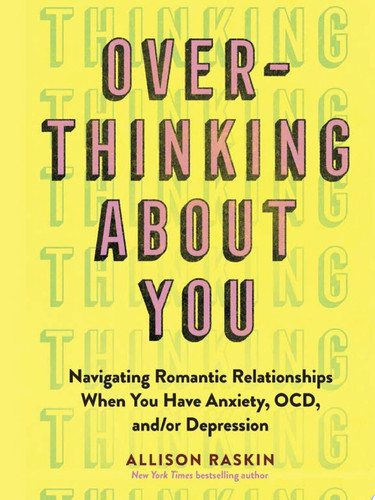
Overthinking about you: navigating romantic relationships when you have anxiety, OCD, and/or depression

Raskin, Allison
"Dating is hard-but when you live with anxiety, OCD, and/or depression, dating can feel like a minefield. At last, a book that focuses solely on mental health and dating-an intersection that demands attention, given that one in five Americans will experience a mental illness in a given year. Overthinking About You is a memoir-driven self-help book that explores the complex connection between brain and heart, for an engaging, useful, and relatable read for anyone whose mental health has gotten in the way of successful romantic relationships"--
Workman Publishing 2022-05-03 197 pages

Reimagining Britain: foundations for hope

Welby, Justin
In a time of political turbulence, and as the Welfare State totters under the strain in a country that has changed dramatically since 1945, Archbishop Justin Welby sets out to identify the values that will enable us to reimagine, and to enact, a more hopeful future. The thesis is that the work of reimagining is as great as it was in 1945, and will happen either by accident – and thus badly – or deliberately. The author draws on Britain's history and Christian tradition to identify this country's foundational values, and the building blocks necessary to implement them in a post-Brexit, multicultural society. He explores the areas in which values are translated into action, including the traditional three of recent history: health (especially public, and mental), housing and education. To these he adds family; the environment; economics and finance; peacebuilding and overseas development; immigration; and integration. He looks particularly at the role of faith groups in enabling, and contributing to, a fairer future. When so many are immobilized by political turmoil, this book builds on our past to offer hope for the future, and practical ways of achieving a more equitable society.
Bloomsbury 2018 300 pages

Third wave capitalism: how money, power, and the pursuit of self-interest have imperiled the American dream

Ehrenreich, John
In Third Wave Capitalism, John Ehrenreich documents the emergence of a new stage in the history of American capitalism. Just as the industrial capitalism of the nineteenth century gave way to corporate capitalism in the twentieth, recent decades have witnessed corporate capitalism evolving into a new phase, which Ehrenreich calls "Third Wave Capitalism." Third Wave Capitalism is marked by apparent contradictions: Rapid growth in productivity and lagging wages; fabulous wealth for the 1 percent and the persistence of high levels of poverty; increases in the standard of living and increases in mental illness, personal misery, and political rage; the apotheosis of the individual and the deterioration of democracy; increases in life expectancy and out-of-control medical costs; an African American president and the incarceration of a large percentage of the black population. Ehrenreich asserts that these phenomena are evidence that a virulent, individualist, winner-take-all ideology and a virtual fusion of government and business have subverted the American dream. Greed and economic inequality reinforce the sense that each of us is "on our own." The result is widespread lack of faith in collective responses to our common problems. The collapse of any organized opposition to business demands makes political solutions ever more difficult to imagine. Ehrenreich traces the impact of these changes on American health care, school reform, income distribution, racial inequities, and personal emotional distress. Not simply a lament, Ehrenreich's book seeks clues for breaking out of our current stalemate and proposes a strategy to create a new narrative in which change becomes possible.--Book flap
ILR Press, an imprint of Cornell University Press 2016-04-07 244 pages

Aboriginal suicide is different: a portrait of life and self-destruction

Tatz, Colin Martin
Every Australian's birthright includes the expectation of a healthy and possibly happy life of some longevity, assisted by all the services which a civilised society can make possible. But this is not yet within the Aboriginal (or Maori, Pacific Islander, Canadian Inuit and American Indian) grasp. That so many young Aboriginal people prefer death to life implies a rejection of what people in the broader Australian society, have on offer. It reflects a failure, as a nation, to provide sufficient incentives for young Aborigines to remain alive. This is a study of youth who have, or feel they have, no purpose in life -- or who may be seeking freedom in death. It is a portrait of life, and of self-destruction, by young Aboriginal men and women. To comprehend this relatively recent phenomenon, which occurs more outside than inside custody, one has to appreciate Aboriginal history -- the effects of which contribute more to an understanding of suicide today than do psychological or medical theories about the victim. Aboriginal youth at risk are suffering more from social than from mental disorder. Adopting a historical and anthropological approach to suicide in New South Wales, the Australian Capital Territory and New Zealand, this book documents rates of suicide that may well be the world's worst. It tries to glimpse the soul of the suicide rather than merely his or her contribution to our national statistics.
Aboriginal Studies Press 2005 191 pages