13 results for "Neuroscience"

You are not your brain: the 4-step solution for changing bad habits, ending unhealthy thinking, and taking control of your life

Schwartz, Jeffrey
Two neuroscience experts explain how their 4-Step Method can help break destructive thoughts and actions and change bad habits for good. A leading neuroplasticity researcher and the coauthor of the groundbreaking books Brain Lock and The Mind and the Brain , Jeffrey M. Schwartz has spent his career studying the structure and neuronal firing patterns of the human brain. He pioneered the first mindfulness-based treatment program for people suffering from OCD, teaching patients how to achieve long-term relief from their compulsions. For the past six years, Schwartz has worked with psychiatrist Rebecca Gladding to refine a program that successfully explains how the brain works and why we often feel besieged by bad brain wiring. Just like with the compulsions of OCD patients, they discovered that bad habits, social anxieties, self-deprecating thoughts, and compulsive overindulgence are all rooted in overactive brain circuits. The key to making life changes that you want-to make your brain work for you-is to consciously choose to "starve" these circuits of focused attention, thereby decreasing their influence and strength. As evidenced by the huge success of Schwartz's previous books, as well as Daniel Amen's Change Your Brain, Change Your Life , and Norman Doidge's The Brain That Changes Itself , there is a large audience interested in harnessing the brain's untapped potential, yearning for a step-by-step, scientifically grounded and clinically proven approach. In fact, readers of Brain Lock wrote to the authors in record numbers asking for such a book. In You Are Not Your Brain , Schwartz and Gladding carefully outline their program, showing readers how to identify negative brain impulses, channel them through the power of focused attention, and ultimately lead more fulfilling and empowered lives.
Avery 2011 362 pages

The brain: the story of you

Eagleman, David
"The dramatic story of the brain's role in creating our world, our experience of it, and ourselves; the basis for a PBS television series by the bestselling David Eagleman. How does a three pound mass of biological matter locked in the dark, silent fortress of the skull produce the extraordinary multi-sensory experience that comprises us, while also constructing reality and guiding us through the endless need to make decisions and determine our judgments and into a future that we are convinced we are shaping? David Eagleman compares the brain to a cityscape with different neighborhoods where neural networks vie for supremacy and determine our behavior in ways we are not always aware or in control of. At the same time, he suggests that the brain works as a storyteller--creating a narrative that allows us to navigate and make sense of a world that it is busy constructing for us"--
Vintage Books 2017-03-07 246 pages

The future of the brain: the promise and perils of tomorrow's neuroscience

Rose, Steven P. R.
Brain repair, smart pills, mind-reading machines--modern neuroscience promises to soon deliver a remarkable array of wonders as well as profound insight into the nature of the brain. But these exciting new breakthroughs, warns Steven Rose, will also raise troubling questions about what it means to be human. In The Future of the Brain, Rose explores just how far neuroscience may help us understand the human brain--including consciousness--and to what extent cutting edge technologies should have the power to mend or manipulate the mind. Rose first offers a panoramic look at what we now know about the brain, from its three-billion-year evolution, to its astonishingly rapid development in the embryo, to the miraculous process of infant development. More important, he shows what all this science can--and cannot--tell us about the human condition. He examines questions that still baffle scientists and he explores the potential threats and promises of new technologies and their ethical, legal, and social implications, wondering how far we should go in eliminating unwanted behavior or enhancing desired characteristics, focusing on the new "brain steroids" and on the use of Ritalin to control young children. The Future of the Brain is a remarkable look at what the brain sciences are telling us about who we are and where we came from--and where we may be headed in years to come.
Oxford University Press 2006 344 pages

Can neuroscience change our minds?

Rose, Hilary,Rose, Steven P. R.
"Neuroscience, with its astounding new technologies, is uncovering the workings of the brain and with this perhaps the mind. The 'neuro' prefix spills out into every area of life, from neuroaesthetics to neuroeconomics, neurogastronomy and neuroeducation. With its promise to cure physical and social ills, government sees neuroscience as a tool to increase the 'mental capital' of the children of the deprived and workless. It sets aside intensifying poverty and inequality, instead claiming that basing children's rearing and education on brain science will transform both the child's and the nation's health and wealth. Leading critic of such neuropretensions, neuroscientist Steven Rose and sociologist of science Hilary Rose take a sceptical look at these claims and the science underlying them, sifting out the sensible from the snake oil. Examining the ways in which science is shaped by and shapes the political economy of neoliberalism, they argue that neuroscience on its own is not able to bear the weight of these hopes. "--Publisher's website
Polity Press 2016 170 pages

The wisdom paradox: how your mind can grow stronger as your brain grows older

Goldberg, Elkhonon
The Wisdom Paradox explores the aging of the mind from a unique, positive perspective. In an era of increasing fears about mental deterioration, world-renowned neuropsychologist Elkhonon Goldberg provides startling new evidence that though the brain diminishes in some tasks as it ages, it gains in many ways. Most notably, it increases in what he terms “wisdom”: the ability to draw upon knowledge and experience gained over a lifetime to make quick and effective decisions. Goldberg delves into the machinery of the mind, separating memory into two distinct types: singular (knowledge of a particular incident or fact) and generic (recognition of broader patterns). As the brain ages, the ability to use singular memory declines, but generic memory is unaffected—and its importance grows. As an individual accumulates generic memory, the brain can increasingly rely upon these stored patterns to solve problems effortlessly and instantaneously. Goldberg investigates the neurobiology of wisdom, and draws on historical examples of artists and leaders whose greatest achievements were realized late in life.
Gotham Books 2006-02-16 337 pages

You and me: the neuroscience of identity

Greenfield, Susan
"What is it that makes you distinct from me? Identity is a term much used but hard to define. For that very reason, it has long been a topic of fascination for philosophers but has been regarded with aversion by neuroscientists - until now. Susan Greenfield takes us on a journey in search of a biological interpretion of this most elusive of concepts, guiding us through the social and psychiatric perspectives and ultimately into the heart of the physical brain. As the brain adapts exquisitely to environment, do cultural challenges of the 21st century mean that we are facing unprecedented changes to identity itself?"--Back cover.
Notting Hill Editions 2011 145 pages

The volitional brain: towards a neuroscience of free will

Benjamin Libet,Anthony Freeman,Keith Sutherland
It is widely accepted in science that the universe is a closed deterministic system in which everything can, ultimately, be explained by purely physical causation. And yet we all experience ourselves as having the freedom to choose between alternatives presented to us -- 'we' are in the driving seat. The puzzling status of volition is explored in this issue by a distinguished body of scientists and philosophers.
Imprint Academic 1999 298 pages

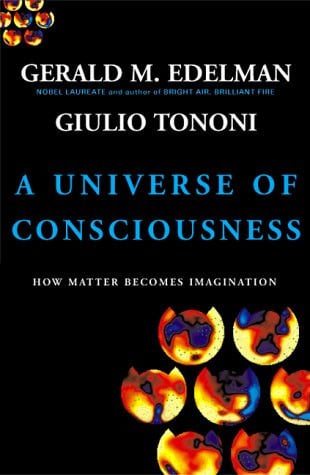
A universe of consciousness: how matter becomes imagination

Edelman, Gerald Maurice
In A Universe of Consciousness, Gerald Edelman builds on the radical ideas he introduced in his monumental trilogy-Neural Darwinism, Topobiology, and The Remembered Present-to present for the first time an empirically supported full-scale theory of consciousness. He and the neurobiolgist Giulio Tononi show how they use ingenious technology to detect the most minute brain currents and to identify the specific brain waves that correlate with particular conscious experiences. The results of this pioneering work challenge the conventional wisdom about consciousness.
Basic Books 2000 274 pages

Second nature: brain science and human knowledge

Edelman, Gerald M.
Burgeoning advancements in brain science are opening up new perspectives on how we acquire knowledge. Indeed, it is now possible to explore consciousness the very center of human concern by scientific means. In this illuminating book, Dr. Gerald M. Edelman offers a new theory of knowledge based on striking scientific findings about how the brain works. And he addresses the related compelling question: Does the latest research imply that all knowledge can be reduced to scientific description? Edelman s brain-based approach to knowledge has rich implications for our understanding of creativity, of the normal and abnormal functioning of the brain, and of the connections among the different ways we have of knowing. While the gulf between science and the humanities and their respective views of the world has seemed enormous in the past, the author shows that their differences can be dissolved by considering their origins in brain functions. He foresees a day when brain-based devices will be conscious, and he reflects on this and other fascinating ideas about how we come to know the world and ourselves.
Yale University Press 2006-10-24 203 pages

Mind wars: brain research and national defense

Moreno, Jonathan D.
In his fascinating new book, Jonathan D. Moreno investigates the deeply intertwined worlds of cutting-edge brain science, U.S. defense agencies, and a volatile geopolitical landscape where a nation's weaponry must go far beyond bombs and men. The first-ever exploration of the connections between national security and brain research, Mind Wars: Brain Research and National Defense reveals how many questions crowd this gray intersection of science and government and urges us to begin to answer them. From neuropharmacology to neural imaging to brain-machine interface devices that relay images and sounds between human brains and machines, Moreno shows how national security entities seek to harness the human nervous system in a multitude of ways as a potent weapon against the enemy soldier. Moreno charts such projects as monkeys moving robotic arms with their minds, technology to read the brain’s thought patterns at a distance, the development of "anti-sleep" drugs to enhance soldiers’ battle performance and others to dampen their emotional reactions to the violence, and advances that could open the door to "neuroweapons"—virus-transported molecules to addle the brain. "As new kinds of weapons are added to the arsenal already at the disposal of fallible human leaders," Moreno writes, "we need to find new ways to address the problem"--of the ethical military application of so powerful and intimate a science. This book is the first step in confronting the quandaries inherent in this partnership of government and neuroscience, serves as a compelling wake-up call for scientists and citizens, and suggests that, with imagination, we might meet the needs of both security and civil liberty.
Dana Press 2006-11-17 210 pages