3 results for "Neuroscience"

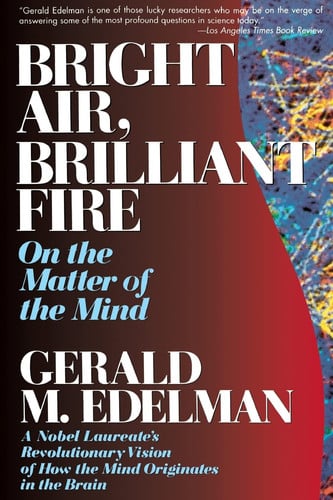
Bright air, brilliant fire: on the matter of the mind

Edelman, Gerald Maurice
We are on the brink of understanding ancient mysteries: how we know, what governs our nature, what makes a person different from a thing. In the last decade, more than twenty disciplines dealing with every aspect of the brain have contributed to a revolution in the neurosciences--a revolution as significant, in the view of many observers, as the Galilean and Copernican revolutions in mathematics and physics or the Darwinian revolution in biology. In this book, one of the world's foremost brain scientists gives us a glimpse into the workings of the human brain--the most complex material object in the universe. A match head's worth of the brain contains about a billion connections that can combine in ways which can only be described as hyperastronomical--on the order of ten followed by millions of zeros (there are only about ten followed by eighty zeros' worth of positively charged particles in the whole known universe).^
BasicBooks 1992 280 pages

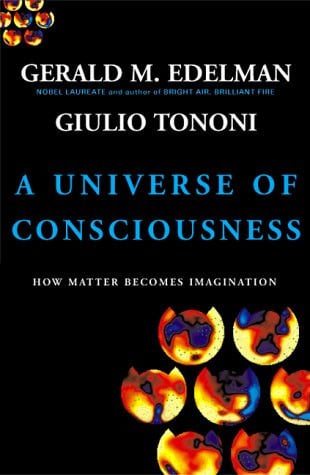
A universe of consciousness: how matter becomes imagination

Edelman, Gerald Maurice
In A Universe of Consciousness, Gerald Edelman builds on the radical ideas he introduced in his monumental trilogy-Neural Darwinism, Topobiology, and The Remembered Present-to present for the first time an empirically supported full-scale theory of consciousness. He and the neurobiolgist Giulio Tononi show how they use ingenious technology to detect the most minute brain currents and to identify the specific brain waves that correlate with particular conscious experiences. The results of this pioneering work challenge the conventional wisdom about consciousness.
Basic Books 2000 274 pages

Conscience: a biography

Van Creveld, Martin
Many consider conscience to be one of the most important--if not the fundamental--quality that makes us human, distinguishing us from animals, on one hand, and machines on the other. But what is conscience, exactly? Is it a product of our biological roots, as Darwin thought, or is it a purely social invention? If the latter, how did it come into the world? In this biography of that most elusive human element, Martin van Creveld explores conscience throughout history, ranging across numerous subjects, from human rights to health to the environment. Along the way he considers the evolution of conscience in its myriad, occasionally strange, and ever-surprising permutations. He examines the Old Testament, which--erroneously, it turns out--is normally seen as the fountainhead from which the Western idea of conscience has sprung. Next, he takes us to meet Antigone, the first person on record to explicitly speak of conscience. We then visit with the philosophers Zeno, Cicero and Seneca; with Christian thinkers such as Paul, Augustine, Aquinas, and, above all, Martin Luther; as well as modern intellectual giants such as Machiavelli, Rousseau, Kant, Hegel, Nietzsche, and Freud. Individual chapters are devoted to Japan, China, and even the Nazis, as well as the most recent discoveries in robotics and neuroscience and how they have contributed to the ways we think about our own morality. Ultimately, van Creveld shows that conscience remains as elusive as ever, a continuously mysterious voice that guides how we think about right and wrong.
Reaktion Books 2015-05-15 285 pages