6 results for "Neuroscience"

The hard problem

Stoppard, Tom
"Hilary, a young psychology researcher at the Krohl Institute for Brain Science, is nursing a private sorrow and a troubling question. She and other researchers at the institute are grappling with what science calls the 'hard problem'--if there is nothing but matter, what is consciousness? What Hilary discovers puts her fundamentally at odds with her colleagues, who include her first mentor and onetime lover, Spike; her boss, Leo; and the billionaire founder of the institute, Jerry. Hilary needs a miracle, and she is prepared to pray for one."--Back cover.
Grove Press 2015 76 pages

You and me: the neuroscience of identity

Greenfield, Susan
"What is it that makes you distinct from me? Identity is a term much used but hard to define. For that very reason, it has long been a topic of fascination for philosophers but has been regarded with aversion by neuroscientists - until now. Susan Greenfield takes us on a journey in search of a biological interpretion of this most elusive of concepts, guiding us through the social and psychiatric perspectives and ultimately into the heart of the physical brain. As the brain adapts exquisitely to environment, do cultural challenges of the 21st century mean that we are facing unprecedented changes to identity itself?"--Back cover.
Notting Hill Editions 2011 145 pages

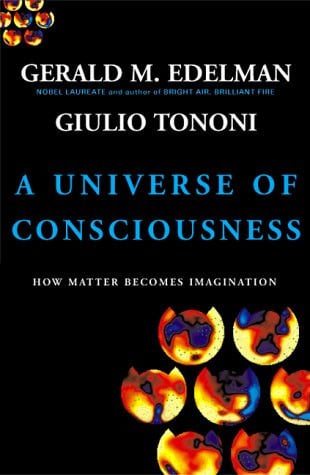
A universe of consciousness: how matter becomes imagination

Edelman, Gerald Maurice
In A Universe of Consciousness, Gerald Edelman builds on the radical ideas he introduced in his monumental trilogy-Neural Darwinism, Topobiology, and The Remembered Present-to present for the first time an empirically supported full-scale theory of consciousness. He and the neurobiolgist Giulio Tononi show how they use ingenious technology to detect the most minute brain currents and to identify the specific brain waves that correlate with particular conscious experiences. The results of this pioneering work challenge the conventional wisdom about consciousness.
Basic Books 2000 274 pages

Critique of impure reason: an essay on neurons, somatic markers, and consciousness

Munz, Peter
Thanks to the enormous progress of neuroscience over the past few decades, we can now monitor the passage of initial stimulations to certain points in the brain. In spite of these findings, however, subjective consciousness still remains an unsolved mystery. This volume exposes neuroscience and cognitive science to philosophical analysis and proposes that we think of our conscious states of mind as a composite phenomenon consisting of three layers: neuronal events, somatic markers, and explicit consciousness. While physics and chemistry can and have been successfully employed to describe the causal relation between the first two layers, the further step to articulate consciousness is purely interpretative and points to the preponderant importance of language. Language is essential for the transformation of inchoate, not very informative somatic markers and mere moods into full consciousness and appraised emotion. Munz uses literary examples to shift our understanding of the mind away from computational models and to show how eloquence about our states of mind is manufactured rather than caused. He firmly rejects the efforts of both Freud and non-Freudian psychologists to find a scientific explanation for such manufacture and to make a science out of the eloquence of folk psychology. Instead he argues that the many ways eloquence is being manufactured to transform somatic markers into conscious states of mind are best accounted for in terms of Wittgenstein's conception of language games. This volume challenges most current thinking about consciousness and mind and will appeal to philosophers, psychologists, neuroscientists, and linguists.
Praeger 1999-02-28 238 pages