
2 results for "Neuroscience"

Human nature & Jewish thought: Judaism's case for why persons matter

Mittleman, Alan
This book explores one of the great questions of our time: How can we preserve our sense of what it means to be a person while at the same time accepting what science tells us to be true-namely, that human nature is continuous with the rest of nature? What, in other words, does it mean to be a person in a world of things? Alan Mittleman shows how the Jewish tradition provides rich ways of understanding human nature and personhood that preserve human dignity and distinction in a world of neuroscience, evolutionary biology, biotechnology, and pervasive scientism. These ancient resources can speak to Jewish, non-Jewish, and secular readers alike. Science may tell us what we are, Mittleman says, but it cannot tell us who we are, how we should live, or why we matter. Traditional Jewish thought, in open-minded dialogue with contemporary scientific perspectives, can help us answer these questions. Mittleman shows how, using sources ranging across the Jewish tradition, from the Hebrew Bible and the Talmud to more than a millennium of Jewish philosophy. Among the many subjects the book addresses are sexuality, birth and death, violence and evil, moral agency, and politics and economics. Throughout, Mittleman demonstrates how Jewish tradition brings new perspectives to-and challenges many current assumptions about-these central aspects of human nature. A study of human nature in Jewish thought and an original contribution to Jewish philosophy, this is a book for anyone interested in what it means to be human in a scientific age.
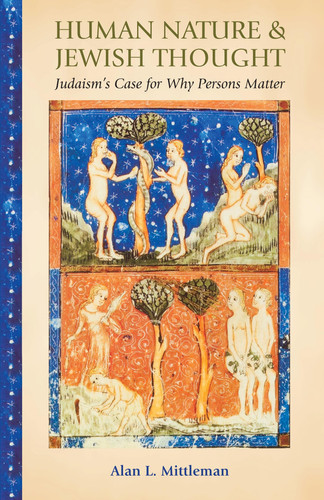
Princeton University Press 2015 215 pages

A dream interpreted within a dream: oneiropoiesis and the prism of imagination

Wolfson, Elliot R.
Dreams have attracted the curiosity of humankind for millennia. Elliot R. Wolfson’s A Dream Interpreted Within a Dream: Oneiropoiesis and the Prism of Imagination grapples with the allusive and elusive place dreaming occupies in the panorama of human experience. Drawing on a variety of contemporary academic disciplines, Wolfson returns to and rethinks past explications of the dream: that the dream state and waking reality are on an equal phenomenal footing; that the sensory world is the dream from which one must awaken by waking to the dream in which one is merely dreaming that one is awake. By interpreting the dream within the dream, Wolfson articulates how a productive paradox emerges to reveal the wakeful character of the dream and the dreamful character of wakefulness. Wolfson utilizes psychoanalysis, phenomenology, literary theory, and neuroscience, to elucidate the oneiric phenomenon in a vast array of biblical, rabbinic, philosophical, and kabbalistic texts. No one morphology of the dream phenomenon is either sufficient or comprehensive. Rather, Wolfson proposes a linguistic archaeology of the dream, a philosophically inflected excavation of a psychological phenomenon that celebrates the contingent and ambiguous as signifiers of truth conceived as proportionate to, but not prescribed by nature. As such, the dream is classified as the immanentizing transcendence under the sign of the imaginary. Through close readings, Wolfson interprets the mythologic of dreams. He discovers therein how and in what form dreams uniquely display the concurrence of purportedly contradictory and incongruent images. To heed the cadence of the dream is, therefore, to appropriate a calculus of the noncalculable, and to embrace the paradox of fictional truth whose authenticity can be gauged only from the standpoint of its artificiality. Through Wolfson’s artful, lucid, and erudite readings, the dream is shown to be an imaginal excessiveness, at once foreseeable but unprecedented, the semblance of the simulacrum wherein truth does not oppose deception, wherein the appearance of truthfulness is impossible to determine independently of the truthfulness of appearance. A Dream Interpreted Within a Dream will ultimately call forth a new way to think the effects and transformations of phenomenological experiences, affective, corporeal and cognitive.
Zone Books 2011-09-09 566 pages