7 results for "Neuroscience"

The Sweet Spot The Pleasures of Suffering and the Search for Meaning

Paul Bloom
"This book will challenge you to rethink your vision of a good life. With sharp insights and lucid prose, Paul Bloom makes a captivating case that pain and suffering are essential to happiness. It's an exhilarating antidote to toxic positivity." --Adam Grant, #1 New York Times bestselling author of Think Again and host of the TED podcast WorkLife One of Behavioral Scientist's "Notable Books of 2021" From the author of Against Empathy, a different kind of happiness book, one that shows us how suffering is an essential source of both pleasure and meaning in our lives Why do we so often seek out physical pain and emotional turmoil? We go to movies that make us cry, or scream, or gag. We poke at sores, eat spicy foods, immerse ourselves in hot baths, run marathons. Some of us even seek out pain and humiliation in sexual role-play. Where do these seemingly perverse appetites come from? Drawing on groundbreaking findings from psychology and brain science, The Sweet Spot shows how the right kind of suffering sets the stage for enhanced pleasure. Pain can distract us from our anxieties and help us transcend the self. Choosing to suffer can serve social goals; it can display how tough we are or, conversely, can function as a cry for help. Feelings of fear and sadness are part of the pleasure of immersing ourselves in play and fantasy and can provide certain moral satisfactions. And effort, struggle, and difficulty can, in the right contexts, lead to the joys of mastery and flow. But suffering plays a deeper role as well. We are not natural hedonists--a good life involves more than pleasure. People seek lives of meaning and significance; we aspire to rich relationships and satisfying pursuits, and this requires some amount of struggle, anxiety, and loss. Brilliantly argued, witty, and humane, Paul Bloom shows how a life without chosen suffering would be empty--and worse than that, boring.
HarperCollins Publishers 2021-11-02 304 pages

Higher Cortical Functions in Man

Alexander R. Luria
This full-length translation of Professor Luria's book introduces to the English speaking world a major document in neuropsychology, summarizing Professor Luria's earlier contributions to that area for nearly a third of a century. It is a monumental contribution. Nothing of this scope exists in the Western literature of this field, with the possible exception of Ajuriaguerra and Hecaen's book (in French) on the cerebral cortex. Professor Luria's book thus marks a further and decisive step toward the eventual coalescence of neurology and psychology, a goal to which only a few laboratories in the East and West have been devoted over the last decades. The book is unique in its organization. The first half deals with observations and interpretations concerning the major syndromes of man's left cerebral hemisphere: those grievous distortions of higher functions traditionally described as aphasia, agnosia, and apraxia. There is also a detailed and brilliant analysis of the syndrome of massive frontal-lobe involvement. The entire second half of the book is given over to a painstaking description of Professor Luria's tests, many of them introduced by himself, and set out in such detail that anyone could repeat them and thus verify Professor Luria's interpretations.
Springer 2012-02-16 662 pages

The wisdom paradox: how your mind can grow stronger as your brain grows older

Goldberg, Elkhonon
The Wisdom Paradox explores the aging of the mind from a unique, positive perspective. In an era of increasing fears about mental deterioration, world-renowned neuropsychologist Elkhonon Goldberg provides startling new evidence that though the brain diminishes in some tasks as it ages, it gains in many ways. Most notably, it increases in what he terms “wisdom”: the ability to draw upon knowledge and experience gained over a lifetime to make quick and effective decisions. Goldberg delves into the machinery of the mind, separating memory into two distinct types: singular (knowledge of a particular incident or fact) and generic (recognition of broader patterns). As the brain ages, the ability to use singular memory declines, but generic memory is unaffected—and its importance grows. As an individual accumulates generic memory, the brain can increasingly rely upon these stored patterns to solve problems effortlessly and instantaneously. Goldberg investigates the neurobiology of wisdom, and draws on historical examples of artists and leaders whose greatest achievements were realized late in life.
Gotham Books 2006-02-16 337 pages

The volitional brain: towards a neuroscience of free will

Benjamin Libet,Anthony Freeman,Keith Sutherland
It is widely accepted in science that the universe is a closed deterministic system in which everything can, ultimately, be explained by purely physical causation. And yet we all experience ourselves as having the freedom to choose between alternatives presented to us -- 'we' are in the driving seat. The puzzling status of volition is explored in this issue by a distinguished body of scientists and philosophers.
Imprint Academic 1999 298 pages

The new executive brain: frontal lobes in a complex world

Goldberg, Elkhonon
Elkhonon Goldberg's groundbreaking The Executive Brain was a classic of scientific writing, revealing how the frontal lobes command the most human parts of the mind. Now he offers a completely new book, providing fresh, iconoclastic ideas about the relationship between the brain and the mind.In The New Executive Brain, Goldberg paints a sweeping panorama of cutting-edge thinking in cognitive neuroscience and neuropsychology, one that ranges far beyond the frontal lobes. Drawing on the latest discoveries, and developing complex scientific ideas and relating them to real life through many fascinating case studies and anecdotes, the author explores how the brain engages in complex decision-making; how it deals with novelty and ambiguity; and how it addresses moral choices. At every step, Goldberg challenges entrenched assumptions. For example, we know that the left hemisphere of the brain is the seat of language--but Goldberg argues that language may not be the central adaptation of the left hemisphere. Apes lack language, yet many also show evidence of asymmetric hemispheric development. Goldberg also finds that a complex interaction between the frontal lobes and the amygdale--between a recently evolved and a much older part of the brain--controls emotion, as conscious thoughts meet automatic impulses. The author illustrates this observation with a personal example: the difficulty he experienced when trying to pick up a baby alligator he knew to be harmless, as his amygdala battled his effort to extend his hand.In the years since the original Executive Brain, Goldberg has remained at the front of his field, constantly challenging orthodoxy. In this revised and expanded edition, he affirms his place as one of our most creative and insightful scientists, offering lucid writing and bold, paradigm-shifting ideas.
Oxford University Press 2009-08-12 334 pages

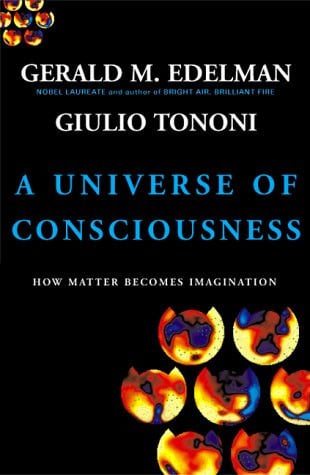
A universe of consciousness: how matter becomes imagination

Edelman, Gerald Maurice
In A Universe of Consciousness, Gerald Edelman builds on the radical ideas he introduced in his monumental trilogy-Neural Darwinism, Topobiology, and The Remembered Present-to present for the first time an empirically supported full-scale theory of consciousness. He and the neurobiolgist Giulio Tononi show how they use ingenious technology to detect the most minute brain currents and to identify the specific brain waves that correlate with particular conscious experiences. The results of this pioneering work challenge the conventional wisdom about consciousness.
Basic Books 2000 274 pages

The organism

Goldstein, Kurt
In this remarkable book by one of the great psychologists and neurologists of the early twentieth century, Kurt Goldstein presents a summation of his “holistic” theory of the human organism. In the course of his studies on brain-damaged soldiers during the First World War, Goldstein became aware of the failure of contemporary biology and medicine to genuinely understand both the impact of such injuries and the astonishing adjustments that patients made to them. He challenged reductivist approaches that dealt with “localized” symptoms, insisting instead that an organism be analyzed in terms of the totality of its behavior and interaction with its surrounding milieu. He was especially concerned with the breakdown of organization and the failure of central cerebral controls that take place in catastrophic responses to situations such as physical or mental illness. But Goldstein was equally attuned to the amazing powers of the organism to readjust to such devastating losses, if only by withdrawal to a more limited range of activity that it could manage by a redistribution of its reduced energies, thus reclaiming as much wholeness as new circumstances allowed. Goldstein’s concepts in The Organism have had a major impact on philosophical and psychological thought throughout this century, as can be seen in the work of Maurice Merleau-Ponty, Georges Canguilhem, Ernst Cassirer, Ludwig Binswanger, and Roman Jakobson, not to mention the wide-ranging field of Gestalt psychology.
Zone 2000-04-04 424 pages