5 results for "Neuroscience"

What is it like to be a bat?

Nagel, Thomas
"This book is a fiftieth anniversary republication of Thomas Nagel's "What Is It Like to Be a Bat?", a classic in the philosophy of mind. Through its argument for the irreducible subjectivity of consciousness, it played an essential role in making the study of consciousness a central part of philosophy, psychology, and neuroscience. It also spurred the now flourishing scientific attention to the consciousness of non-human creatures: mammals, birds, fish, mollusks, and insects. The book also includes a second essay offering Nagel's more recent thoughts on the most promising positive response to the mind-body problem, as posed in the original essay"--
Oxford University Press 2024 64 pages

Concepts: where cognitive science went wrong

Fodor, Jerry A.
Oxford Cognitive Science Series General Editors: Martin Davies, Wilde Reader in Mental Philosophy, University of Oxford, UK, James Higginbotham, Professor of General Linguistics, University of Oxford, UK, John O'Keefe, Professor of Cognitive Neuroscience, University College, London, UK, Christopher Peacocke, Waynflete Professor of Metaphysical Philosophy, University of Oxford, UK, and Kim Plunkett, University Lecturer in Psychology, University of Oxford, UK The Oxford Cognitive Science series is a forum for the best contemporary work in this flourishing field, where various disciplines - cognitive psychology, philosophy, linguistics, cognitive neuroscience, and computational theory - join forces in the investigation of thought, awareness, understanding, and associated workings of the mind. Each book will represent an original contribution to its subject, but will be accessible beyond the ranks of specialists, so as to reach a broad interdisciplinary readership. The serieswill be carefully shaped and steered by the general editors, with the aim of representing the most important developments in the field and bringing together its constituent disciplines. About this book The renowned philosopher Jerry Fodor, who has been a leading figure in the study of the mind for more than twenty years, presents a strikingly original theory of the basic constituents of thought. He suggests that the heart of a cognitive science is its theory of concepts, and that cognitive scientists have gone badly wrong in many areas because their assumptions about concepts have been seriously mistaken. Fodor argues compellingly for an atomistic theory of concepts, deals out witty and pugnacious demolitions of the rival theories that have prevailed in recent years, and suggests that future work on human cognition should build upon new foundations. This lively, conversational, and surprisingly accessible book is the first volume in the Oxford Cognitive Science Series, where the best original work in this field will be presented to a broad readership. Concepts will fascinate anyone interested in contemporary work on mind and language. Cognitive science will never be the same again.
Clarendon Press 1998 174 pages

On nature and language

Chomsky, Noam
In On Nature and Language Noam Chomsky develops his thinking on the relation between language, mind and brain, integrating current research in linguistics into the burgeoning field of neuroscience. This 2002 volume begins with a lucid introduction by the editors Adriana Belletti and Luigi Rizzi. This is followed by some of Chomsky's writings on these themes, together with a penetrating interview in which Chomsky provides the clearest and most elegant introduction to current theory available. It should make his Minimalist Program accessible to all. The volume concludes with an essay on the role of intellectuals in society and government. Nature and Language is a significant landmark in the development of linguistic theory. It will be welcomed by students and researchers in theoretical linguistics, neurolinguistics, cognitive science and politics, as well as anyone interested in the development of Chomsky's thought.
Cambridge University Press 2002-10-10 206 pages

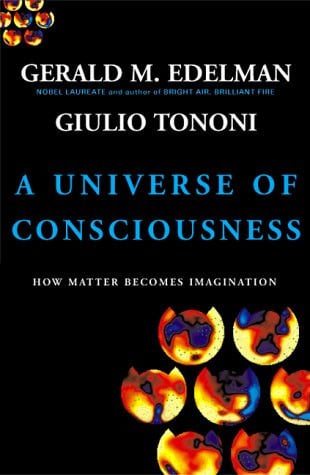
A universe of consciousness: how matter becomes imagination

Edelman, Gerald Maurice
In A Universe of Consciousness, Gerald Edelman builds on the radical ideas he introduced in his monumental trilogy-Neural Darwinism, Topobiology, and The Remembered Present-to present for the first time an empirically supported full-scale theory of consciousness. He and the neurobiolgist Giulio Tononi show how they use ingenious technology to detect the most minute brain currents and to identify the specific brain waves that correlate with particular conscious experiences. The results of this pioneering work challenge the conventional wisdom about consciousness.
Basic Books 2000 274 pages

Critique of impure reason: an essay on neurons, somatic markers, and consciousness

Munz, Peter
Thanks to the enormous progress of neuroscience over the past few decades, we can now monitor the passage of initial stimulations to certain points in the brain. In spite of these findings, however, subjective consciousness still remains an unsolved mystery. This volume exposes neuroscience and cognitive science to philosophical analysis and proposes that we think of our conscious states of mind as a composite phenomenon consisting of three layers: neuronal events, somatic markers, and explicit consciousness. While physics and chemistry can and have been successfully employed to describe the causal relation between the first two layers, the further step to articulate consciousness is purely interpretative and points to the preponderant importance of language. Language is essential for the transformation of inchoate, not very informative somatic markers and mere moods into full consciousness and appraised emotion. Munz uses literary examples to shift our understanding of the mind away from computational models and to show how eloquence about our states of mind is manufactured rather than caused. He firmly rejects the efforts of both Freud and non-Freudian psychologists to find a scientific explanation for such manufacture and to make a science out of the eloquence of folk psychology. Instead he argues that the many ways eloquence is being manufactured to transform somatic markers into conscious states of mind are best accounted for in terms of Wittgenstein's conception of language games. This volume challenges most current thinking about consciousness and mind and will appeal to philosophers, psychologists, neuroscientists, and linguists.
Praeger 1999-02-28 238 pages