
3 results for "Neuroscience"

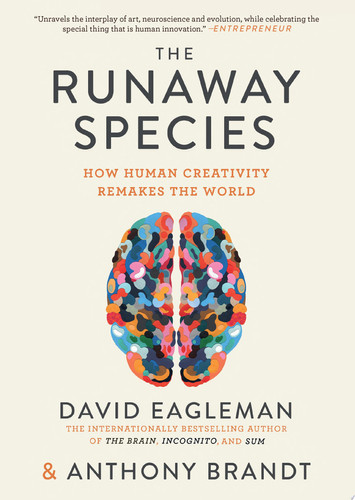
The Runaway Species How Human Creativity Remakes the World

David Eagleman,Anthony Brandt
This enlightening examination of creativity looks “at art and science together to examine how innovations . . . build on what already exists and rely on three brain operations: bending, breaking and blending” ( The Wall Street Journal ) The Runaway Species is a deep dive into the creative mind, a celebration of the human spirit, and a vision of how we can improve our future by understanding and embracing our ability to innovate. David Eagleman and Anthony Brandt seek to answer the question: what lies at the heart of humanity’s ability—and drive—to create? Our ability to remake our world is unique among all living things. But where does our creativity come from, how does it work, and how can we harness it to improve our lives, schools, businesses, and institutions? Eagleman and Brandt examine hundreds of examples of human creativity through dramatic storytelling and stunning images in this beautiful, full–color volume. By drawing out what creative acts have in common and viewing them through the lens of cutting–edge neuroscience, they uncover the essential elements of this critical human ability, and encourage a more creative future for all of us. “ The Runaway Species approach[es] creativity scientifically but sensitively, feeling its roots without pulling them out.” — The Economist
Catapult 2018-06-19 304 pages

The Sweet Spot The Pleasures of Suffering and the Search for Meaning

Paul Bloom
"This book will challenge you to rethink your vision of a good life. With sharp insights and lucid prose, Paul Bloom makes a captivating case that pain and suffering are essential to happiness. It's an exhilarating antidote to toxic positivity." --Adam Grant, #1 New York Times bestselling author of Think Again and host of the TED podcast WorkLife One of Behavioral Scientist's "Notable Books of 2021" From the author of Against Empathy, a different kind of happiness book, one that shows us how suffering is an essential source of both pleasure and meaning in our lives Why do we so often seek out physical pain and emotional turmoil? We go to movies that make us cry, or scream, or gag. We poke at sores, eat spicy foods, immerse ourselves in hot baths, run marathons. Some of us even seek out pain and humiliation in sexual role-play. Where do these seemingly perverse appetites come from? Drawing on groundbreaking findings from psychology and brain science, The Sweet Spot shows how the right kind of suffering sets the stage for enhanced pleasure. Pain can distract us from our anxieties and help us transcend the self. Choosing to suffer can serve social goals; it can display how tough we are or, conversely, can function as a cry for help. Feelings of fear and sadness are part of the pleasure of immersing ourselves in play and fantasy and can provide certain moral satisfactions. And effort, struggle, and difficulty can, in the right contexts, lead to the joys of mastery and flow. But suffering plays a deeper role as well. We are not natural hedonists--a good life involves more than pleasure. People seek lives of meaning and significance; we aspire to rich relationships and satisfying pursuits, and this requires some amount of struggle, anxiety, and loss. Brilliantly argued, witty, and humane, Paul Bloom shows how a life without chosen suffering would be empty--and worse than that, boring.
HarperCollins Publishers 2021-11-02 304 pages

The social neuroscience of empathy

Jean Decety
In recent decades, empathy research has blossomed into a vibrant and multidisciplinary field of study. The social neuroscience approach to the subject is premised on the idea that studying empathy at multiple levels (biological, cognitive, and social) will lead to a more comprehensive understanding of how other people's thoughts and feelings can affect our own thoughts, feelings, and behavior. In these cutting-edge contributions, leading advocates of the multilevel approach view empathy from the perspectives of social, cognitive, developmental, and clinical psychology and cognitive/affective neuroscience. Chapters include a critical examination of the various definitions of the empathy construct; surveys of major research traditions based on these differing views (including empathy as emotional contagion, as the projection of one's own thoughts and feelings, and as a fundamental aspect of social development); clinical and applied perspectives, including psychotherapy and the study of empathy for other people's pain; various neuroscience perspectives; and discussions of empathy's evolutionary and neuroanatomical histories, with a special focus on neuroanatomical continuities and differences across the phylogenetic spectrum. The new discipline of social neuroscience bridges disciplines and levels of analysis. In this volume, the contributors' state-of-the-art investigations of empathy from a social neuroscience perspective vividly illustrate the potential benefits of such cross-disciplinary integration. Contributors : C. Daniel Batson, R. J. R. Blair, Karina S. Blair, Jerold D. Bozarth, Ann Buysse, Susan F. Butler, Michael Carlin, C. Sue Carter, Kenneth D. Craig, Mirella Dapretto, Jean Decety, Mathias Dekeyser, Ap Dijksterhuis, Robert Elliott, Natalie D. Eggum, Nancy Eisenberg, Norma Deitch Feshbach, Seymour Feshbach, Liesbet Goubert, Leslie S. Greenberg, Elaine Hatfield, James Harris, William Ickes, Claus Lamm, Yen-Chi Le, Mia Leijssen, Raymond S. Nickerson, Jennifer H. Pfeifer, Stephen W. Porges, Richard L. Rapson, Simone G. Shamay-Tsoory, Rick B. van Baaren, Matthijs L. van Leeuwen, Andries van der Leij, Jeanne C. Watson Social Neuroscience series
MIT Press 2009 255 pages