20 results for "Nobel"

Shimon Peres: the biography

Bar-Zohar, Michael
Twice Israel’s prime minister, winner of the Nobel Peace Prize, bold leader in a war-torn region, Shimon Peres was one of the great statesmen of the modern world. Peres was also a fascinating, complex man–a brilliant intellectual who was entirely at home in the corridors of power; an individual revered by the world and yet highly controversial in his own country; at once a hero and a figure of tragedy. Now, in this definitive biography, Michael Bar-Zohar takes the full measure of a towering, enigmatic leader. Drawing on his decades-long association with Peres, as well as the full cooperation of the leader’s family, friends, supporters, and political rivals, Bar-Zohar has crafted a vibrant, daring, richly textured portrait of a man whose life and career span the entire history of Israel. Born in Poland in 1923, Peres emigrated to the Holy Land at the age of twelve, already a fiercely idealistic Zionist. Peres joined a kibbutz and, while still in his teens, became the leader of a major youth movement. When the struggle for Israeli independence broke out, future prime minister David Ben-Gurion tapped him to join his inner circle.As director general of the Defense Ministry under Ben-Gurion, Peres spearheaded a far-reaching campaign to turn Israel into a major military power. He jump-started Israel’s aircraft industry, forged a secret alliance with France, and successfully pursued his dream of making Israel a nuclear power. And yet Peres’s real triumph came not as a man of war but as a peacemaker.Elected prime minister in 1984, Peres brought new hope by pulling Israeli troops out of the quagmire in Lebanon, defusing tensions with Jordan, and, at the risk of his own political future, making serious overtures to the Palestinians. Peres and his longtime rival Yitzhak Rabin together secured the top-secret Oslo Accords of 1993, which won them and Yasser Arafat the Nobel Peace Prize–only to see the hope of peace shattered in a resurgence of regional violence.In a half-century of leadership, Peres has worked beside–or fought against–such giants as Moshe Dayan, Golda Meir, Menachem Begin, Ariel Sharon, and, tragically, Rabin, who was slain at the rally that marked his reconciliation with Peres. In this stunning, courageously frank, and scrupulously factual biography, Michael Bar-Zohar gives an eminent man his due.
Random House 2007-02-27 554 pages

In search of memory: the emergence of a new science of mind

Kandel, Eric R.
Nobelist Eric Kandel's account of how his personal quest to understand memory intersected with the emergence of a new science. In Search of Memory relates the astonishing story of how four different and distinct disciplinesbehaviorist psychology, cognitive psychology, neuroscience, and molecular biologyconverged into a powerful new science of mind. Through its profound insights into thought, perception, action, recollection, and mental illness, this new science is revolutionizing our understanding of learning and memory while simultaneously showing great promise for more effective healing. The narrative follows Eric R. Kandel through the last five decades, focusing on Vienna, where he became fascinated with memory. With intrepid scientific ardor, Kandel was captivated first by history and psychoanalysis, then by neurobiology, and finally by the biological processes of memory. His resulting, multifaceted perspective was the foundation for his path-breaking research that will continue to dominate modern thoughtnot only in science but in culture at large. 50 illustrations.
W. W. Norton & Company 2006 510 pages

Ravenous: Otto Warburg, the Nazis, and the search for the cancer-diet connection

Apple, Sam
"The extraordinary story of the Nazi-era scientific genius who discovered how cancer cells eat-and what it means for how we should. The Nobel laureate Otto Warburg-a cousin of the famous finance Warburgs-was widely regarded in his day as one of the most important biochemists of the twentieth century, a man whose research was integral to humanity's understanding of cancer. He was also among the most despised figures in Nazi Germany. As a Jewish homosexual living openly with his male partner, Warburg represented all that the Third Reich abhorred. Yet Hitler and his top advisors dreaded cancer, and protected Warburg in the hope that he could cure it"--
Liveright Publishing Corporation, a division of W.W. Norton & Company 2021-05-25 399 pages

Hemingway and me: letters, anecdotes, and memories of a life-changing friendship

Lyons, Jeffrey
"When Ernest Hemingway died on July 2, 1961, Mary Hemingway asked the Hemingway's good friend, journalist Leonard Lyons, to announce the death of the Nobel Prize-winner to stunned readers and admirer everywhere. Both Hemingways admired Lyons for his fidelity to the truth, that "he would get the story right." (As it turns out the "truth" was not quite what it seemed, since Mary initially denied that her husband's death was suicide.) This memoir recounts the quarter-century long friendship between Hemingway and Leonard Lyons, which eventually came to include Lyons's wife and three sons. In this short book Jeffrey Lyons recounts visits to Hemingway in Cuba (where "Papa" first taught him how to shoot a gun) as well as nights out with the great writer at such popular New York watering holes as the Stork Club and Toots Shor's. Throughout the book Hemingway comes across as a hard-working, generous, and thoughtful man of letters, and not the gruff, hard drinking beast perpetually looking for a fight that he was often perceived as. This is a book about friendship, loyalty, and trust between a famed novelist and a working journalist and his family"--
Lyons Press 2021-05-01 140 pages

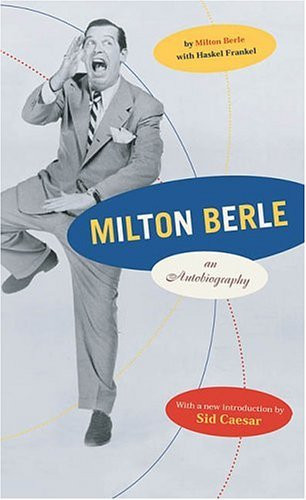
Milton Berle: an autobiography

Berle, Milton
(Applause Books). When Milton Berle died in the Spring of 2002, THE NEW YORK TIMES declared that the legendary comic "may have had a more profound influence on our way of life than some presidents or Nobel Prize winners." This landmark memoir, as startling today as it was when it was first published, reveals the life and times of the man known affectionately to millions as Uncle Miltie. Told with unflinching candor, here is one of the most fabled and influential show business careers of all time: from performing as a child in Vaudeville and making silent movies with Charlie Chaplin and Mary Pickford, to nightclub performances for Al Capone, working on radio during World War II, performing in Broadway musicals, and, finally, superstardom on television. Perhaps even more fascinating is Berle's scandal-ridden private life: his star-crossed love affair with a 1930's movie queen and the child they had out of wedlock, his numerous affairs with women ranging from evangelist Aimee Semple McPherson to Marilyn Monroe, and his stormy relationship with beautiful showgirl Joyce Mathews, whom Berle married twice. It is Berle's unsparing account of his life and his determination to show the world his real face that led Frank Sinatra, at the time, to call this "the gutsiest book I've read in years." Told with equal amounts of comedy and pathos, and featuring colorful appearancesby all the major stars of his day, MILTON BERLE is simply one of the best show business memoirs ever written.
Applause Theatre & Cinema Books 2002-09-01 337 pages

Wassily Leontief and input-output economics

Wassily Leontief,Erik Dietzenbacher,Michael L. Lahr
Wassily Leontief (1905–1999) was the founding father of input-output economics, for which he received the Nobel Prize in 1973. This book offers a collection of papers in memory of Leontief by his students and close colleagues. The first part, 'Reflections on Input-Output Economics', focuses upon Leontief as a person and scholar as well as his personal contributions to economics. It includes contributions by Nobel Laureate Paul A. Samuelson who shares his memories of a young Professor Leontief at Harvard and ends with the last joint interview with Wassily and his wife, to date previously unpublished. The second part, 'Perspectives of Input-Output Economics', includes theoretical and empirical research inspired by Leontief's work and offers a wide-ranging sample of the state of interindustry economics, a field Leontief founded. This is a strong collection likely to appeal to a wide range of professionals in universities, government, industry and international organizations.
Cambridge University Press 2004-03-25 396 pages

Battling for peace: a memoir

Peres, Shimon
"One of the great statesmen of our century, Shimon Peres, winner of the 1994 Nobel Peace Prize, has shaped the history of Israel and the future of the Middle East. In the seventies, as Israel's minister of defense, he engineered the legendary Entebbe raid against PLO terrorists; in the eighties, as prime minister, he saved the Israeli economy from near collapse; and as foreign minister, Shimon Peres is now a key negotiator in the peace accords that he helped bring about. In Battling for Peace, he tells, for the first time, the story of his amazing career. As we follow Peres from his ancestral home in Poland to Israel, from the youth village of Ben-Shemen to Kibbutz Alumot, from youth movement leader to prime minister, we are introduced both to a man and to a nation. A thoughtful, disciplined, and immensely resourceful young man, Peres was singled out by Israel's great leader David Ben-Gurion, who appointed him, while still in his twenties, director general of the Ministry of Defense. From this point on, Peres's life was inseparable from his country's history. Peres writes of his bitter quarrels with Golda Meir and Yitzhak Rabin, and of his great admiration for Ben-Gurion, Moshe Dayan, and Francois Mitterrand. He discusses the origins of Israel's nuclear program, and tells how he led the way toward the Oslo agreement, describing his secret talks with King Hussein in London ten years ago, and revealing how a chance for peace was thwarted by self-serving politicians and timid American diplomacy"--OCLC
Random House 1995-05-10 350 pages

Amos Oz: writer, activist, icon

Alter, Robert
"Amos Oz (1939-2018) was one of Israel's most prolific and prominent writers, as well as a regular contender for the Nobel Prize for Literature. He was the author of dozens of novels, essay collections, and novellas written between 1965 and shortly before his death. In this first published biography of Oz, the celebrated translator, literary critic, and biblical scholar Robert Alter explores Oz's relationship with his family, beginning with the suicide of his mother, Fania Klausner, when he was twelve years old, and goes on to review his time in Kibbutz Hulda, which he entered at fourteen following his separation from his father, Arieh Klausner; his family's right-wing Zionism; his writing career; his activism in support of a pluralistic Israel; and his work as an international lecturer. In examining Oz's life and work, Alter brings together testimony from Oz and his circle, as well as close readings of his central works, to present the inner world and public persona of Amos Oz.--Dust jacket.
Yale University Press 2023 176 pages

Obama: the historic journey

Abramson, Jill
This is the remarkable story of Barack Obama's journey to the White House, as told by the greatest cultural recorders in the world, the staff of The New York Times. From the first mention of Barack Obama in its pages (when he was elected president of the Harvard Law Review), to his electrifying speech at the 2004 Democratic Convention, to the days and months of the hardfought, innovative campaign for Presidency, The New York Times has documented, recorded, and analyzed Obama in all the ways that he has irrevocably changed this country. In twelve rich chapters, filled with award-winning photos and graphics, as well as text from Nobel Prize and Pulitzer€”winning columnists like Paul Krugman and Thomas Friedman, and seasoned political reporters like Adam Nagourney, The New York Times tells Obama's unlikely and incredible journey from the beginning all the way to his inauguration as President of the United States. Jill Abramson, the managing e
New York Times 2009-02-16 237 pages

From the kingdom of memory: reminiscences

Wiesel, Elie
In this "powerful" (New York Times Book review) collection of personal essays and landmark speeches by "one of the great writers of our generation" (New Republic), Elie Wiesel weaves together reminiscences of his life before the Holocaust, his struggle to find meaning afterward, and the actions he has taken on behalf of others that have defined him as a leading advocate of humanity and have earned him the Nobel Peace Prize. Here, too, as a tribute to the dead and an exhortation to the living are landmark speeches, among them his powerful testimony at the Klaus Barbie trial, his impassioned plea to President Reagan not to visit a German S.S. cemetery, and the speech he gave in Oslo in acceptance of the Nobel Peace Prize, in which he voices his hope that "the memory of evil will serve as a shield against evil."
Schocken Books 1995-01-31 250 pages

Visionary women

Nazarian, Angella M.
"Following the great success of Pioneers of the Possible, Angella Nazarian returns with an extraordinary sequel, Visionary Women. Featuring a foreword by Melanne Verveer, the director of the Georgetown Institute for Women, Peace and Security, this new title highlights twenty more innovative and forward-thinking women. From Malala Yousafzai as the youngest Nobel Prize laureate and Carmen Amaya beginning her remarkable dance career at age four to swimmer Diana Nyad breaking a world record at sixty-four and Doris Lessing still penning stories into her nineties, this inspiring volume will compel readers to reconnect with their own dreams and envision new goals to challenge themselves at any stage of life"--Publisher's description.
Assouline 2015 165 pages

Menachem Begin: the battle for Israel's soul

Gordis, Daniel
Reviled as a fascist by his great rival Ben-Gurion, venerated by Israel's underclass, the first Israeli to win the Nobel Peace Prize, a proud Jew but not a conventionally religious one, Menachem Begin was both complex and controversial. Born in Poland in 1913, Begin was a youthful admirer of the Revisionist Zionist movement. A powerful orator, Begin was imprisoned by the Soviets in 1940, joined the Free Polish Army in 1942, and arrived in Palestine as a Polish soldier shortly thereafter. Joining the underground paramilitary Irgun in 1943, he achieved instant notoriety for the organization's violent acts. Intentionally left out of the new Israeli government, Begin's right-leaning Herut party became a fixture of the opposition, until the surprising parliamentary victory of his political coalition in 1977 made him prime minister. Welcoming Egyptian president Anwar Sadat to Israel and cosigning a peace treaty with him on the White House lawn in 1979, Begin accomplished what his predecessors could not. His outreach to Ethiopian Jews and Vietnamese "boat people" was universally admired, and his decision to bomb Iraq's nuclear reactor in 1981 is now regarded as an act of courageous foresight. But the disastrous invasion of Lebanon, combined with his declining health and the death of his wife, led Begin to resign in 1983. He spent the next nine years in virtual seclusion, until his death in 1992. Begin was buried not alongside Israel's prime ministers, but alongside the Irgun comrades who died in the struggle to create the Jewish national home to which he had devoted his life. Daniel Gordis's perceptive biography gives us new insight into a remarkable political figure whose influence continues to be felt throughout the world.--From publisher description.
Nextbook/Schocken 2014-03-04 295 pages

Never lose your nerve!

Heeger, Alan J.
Never Lose Your Nerve! chronicles the ups and downs of a Nobel Laureate's life. Professor Alan J Heeger was awarded the Nobel Prize in Chemistry in 2000 together with Professor Alan G MacDiarmid and Professor Hideki Shirakawa. Filled with humor, this book tells Professor Heeger's story -- his love for his family, especially how his wife's love has always been his guiding light, his progress from a young student to an eminent scientist, his passion for the theatre and its impact on his science, his adventures as a successful entrepreneur, and his personal losses. Many think of scientists as risk-adverse individuals but Professor Heeger shows the absolute necessity of risk in research and that scientists are, in fact, risk-addicted, as taking the first, risky step into unfamiliar territory is a step in the right direction towards creativity and great discoveries. Never lose your nerve and you will be rewarded. Life is an exciting adventure and this book clearly demonstrates it, and is for those who are looking to impact others.'Perhaps the greatest pleasure of being a scientist is to have an abstract idea, then to do an experiment (more often a series of experiments is required) that demonstrates the idea was correct; that is, Nature actually behaves as conceived in the mind of the scientist. This process is the essence of creativity in science. I have been fortunate to have experienced this intense pleasure many times in my life.'Alan J Heeger
World Scientific 2016 271 pages

Spinach on the ceiling: the multifaceted life of a theoretical chemist

Karplus, Martin
"The autobiography of Martin Karplus, Nobel Prize in Chemistry, 2013, describes the journey from his childhood in Vienna, his escape to Switzerland in 1938 shortly after Hitler's entrance into Austria, his education in New England and California, and scientific career which took him to England, Illinois, Columbia, Strasbourg, and Harvard. The author's optimistic outlook and faith in himself made it possible for him to overcome difficulties in his research and to develop methods in several different fields of science that asked questions to teach him and others something not known before. Paralleling his efforts in science, Martin Karplus enjoyed a life-long interest in cooking, working at some of the best restaurants in France and Spain, and in photography, holding numerous exhibitions of his work around the world"--
World Scientific 2020 298 pages

Rebels, mavericks, and heretics in biology

Oren Solomon Harman,Michael R. Dietrich
This book is the first devoted to modern biology s innovators and iconoclasts: men and women who challenged prevailing notions in their fields. Some of these scientists were Nobel Prize winners, some were considered cranks or gadflies, some were in fact wrong. The stories of these stubborn dissenters are individually fascinating. Taken together, they provide unparalleled insights into the role of dissent and controversy in science and especially the growth of biological thought over the past century. Each of the book s nineteen specially commissioned chapters offers a detailed portrait of the intellectual rebellion of a particular scientist working in a major area of biology--genetics, evolution, embryology, ecology, biochemistry, neurobiology, and virology as well as others. An introduction by the volume s editors and an epilogue by R. C. Lewontin draw connections among the case studies and illuminate the nonconforming scientist s crucial function of disturbing the comfort of those in the majority. By focusing on the dynamics and impact of dissent rather than on winners who are credited with scientific advances, the book presents a refreshingly original perspective on the history of the life sciences. Scientists featured in this volume: Alfred Russel Wallace Hans Driesch Wilhelm Johannsen Raymond Arthur Dart C. D. Darlington Richard Goldschmidt Barbara McClintock Oswald T. Avery Roger Sperry Leon Croizat Vero Copner Wynne-Edwards Peter Mitchell Howard Temin Motoo Kimura William D. Hamilton Carl Woese Stephen Jay Gould Thelma Rowell Daniel S. Simberloff "
Yale University Press 2008 400 pages

Gabriel García Márquez: the early years

Stavans, Ilan
This long awaited biography provides a fascinating and comprehensive picture of Garcia Marquez's life up to the publication of his classic 100 Years of Solitude. Based on nearly a decade of research, this biographical study sheds new light on the life and works of the Nobel Laureate, father of magical realism, and bestselling author in the history of the Spanish language. As Garcia Marquez's impact endures on well into his ninth decade, the biographer's keen insights constitute the definitive re-appraisal of the literary giant's life and corpus. The later part of his life will be covered in a second book
Palgrave Macmillan 2010-01-05 237 pages

What a time I am having: selected letters of Max Perutz

Perutz, Max F.
Selected by his daughter, Vivien, from Max Perutz's voluminous correspondence, the letters reproduced here portray their author with a spontaneity and directness no autobiography could have matched. They chronicle Perutz's adventurous life through his own vivid, erudite and humorous pen, documenting the hopes, roadblocks and moments of elation of his sixty-year quest to understand the molecular biology of hemoglobin. The first great step in this quest ― unraveling the molecular structure of hemoglobin ― earned Perutz the 1962 Nobel Prize in Chemistry. Narrated against a backdrop of family and friends, politics and war, literature, travels, and Max's beloved mountains, these letters provide rare insight into the thoughts of a remarkable and very human scientist, and delightful sketches of some of the people he encountered. Starting with lively letters to a girlfriend written in his youth in Vienna and the impressions of a young scientist in Cambridge, the letters progress to the desperate pleas of an "enemy alien" interned in Canada during World War II. The diary of Perutz's subsequent super-secret war work for the British to build a floating ice airstrip in the North Atlantic, ardent campaigning letters to scientists and politicians, and self-deprecating stories of his own mishaps written to amuse his children and grandchildren are some of the many highlights of these fascinating letters, unique in the annals of recent scientific history. This book is a companion to Georgina Ferry's Max Perutz and the Secret of Life. Together these volumes provide a portrait of an extraordinary character in the development of molecular biology.
Cold Spring Harbor Laboratory Press 2009 506 pages