37 results for "Nobel"

"Surely you're joking, Mr. Feynman!”: adventures of a curious character

Feynman, Richard P.
Winner of the Nobel Prize for Physics in 1965, Richard Feynman was one of the world's greatest theoretical physicists, but he was also a man who fell, often jumped, into adventure. An artist, safecracker, practical joker and storyteller, Feynman's life was a series of combustible combinations made possible by his unique mixture of high intelligence, unquenchable curiosity and eternal skepticism. Over a period of years, Feynman's conversations with his friend Ralph Leighton were first taped and then set down as they appear here, little changed from their spoken form, giving a wise, funny, passionate and totally honest self-portrait of one of the greatest men of our age.
Norton 1985 350 pages

Einstein lived here

Pais, Abraham
Abraham Pais's 'Subtle is the Lord...' is the definitive biography of Albert Einstein. Timothy Ferris, in The New York Times Book Review, called it "the biography of Einstein he himself would have liked best," adding that "it is a work against which future scientific biographies will be measured." As a respected physicist himself, Pais was the first biographer to give Einstein's thinking its full due, and as a close friend and associate of Einstein, he could provide an intimate, first-hand account of the life of this great scientist. The result was a national bestseller. Indeed, it was one of The New York Times's Best Books of the Year, and the winner of the 1983 American Book Award for Science. Now, Pais turns his attention to the great physicist's life outside of science, with an informal, almost kalaidoscopic portrait of Einstein--his personal life and his public persona ("my mythical namesake who has made my life so burdensome"), his scientific contributions, and his thoughts on religion, philosophy, and politics, on Israel and Zionism, on the rise of Nazism and McCarthyism, and on much more. Pais offers a candid look at Einstein's troubled personal life--his two failed marriages, his first child Lieserl, who was born out of wedlock (and of whom all trace has vanished), his estranged son Hans Albert, also a scientist, who felt his father had abandoned the family, and his son Eduard, who gradually descended into madness. Of course, any book on Einstein must touch upon science, and Pais includes several illuminating chapters, one of which offers general readers an accessible explanation of relativity, and another traces the long road to Einstein's Nobel Prize (after being nominated almost every year from 1909 to 1920, he finally won in 1921--not for relativity, but for his work on the photoelectric effect). On the lighter side, Pais includes samples from Einstein's "curiosity file," in which he kept crank letters, marriage proposals, hate mail (one began "You are the prince of idiocy, the count of imbecility, the duke of cretinism, the baron of morons"), and the like. But the heart of the book is the final section, where Pais traces Einstein's life as seen through the media. Here we not only meet Einstein the living legend--receiving the keys to New York City from flamboyant Mayor Jimmy Walker, attending the Hollywood premier of City Lights with Charlie Chaplin--but also witness his extensive involvement in the issues of his day. Much of his commentary is amazingly prescient. In 1933, he said of Nazism: "I cannot understand the passive response of the whole civilized world to this modern barbarism. Does the world not see that Hitler is aiming for war?"
Clarendon Press 1994 282 pages

Bob Dylan in America

Wilentz, Sean
A brilliantly written and groundbreaking book about Dylan's music - now the recipient of the Nobel Prize for Literature 2016 - and its musical, political and cultural roots in early 20th-century America Growing up in Greenwich Village in the 1960s Sean Wilentz discovered the music of Bob Dylan as a young teenager. Almost half a century later, now a distinguished professor of American history, he revisits Dylan's work with the critical skills of a scholar and the passion of a fan. Drawing partly on his work as the current historian-in-residence on Dylan's official website, Sean Wilentz provides a unique blend of biography, memoir and analysis in a book which, much like its subject, shifts gears and changes shape as the occasion demands.
Vintage 2011 390 pages

Shimon Peres: the biography

Bar-Zohar, Michael
Twice Israel’s prime minister, winner of the Nobel Peace Prize, bold leader in a war-torn region, Shimon Peres was one of the great statesmen of the modern world. Peres was also a fascinating, complex man–a brilliant intellectual who was entirely at home in the corridors of power; an individual revered by the world and yet highly controversial in his own country; at once a hero and a figure of tragedy. Now, in this definitive biography, Michael Bar-Zohar takes the full measure of a towering, enigmatic leader. Drawing on his decades-long association with Peres, as well as the full cooperation of the leader’s family, friends, supporters, and political rivals, Bar-Zohar has crafted a vibrant, daring, richly textured portrait of a man whose life and career span the entire history of Israel. Born in Poland in 1923, Peres emigrated to the Holy Land at the age of twelve, already a fiercely idealistic Zionist. Peres joined a kibbutz and, while still in his teens, became the leader of a major youth movement. When the struggle for Israeli independence broke out, future prime minister David Ben-Gurion tapped him to join his inner circle.As director general of the Defense Ministry under Ben-Gurion, Peres spearheaded a far-reaching campaign to turn Israel into a major military power. He jump-started Israel’s aircraft industry, forged a secret alliance with France, and successfully pursued his dream of making Israel a nuclear power. And yet Peres’s real triumph came not as a man of war but as a peacemaker.Elected prime minister in 1984, Peres brought new hope by pulling Israeli troops out of the quagmire in Lebanon, defusing tensions with Jordan, and, at the risk of his own political future, making serious overtures to the Palestinians. Peres and his longtime rival Yitzhak Rabin together secured the top-secret Oslo Accords of 1993, which won them and Yasser Arafat the Nobel Peace Prize–only to see the hope of peace shattered in a resurgence of regional violence.In a half-century of leadership, Peres has worked beside–or fought against–such giants as Moshe Dayan, Golda Meir, Menachem Begin, Ariel Sharon, and, tragically, Rabin, who was slain at the rally that marked his reconciliation with Peres. In this stunning, courageously frank, and scrupulously factual biography, Michael Bar-Zohar gives an eminent man his due.
Random House 2007-02-27 554 pages

Mandela's way: lessons in life

Stengel, Richard
Written by the co-author of international bestseller Long Walk to Freedom, Mandela's Way presents fifteen powerful lessons on life and leadership based on the life and work of Nelson Mandela, whose fight against apartheid in South Africa has become an enduring example of resistance against injustice and oppression. A recipient of the 1993 Nobel Peace Prize, Mandela is a man who truly changed the course of world history and is arguably the most inspirational figure of the past century.The result of many hours of discussion between the author Richard Stengel and Mandela, Mandela's Way features a series of essential lessons, such as 'Nothing is black and white' and 'Courage is not the absence of fear - it's inspiring others to move beyond it'. Stengel spent two years with Mandela working on his bestselling autobiography Long Walk to Freedom, and through that process became a close friend.Written with the blessing of the Nelson Mandela Foundation, to which the author will donate a percentage of his royalties, Mandela's Way is an inspirational book of wisdom that will encourage people of all ages to look within themselves to improve their lives, to reconsider the things they take for granted, and to think about the legacy they leave behind.
Virgin 2010 243 pages

The art and politics of science

Varmus, Harold
A Nobel Prize–winning cancer biologist, leader of major scientific institutions, and scientific adviser to President Obama reflects on his remarkable career. A PhD candidate in English literature at Harvard University, Harold Varmus discovered he was drawn instead to medicine and eventually found himself at the forefront of cancer research at the University of California, San Francisco. In this “timely memoir of a remarkable career” ( American Scientist ), Varmus considers a life’s work that thus far includes not only the groundbreaking research that won him a Nobel Prize but also six years as the director of the National Institutes of Health; his current position as the president of the Memorial Sloan-Kettering Cancer Center; and his important, continuing work as scientific adviser to President Obama. From this truly unique perspective, Varmus shares his experiences from the trenches of politicized battlegrounds ranging from budget fights to stem cell research, global health to science publishing.
W. W. Norton 2010-04-27 315 pages

In search of memory: the emergence of a new science of mind

Kandel, Eric R.
Nobelist Eric Kandel's account of how his personal quest to understand memory intersected with the emergence of a new science. In Search of Memory relates the astonishing story of how four different and distinct disciplinesbehaviorist psychology, cognitive psychology, neuroscience, and molecular biologyconverged into a powerful new science of mind. Through its profound insights into thought, perception, action, recollection, and mental illness, this new science is revolutionizing our understanding of learning and memory while simultaneously showing great promise for more effective healing. The narrative follows Eric R. Kandel through the last five decades, focusing on Vienna, where he became fascinated with memory. With intrepid scientific ardor, Kandel was captivated first by history and psychoanalysis, then by neurobiology, and finally by the biological processes of memory. His resulting, multifaceted perspective was the foundation for his path-breaking research that will continue to dominate modern thoughtnot only in science but in culture at large. 50 illustrations.
W. W. Norton & Company 2006 510 pages

Ravenous: Otto Warburg, the Nazis, and the search for the cancer-diet connection

Apple, Sam
"The extraordinary story of the Nazi-era scientific genius who discovered how cancer cells eat-and what it means for how we should. The Nobel laureate Otto Warburg-a cousin of the famous finance Warburgs-was widely regarded in his day as one of the most important biochemists of the twentieth century, a man whose research was integral to humanity's understanding of cancer. He was also among the most despised figures in Nazi Germany. As a Jewish homosexual living openly with his male partner, Warburg represented all that the Third Reich abhorred. Yet Hitler and his top advisors dreaded cancer, and protected Warburg in the hope that he could cure it"--
Liveright Publishing Corporation, a division of W.W. Norton & Company 2021-05-25 399 pages

Hemingway and me: letters, anecdotes, and memories of a life-changing friendship

Lyons, Jeffrey
"When Ernest Hemingway died on July 2, 1961, Mary Hemingway asked the Hemingway's good friend, journalist Leonard Lyons, to announce the death of the Nobel Prize-winner to stunned readers and admirer everywhere. Both Hemingways admired Lyons for his fidelity to the truth, that "he would get the story right." (As it turns out the "truth" was not quite what it seemed, since Mary initially denied that her husband's death was suicide.) This memoir recounts the quarter-century long friendship between Hemingway and Leonard Lyons, which eventually came to include Lyons's wife and three sons. In this short book Jeffrey Lyons recounts visits to Hemingway in Cuba (where "Papa" first taught him how to shoot a gun) as well as nights out with the great writer at such popular New York watering holes as the Stork Club and Toots Shor's. Throughout the book Hemingway comes across as a hard-working, generous, and thoughtful man of letters, and not the gruff, hard drinking beast perpetually looking for a fight that he was often perceived as. This is a book about friendship, loyalty, and trust between a famed novelist and a working journalist and his family"--
Lyons Press 2021-05-01 140 pages

Elie Wiesel: an extraordinary life and legacy

Nadine Epstein
Elie Wiesel (1928-2016) is best known as the author of Night, survivor of Auschwitz and a powerful, enduring voice of the Holocaust. A recipient of the Nobel Peace Prize and the Presidential Medal of Freedom, he was a hero of human rights, professor and author of more than 50 books. Among his accomplishments, Wiesel co-founded Moment Magazine with Leonard Fein in 1975 to be a place of conversation for America's Jews. For editor-in-chief Nadine Epstein, he became a mentor and friend after she took over the magazine in 2004. In this striking volume, Epstein shares her memories of Wiesel and brings together 36 interviews with friends, colleagues and others who knew him - including, his son Elisha, Michael Berenbaum, Wolf Blitzer, Father Patrick Debois, Ronald S. Lauder, Bernard Henri-Levi, Kati Marton, Natan Sharansky, Ben Kingsley, and Oprah Winfrey. The foreword is by British Rabbi Jonathan Sacks and the afterword is by broadcaster Ted Koppel. To celebrate this humanitarian and keep his inspiration alive, Epstein presents readers with a visual history of Wiesel's life and examines the influence of Night. This chilling story of the Holocaust has already gripped the souls of millions of readers. Epstein includes a selection of his speeches and writings, lively conversations with teenagers about Night and discussion questions. The book features more than 100 photos. Says Rabbi Jonathan Sacks: "This book of reflections is a fitting tribute to the legacy of Elie Wiesel. In its pages and through the words of its contributors, you will feel a promise, not just to the souls who perished, but also to Elie and all those who survived Europe's darkest night." From the Inside Flap "It is absolutely imperative for this legacy of Elie Wiesel's to continue. It has to, and if it doesn't, it is our loss, and it will be an unfathomable loss." ―Ben Kingsley "Wiesel taught us that we must not forget; that there is no greater sin than that of silence and indifference. In doing so he has not just illumined the past, he has illumined the future" ―Oprah Winfrey "There was something burning inside of Elie, a flame ignited by injustice and pain. He was willing to share that part of himself. Pain can make people retreat from life, but opened Elie to the world." ―Kathleen Kennedy Townsend "He performed the alchemy of converting pain, injustice and horror into love, compassion and tolerance. We remember him not so much because he so often succeeded but because he never stopped trying." ―Ted Koppel "I believe there is a risk of Elie Wiesel, the Holocaust, and other genocides being forgotten. Without a real effort to retain their memory, they may simply disappear from history. Elie Wiesel was a light in the night for the whole world, not just the Jewish one." ―Father Patrick Desbois About the Author Editor: Nadine Epstein, Editor-in-Chief of Moment Magazine, is the founder and executive director of the Center for Creative Change and founder of the Daniel Pearl Investigative Journalism Initiative. An award-winning journalist and author, she reported for the City News Bureau of Chicago and the Chicago Bureau of the New York Times and covered the U.S.-Mexico border. She was a Knight-Wallace Fellow at the University of Michigan, where she also taught journalism. She is also an artist and the creator of the iShadow Project. Foreword: Rabbi Lord Jonathan Sacks is the former Chief Rabbi of the United Kingdom. He is the author of more than 25 books, most recently Not in God's Name: Confronting Religious Violence. Ted Koppel was the anchor and managing editor of ABC News Nightline for 25 years. He is currently a contributor to CBS News Sunday Morning and author of Lights Out.
MomentBooks 2019 176 pages

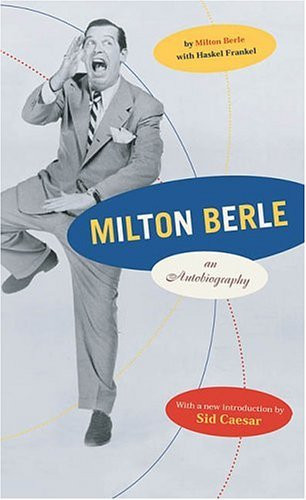
Milton Berle: an autobiography

Berle, Milton
(Applause Books). When Milton Berle died in the Spring of 2002, THE NEW YORK TIMES declared that the legendary comic "may have had a more profound influence on our way of life than some presidents or Nobel Prize winners." This landmark memoir, as startling today as it was when it was first published, reveals the life and times of the man known affectionately to millions as Uncle Miltie. Told with unflinching candor, here is one of the most fabled and influential show business careers of all time: from performing as a child in Vaudeville and making silent movies with Charlie Chaplin and Mary Pickford, to nightclub performances for Al Capone, working on radio during World War II, performing in Broadway musicals, and, finally, superstardom on television. Perhaps even more fascinating is Berle's scandal-ridden private life: his star-crossed love affair with a 1930's movie queen and the child they had out of wedlock, his numerous affairs with women ranging from evangelist Aimee Semple McPherson to Marilyn Monroe, and his stormy relationship with beautiful showgirl Joyce Mathews, whom Berle married twice. It is Berle's unsparing account of his life and his determination to show the world his real face that led Frank Sinatra, at the time, to call this "the gutsiest book I've read in years." Told with equal amounts of comedy and pathos, and featuring colorful appearancesby all the major stars of his day, MILTON BERLE is simply one of the best show business memoirs ever written.
Applause Theatre & Cinema Books 2002-09-01 337 pages

Wassily Leontief and input-output economics

Wassily Leontief,Erik Dietzenbacher,Michael L. Lahr
Wassily Leontief (1905–1999) was the founding father of input-output economics, for which he received the Nobel Prize in 1973. This book offers a collection of papers in memory of Leontief by his students and close colleagues. The first part, 'Reflections on Input-Output Economics', focuses upon Leontief as a person and scholar as well as his personal contributions to economics. It includes contributions by Nobel Laureate Paul A. Samuelson who shares his memories of a young Professor Leontief at Harvard and ends with the last joint interview with Wassily and his wife, to date previously unpublished. The second part, 'Perspectives of Input-Output Economics', includes theoretical and empirical research inspired by Leontief's work and offers a wide-ranging sample of the state of interindustry economics, a field Leontief founded. This is a strong collection likely to appeal to a wide range of professionals in universities, government, industry and international organizations.
Cambridge University Press 2004-03-25 396 pages

Battling for peace: a memoir

Peres, Shimon
"One of the great statesmen of our century, Shimon Peres, winner of the 1994 Nobel Peace Prize, has shaped the history of Israel and the future of the Middle East. In the seventies, as Israel's minister of defense, he engineered the legendary Entebbe raid against PLO terrorists; in the eighties, as prime minister, he saved the Israeli economy from near collapse; and as foreign minister, Shimon Peres is now a key negotiator in the peace accords that he helped bring about. In Battling for Peace, he tells, for the first time, the story of his amazing career. As we follow Peres from his ancestral home in Poland to Israel, from the youth village of Ben-Shemen to Kibbutz Alumot, from youth movement leader to prime minister, we are introduced both to a man and to a nation. A thoughtful, disciplined, and immensely resourceful young man, Peres was singled out by Israel's great leader David Ben-Gurion, who appointed him, while still in his twenties, director general of the Ministry of Defense. From this point on, Peres's life was inseparable from his country's history. Peres writes of his bitter quarrels with Golda Meir and Yitzhak Rabin, and of his great admiration for Ben-Gurion, Moshe Dayan, and Francois Mitterrand. He discusses the origins of Israel's nuclear program, and tells how he led the way toward the Oslo agreement, describing his secret talks with King Hussein in London ten years ago, and revealing how a chance for peace was thwarted by self-serving politicians and timid American diplomacy"--OCLC
Random House 1995-05-10 350 pages

Amos Oz: writer, activist, icon

Alter, Robert
"Amos Oz (1939-2018) was one of Israel's most prolific and prominent writers, as well as a regular contender for the Nobel Prize for Literature. He was the author of dozens of novels, essay collections, and novellas written between 1965 and shortly before his death. In this first published biography of Oz, the celebrated translator, literary critic, and biblical scholar Robert Alter explores Oz's relationship with his family, beginning with the suicide of his mother, Fania Klausner, when he was twelve years old, and goes on to review his time in Kibbutz Hulda, which he entered at fourteen following his separation from his father, Arieh Klausner; his family's right-wing Zionism; his writing career; his activism in support of a pluralistic Israel; and his work as an international lecturer. In examining Oz's life and work, Alter brings together testimony from Oz and his circle, as well as close readings of his central works, to present the inner world and public persona of Amos Oz.--Dust jacket.
Yale University Press 2023 176 pages

Obama: the historic journey

Abramson, Jill
This is the remarkable story of Barack Obama's journey to the White House, as told by the greatest cultural recorders in the world, the staff of The New York Times. From the first mention of Barack Obama in its pages (when he was elected president of the Harvard Law Review), to his electrifying speech at the 2004 Democratic Convention, to the days and months of the hardfought, innovative campaign for Presidency, The New York Times has documented, recorded, and analyzed Obama in all the ways that he has irrevocably changed this country. In twelve rich chapters, filled with award-winning photos and graphics, as well as text from Nobel Prize and Pulitzer€”winning columnists like Paul Krugman and Thomas Friedman, and seasoned political reporters like Adam Nagourney, The New York Times tells Obama's unlikely and incredible journey from the beginning all the way to his inauguration as President of the United States. Jill Abramson, the managing e
New York Times 2009-02-16 237 pages

From the kingdom of memory: reminiscences

Wiesel, Elie
In this "powerful" (New York Times Book review) collection of personal essays and landmark speeches by "one of the great writers of our generation" (New Republic), Elie Wiesel weaves together reminiscences of his life before the Holocaust, his struggle to find meaning afterward, and the actions he has taken on behalf of others that have defined him as a leading advocate of humanity and have earned him the Nobel Peace Prize. Here, too, as a tribute to the dead and an exhortation to the living are landmark speeches, among them his powerful testimony at the Klaus Barbie trial, his impassioned plea to President Reagan not to visit a German S.S. cemetery, and the speech he gave in Oslo in acceptance of the Nobel Peace Prize, in which he voices his hope that "the memory of evil will serve as a shield against evil."
Schocken Books 1995-01-31 250 pages