3 results for "Nobel"

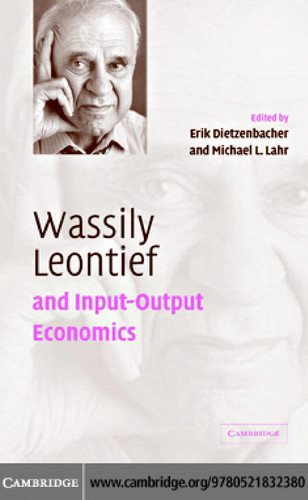
Wassily Leontief and input-output economics

Wassily Leontief,Erik Dietzenbacher,Michael L. Lahr
Wassily Leontief (1905–1999) was the founding father of input-output economics, for which he received the Nobel Prize in 1973. This book offers a collection of papers in memory of Leontief by his students and close colleagues. The first part, 'Reflections on Input-Output Economics', focuses upon Leontief as a person and scholar as well as his personal contributions to economics. It includes contributions by Nobel Laureate Paul A. Samuelson who shares his memories of a young Professor Leontief at Harvard and ends with the last joint interview with Wassily and his wife, to date previously unpublished. The second part, 'Perspectives of Input-Output Economics', includes theoretical and empirical research inspired by Leontief's work and offers a wide-ranging sample of the state of interindustry economics, a field Leontief founded. This is a strong collection likely to appeal to a wide range of professionals in universities, government, industry and international organizations.
Cambridge University Press 2004-03-25 396 pages

Models of my life

Simon, Herbert A.
In this candid and witty autobiography, Nobel laureate Herbert A. Simon looks at his distinguished and varied career, continually asking himself whether (and how) what he learned as a scientist helps to explain other aspects of his life. A brilliant polymath in an age of increasing specialization, Simon is one of those rare scholars whose work defines fields of inquiry. Crossing disciplinary lines in half a dozen fields, Simon's story encompasses an explosion in the information sciences, the transformation of psychology by the information-processing paradigm, and the use of computer simulation for modeling the behavior of highly complex systems. Simon's theory of bounded rationality led to a Nobel Prize in economics, and his work on building machines that think&-- based on the notion that human intelligence is the rule-governed manipulation of symbols&--laid conceptual foundations for the new cognitive science. Subsequently, contrasting metaphors of the maze (Simon's view) and of the mind (neural nets) have dominated the artificial intelligence debate. There is also a warm account of his successful marriage and of an unconsummated love affair, letters to his children, columns, a short story, and political and personal intrigue in academe.
MIT Press 1996-10-08 415 pages