30 results for "Nobel"

"Surely you're joking, Mr. Feynman!”: adventures of a curious character

Feynman, Richard P.
Winner of the Nobel Prize for Physics in 1965, Richard Feynman was one of the world's greatest theoretical physicists, but he was also a man who fell, often jumped, into adventure. An artist, safecracker, practical joker and storyteller, Feynman's life was a series of combustible combinations made possible by his unique mixture of high intelligence, unquenchable curiosity and eternal skepticism. Over a period of years, Feynman's conversations with his friend Ralph Leighton were first taped and then set down as they appear here, little changed from their spoken form, giving a wise, funny, passionate and totally honest self-portrait of one of the greatest men of our age.
Norton 1985 350 pages

Arguing with zombies: economics, politics, and the fight for a better future

Krugman, Paul R.
"An accessible, compelling introduction to today's major policy issues from columnist, best-selling author, and Nobel Prize-winning economist Paul Krugman. There is no better guide than Paul Krugman to basic economics, the ideas that animate much of our public policy. Likewise, there is no better foe of zombie economics, the misunderstandings that just won't die. This delightful new book finds Krugman at his best, turning readers into intelligent consumers of the daily news with quick, vivid sketches of the key concepts behind taxes, health care, international trade, and more. Arguing with Zombies will put Krugman at the front of the debate in the 2020 election year. Building on and expanding his New York Times columns and other writings, it contains short, accessible chapters on topics including the fight for national health care in the United States, the housing bubble and financial meltdown of 2007- 2008, the European Union and Brexit, the attack on Social Security, and the fraudulent argument- the ultimate zombie- that tax cuts for the rich will benefit all"--
W. W. Norton & Company 2020-01-28 444 pages

Breaking the sound barrier

Goodman, Amy
Amy Goodman, award-winning host of the daily internationally broadcast radio and television program Democracy Now!, breaks through the corporate media's lies, sound bites, and silence in this wide-ranging new collection of articles. "Amy Goodman has taken investigative journalism to new heights of exciting, informative, and probing analysis."--Noam Chomsky "You can learn more of the truth about Washington and the world from one week of Amy Goodman's Democracy Now! than from a month of Sunday morning talk shows. Make that a year of Sunday talk shows. That's because Amy, as you will discover on every page of this book, knows the critical question for journalists is how close they are to the truth, not how close they are to power."--From the Preface by Bill Moyers In place of the usual suspects--the "experts" who, in Goodman's words, "know so little about so much, explain the world to us, and get it so wrong"--this accessible, lively collection allows the voices the corporate media exclude and ignore to be heard loud and clear. From community organizers in New Orleans, to the courageous American soldiers who've said "No" to Washington's wars, to the victims of torture and police violence, we are given the extraordinary opportunity to hear ordinary people standing up and speaking out. Written with all of the fierce intelligence and passion for truth that millions have come to expect from Amy Goodman's reportage, Breaking the Sound Barrier proves the power that independent journalism can play in the struggle for a better world, one in which ordinary citizens are the true experts of their own lives and communities. Amy Goodman is an award-winning investigative journalist and syndicated columnist, author and the host/executive producer of Democracy Now! airing on nearly 800 stations worldwide. Goodman is the first journalist to receive the Right Livelihood Award, widely known as the 'Alternative Nobel Prize' for "developing an innovative model of truly independent grassroots political journalism that brings to millions of people the alternative voices that are often excluded by the mainstream media.". Goodman is the co-author with her brother, journalist David Goodman, of three New York Times bestsellers: Standing Up to the Madness, Static, and The Exception to the Rulers.
Haymarket Books 2009 377 pages

The genius factory: the curious history of the Nobel Prize sperm bank

Plotz, David
It was the most radical human-breeding experiment in American history, and no one knew how it turned out. The Repository for Germinal Choice–nicknamed the Nobel Prize sperm bank–opened to notorious fanfare in 1980, and for two decades, women flocked to it from all over the country to choose a sperm donor from its roster of Nobel-laureate scientists, mathematical prodigies, successful businessmen, and star athletes. But the bank quietly closed its doors in 1999–its founder dead, its confidential records sealed, and the fate of its children and donors unknown. In early 2001, award-winning columnist David Plotz set out to solve the mystery of the Nobel Prize sperm bank. Plotz wrote an article for Slate inviting readers to contact him–confidentially–if they knew anything about the bank. The next morning, he received an email response, then another, and another–each person desperate to talk about something they had kept hidden for years. Now, in The Genius Factory, Plotz unfolds the full and astonishing story of the Nobel Prize sperm bank and its founder’s radical scheme to change our world. Believing America was facing genetic catastrophe, Robert Graham, an eccentric millionaire, decided he could reverse the decline by artificially inseminating women with the sperm of geniuses. In February 1980, Graham opened the Repository for Germinal Choice and stocked it with the seed of gifted scientists, inventors, and thinkers. Over the next nineteen years, Graham’s “genius factory” produced more than two hundred children. What happened to them? Were they the brilliant offspring that Graham expected? Did any of the “superman” fathers care about the unknown sons and daughters who bore their genes? What were the mothers like? Crisscrossing the country and logging countless hours online, Plotz succeeded in tracking down previously unknown family members–teenage half-brothers who ended up following vastly different paths, mothers who had wondered for years about the identities of the donors they had selected on the basis of code names and brief character profiles, fathers who were proud or ashamed or simply curious about the children who had been created from their sperm samples. The children of the “genius factory” are messengers from the future–a future that is bearing down on us fast. What will families be like when parents routinely “shop” for their kids’ genes? What will children be like when they’re programmed for greatness? In this stunning, eye-opening book, one of our finest young journalists previews America’s coming age of genetic expectations.
Random House 2005-06-07 262 pages

Globalization and its discontents

Stiglitz, Joseph E.
Our world is changing. Globalisation is not working. It is hurting those it was meant to help. And now, the tide is turning . . .Explosive and shocking, Globalization and Its Discontents is the bestselling expose of the all-powerful organisations that control our lives - from the man who has seen them at work first hand. As chief economist at the World Bank, Nobel Prize-winner Joseph Stiglitz had a unique insider's view into the management of globalisation. Now he speaks out against it- how the IMF and WTO preach fair trade yet impose crippling economic policies on developing nations; how free market 'shock therapy' made millions in East Asia and Russia worse off than they were before; and how the West has driven the global agenda to further its own financial interests. Globalisation can still be a force for good, Stiglitz argues. But the balance of power has to change. Here he offers real, tough solutions for the future.
Penguin 2002 288 pages

The silenced majority: stories of uprisings, occupations, resistance, and hope

Goodman, Amy
""Amy Goodman has taken investigative journalism to new heights of exciting, informative, and probing analysis."-Noam Chomsky Amy Goodman and Denis Moynihan began writing a weekly column, "Breaking the Sound Barrier," for King Features Syndicate in 2006. This timely new sequel to Goodman's New York Times bestseller of the same name gives voice to the many ordinary people standing up to corporate and government power-and refusing to be silent. The Silenced Majority pulls back the veil of corporate media reporting to dig deep into the politics of "climate apartheid," the implications of the Fukushima nuclear disaster, the movement to halt the execution of Troy Anthony Davis, and the globalization of dissent "From Tahrir Square to Liberty Plaza." Throughout Goodman and Moynihan show the power of ordinary people to change their media-and change the world. Amy Goodman is a multiple New York Times best-selling author and the host and executive producer of Democracy Now! a daily independent news program airing on more than one thousand television and radio stations. Time named Democracy Now! its "Pick of the Podcasts," along with NBC's Meet the Press. Goodman is the first journalist to receive the Right Livelihood Award, widely known as the "Alternative Nobel Prize." Denis Moynihan, since helping co-found Democracy Now! as an independent production company in 2002, has participated in the organization's growth, focusing primarily on distribution, infrastructure development, and coordinating complex live broadcasts from all continents (save Antarctica). He lives in Denver, Colorado. "--
Haymarket Books 2012 345 pages

Economics of the public sector

Stiglitz, Joseph E.
What should be the role of government in society? How should it design its programs? How should tax systems be designed to promote both efficiency and fairness? Nobel Laureate Joseph Stiglitz and new co-author Jay Rosengard use their first-hand policy-advising experience to address these key issues of public-sector economics in this modern and accessible Fourth Edition.
W. W. Norton & Company, Inc 2015 923 pages

Human capital: a theoretical and empirical analysis, with special reference to education

Becker, Gary S.
Human Capital is Becker's classic study of how investment in an individual's education and training is similar to business investments in equipment. Recipient of the 1992 Nobel Prize in Economic Science, Gary S. Becker is a pioneer of applying economic analysis to human behavior in such areas as discrimination, marriage, family relations, and education. Becker's research on human capital was considered by the Nobel committee to be his most noteworthy contribution to economics. This expanded edition includes four new chapters, covering recent ideas about human capital, fertility and economic growth, the division of labor, economic considerations within the family, and inequality in earnings. "Critics have charged that Mr. Becker's style of thinking reduces humans to economic entities. Nothing could be further from the truth. Mr. Becker gives people credit for having the power to reason and seek out their own best destiny."— Wall Street Journal
The University of Chicago Press 1993-01 390 pages

Bob Dylan in America

Wilentz, Sean
A brilliantly written and groundbreaking book about Dylan's music - now the recipient of the Nobel Prize for Literature 2016 - and its musical, political and cultural roots in early 20th-century America Growing up in Greenwich Village in the 1960s Sean Wilentz discovered the music of Bob Dylan as a young teenager. Almost half a century later, now a distinguished professor of American history, he revisits Dylan's work with the critical skills of a scholar and the passion of a fan. Drawing partly on his work as the current historian-in-residence on Dylan's official website, Sean Wilentz provides a unique blend of biography, memoir and analysis in a book which, much like its subject, shifts gears and changes shape as the occasion demands.
Vintage 2011 390 pages

The art and politics of science

Varmus, Harold
A Nobel Prize–winning cancer biologist, leader of major scientific institutions, and scientific adviser to President Obama reflects on his remarkable career. A PhD candidate in English literature at Harvard University, Harold Varmus discovered he was drawn instead to medicine and eventually found himself at the forefront of cancer research at the University of California, San Francisco. In this “timely memoir of a remarkable career” ( American Scientist ), Varmus considers a life’s work that thus far includes not only the groundbreaking research that won him a Nobel Prize but also six years as the director of the National Institutes of Health; his current position as the president of the Memorial Sloan-Kettering Cancer Center; and his important, continuing work as scientific adviser to President Obama. From this truly unique perspective, Varmus shares his experiences from the trenches of politicized battlegrounds ranging from budget fights to stem cell research, global health to science publishing.
W. W. Norton 2010-04-27 315 pages

In search of memory: the emergence of a new science of mind

Kandel, Eric R.
Nobelist Eric Kandel's account of how his personal quest to understand memory intersected with the emergence of a new science. In Search of Memory relates the astonishing story of how four different and distinct disciplinesbehaviorist psychology, cognitive psychology, neuroscience, and molecular biologyconverged into a powerful new science of mind. Through its profound insights into thought, perception, action, recollection, and mental illness, this new science is revolutionizing our understanding of learning and memory while simultaneously showing great promise for more effective healing. The narrative follows Eric R. Kandel through the last five decades, focusing on Vienna, where he became fascinated with memory. With intrepid scientific ardor, Kandel was captivated first by history and psychoanalysis, then by neurobiology, and finally by the biological processes of memory. His resulting, multifaceted perspective was the foundation for his path-breaking research that will continue to dominate modern thoughtnot only in science but in culture at large. 50 illustrations.
W. W. Norton & Company 2006 510 pages

The optimum quantity of money

Friedman, Milton
This classic set of essays by Nobel Laureate and leading monetary theorist Milton Friedman presents a coherent view of the role of money, focusing on specific topics related to the empirical analysis of monetary phenomena and policy. The early chapters cover factors determining the real quantity of money held in a community and the welfare implications of policies that affect the quantity held. The following chapters formally restate why quantity analysis has become central to the science of economics. Friedman's presidential address to the American Economic Association, included here, provides a general summary of his views on the role of monetary policy, with an emphasis on its limitations and its possibilities. This theoretical framework is used in examining a number of empirical problems: the demand for money, the explanation of price changes in wartime periods, and the role of money in business cycles. These essays summarize some of the most important results of Friedman's extensive research over the course of his lifetime. The chapters on policy that follow survey the positions of earlier economists and deal with the importance of lags and the implications of destabilizing speculation in foreign markets. Taken as a whole, The Optimum Quantity of Money provides a comprehensive view of the body of monetary theory developed in leading centers of monetary analysis. This work is essential reading for economists and graduate students in the field. The volume will be no less important for practicing business and banking personnel as well. The new statement by Michael Bordo, a student of Friedman's and an expert in the field, provides a sense of where the field now stands in the economy and academy. Milton Friedman is a senior fellow at the Hoover Institution of Stanford University. Before that, he was Distinguished Service Professor of Economics at the University of Chicago. He has also taught at Columbia University, the University of Wisconsin, the University of Minnesota, and Cambridge University. Among his many books are Essays in Positive Economics , A Program for Monetary Stability , Capitalism and Freedom , and A Monetary History of the United States . Michael D. Bordo is professor of economics at Rutgers, The State University of New Jersey, and author, with Lars Jonung, of, among other works, Demand for Money .
Aldine Transaction 2006 296 pages

The Pope of Physics Enrico Fermi and the Birth of the Atomic Age

Gino Segrè,Bettina Hoerlin
A New York Times Book Review Editors’ Choice Named a Best Book of the Year by Bloomberg (Chosen by Philip Tetlock), Booklist ’s Top 10 Science Books of the Year, and Shortlisted for Physics World ’s Book of the Year A Major Biography of the Nobel Prize–Winning Physicist, Enrico Fermi, a Leading Architect of the Atomic Age Enrico Fermi is unquestionably among the greats of the world’s physicists, the most famous Italian scientist since Galileo. Called “the Pope” by his peers, he was regarded as infallible in his instincts and research. His discoveries changed our world; they led to weapons of mass destruction and conversely to life-saving medical interventions. This unassuming man struggled with issues relevant today, such as the threat of nuclear annihilation and the relationship of science to politics. Fleeing Fascism and anti-Semitism, Fermi became a leading figure in America’s most secret project: building the atomic bomb. An examination of the human dramas that touched Fermi’s life as well as a thrilling history of scientific innovation in the twentieth century, this is the comprehensive biography that Fermi deserves.
Picador 2017-10-10 384 pages

Hemingway and me: letters, anecdotes, and memories of a life-changing friendship

Lyons, Jeffrey
"When Ernest Hemingway died on July 2, 1961, Mary Hemingway asked the Hemingway's good friend, journalist Leonard Lyons, to announce the death of the Nobel Prize-winner to stunned readers and admirer everywhere. Both Hemingways admired Lyons for his fidelity to the truth, that "he would get the story right." (As it turns out the "truth" was not quite what it seemed, since Mary initially denied that her husband's death was suicide.) This memoir recounts the quarter-century long friendship between Hemingway and Leonard Lyons, which eventually came to include Lyons's wife and three sons. In this short book Jeffrey Lyons recounts visits to Hemingway in Cuba (where "Papa" first taught him how to shoot a gun) as well as nights out with the great writer at such popular New York watering holes as the Stork Club and Toots Shor's. Throughout the book Hemingway comes across as a hard-working, generous, and thoughtful man of letters, and not the gruff, hard drinking beast perpetually looking for a fight that he was often perceived as. This is a book about friendship, loyalty, and trust between a famed novelist and a working journalist and his family"--
Lyons Press 2021-05-01 140 pages

Elie Wiesel: an extraordinary life and legacy

Nadine Epstein
Elie Wiesel (1928-2016) is best known as the author of Night, survivor of Auschwitz and a powerful, enduring voice of the Holocaust. A recipient of the Nobel Peace Prize and the Presidential Medal of Freedom, he was a hero of human rights, professor and author of more than 50 books. Among his accomplishments, Wiesel co-founded Moment Magazine with Leonard Fein in 1975 to be a place of conversation for America's Jews. For editor-in-chief Nadine Epstein, he became a mentor and friend after she took over the magazine in 2004. In this striking volume, Epstein shares her memories of Wiesel and brings together 36 interviews with friends, colleagues and others who knew him - including, his son Elisha, Michael Berenbaum, Wolf Blitzer, Father Patrick Debois, Ronald S. Lauder, Bernard Henri-Levi, Kati Marton, Natan Sharansky, Ben Kingsley, and Oprah Winfrey. The foreword is by British Rabbi Jonathan Sacks and the afterword is by broadcaster Ted Koppel. To celebrate this humanitarian and keep his inspiration alive, Epstein presents readers with a visual history of Wiesel's life and examines the influence of Night. This chilling story of the Holocaust has already gripped the souls of millions of readers. Epstein includes a selection of his speeches and writings, lively conversations with teenagers about Night and discussion questions. The book features more than 100 photos. Says Rabbi Jonathan Sacks: "This book of reflections is a fitting tribute to the legacy of Elie Wiesel. In its pages and through the words of its contributors, you will feel a promise, not just to the souls who perished, but also to Elie and all those who survived Europe's darkest night." From the Inside Flap "It is absolutely imperative for this legacy of Elie Wiesel's to continue. It has to, and if it doesn't, it is our loss, and it will be an unfathomable loss." ―Ben Kingsley "Wiesel taught us that we must not forget; that there is no greater sin than that of silence and indifference. In doing so he has not just illumined the past, he has illumined the future" ―Oprah Winfrey "There was something burning inside of Elie, a flame ignited by injustice and pain. He was willing to share that part of himself. Pain can make people retreat from life, but opened Elie to the world." ―Kathleen Kennedy Townsend "He performed the alchemy of converting pain, injustice and horror into love, compassion and tolerance. We remember him not so much because he so often succeeded but because he never stopped trying." ―Ted Koppel "I believe there is a risk of Elie Wiesel, the Holocaust, and other genocides being forgotten. Without a real effort to retain their memory, they may simply disappear from history. Elie Wiesel was a light in the night for the whole world, not just the Jewish one." ―Father Patrick Desbois About the Author Editor: Nadine Epstein, Editor-in-Chief of Moment Magazine, is the founder and executive director of the Center for Creative Change and founder of the Daniel Pearl Investigative Journalism Initiative. An award-winning journalist and author, she reported for the City News Bureau of Chicago and the Chicago Bureau of the New York Times and covered the U.S.-Mexico border. She was a Knight-Wallace Fellow at the University of Michigan, where she also taught journalism. She is also an artist and the creator of the iShadow Project. Foreword: Rabbi Lord Jonathan Sacks is the former Chief Rabbi of the United Kingdom. He is the author of more than 25 books, most recently Not in God's Name: Confronting Religious Violence. Ted Koppel was the anchor and managing editor of ABC News Nightline for 25 years. He is currently a contributor to CBS News Sunday Morning and author of Lights Out.
MomentBooks 2019 176 pages

Something to remember me by

Bellow, Saul
A trio of short works by the Nobel laureate and "greatest writer of American prose of the twentieth century" (James Wood, "The New Republic") While Saul Bellow is known best for his longer fiction in award-winning novels such as "The Adventures of Augie March" and "Herzog," "Something to Remember Me By" will draw new readers to Bellow as it showcases his extraordinary gift for creating memorable characters within a smaller canvas. The loss of a ring in "A Theft" helps an oft-married woman understand her own wisdom and capacity for love. In "The Bellarosa Connection," Harry Fonstein has escaped from Nazi brutality with the help of an underground organization masterminded by the legendary Broadway impresario Billy Rose, and his story continues in America . In the title story, seventeen-year-old Louie--whose mother is dying of cancer--strays far from home and finds not solace but humiliation and, ultimately, the blessing of his father's wrath.
Penguin 1991 222 pages

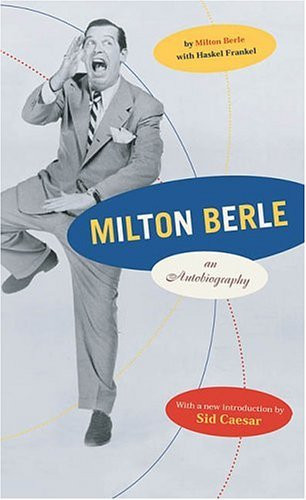
Milton Berle: an autobiography

Berle, Milton
(Applause Books). When Milton Berle died in the Spring of 2002, THE NEW YORK TIMES declared that the legendary comic "may have had a more profound influence on our way of life than some presidents or Nobel Prize winners." This landmark memoir, as startling today as it was when it was first published, reveals the life and times of the man known affectionately to millions as Uncle Miltie. Told with unflinching candor, here is one of the most fabled and influential show business careers of all time: from performing as a child in Vaudeville and making silent movies with Charlie Chaplin and Mary Pickford, to nightclub performances for Al Capone, working on radio during World War II, performing in Broadway musicals, and, finally, superstardom on television. Perhaps even more fascinating is Berle's scandal-ridden private life: his star-crossed love affair with a 1930's movie queen and the child they had out of wedlock, his numerous affairs with women ranging from evangelist Aimee Semple McPherson to Marilyn Monroe, and his stormy relationship with beautiful showgirl Joyce Mathews, whom Berle married twice. It is Berle's unsparing account of his life and his determination to show the world his real face that led Frank Sinatra, at the time, to call this "the gutsiest book I've read in years." Told with equal amounts of comedy and pathos, and featuring colorful appearancesby all the major stars of his day, MILTON BERLE is simply one of the best show business memoirs ever written.
Applause Theatre & Cinema Books 2002-09-01 337 pages

The economists' voice: top economists take on today's problems

Joseph E. Stiglitz,Aaron S. Edlin,J. Bradford De Long
In this valuable resource, more than thirty of the world's top economists offer innovative policy ideas and insightful commentary on our most pressing economic issues, such as global warming, the global economy, government spending, Social Security, tax reform, real estate, and political and social policy, including an extensive look at the economics of capital punishment, welfare reform, and the recent presidential elections. Contributors are Nobel Prize winners, former presidential advisers, well-respected columnists, academics, and practitioners from across the political spectrum. Joseph E. Stiglitz takes a hard look at the high cost of the Iraq War; Nobel Laureates Kenneth Arrow, Thomas Schelling, and Stiglitz provide insight and advice on global warming; Paul Krugman demystifies Social Security; Bradford DeLong presents divergent views on the coming dollar crisis; Diana Farrell reconsiders the impact of U.S. offshoring; Michael J. Boskin distinguishes what is "sense" and what is "nonsense" in discussions of federal deficits and debt; and Ronald I. McKinnon points out the consequences of the deindustrialization of America. Additional essays question whether welfare reform was successful and explore the economic consequences of global warming and the rebuilding of New Orleans. They describe how a simple switch in auto insurance policy could benefit the environment; unravel the dangers of an unchecked housing bubble; and investigate the mishandling of the lending institutions Freddie Mac and Fannie Mae. Balancing empirical data with economic theory, The Economists' Voice proves that the unique perspective of the economist is a vital one for understanding today's world. To learn more about the electronic journals published by The Berkeley Electronic Press, please visit http://www.bepress.com/ev.
Columbia University Press 2011 317 pages

Wassily Leontief and input-output economics

Wassily Leontief,Erik Dietzenbacher,Michael L. Lahr
Wassily Leontief (1905–1999) was the founding father of input-output economics, for which he received the Nobel Prize in 1973. This book offers a collection of papers in memory of Leontief by his students and close colleagues. The first part, 'Reflections on Input-Output Economics', focuses upon Leontief as a person and scholar as well as his personal contributions to economics. It includes contributions by Nobel Laureate Paul A. Samuelson who shares his memories of a young Professor Leontief at Harvard and ends with the last joint interview with Wassily and his wife, to date previously unpublished. The second part, 'Perspectives of Input-Output Economics', includes theoretical and empirical research inspired by Leontief's work and offers a wide-ranging sample of the state of interindustry economics, a field Leontief founded. This is a strong collection likely to appeal to a wide range of professionals in universities, government, industry and international organizations.
Cambridge University Press 2004-03-25 396 pages