44 results for "Novel"

Queen Charlotte

Quinn, Julia,Rhimes, Shonda
Go beyond the original Shondaland series on Netflix, Queen Charlotte, with this lushly romantic Bridgerton prequel novel written by New York Times bestselling authors Julia Quinn and Shonda Rhimes as the marriage of Queen Charlotte and King George of England leads to an unexpected love story and a union that transforms society. In 1761, on a sunny day in September, a King and Queen met for the very first time. They were married within hours. Born a German Princess, Charlotte of Mecklenburg-Strelitz was beautiful, headstrong, and fiercely intelligent... not precisely the attributes the British Court had been seeking in a spouse for the young King George III. But her fire and independence were exactly what she, and her King, needed. Because George has secrets... secrets with the potential to shake the very foundations of the monarchy. Thrust into her new role, Charlotte must navigate the intricate politics of the court--with the newly-titled Lady Danbury at her side--all the while guarding her heart, because she is falling in love with the King...even as he pushes her away. Now, Charlotte must learn to rule, and to understand that she has been given the power to remake society, fulfilling her destiny as Queen. But she also has to fight for the love growing between her and George as people first, royals second. As she says to him: "Fight with me! Fight for me!"
Avon 2023 335 pages

Incidents in the Life of a Slave Girl by Harriet Jacobs

Harriet Jacobs
A true account that reads as a novel, Harriet Jacobs's narrative bears rare witness to the female experience of slavery, highlighting the threat of sexual exploitation and appealing directly to women." -Victoria Segal ; The Guardian Harriet Jacobs (1813-1897) was an African-American writer who escaped from slavery and was later freed. She became an abolitionist and reformer. Jacobs wrote an autobiography, Incidents in the Life of a Slave Girl, published in 1861 under the pseudonym Linda Brent. It was a reworking of the genres of slave narrative and sentimental novel, and was one of the first books to address the struggle for freedom by female slaves, explore their struggles with sexual harassment and abuse and their effort to protect their roles as women and mothers. After being overshadowed by the American Civil War, the book was rediscovered in the late 20th century, when there was new interest in minority and women writers. A Must Read Classic for All Those Interested in African American History
Independently Published 2020-02-07 157 pages

Jane Eyre

Malouf, David
Perfectly preserving the tone and mood of the novel whilst condensing it into two acts, David Malouf, with the gift for language already evident from his novels and poetry, presents afresh the timeless story of Charlotte Brontë's Jane Eyre, one of the most enduring literary classics of all time. The love between Jane and Mr Rochester, and the mystery of the woman behind the locked door, are here set to music in the opera composed by Michael Berkeley.
Vintage 2011 27 pages

The other Victorians: a study of sexuality and pornography in mid-nineteenth-century England

Marcus, Steven
"Taking as his point of departure the authors, the audience, and the texts of Victorian writings on sex in general and of Victorian pornography in particular, Steven Marcus offers a startling and revolutionary perspective on the underside of Victorian culture. The way these subjects were regarded--and the way our notions of the Victorians continue to change, as the efforts of contemporary scholarship restore them to their full historical dimensions--are matters today of some surprise and wonder. Marcus first examines the writings of Dr. William Acton, who may be said to represent the "official views" of sexuality held by Victorian society, and Henry Spencer Ashby, the first and most important bibliographer-scholar of pornography. He then turns to the most significant work of its kind from the period, the eleven-volume anonymous autobiography My Secret Life. There follows an analysis of four pornographic Victorian novels--an analysis that throws an oblique but fascinating light on the classics of Victorian literature--and a review of the odd flood of Victorian publications devoted to flagellation. The books concludes with a chapter propounding a general theory of pornography as a sociological phenomenon. Most of the writers and writing being discussed by Marcus belong to Victorian sub-literature rather than to literature proper; in this way the work remains connected to a consideration of the exotic sub-literature. A brilliantly written book in its own right, this work transformed the study of the Victorian period as did no other." -- Provided by publisher
Transaction Publishers 2009 292 pages

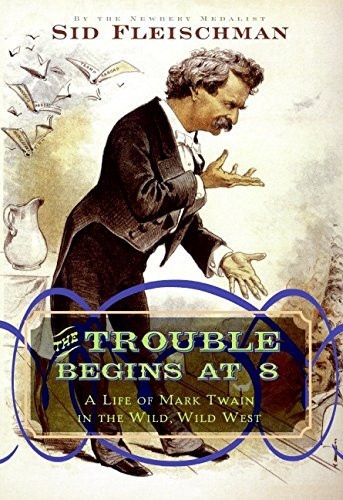
The trouble begins at 8: a life of Mark Twain in the wild, wild West

Fleischman, Sid
"Mark Twain was born fully grown, with a cheap cigar clamped between his teeth." So begins Sid Fleischman's ramble-scramble biography of the great American author and wit, who started life in a Missouri village as a barefoot boy named Samuel Clemens. Abandoning a career as a young steamboat pilot on the Mississippi River, Sam took a bumpy stagecoach to the Far West. In the gold and silver fields, he expected to get rich quick. Instead, he got poor fast, digging in the wrong places. His stint as a sagebrush newspaperman led to a duel with pistols. Had he not survived, the world would never have heard of Tom Sawyer or Huckleberry Finn—or red-headed Mark Twain. Samuel Clemens adopted his pen name in a hotel room in San Francisco and promptly made a jumping frog (and himself) famous. His celebrated novels followed at a leisurely pace; his quips at jet speed. "Don't let schooling interfere with your education," he wrote. Here, in high style, is the story of a wisecracking adventurer who came of age in the untamed West; an ink-stained rebel who surprised himself by becoming the most famous American of his time. Bountifully illustrated.
Greenwillow Books 2008 224 pages

Imagined cities: urban experience and the language of the novel

Alter, Robert
A literary investigation of how the modern metropolis--intoxicating, disturbing, powerful--changed perceptions and irrevocably altered the Western imagination. Alter traces the arc of literary development triggered by the runaway growth of urban centers from the early nineteenth century through the first two decades of the twentieth. As new technologies and arrangements of public and private space changed the ways people experienced time and space, the urban panorama became less coherent--a metropolis defying traditional representation and definition, a vast jumble of shifting fragments and glimpses--and writers were compelled to create new methods for conveying the experience of the city. In interpretations of novels by Flaubert, Dickens, Bely, Woolf, Joyce, and Kafka, Alter reveals the ways the city entered the literary imagination.--From publisher description.
Yale University Press 2005 175 pages

The waterworks

Doctorow, E. L.
“An elegant page-turner of nineteenth-century detective fiction.” –The Washington Post Book World One rainy morning in 1871 in lower Manhattan, Martin Pemberton a freelance writer, sees in a passing stagecoach several elderly men, one of whom he recognizes as his supposedly dead and buried father. While trying to unravel the mystery, Pemberton disappears, sending McIlvaine, his employer, the editor of an evening paper, in pursuit of the truth behind his freelancer’s fate. Layer by layer, McIlvaine reveals a modern metropolis surging with primordial urges and sins, where the Tweed Ring operates the city for its own profit and a conspicuously self-satisfied nouveau-riche ignores the poverty and squalor that surrounds them. In E. L. Doctorow’s skilled hands, The Waterworks becomes, in the words of The New York Times , “a dark moral tale . . . an eloquently troubling evocation of our past.” “Startling and spellbinding . . . The waters that lave the narrative all run to the great confluence, where the deepest issues of life and death are borne along on the swift, sure vessel of [Doctorow’s] poetic imagination.” – The New York Times Book Review “Hypnotic . . . a dazzling romp, an extraordinary read, given strength and grace by the telling, by the poetic voice and controlled cynical lyricism of its streetwise and world-weary narrator.” – The Philadelphia Inquirer “A gem of a novel, intimate as chamber music . . . a thriller guaranteed to leave readers with residual chills and shudders.” – Boston Sunday Herald “Enthralling . . . a story of debauchery and redemption that is spellbinding from first page to last.” – Chicago Sun-Times “An immense, extraordinary achievement.” –San Francisco Chronicle
Random House Trade Paperbacks 2007-05-08 253 pages

Balzac's Paris: the city as human comedy

Hazan, Éric
"Eric Hazan follows in Balzac's footsteps, criss-crossing the city in the novelist's outsize boots, running between printers, publishers, coffee merchants, mistresses and friends, stopping for a moment, struck by a detail that would be fixed in Balzac's photographic memory. More than a tour of the city, this is an attempt to measure the soul of a city as recovered in its finest literature"--
Verso 2024-06-25 200 pages

The secrets of Blythswood Square

Sheridan, Sara
LONGLISTED FOR SCOTLAND'S NATIONAL BOOK AWARDS 2024. THE ENCHANTING NEW NOVEL BY THE AUTHOR OF THE 2022 WATERSTONES SCOTTISH BOOK OF THE YEAR, THE FAIR BOTANISTS. 'Gripping' Good Housekeeping 'S ecrets discovered, ruinous rumours scotched, happiness regained and friendships founded' Daily Mail 'A novel of feeling and intellect which will surely and deservedly be a great success' Allan Massie, The Scotsman You wouldn't suspect it, but scandalous secrets are being kept on Blythswood Square... 1846. Glasgow is a city on the cusp of great social change, but behind the curtains, neighbours are watching, and rumours of improper behaviour spread like wildfire on the respectable Blythswood Square. When Charlotte Nicholl discovers that the fortune she has been bequeathed by her father is tied up in a secret collection of erotic art, she is faced with a terrible dilemma: sell it and risk shaming her family's good name or lose her home. An encounter with Ellory Mann, a talented working-class photographer newly arrived in Glasgow, leads Charlotte to hope she has found not only someone who might help her, but also a friend. Yet Ellory is hiding secrets of her own - secrets that become harder to conceal as she finds herself drawn into Charlotte's world. As the truth begins to catch up with both women, will it destroy everything they've fought to build - or set them both free? Readers love Sara Sheridan's storytelling! 'I absolutely love Sara Sheridan's books. They're so easy to get into and so hard to put down. The Secrets of Bythwood Square is no exception. It's a great story populated with excellent, believable characters and woven with rich historical detail' 5* reader review, NetGalley 'A fascinating, atmospheric story which I greatly enjoyed' 5* reader review, NetGalley 'I absolutely loved it, finished it within 2 days' 5* reader review, NetGalley 'Wonderful characters and a beautifully interwoven story.' 4* reader review, NetGalley PRAISE FOR THE FAIR BOTANISTS : 'Sheridan creates an evocative, enjoyable portrait of two women determined to lead independent lives' SUNDAY TIMES 'Completely enchanting and fascinating . . . a rollicking and immensely readable tale' SCOTSMAN 'Lush, seductive and scandalous, this is a gorgeous read' DAILY MAIL 'A cracking good read' VAL MCDERMID 'Dazzling, original, full of wonderful characters' KATIE FFORDE 'What a beautiful, immersive gem of historical fiction' GOOD HOUSEKEEPING 'An absolute treat for fans of historical fiction and rich storytelling' RED
Hodder 2024 352 pages

Disraeli: the novel politician

Cesarani, David
Product Description A fresh, vivid look at Disraeli's life, achievements, and temperament that casts doubts on his much-touted commitment to Jewish rights Lauded as a “great Jew,” excoriated by antisemites, and one of Britain’s most renowned prime ministers, Benjamin Disraeli has been widely celebrated for his role in Jewish history. But is the perception of him as a Jewish hero accurate? In what ways did he contribute to Jewish causes? In this groundbreaking, lucid investigation of Disraeli’s life and accomplishments, David Cesarani draws a new portrait of one of Europe’s leading nineteenth-century statesmen, a complicated, driven, opportunistic man. While acknowledging that Disraeli never denied his Jewish lineage, boasted of Jewish achievements, and argued for Jewish civil rights while serving as MP, Cesarani challenges the assumption that Disraeli truly cared about Jewish issues. Instead, his driving personal ambition required him to confront his Jewishness at the same time as he acted opportunistically. By creating a myth of aristocratic Jewish origins for himself, and by arguing that Jews were a superior race, Disraeli boosted his own career but also contributed to the consolidation of some of the most fundamental stereotypes of modern antisemitism. Book Description In this groundbreaking, vivid look at Disraeli’s life and accomplishments, David Cesarani draws a new portrait of one of Europe’s leading nineteenth-century statesmen, a complicated, driven, opportunistic man. While acknowledging that Disraeli never denied his Jewish lineage, boasted of Jewish achievements, and argued for Jewish civil rights while serving as MP, Cesarani challenges the assumption that Disraeli truly cared about Jewish issues. About the Author David Cesarani (1956–2015) was a research professor in History at Royal Holloway, University of London, and director of the Holocaust Research Centre. In 2005 he was named an Officer of the Order of the British Empire for his work in establishing a Holocaust Memorial Day in the UK.
Yale University Press 2018 304 pages

The fair botanists

Sheridan, Sara
It's the summer of 1822 and Edinburgh is abuzz with rumours of King George IV's impending visit. In botanical circles, however, a different kind of excitement has gripped the city. In the newly-installed Botanic Garden, the Agave Americana plant looks set to flower, an event that only occurs once every few decades. When newly widowed Elizabeth arrives in Edinburgh to live with her late husband's aunt Clementina, she's determined to put her unhappy past in London behind her. As she settles into her new home, she becomes fascinated by the beautiful Botanic Garden which borders the grand house and offers her services as an artist to record the rare plant's impending bloom. In this pursuit, she meets Belle Brodie, a vivacious young woman with a passion for botany and the lucrative, dark art of perfume creation. Belle is determined to keep both her real identity and the reason for her interest the Garden secret from her new friend. But as Elizabeth and Belle are about to discover, secrets don't last long in this Enlightenment city.
Hodder & Stoughton 2022 371 pages

Savage reprisals

Gay, Peter
A revelatory work that examines the intricate relationship between history and literature, truth and fiction—with some surprising conclusions. Focusing on three literary masterpieces—Charles Dickens's Bleak House (1853), Gustave Flaubert's Madame Bovary (1857), and Thomas Mann's Buddenbrooks (1901)—Peter Gay, a leading cultural historian, demonstrates that there is more than one way to read a novel. Typically, readers believe that fiction, especially the Realist novels that dominated Western culture for most of the nineteenth century and beyond, is based on historical truth and that great novels possess a documentary value. That trust, Gay brilliantly shows, is misplaced; novels take their own path to reality. Using Dickens, Flaubert, and Mann as his examples, Gay explores their world, their craftsmanship, and their minds. In the process, he discovers that all three share one overriding quality: a resentment and rage against the society that sustains the novel itself. Using their stylish writing as a form of revenge, they deal out savage reprisals, which have become part of our Western literary canon. A New York Times Notable Book and a Best Book of 2002.
W W Norton 2003-12-17 192 pages

Slave law in the American South: State v. Mann in history and literature

Tushnet, Mark V.
Product Description Slavery in the American South could not have existed without the authority of law defining slaves as the property of their masters. But the fact that slaves were also human beings placed limits on this harsh reality. When the rigor of the law and the complex bonds of sentiment linking master and slave came into conflict, masters looked to the courts. In one such case, State v. Mann, North Carolina Supreme Court justice Thomas Ruffin ruled that masters could not be prosecuted for assaulting their slaves. In articulating the legal basis for his decision, Justice Ruffin also revealed his own view of the "logic of slavery," in which he sanctioned the owner's rights even as he expressed his own horror at the mistreatment of the slave. Mark Tushnet, one of the foremost living authorities on antebellum slave law, now shows how studying such a simple case can illuminate an entire society. For those who detested slavery, the case represented all that was intolerable about that institution; for those who defended it, it raised vexing and persistent issues that could not be wished away. As further testament to the importance of State v. Mann, Harriet Beecher Stowe even made it central to her second antislavery novel, Dred. Tushnet discusses the opinion's place in the novel-in which she quoted liberally from Ruffin's decision-and evaluates other historians' interpretations of both the opinion and Stowe's provocative novel. Tushnet provides a finely detailed analysis of Ruffin's opinion, portraying the judge as a man compelled by law to uphold the slaveowner's right while moved as a Christian by the slave's maltreatment and ever hopeful that communal morality and a deep-seated sense of honor would moderate the excesses of slave owners. As Tushnet shows, however, slave law was a means for maintaining the ideological hegemony of the Southern master class. Slave Law in the American South paints a broad picture of a landmark case, tying together legal, historical, social, political, and even literary strands to show how the law itself was implicated in the persistence of slavery. It sheds new light on slavery and Southern history, as it probes the conscience of a troubled jurist incapable of fully transcending his times. This book is part of the Landmark Law Cases and American Society series. From the Back Cover "While losing neither objectivity nor moral compass, Mark Tushnet skillfully navigates the murky waters of Southern judicial and legal logic. His inspired study highly deserves close and serious attention."--Bertram Wyatt-Brown, author of The Shaping of Southern Culture: Honor, Grace, and War, 1760-1880s"More than two decades ago, Tushnet ignited the field of slave law studies with his provocative and thoughtful overview of the subject, The American Law of Slavery, 1810-1860. Now he has given us the first book-length study of a classic American slave case. Comprehensive and insightful, it merits the attention of legal scholars, historians, and non-specialists alike."--Timothy S. Huebner, author of The Southern Judicial Tradition: State Judges and Section Distinctness, 1790-1890 About the Author Mark V. Tushnet is Carmack Waterhouse Professor of Constitutional Law at Georgetown University Law Center. A former law clerk to Justice Thurgood Marshall, he is the author of numerous books including Taking the Constitution Away from the Courts and Red, White, and Blue: A Critical Analysis of Constitutional Law.
University Press of Kansas 2003 150 pages

An anthology of Jewish-Russian literature: two centuries of dual identity in prose and poetry

Maxim Shrayer
This definitive anthology gathers stories, essays, memoirs, excerpts from novels, and poems by more than 130 Jewish writers of the past two centuries who worked in the Russian language. It features writers of the tsarist, Soviet, and post-Soviet periods, both in Russia and in the great emigrations, representing styles and artistic movements from Romantic to Postmodern. The authors include figures who are not widely known today, as well as writers of world renown. Most of the works appear here for the first time in English or in new translations. The editor of the anthology, Maxim D. Shrayer of Boston College, is a leading authority on Jewish-Russian literature. The selections were chosen not simply on the basis of the author's background, but because each work illuminates questions of Jewish history, status, and identity. Each author is profiled in an essay describing the personal, cultural, and historical circumstances in which the writer worked, and individual works or groups of works are headnoted to provide further context. The anthology not only showcases a wide selection of individual works but also offers an encyclopedic history of Jewish-Russian culture. This handsome two-volume set is organized chronologically. The first volume spans the nineteenth century and the first part of the twentieth century, and includes the editor's extensive introduction to the Jewish-Russian literary canon. The second volume covers the period from the death of Stalin to the present, and each volume includes a corresponding survey of Jewish-Russian history by John D. Klier of University College, London, as well as detailed bibliographies of historical and literary sources.
Sharpe 2007 1278 pages

The body of Raphaelle Peale: still life and selfhood, 1812-1824

Nemerov, Alexander
"This book is mind-blowing. Nemerov is a groundbreaking thinker in his field."—John Wilmerding, Princeton University "This is a book for all serious Americanists."—Jay Fliegelman, author of Declaring Independence "Each haunting and delicately wrought canvas expands as Nemerov writes about it, so that his interpretive work both mirrors and supplements the wondrous intensity of the paintings themselves."—Ellen Handler Spitz, Museums of the Mind "Underneath their apparent simplicity, Raphaelle Peale's still lifes glow mysteriously in the dark light of their making. Peale transformed the common items of the early-nineteenth-century kitchen and market into explorations of the American unconscious. Now, writing as coolly and lucidly as Peale painted, Alexander Nemerov has unpeeled those still lifes in a tour de force of formalistic analysis. Through close interrogation of these small, hermetic images, Nemerov's book reveals the whole world of early America, in the process bringing us as close as possible to the genius of Raphaelle Peale."—David C. Ward, National Portrait Gallery, Smithsonian Institution. "This is a dazzling study, lively and imaginative, of an important body of work. Nemerov's novel arguments regarding still life in general and Raphaelle Peale in particular reveal much about the art, the man, and the times. It is a thoughtful and provocative book, certain to generate interest and debate. "—Charles C. Eldredge, Hall Distinguished Professor of American Art and Culture, University of Kansas "A triumph of interpretation! Not since Michael Fried's groundbreaking account of Thomas Eakins has a critic so reimagined the very terms by which we see painting. Nemerov's account singlehandedly catapults a painter we had previously considered to be interesting, but minor, into the forefront of discussions about American art during the early National Period. The Body of Raphaelle Peale will no doubt spark the beginning of an exciting revival of scholarship in American Romantic painting."—Bryan J. Wolf, author of Romantic Re-Vision
University of California Press 2001-03-12 260 pages