15 results for "Novel"

The Fran Lebowitz Reader

Fran Lebowitz
A brilliant collection of acerbic, wisecracking and hilarious essays from New York icon Fran Lebowitz, star of Martin Scorsese's hit Netflix series, Pretend It's a City. Fran Lebowitz is a New York legend. Arriving in the city over fifty years ago, she made her name as a columnist on Andy Warhol's Interview magazine, before publishing two bestselling collections of essays. She's one of America's most insightful social commentators, a sought-after public speaker, a style icon, wit and flaneur. In these essays, Lebowitz turns her trademark caustic wit to everything from children ('rarely in the position to lend one a truly interesting sum of money'), to novelty ice cubes ('flowers belong in one's lapel, not in one's bourbon') and landlords ('it is the solemn duty of every landlord to maintain an adequate supply of roaches'). And her attitude to work is the perfect antidote to our exhausting culture of self-betterment ('3.40pm. I consider getting out of bed. I reject the notion as being unduly vigorous. I read and smoke a bit more'). 'Great people talk about ideas, average people talk about things and small people talk about wine' 'Think before you speak. Read before you think' 'All God's children are not beautiful. Most of God's children are, in fact, barely presentable.' 'If your sexual fantasies were truly of interest to others, they would no longer be fantasies.' Note: contains a different selection of essays to earlier editions.
Virago 2021 336 pages

A jury of her peers: American women writers from Anne Bradstreet to Annie Proulx

Showalter, Elaine
LITERARY STUDIES: GENERAL. Fascinating, incisive, intelligent and never afraid of being controversial, Elaine Showalter introduces us to more than 250 writers. Here are the famous and expected names, including Harriet Beecher Stowe, Willa Cather, Dorothy Parker, Flannery O'Connor, Gwendolyn Brooks, Grace Paley, Toni Morrison, and Jodi Picoult. And also many successful and acclaimed yet little-known writers, from the early American bestselling novelist Catherine Sedgwick to the Pulitzer Prize-winning playwright Susan Glaspell. A JURY OF HER PEERS is an irresistible invitation to discover great authors never before encountered and to return to familiar books with a deeper appreciation. It is a monumental work that enriches our understanding of American literary history and culture.
Virago 2010 679 pages

Young lions: how Jewish authors reinvented the American war novel

Garrett, Leah
"Young Lions: How Jewish Authors Reinvented the American War Novel shows how Jews, traditionally castigated as weak and cowardly, for the first time became the popular literary representatives of what it meant to be a soldier and what it meant to be an American. Revisiting best-selling works ranging from Norman Mailer's The Naked and the Dead to Joseph Heller's Catch-22, and uncovering a range of unknown archival material, Leah Garrett shows how Jewish writers used the theme of World War II to reshape the American public's ideas about war, the Holocaust, and the role of Jews in postwar life. In contrast to most previous war fiction these new Jewish war novels were often ironic, funny, and irreverent and sought to teach the reading public broader lessons about liberalism, masculinity, and pluralism"--Page 4 of cover.
Northwestern University Press 2015-09-30 275 pages

Pen of iron: American prose and the King James Bible

Alter, Robert
In this book, biblical translator and literary critic Robert Alter traces some of the fascinating ways that American novelists--from Melville, Hemingway, and Faulkner to Bellow, Marilynne Robinson, and Cormac McCarthy--have drawn on the rich stylistic resources of the canonical English Bible to fashion their own strongly resonant styles and distinctive visions of reality. --from publisher description
Princeton University Press 2010 198 pages

Imaginations

Williams, William Carlos
Written between 1920 and 1932, all five were first published in small editions, three of them in France. These are pivotal and seminal works, books in which a great writer was charting the course he later would follow, experimenting freely, boldly searching for a new kind of prose style to express "the power of the imagination to hold human beings to life and propel them onward." The prose-poem improvisations (Kora in Hell) . . . the interweaving of prose and poetry in alternating passages (Spring and All and The Descent of Winter) . . . an antinovel whose subject is the impossibility of writing "The Great American Novel" in America . . . automatic writing (A Novelette) . . . these are the challenges which Williams accepted and brilliantly met in his early work.
New Directions 1971 365 pages

What is Jewish literature?

Wirth-Nesher, Hana
What Is Jewish Literature? is a richly thoughtful analysis and comprehensive overview of what defines Jewish literature. It is an international collection, featuring authors and scholars who write in different languages from different literary, spiritual, and personal perspectives.The book explores long-standing What are the criteria for identifying Jewish literature? Are they language, religious affiliation of the author, religious sensibility, a distinctive Jewish imagination, or literary tradition?If the writer is the criterion, do Sholem Aleichem and Nathanael West really inhabit a shared universe? Is a text by S.Y. Agnon part of the same literary tradition as a play by Arthur Miller?Is Yiddish or Hebrew or Ladino the defining element? If so, where do we place Franz Kafka, Primo Levi, Elie Weisel, Saul Bellow, Nellie Sachs?Is tradition the yardstick? Do we then classify Saul Bellow's Mr. Sammler's Planet as a Jewish novel... as Holocaust literature... as American fiction?What Is Jewish Literature? debates all these possibilities. It is a landmark collection that encourages the reader to participate in the quest for answers that defy simple responses.The contributors reflect the multilingual and multicultural nature of any discussion of Jewish literature. Their voices range from polemical to speculative, from scientific to lyrical.What Is Jewish Literature? is an enduring contribution to the literary resource for the scholar, the teacher, and the student and for any individual who strives to appreciate, evaluate, and understand the varied riches of Jewish writing.
Jewish Publication Society 1994 271 pages

Bodies of work: essays

Acker, Kathy
With enervating experimentation but touching directness, postmodern novelist Acker (Portrait of an Eve, 1992; My Mother: Demonology, 1993; etc.) explores art, politics, and being in her first essay collection. Subjects are various, ranging from William Burroughs to Goya to San Francisco; many of the pieces have been published previously (prefaces to books, articles in Marxism Today, the Critical Quarterly, etc.). Despite the variety of subjects and sources, the collection is neatly structured: Essays are grouped agreeably by subject-'On Art and Artists,' 'The City,' 'Bodies of Work.' Though Acker says she aims to 'destroy' the essay form, she does more of what the form openly invites--to tinker and confess. For example, she interweaves stories into a piece on artist Nayland Blake and applies Wittgenstein's 'language games' to bodybuilding: 'In a gym, verbal language or language whose purpose is meaning occurs, if at all, only at the edge of becoming lost.' But she also reveals her current weightlifting goals and describes a childhood desire to be a pirate. Not surprisingly, her most accessible works are those written for a wide audience, particularly an illuminating essay for the Village Voice on film director Peter Greenaway and a moving piece for the MMLA on copyright in the age of the Internet. In all, these essays are serious and reflective of a discontented mind bent on deconstruction. Some may find dreary her tale of patriarchy, dualism, and linearity of time; her elliptical tales and stark sentences may lack immediate clarity. For sure, her essays aren't casually authoritative like Updike's or reassuringly religious like Dillard's. Read Acker when you're patient and don't want to be comforted--or even satisfied. An unthreatening introduction to a vexing writer.-Kirkus
Serpent's Tail 1997 175 pages

The Paul Goodman reader

Goodman, Paul
A one-man think-tank for the New Left, Paul Goodman wrote over thirty books, most of them before his decade of fame as a social critic in the Sixties. A Paul Goodman Reader that does him justice must be a compendious volume, with excerpts not only from best-sellers like Growing Up Absurd, but also from his landmark books on education, community planning, anarchism, psychotherapy, language theory, and poetics. Samples as well from The Empire City, a comic novel reviewers compared to Don Quixote, prize-winning short stories, and scores of poems that led America's most respected poetry reviewer, Hayden Carruth, to exclaim, "Not one dull page. It's almost unbelievable." Goodman called himself as an old-fashioned man of letters, which meant that all these various disciplines and occasions added up to a single abiding concern for the human plight in perilous times, and for human promise and achieved grandeur, love and hope.
PM 2010 479 pages

Pages passed from hand to hand: the hidden tradition of homosexual literature in English from 1748 to 1914

Leavitt, David,Mitchell, Mark
Before E. M. Forster's Maurice, written in 1914, introduced a new openness about the favorable depiction of homosexuality in English fiction, a number of novels and stories carried coded portraits of homosexuals and homosexuality. Many of these were, by necessity, published privately; still others were written to insure that the homosexual component would be recognizable to a select few; still others embedded homosexual content within such "safe" genres as the Western and the public school novel. There have been several recent anthologies of twentieth-century gay fiction, but David Leavitt and Mark Mitchell's fascinating book is the first to explore the texts that circulated before the "gay fiction" genre came into being, and before greater tolerance allowed writers to treat homosexual themes directly. Leavitt and Mitchell include extracts from stories and novels by well-known writers such as Herman Melville, Walter Pater, Henry James, Willa Cather, and D. H. Lawrence, as well as work from neglected figures such as Count Eric Stenbock, John Francis Bloxam, "Alan Dale," and Gerald Hamilton -- the inspiration for Christopher Isherwood's Mr. Norris. The result is an entertaining and revelatory anthology, and a valuable contribution to our understanding of the literary treatment of homosexuality.
Houghton Mifflin 1997 458 pages

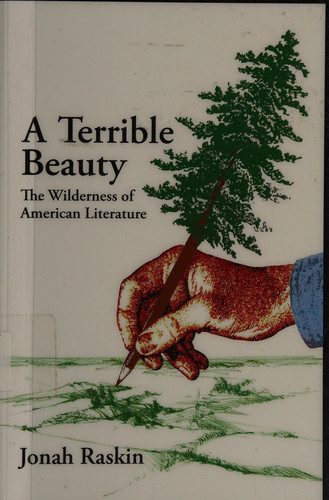
A terrible beauty: the wilderness of American literature

Raskin, Jonah
ABOUT THE BOOK Shortly before he published Walden; or Life in the Woods, Henry David Thoreau called ¿The library a wilderness of books.¿ He also noted that while Americans were ¿clearing the forest in our westward progress, we are accumulating a forest of books in our rear, as wild and unexplored as any of nature¿s primitive wildernesses.¿ In "A Terrible Beauty: the Wilderness of American Literature," Jonah Raskin takes a long close look at the forest of books that poets, novelists and essayists mapped and explored before and after Thoreau. The first work of cultural criticism to look back at writing in the United States from the perspective of the contemporary environmental crisis, Raskin offers insights for students, teachers and lovers of literature as well as for backpackers and hikers who have trekked across untrammeled forests, deserts and mountains. ABOUT THE AUTHOR Jonah Raskin, Phd, has taught American literature at Sonoma State University, the State University of New York at Stony Brook and as a Fulbright professor at the University of Antwerp and the University of Ghent in Belgium. The author of fifteen books, he earned his B.A. at Columbia College in New York, his M.A. at Columbia University and his Ph.D. at the University of Manchester, Manchester, England. He lives in northern California and has written for The San Francisco Chronicle, The L.A. Times, The Nation, The Redwood Coast Review and Catamaran.
Regent Press 2014 366 pages

The men in my life

Gornick, Vivian
Gornick on V. S. Naipaul, James Baldwin, George Gissing, Randall Jarrell, H. G. Wells, Loren Eiseley, Allen Ginsberg, Hayden Carruth, Saul Bellow, and Philip Roth and the intimate relationship between emotional damage and great literature. Vivian Gornick, one of our finest critics, tackled the theme of love and marriage in her last collection of essays, The End of the Novel of Love , a National Book Critics Circle Award finalist. In this new collection, she turns her attention to another large theme in literature: the struggle for the semblance of inner freedom. Great literature, she believes, is not the record of the achievement, but of the effort. Gornick, who emerged as a major writer during the second-wave feminist movement, came to realize that “ideology alone could not purge one of the pathological self-doubt that seemed every woman's bitter birthright.” Or, as Anton Chekhov put it so memorably: “Others made me a slave, but I must squeeze the slave out of myself, drop by drop.” Perhaps surprisingly, Gornick found particular inspiration for this challenge in the work of male writers—talented, but locked in perpetual rage, self-doubt, or social exile. From these men—who had infinitely more permission to do and be than women had ever known—she learned what it really meant to wrestle with demons. In the essays collected here, she explores the work of V. S. Naipaul, James Baldwin, George Gissing, Randall Jarrell, H. G. Wells, Loren Eiseley, Allen Ginsberg, Hayden Carruth, Saul Bellow, and Philip Roth. Throughout the book, Gornick is at her best: interpreting the intimate interrelationship of emotional damage, social history, and great literature.
MIT Press 2008-08-22 194 pages

Writing in America

John Fischer,Robert B. Silvers
"In the fall of 1959, Harper's Magazine published a special supplement on the state of writing and the American literary scene. The supplement was greeted with a broadside of commendation and a fusillade of cavil, and has since become recognized as the most useful brief survey of the contemporary state of the American writing arts and of their fellow travelers, the spoken word, the typescript word, the filmed and televised word, and the publishing memorandum. In this newly reissued volume in the Rutgers University Press Classics Imprint, Writing in America proves to be as stimulating as it was in 1960. Here, writers including Robert Brustein, Stanley Kunitz, and C.P. Snow examine the state of writing in American novels, films, and television candidly and critically. The result is a collection of essays that showcase a first-rate and highly entertaining piece of reporting on the American literary scene that resonate in 2017"--
Rutgers University Press 2018 153 pages

A cultural citizen of the world: Sigmund Freud's knowledge and use of British and American writings

Prawer, Siegbert Salomon
Based on an intensive study of the original German text of Freud's writings, letters and journals, S. S. Prawer's new book is the first to make a full and systematic map of Freud's use of English literature. The great psychoanalyst has long been acclaimed as a polymath, as a practical doctor who was also a theoretician, as a writer of non-fiction which was also a counterpoint to the great novels of the early twentieth century, and as an essayist who, like Montaigne, absorbed all of the cultural world around him. Freud was fascinated by writings from many nations and languages, and his use of English shows the great range of his reading: from Shakespeare to Bernard Shaw, Henry Fielding to George Eliot, Mark Twain to Thornton Wilder; from scientific works by Maxwell and Darwin to the economics of Adam Smith, Malthus and Keynes, and from psychology and anthropology to the origins of religion. Though Freud's genius was unique, his sense of being a citizen of a world far wider than Vienna was not, and it can tell us much about the exchange of ideas across national and linguistic frontiers. Though he was a reader par excellence, he was also a case study in how world literature can be used by men and women who are not professional literary scholars or critics -- and of how much it can come to mean to them, and for their sense of who they are.
Legenda 2009 145 pages

What ever happened to modernism?

Josipovici, Gabriel
The quality of today's literary writing arouses the strongest opinions. For novelist and critic Gabriel Josipovici, the contemporary novel in English is profoundly disappointing--a poor relation of its groundbreaking Modernist forebears. This agile and passionate book asks why. Modernism, Josipovici suggests, is only superficially a reaction to industrialization of a revolution in diction and form; essentially, it is art arriving at a consciousness of its own limits and responsibilities. And its origins are to be sought not in 1850 or even 1800, but in the early 1500s, with the crisis of society and perception that also led to the rise of Protestantism. With sophistication and persuasiveness, Josipovici charts some of Modernism's key stages, from Dürer, Rabelais, and Cervantes to the present, bringing together a rich array of artists, musicians, and writers both familiar and unexpected--including Beckett, Borges, Friedrich, Cézanne, Stevens, Robbe-Grillet, Beethoven, and Wordsworth. He concludes with a stinging attack on the current literary scene in Britain and America, which raises questions not only about national taste, but about contemporary culture itself. Gabriel Josipovici has spent a lifetime writing and writing about other writers. This book is a strident call to arms and a tour de force of literary, artistic, and philosophical explication that will stimulate anyone interested in art in the twentieth century and today.
Yale University Press 2011 208 pages