30 results for "Novel"

Leon Uris: life of a best seller

Nadel, Ira Bruce
As the best-selling author of Exodus, Mila 18, QB VII, and Trinity, Leon Uris blazed a path to celebrity with books that readers could not put down. Uris’s thirteen novels sold millions of copies, spent months on the best-seller lists, appeared in fifty languages, and have been adapted into equally popular movies and TV miniseries. Few other writers equaled Uris’s fame in the mid-twentieth century. His success fueled the rise of mass-market paperbacks, movie tie-ins, and celebrity author tours. Beloved by the public, Uris was, not surprisingly, dismissed by literary critics. Until now, his own life and work—as full of drama as his fiction—have never been the subject of a book. In Leon Uris: Life of a Best Seller, Ira Nadel traces Uris from his disruptive youth to his life-changing experiences as a marine in World War II. These experiences, coupled with Uris’s embrace of his Judaism and desire to write, led to his unprecedented success and the lavish excesses of a career as a best-selling author. Nadel reveals that Uris lived the adventures he described, including his war experiences in the Pacific (Battle Cry), life-threatening travels in Israel (Exodus), visit to Communist Poland (Mila 18), libel trial in Britain (QB VII), and dangerous sojourn in fractious Northern Ireland and the Irish Republic (Trinity). Nadel also demonstrates that Uris’s talent for writing action-packed, yet thoroughly researched, novels meshed perfectly with the public’s desire to revisit and understand the tumultuous events of recent history. This made him far more popular (and wealthy) than more literary authors, while paving the way for writers such as Irving Wallace and Tom Clancy.
University of Texas Press 2010-10-15 352 pages

Wallace Stegner and the American West

Fradkin, Philip L.
Wallace Stegner was the premier chronicler of the twentieth-century western American experience, and his novels, the Pulitzer Prize–winning Angle of Repose and the National Book Award–winning The Spectator Bird, brought the life and landscapes of the West to national and international attention. Now, in this illuminating biography, Philip L. Fradkin goes beyond Stegner’s iconic literary status to give us, as well, the influential teacher and visionary conservationist, the man for whom the preservation and integrity of place was as important as his ability to render its qualities and character in his brilliantly crafted fiction and nonfiction. From his birth in 1909 until his death in 1993, Stegner witnessed nearly a century of change in the land that he loved and fought so hard to preserve. We learn of his hardscrabble youth on the Canadian frontier and in Utah, and of his painful relationship with his father, a bootlegger and gambler. We follow his intellectual awakening as a young man and his years as a Depression-era graduate student at the University of Iowa, during its earliest days as a literary center. We watch as he finds his home, with his wife, Mary, in the foothills above Palo Alto, which provided him with a long-awaited sense of belonging and a refuge in which he would write his most treasured works. And here are his years as the legendary founder of the Stanford Creative Writing Program, where his students included Ken Kesey, Edward Abbey, Robert Stone, and Wendell Berry. But the changes wrought by developers and industrialists were too much for Stegner, and he tirelessly fought the transformation of his Garden of Eden into Silicon Valley. His writings on the importance of establishing national parks and wilderness areas—not only for the preservation of untouched landscape but also for the enrichment of the human spirit—played a key role in the passage of historic legislation and comprise some of the most beautiful words ever written about the natural world. Here, too, is the story—told in full for the first time—of the accusations of plagiarism that followed the publication of Angle of Repose, and of the shadow they have cast on his greatest work. Rich in personal and literary detail, and in the sensual description of the country that shaped his work and his life—this is the definitive account of one of the most acclaimed and admired writers, teachers, and conservationists of our time.
Alfred A. Knopf 2008-02-12 369 pages

Sailor and fiddler: reflections of a 100-year-old author

Wouk, Herman
"In an unprecedented literary accomplishment, Herman Wouk, one of America's most beloved and enduring authors, reflects on his life and times from the remarkable vantage point of 100 years old. Many years ago, the great British philosopher Sir Isaiah Berlin urged Herman Wouk to write his autobiography. Wouk responded, "Why me? I'm nobody." Berlin answered, "No, no. You've traveled. You've known many people. You have interesting ideas. It would do a lot of good." Now, in the same year he has celebrated his hundredth birthday, Herman Wouk finally reflects on the life experiences that inspired his most beloved novels. Among those experiences are his days writing for comedian Fred Allen's radio show, one of the most popular shows in the history of the medium; enlisting in the US Navy during World War II; falling in love with Betty Sarah Brown, the woman who would become his wife (and literary agent) for sixty-six years; writing his Pulitzer Prize-winning novel, The Caine Mutiny; as well as a big hit Broadway play The Caine Mutiny Court Martial; and the surprising inspirations and people behind such masterpieces as The Winds of War, War and Remembrance, Marjorie Morningstar, and Youngblood Hawke. Written with the wisdom of a man who has lived through two centuries and the wit of someone who began his career as professional comedy writer, the first part of Wouk's memoir ("Sailor") refers to his Navy experience and writing career, the second ("Fiddler") to what he's learned from living a life of faith. Ultimately, Sailor and Fiddler is an unprecedented reflection from a vantage point few people have lived to experience"-- Provided by publisher.
Simon & Schuster 2016-10-18 137 pages

Saul Bellow: letters

Bellow, Saul
"Saul Bellow wrote marvelously acute, unsparing, tender, ferocious, hilarious, and wise letters throughout his long life (1915-2005). Friends, lovers, wives, colleagues, and fans all cross these pages.This self-portrait shows the influences at work in the man and illuminates his enduring legacy: the novels and stories that earned him a Nobel Prize and the admiration of readers the world over."-Back cover.
Viking 2010 571 pages

Hemingway and me: letters, anecdotes, and memories of a life-changing friendship

Lyons, Jeffrey
"When Ernest Hemingway died on July 2, 1961, Mary Hemingway asked the Hemingway's good friend, journalist Leonard Lyons, to announce the death of the Nobel Prize-winner to stunned readers and admirer everywhere. Both Hemingways admired Lyons for his fidelity to the truth, that "he would get the story right." (As it turns out the "truth" was not quite what it seemed, since Mary initially denied that her husband's death was suicide.) This memoir recounts the quarter-century long friendship between Hemingway and Leonard Lyons, which eventually came to include Lyons's wife and three sons. In this short book Jeffrey Lyons recounts visits to Hemingway in Cuba (where "Papa" first taught him how to shoot a gun) as well as nights out with the great writer at such popular New York watering holes as the Stork Club and Toots Shor's. Throughout the book Hemingway comes across as a hard-working, generous, and thoughtful man of letters, and not the gruff, hard drinking beast perpetually looking for a fight that he was often perceived as. This is a book about friendship, loyalty, and trust between a famed novelist and a working journalist and his family"--
Lyons Press 2021-05-01 140 pages

As consciousness is harnessed to flesh: diaries 1964-1980

Sontag, Susan
As Consciousness is Harnessed to Flesh reveals the inner life of Susan Sontag.Providing a unique insight into the mind of one of the leading intellectuals of the modern age, Susan Sontag's As Conscious is Harnessed to Flesh chronicles the cultural, moral, and political journeys of this renowned critic and artist at the height of her powers.As Consciousness Is Harnessed to Flesh follows Sontag through the turbulent years of the late 1960s - from her trip to Hanoi at the peak of the Vietnam War to her time making films in Sweden - up to 1980, just before the beginning of the Reagan era. This is an invaluable record of the inner workings of one of the most inquisitive and analytical thinkers of the twentieth century at the height of her power. It is also a remarkable document of on individual's political and moral awakening.'More true to life, both intellectual and emotional, than the most artful novel or careful biography' Sunday Telegraph'Gold dust' Sunday Times'A powerful self-portrait emerges. In its fragmentation . . . and passion, its combination of the erudite and the everyday, it is more true to life, both intellectual and emotional, than the most artful novel or careful biography. It may well be that Sontag's diaries will come to be seen as just as brilliant and important as anything she wrote' Sunday Telegraph'Mesmerising, fascinating' Guardian'Express the fullness and diversity of her intellectual curiosity. Revelatory in the most profound sense: they are existential fragments, self-selected thoughts, emotions, reactions . . . arising in one of the most remarkable minds of the twentieth century' The TimesOne of America's best-known and most admired writers, Susan Sontag was also a leading commentator on contemporary culture until her death in December 2004. Her books include four novels and numerous works of non-fiction, among them Regarding the Pain of Others, On Photography, Illness as Metaphor, At the Same Time, Against Interpretation and Other Essays and Reborn: Early Diaries 1947-1963, all of which are published by Penguin. A further eight books, including the collections of essays Under the Sign of Saturn and Where the Stress Falls, and the novels The Volcano Lover and The Benefactor, are available from Penguin Modern Classics.
Hamish Hamilton 2012 523 pages

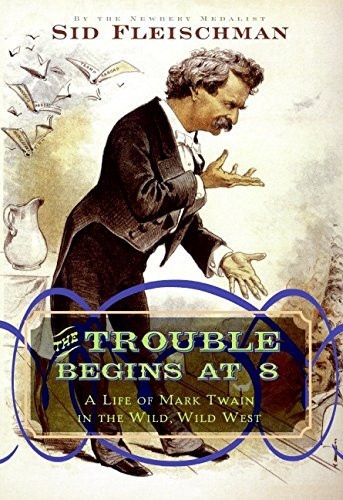
The trouble begins at 8: a life of Mark Twain in the wild, wild West

Fleischman, Sid
"Mark Twain was born fully grown, with a cheap cigar clamped between his teeth." So begins Sid Fleischman's ramble-scramble biography of the great American author and wit, who started life in a Missouri village as a barefoot boy named Samuel Clemens. Abandoning a career as a young steamboat pilot on the Mississippi River, Sam took a bumpy stagecoach to the Far West. In the gold and silver fields, he expected to get rich quick. Instead, he got poor fast, digging in the wrong places. His stint as a sagebrush newspaperman led to a duel with pistols. Had he not survived, the world would never have heard of Tom Sawyer or Huckleberry Finn—or red-headed Mark Twain. Samuel Clemens adopted his pen name in a hotel room in San Francisco and promptly made a jumping frog (and himself) famous. His celebrated novels followed at a leisurely pace; his quips at jet speed. "Don't let schooling interfere with your education," he wrote. Here, in high style, is the story of a wisecracking adventurer who came of age in the untamed West; an ink-stained rebel who surprised himself by becoming the most famous American of his time. Bountifully illustrated.
Greenwillow Books 2008 224 pages

Ex-friends

Podhoretz, Norman
Allen Ginsberg, Lionel and Diana Trilling, Lillian Hellman, Hannah Arendt, and Norman Mailer -- all are ex-friends of Norman Podhoretz, the renowned editor and critic and leading member of the group of New York intellectuals who came to be known as "the Family." As only a family member could, Podhoretz tells the story of these friendships, once central to his life, and shows how the political and cultural struggles of the past fifty years made them impossible to sustain. With wit, piercing insight, and startling honesty, we are introduced as never before to a type of person for whom ideas were often matters of life and death, and whose passing from the scene has left so large a gap in American culture. Podhoretz was the trailblazer of the now-famous journey of a number of his fellow intellectuals from radicalism to conservatism -- a journey through which they came to exercise both cultural and political influence far beyond their number. With this fascinating account of his once happy and finally troubled relations with these cultural icons, Podhoretz helps us understand why that journey was undertaken and just how consequential it became. In the process we get a brilliantly illuminating picture of the writers and intellectuals who have done so much to shape our world. Combining a personal memoir with literary, social, and political history, this unique gallery of stern and affectionate portraits is as entertaining as a novel and at the same time more instructive about postwar American culture than a formal scholarly study. Interwoven with these tales of some of the most quixotic and scintillating of contemporary American thinkers are themes that are introduced, developed, and redeveloped in a variety of contexts, with each appearance enriching the others, like a fugue in music. It is all here: the perversity of brilliance; the misuse of the mind; the benightedness of people usually considered especially enlightened; their human foibles and olympian detachment; the rigors to be endured and the prizes to be won and the prices to be paid for the reflective life. Most people live their lives in a very different way, and at one point, in a defiantly provocative defense of the indifference shown to the things by which intellectuals are obsessed, Norman Podhoretz says that Socrates' assertion that the unexamined life was not worth living was one of the biggest lies ever propagated by a philosopher. And yet, one comes away from Ex-Friends feeling wistful for a day when ideas really mattered and when there were people around who cared more deeply about them than about anything else. Reading of a time when the finest minds of a generation regularly gathered in New York living rooms to debate one another with an articulateness, a passion, and a level of erudition almost extinct, we come to realize how enviable it can be to live a life as poignantly and purposefully examined as Norman Podhoretz's is in Ex-Friends.
Free Press 1999-02-21 244 pages

The mural at the Waverly Inn: a portrait of Greenwich Village bohemians

Sorel, Edward
The Waverly Inn has been a landmark in New York’s Greenwich Village since the 1920’s. But since 2006, when Vanity Fair editor Graydon Carter bought and refurbished the restaurant, it has also been one of the most sought after destinations in the city. And while we can’t guarantee you a reservation there, we can bring you the wonderful, witty mural by Edward Sorel that graces its walls. Sorel--whose caricatures and drawings regularly appear in The New Yorker and on its cover--chose forty Greenwich Village greats from the past 150 years to cavort in bacchanalian splendor. Each of the 40 makes a solo appearance in these pages alongside a charming, telling vignette of his or her life by Dorothy Gallagher, then appears in a foldout of the entire mural at the back of the book. Here you will find Walt Whitman being attacked by a ferocious Truman Capote butterfly; Jane Jacobs, Gertrude Vanderbilt Whitney and Willa Cather playing ring-around the rosy; those famous denizens of the White Horse Tavern, Dylan Thomas--who breakfasted on beer and lunched on brandy--and Jack Kerouac, typing his long roll of a novel. Anais Nin appears nude, which, Gallagher points out, was her usual state. Norman Mailer admires himself in a reflecting pond. Here, too, are Djuna Barnes and Edna St. Vincent Millay, Jackson Pollack and James Baldwin, Thelonius Monk, Bob Dylan, and Joan Baez, Andy Warhol and Fran Lebowitz, Margaret Sanger, Marlon Brando, and many others. The Mural at the Waverly Inn is an enduring delight to treasure and to give.
Pantheon Books 2008 56 pages

Turning right at Hollywood and Vine: the perils of coming out conservative in Tinseltown

Simon, Roger L.
An Academy Award-nominated screenwriter and a mystery novelist, Roger L. Simon is the only American writer to pull off the amazing trick of being profiled positively in both Mother Jones and National Review in one lifetime. The stunning story of his political odyssey is told in this memoir, where Simon recounts his migration from financier of the Black Panther Breakfast Program to pioneer blogosphere mogul beloved by the right as a 9/11 Democrat. But Simon is beholden to neither right nor left in this tale of Hollywood chic run amuck, as he talks out of school about his adventures with, among many others, Richard Pryor, Warren Beatty, Timothy Leary, Richard Dreyfuss, Woody Allen, and Julian Semyonov, the Soviet Union's version of Robert Ludlum and also a KGB colonel who tempted Simon to join the KGB himself. Among the topics covered along the way: Is there a new blacklist in Hollywood, this one targeting conservatives? Simon's red-carpet tours of the People's Republic of China, Cuba, and the Soviet Union with Hollywood screenwriters and famous mystery novelists. Why Al Gore's documentary on global warming didn't deserve the Oscar on artistic grounds alone; and why the Academy's voting system is so corrupt. And, as they say, there is much, much more besides.
Encounter Books 2010 209 pages

The worlds of Lincoln Kirstein

Duberman, Martin B.
Finalist, 2008 Pulitzer Prize Lincoln Kirstein was a tireless champion of the arts in America. Working behind the scenes to provide artists with money, space, audiences, and, at times, emotional support, he helped found such landmark cultural institutions as the New York City Ballet, the School of American Ballet, New York’s Lincoln Center and Stratford's American Shakespeare Festival. Duberman's biography sheds light on this lamentably neglected cultural figure. Though best known as a benefactor of the arts, Kirstein was also an adept critic, poet and novelist who published some fifteen books in his lifetime. From his undergraduate years at Harvard, where he established the influential literary magazine Hound and Horn , as well as the Harvard Society for Contemporary Art (precursor to the Modern Museum of Art), to his complex and historically significant relationship with George Balanchine, Kirstein's contributions were indespensible to the development of the arts in America. Authoritative and elegant, Duberman's biography utilizes previously unavailable documents, including Kirstein's diaries, to reveal the keen eye, incessant self-doubt, and enormous ambition that drove Kirstein's relentless advocacy. The Worlds of Lincoln Kirstein brings attention to an important, but until-now unappreciated figure whose individual contribution to the arts was one of the greatest of the twentieth century.
Alfred A. Knopf 2007 723 pages

Jerzy

Charyn, Jerome
"Jerzy Kosinski was a great enigma of post-World War II literature. When he exploded onto the American literary scene in 1965 with his best-selling novel The Painted Bird, he was revered as a Holocaust survivor and refugee from the world hidden behind the Soviet Iron Curtain. He won major literary awards, befriended actor Peter Sellers (who appeared in the screen adaptation of his novel Being There), and was a guest on talk shows and at the Oscars. But soon the facade began to crack, and behind the public persona emerged a ruthless social climber, sexual libertine, and pathological liar who may have plagiarized his greatest works. Jerome Charyn lends his unmistakable style to this most American story of personal disintegration, told through the voices of multiple narrators--a homicidal actor, a dominatrix, and Joseph Stalin's daughter--who each provide insights into the shifting facets of Kosinski's personality. The story unfolds like a Russian nesting doll, eventually revealing the lost child beneath layers of trauma, while touching on the nature of authenticity, the atrocities of WWII, the allure of sadomasochism, and the fickleness of celebrity."-- Page [4] of cover.
Bellevue Literary Press 2017 237 pages

The art of fiction

Salter, James
James Salter's exalted place in American letters is based largely on the intense admiration of other writers, but his work resonates far beyond the realm of fellow craftsmen, addressing themes--youth, war, erotic love, marriage, life abroad, friendship--that speak to us all. Following the publication of his first novel, Salter left behind a military career of great promise to write full-time and--through decades of searching, exacting work--became one of American literature's master stylists. Only months before he died, at the age of eighty-nine, he agreed to serve as the first Kapnick Writer-in-Residence at the University of Virginia, where he composed and delivered the three lectures presented in this book and introduced by his friend and fellow novelist, National Book Award-winning author John Casey. Salter speaks to us here with an easy intimacy, sharing his unceasing enchantment with the books that made up his reading life, including works by Balzac, Flaubert, Babel (whose prose is "like a handful of radium"), Dreiser, Celine, Faulkner. These talks provide an invaluable opportunity to see the way in which a great writer reads. They also offer a candid look at the writing life--the rejection letters, not one but two negative reviews in the New York Times for the same book, writing in the morning or at night and worrying about money during the long afternoons. Salter raises the question, Why does one write? For wealth? For admiration, or a sense of "importance"? Confronting a blank sheet that always offers too many choices, practicing a vocation that often demands one write instead of live, the answer for Salter was creating a style that captured experience, in a world where anything not written down fades away. -- Amazon.com.
University of Virginia Press 2016 77 pages

Many subtle channels: in praise of potential literature

Levin Becker, Daniel
What sort of society could bind together Jacques Roubaud, Italo Calvino, Marcel Duchamp, and Raymond Queneau—and Daniel Levin Becker, a young American obsessed with language play? Only the Oulipo, the Paris-based experimental collective founded in 1960 and fated to become one of literature’s quirkiest movements. An international organization of writers, artists, and scientists who embrace formal and procedural constraints to achieve literature’s possibilities, the Oulipo (the French acronym stands for “workshop for potential literature”) is perhaps best known as the cradle of Georges Perec’s novel A Void, which does not contain the letter e. Drawn to the Oulipo’s mystique, Levin Becker secured a Fulbright grant to study the organization and traveled to Paris. He was eventually offered membership, becoming only the second American to be admitted to the group. From the perspective of a young initiate, the Oulipians and their projects are at once bizarre and utterly compelling. Levin Becker’s love for games, puzzles, and language play is infectious, calling to mind Elif Batuman’s delight in Russian literature in The Possessed. In recent years, the Oulipo has inspired the creation of numerous other collectives: the OuMuPo (a collective of DJs), the OuMaPo (marionette players), the OuBaPo (comic strip artists), the OuFlarfPo (poets who generate poetry with the aid of search engines), and a menagerie of other Ou-X-Pos (workshops for potential something ). Levin Becker discusses these and other intriguing developments in this history and personal appreciation of an iconic—and iconoclastic—group.
Harvard University Press 2012-04-30 338 pages

Conversations with Gordon Lish

Lish, Gordon
"Known as "Captain Fiction," Gordon Lish (b. 1934) is among the most influential, and controversial, figures in modern American letters. As an editor at Esquire (1969-1977), Alfred A. Knopf (1977-1995) and The Quarterly (1987-1995), and as a teacher both in and outside the university system, he has worked closely with many of the most pioneering writers of recent times, including Raymond Carver, Don DeLillo, Barry Hannah, Amy Hempel, Sam Lipsyte, and Ben Marcus. A prolific author of stories and novels, Lish has also won a cult following for his own fiction, earning comparisons with Gertrude Stein and Samuel Beckett. Conversations with Gordon Lish collects all of Lish's major interviews, covering the entire span of his extraordinary career. Ranging from 1965 to 2015, these interviews document his pivotal role in the period's defining developments: the impact of the Californian counterculture, the rise and decline of so-called literary "minimalism," dramatic transformations in book and magazine publishing, and the ongoing growth of creative writing instruction. Over time, Lish--a self-described "dynamic conversationalist"--forges an evolving conversation not only with his interviewers, but with the central trends of twentieth-century literary history. This book will be essential reading not only for students and fans of contemporary fiction, but for writers too: included are several interviews in which Lish discusses his secretive private writing classes. Indeed, these pieces themselves amount to a masterclass in Lishian literary language--each is a work of art in its own right." -- provided by publisher.
University Press of Mississippi 2018 174 pages

Conversations with James Salter

Salter, James
"James Salter (born James Horowitz in 1925) has been known throughout his career as a "writer's writer," acclaimed by such literary greats as Susan Sontag, Richard Ford, John Banville, and Peter Matthiessen for his lyrical prose, his insightful and daring explorations of sex, and his examinations of the inner lives of women and men. Conversations with James Salter collects interviews published from 1972 to 2014 with the award-winning author of The Hunters, A Sport and a Pastime, Light Years, and All That Is. Gathered here are his earliest interviews following acclaimed but moderately selling novels, conversations covering his work as a screenwriter and award-winning director, and interviews charting his explosive popularity after publishing All That Is, his first novel after a gap of thirty-four years. These conversations chart Salter's progression as a writer, his love affair with France, his military past as a fighter pilot, and his lyrical explorations of gender relations.The collection contains interviews from Sweden, Chile, France, and Argentina appearing for the first time in English. Included as well are published conversations from the United States, Canada, and Australia, some of which are significantly extended versions, giving this collection an international scope of Salter's wide-ranging career and his place in world literature"--
University Press of Mississippi 2015 236 pages

Forever fat: essays by the Godfather

Gutkind, Lee
Dubbed-some would say drubbed-the "godfather behind creative nonfiction" by Vanity Fair, Lee Gutkind takes the opportunity of these essays, and the rich material of his own life, to define, defend, and further expand the genre he has done so much to shape. The result is an explosive and hilarious memoir of Gutkind's colorful life as a motorcyclist, a medical insider, a sailor, a college professor, an over-aged insecure father, and a literary whipping boy. In Forever Fat Gutkind battles his weight, his ex-wives, his father, his rabbi, his psychiatrist, and his critics in a lifelong cross-country, cross-cultural search for stability and identity. And from Gutkind's battles, the reader emerges a winner, treated to a sometimes poignant, sometimes harrowing, sometimes uproarious, and always engrossing story of the simultaneous awakening of a man and his mission, and of the constant struggle, in literature and in life, to sort out memory and imagination. Here, enacted in technicolor terms, is the universal, symbolic truth that no matter how far you travel, over how many years, you will never completely shed the weighty baggage of adolescence. Yet, as Gutkind proves again and again, he has learned to describe his burden with an ever-lightening brilliance. Lee Gutkind is the founder and editor of the journal Creative Nonfiction. The author and editor of a dozen books, including the award-winning Many Sleepless Nights: The World of Organ Transplantation, he is a professor of English at the University of Pittsburgh and the director of the Mid-Atlantic Creative Nonfiction Writers' Conference at Goucher College.
University of Nebraska Press 2003 177 pages

The damned don't cry -- they just disappear: the life and works of Harry Hervey

Greene, Harlan
"In The Damned Don't Cry -- They Just Disappear, literary historian and Lamba Award--winning novelist Harlan Greene has created a portrait of a nearly forgotten Southern writer, unearthing information from archives, rare books, film libraries, and small-town newspapers. Greene brings Harry Hervey (1900-1951) to life and explicates his works to reveal him as a hardworking writer and master of many genres, bravely unwilling to conform to conventional values. As Greene illustrates, Hervey's novels, short stories, nonfiction books, and film scripts contain complex mixtures of history and thinly disguised homoerotic situations and themes. They blend local color, naturalism, melodrama, and psychological and sexual truths that provide a view of the circles in which he moved. Living openly with his male lover in Savannah, Georgia, and Charleston, South Carolina, Hervey set novels in these cities that scandalized the locals and critics as well. He challenged the sexual mores of his day, sometimes subtly and at other times brazenly presenting texts that told one story to gay male readers, while still courting a mainstream audience. His novels and nonfiction may have been coded and thus escaped detection in their day, but twenty-first-century readers can decipher them easily" --
University of South Carolina Press 2017 184 pages

O.J. in the morning, G&T at night: spirited dispatches on aging with Joie de Vivre

Hotchner, A. E.
""Acclaimed author and feisty nonagenarian Hotchner's witty ruminations about the art of living well into old age...with brio and a touch of his trademark sass, Hotchner writes about rediscovering love after 75, finding joy in a scrappy African gray parrot he named after his longtime friend, Ernest Hemingway, and going on his very first safari at age 88." - Kirkus Reviews When youngsters in their seventies and eighties, nervously lurching toward the horizon of ninety, ask me, "What's the secret?" That's what I tell them: "O.J. in the morning, gin and tonic at night." You don't have to be in your seventies or eighties to enjoy A. E. Hotchner's elixir for aging happily, but after reading this charming collection of essays, you may wish you were. Nonagenarian, novelist, playwright, and biographer, Hotchner gives us heartfelt and laugh-out-loud anecdotes that describe his unique reflections on the aging process. His musings cover everything from the outlandish commercials that target the older generation (Viagra, Cialis, and Flomax) to suggestions on adapting the tennis game for seniors (he suggests lowering the net by two inches and moving all outer lines two feet inward) to the advantages of having a pet (his pet parrot often tells guests to "kiss my ass"). He can equally capture the headier side of aging, which is bittersweetly revealed in his piece about divorce. With his disarming, eloquent voice and dry sense of humor, Hotch illuminates life's wisdoms through his optimistic, witty, and romantic outlook, all the while maing you feel, well, not unhappy about growing older. O.J. in the Morning, G&T at Night is a book of courageous advice, humorous wisdom, and, above all, good strategies for how to stay young at heart"--
St. Martin's Press 2013 179 pages