10 results for "Novel"

Lives of houses

Kate Kennedy,Hermione Lee
A group of notable writers--including UK poet laureate Simon Armitage, Julian Barnes, Margaret MacMillan, and Jenny Uglow--celebrate our fascination with the houses of famous literary figures, artists, composers, and politicians of the past What can a house tell us about the person who lives there? Do we shape the buildings we live in, or are we formed by the places we call home? And why are we especially fascinated by the houses of the famous and often long-dead? In Lives of Houses, a group of notable biographers, historians, critics, and poets explores these questions and more through fascinating essays on the houses of great writers, artists, composers, and politicians of the past. Editors Kate Kennedy and Hermione Lee are joined by wide-ranging contributors, including Simon Armitage, Julian Barnes, David Cannadine, Roy Foster, Alexandra Harris, Daisy Hay, Margaret MacMillan, Alexander Masters, and Jenny Uglow. We encounter W. H. Auden, living in joyful squalor in New York's St. Mark's Place, and W. B. Yeats in his flood-prone tower in the windswept West of Ireland. We meet Benjamin Disraeli, struggling to keep up appearances, and track the lost houses of Virginia Woolf and Elizabeth Bowen. We visit Benjamin Britten in Aldeburgh, England, and Jean Sibelius at Ainola, Finland. But Lives of Houses also considers those who are unhoused, unwilling or unable to establish a home--from the bewildered poet John Clare wandering the byways of England to the exiled Zimbabwean writer Dambudzo Marechera living on the streets of London. With more than forty illustrations, Lives of Houses illuminates what houses mean to us and how we use them to connect to and think about the past. The result is a fresh and engaging look at house and home. Featuring Alexandra Harris on moving house; Susan Walker on Morocco's ancient Roman House of Venus; Hermione Lee on biographical quests for writers' houses; Margaret Macmillan on her mother's Toronto house; a poem by Maura Dooley, "Visiting Orchard House, Concord, Massachusetts"--the house in which Louisa May Alcott wrote and set her novel Little Women; Felicity James on William and Dorothy Wordsworth's Dove Cottage; Robert Douglas-Fairhurst at home with Tennyson; David Cannadine on Winston Churchill's dream house, Chartwell; Jenny Uglow on Edward Lear at San Remo's Villa Emily; Lucy Walker on Benjamin Britten at Aldeburgh, England; Seamus Perry on W. H. Auden at 77 St. Mark's Place, New York City; Rebecca Bullard on Samuel Johnson's houses; a poem by Simon Armitage, "The Manor"; Daisy Hay at home with the Disraelis; Laura Marcus on H. G. Wells at Uppark; Alexander Masters on the fear of houses; Elleke Boehmer on sites associated with Zimbabwean writer Dambudzo Marechera; Kate Kennedy on the mental asylums where World War I poet Ivor Gurney spent the last years of his life; a poem by Bernard O'Donoghue, "Safe Houses"; Roy Foster on W. B. Yeats and Thoor Ballylee; Sandra Mayer on W. H. Auden's Austrian home; Gillian Darley on John Soane and the autobiography of houses; Julian Barnes on Sibelius and Ainola.
Princeton University Press 2020-03-24 297 pages

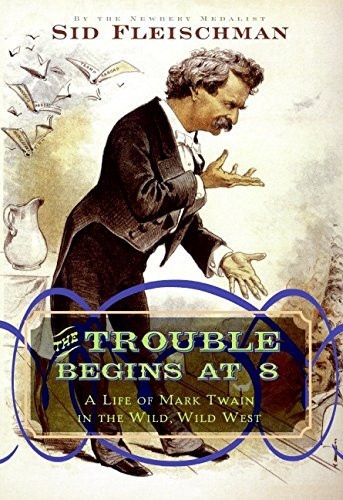
The trouble begins at 8: a life of Mark Twain in the wild, wild West

Fleischman, Sid
"Mark Twain was born fully grown, with a cheap cigar clamped between his teeth." So begins Sid Fleischman's ramble-scramble biography of the great American author and wit, who started life in a Missouri village as a barefoot boy named Samuel Clemens. Abandoning a career as a young steamboat pilot on the Mississippi River, Sam took a bumpy stagecoach to the Far West. In the gold and silver fields, he expected to get rich quick. Instead, he got poor fast, digging in the wrong places. His stint as a sagebrush newspaperman led to a duel with pistols. Had he not survived, the world would never have heard of Tom Sawyer or Huckleberry Finn—or red-headed Mark Twain. Samuel Clemens adopted his pen name in a hotel room in San Francisco and promptly made a jumping frog (and himself) famous. His celebrated novels followed at a leisurely pace; his quips at jet speed. "Don't let schooling interfere with your education," he wrote. Here, in high style, is the story of a wisecracking adventurer who came of age in the untamed West; an ink-stained rebel who surprised himself by becoming the most famous American of his time. Bountifully illustrated.
Greenwillow Books 2008 224 pages

Balzac's Paris: the city as human comedy

Hazan, Éric
"Eric Hazan follows in Balzac's footsteps, criss-crossing the city in the novelist's outsize boots, running between printers, publishers, coffee merchants, mistresses and friends, stopping for a moment, struck by a detail that would be fixed in Balzac's photographic memory. More than a tour of the city, this is an attempt to measure the soul of a city as recovered in its finest literature"--
Verso 2024-06-25 200 pages

Bronx boy: a memoir

Charyn, Jerome
Jerome Charyn's three-part memoir of his boyhood in the Bronx has all the imagery and color of an enchanting and entertaining novel -- someone has said that it captures the author's world so accurately that it can't possibly be true. Bronx Boy , like The Dark Lady of Belorusse and The Black Swan , both selected by The New York Times as Notable Books of the Year, is a tour de force of memory and imagination. In this third and final installment, the higher truths of a masterly writer's art render moot the question of exactly where the real world ends and Charyn's imagined world begins. Still known as "Baby" although a younger brother has come along, young Charyn makes pocket money delivering eggs, belongs to a group of 12-year-old wannabe gangsters that meet in a soda shop run by an ex-con, and spends afternoons telling stories to the adoring wife of a wealthy Russian émigré. He becomes famous for his black-and-tans -- a concoction of coffee ice cream, seltzer, milk, chocolate sauce, crushed pecans -- and "a touch of bitterness that may have been the Bronx." So famous, indeed, that he walks away the winner of an annual black-and-tan contest sponsored by the real-life top gangster called "The Little Man" -- Meyer Lansky. In Charyn's hands, the often ridiculed Bronx is a magic place, as full of odd and wonderful characters as a three-ring circus. And at the center of it all, young "Baby," not as lucky in love as he would like to be, drinking it all in, putting his own extraordinary take on it. Charyn looks back at this with his singular vision, and records it all for us with the skill of the fine writer he is. This is a delightful and often moving story of a childhood that could only have been lived in New York in the fifties, a New York experience that could only have taken place in the Bronx of those days, a growing-up saga that could only have been captured by this singular author.
Thomas Dunne Books/St. Martin's Press 2002-04-11 184 pages

The dark lady from Belorusse: a memoir

Charyn, Jerome
How to describe Faigele? A recent immigrant from Russia, the wife of an immigrant fur worker, a mother, a housewife, a greenhorn - and an enchantress of such striking beauty that she had the Bronx at her feet. The local postmaster consoled her with hot tea in his office every morning when she came with "Baby" Jerome, hoping for a letter from her brother in war-torn Russia. An admirer enlisted five-year-old Baby to help him produce a forged letter to ease her worry. But it was her dentist, a blackmarketer on the side, who introduced her to the circle of Bronx politicians who made her the dealer of their weekly poker game. Beautiful, passionate, worlds above words like "naive or sophisticated," Faigele has been blessed by her son, a rarely gifted writer who vividly recaptures this astonishing woman in her turbulent setting.
St. Martin's Press 1997 106 pages

The black swan: a memoir

Charyn, Jerome
A Memoir"It was easy to invent a fable.When the letters did come from school, I'd scratch out a note in my father's hand, talk of fatigue, visits to the brain surgeon, etc.The East Bronx was like the Sahara, where a child and all his records could get lost in some infinite sand dune."What does an 11 year-old boy do when his classmates call him "Dumbo" and his parents don't seem to know that he exists?His mother, the beautiful Faigele spends her days pushing her 2 year-old son Marvin around in a stroller and barely hears Jerome's clarinet playing. The answer for Jerome Charyn is to go to the local movie house and hide out for a few hours every day.At the movies, he can escape, not be himself for a little while. One day, while watching Samson and Delilah for the seventh time that week, he is suddenly grabbed from his seat, dragged down a flight of stairs and winds up being introduced to a whole new way of life by three "cellar rats," as Jerome likes to call them.They make him a part of their group and he soon finds himself dressed in a Feuerman & Marx suit collecting money for Farouk, the local gangster. Many of the men remember his mother, The Dark Lady, from her days as dealer of their local poker game.With his distinctive style, a deep and accurate feeling for time and place, and an uncanny ability to communicate the world as seen through the imagination of an unusual boy, Charyn has created another gem of a memoir, a worthy sequel to The Dark Lady from Belorusse.
Thomas Dunne Books 2000 182 pages

Paris in the fifties

Karnow, Stanley
In July 1947, fresh out of college and long before he would win the Pulitzer Prize and become known as one of America's finest historians, Stanley Karnow boarded a freighter bound for France, planning to stay for the summer. He stayed for ten years, first as a student and later as a correspondent for Time magazine. By the time he left, Karnow knew Paris so intimately that his French colleagues dubbed him "le plus parisien des Américains" --the most Parisian American. Now, Karnow returns to the France of his youth, perceptively and wittily illuminating a time and place like none other. Karnow came to France at a time when the French were striving to return to the life they had enjoyed before the devastation of World War II. Yet even during food shortages, political upheavals, and the struggle to come to terms with a world in which France was no longer the mighty power it had been, Paris remained a city of style, passion, and romance. Paris in the Fifties transports us to Latin Quarter cafés and basement jazz clubs, to unheated apartments and glorious ballrooms. We meet such prominent political figures as Charles de Gaulle and Pierre Mendès-France, as well as Communist hacks and the demagogic tax rebel Pierre Poujade. We get to know illustrious intellectuals, among them Jean-Paul Sartre, Simone de Beauvoir, Albert Camus, and André Malraux, and visit the glittering salons where aristocrats with exquisite manners mingled with trendy novelists, poets, critics, artists, composers, playwrights, and actors. We meet Christian Dior, who taught Karnow the secrets of haute couture, and Prince Curnonsky, France's leading gourmet, who taught the young reporter to appreciate the complexities of haute cuisine. Karnow takes us to marathon murder trials in musty courtrooms, accompanies a group of tipsy wine connoisseurs on a tour of the Beaujolais vineyards, and recalls the famous automobile race at Le Mans when a catastrophic accident killed more than eighty spectators. Back in Paris, Karnow hung out with visiting celebrities like Ernest Hemingway, Orson Welles, and Audrey Hepburn, and in Paris in the Fifties we meet them too. A veteran reporter and historian, Karnow has written a vivid and delightful history of a charmed decade in the greatest city in the world.
Random House International 1999-01-26 368 pages

Florence, a delicate case

Leavitt, David
David Leavitt brings the wonders and mysteries of Florence alive, illuminating why it is, and always has been, one of the most popular tourist destinations in the world. The third in the critically-acclaimed Writer and the City Series-in which some of the world's finest novelists reveal the secrets of the cities they know best- Florence is a lively account of expatriate life in the 'city of the lily'. Why has Florence always drawn so many English and American visitors? (At the turn of the century, the Anglo-American population numbered more than thirty thousand.) Why have men and women fleeing sex scandals traditionally settled here? What is it about Florence that has made it so fascinating-and so repellent-to artists and writers over the years? Moving fleetly between present and past and exploring characters both real and fictional, Leavitt's narrative limns the history of the foreign colony from its origins in the middle of the nineteenth century until its demise under Mussolini, and considers the appeal of Florence to figures as diverse as Tchaikovsky, E.M. Forster, Ronald Firbank, and Mary McCarthy. Lesser-known episodes in Florentine history-the moving of Michelangelo's David , and the construction of temporary bridges by black American soldiers in the wake of the Second World War-are contrasted with images of Florence today (its vast pizza parlors and tourist culture). Leavitt also examines the city's portrayal in such novels and films as A Room with a View , The Portrait of a Lady and Tea with Mussolini .
Bloomsbury 2002-06-01 176 pages

James Joyce and Italo Svevo: the story of a friendship

Price, Stanley
James Joyce left Dublin in 1904, bound for Trieste and a job teaching English at the Berlitz School. He was to live there for the next eleven years. Italo Svevo, born and bred in Trieste, worked there for his family's marine paint company. He had also written two novels, published privately and unsuccessfully. In 1907, wanting to improve his English to do business with the British Admiralty, Svevo went to Berlitz, where Joyce became his teacher. Svevo was then 46 and Joyce 25. Despite their different backgrounds, Irish Catholic and Triestene Jewish, they had, intellectually, much in common. They admired each other's writing. Joyce improved Svevo's English. Svevo helped Joyce stay solvent, and also became the inspiration for Leopold Bloom. In Ulysses, the near father-son relationship between Stephen Dedalus and Bloom in Dublin was very close to that of Svevo and Joyce in Trieste. The two writers lived through the great political and cultural upheavals of the early twentieth century, and their story has a fascinating supporting cast - W.B. Yeats and G.B. Shaw, Proust and Hemingway, Freud and Jung, H.G. Wells and T.S. Eliot. Although often living in different cities - Zurich, Paris, London - their friendship survived. When Ulysses was finally published in Paris in 1922, its success enabled Joyce to help Svevo find a publisher for his great comic masterpiece The Confessions of Zeno. European literature owes a great deal to that meeting in Trieste.
Somerville Press 2016 276 pages