15 results for "Novel"

More alive and less lonely: on books and writers

Lethem, Jonathan
"A collection of bestselling, NBCC prize-winning author Jonathan Lethem's finest writing on the subject of writers and writing. A readerly wake-up call from one of America's finest and most acclaimed working writers. Picking up where his NBCC Award finalist collection The Ecstasy of Influence left off, More Alive and Less Lonely collects more than a decade of Lethem's finest writing on writing, with new and previously unpublished material, including: impassioned appeals for forgotten writers and overlooked books, razor-sharp essays, and personal accounts of his most extraordinary literary encounters and discoveries. Only Lethem, with his love of cult favorites and the canon alike, can write with equal insight about the stories of modern masters like Lorrie Moore and Salman Rushdie, graphic novelist Chester Brown, science fiction outlier Philip K. Dick, and classic icons like Moby-Dick. Edited by novelist Christopher Boucher (Golden Delicious), More Alive and Less Lonely deserves a place on every serious reader's bookshelf. Lethem's joyful approach to literature will inspire you to dive back into your favorite books and then point you towards what to read next"--
Melville House 2017 300 pages

J.M. Coetzee and ethics: philosophical perspectives on literature

Anton Leist,Peter Singer
In 2003, South African writer J. M. Coetzee was awarded the Nobel Prize in Literature for his riveting portrayals of racial repression, sexual politics, the guises of reason, and the hypocrisy of human beings toward animals and nature. Coetzee was credited with being "a scrupulous doubter, ruthless in his criticism of the cruel rationalism and cosmetic morality of western civilization." The film of his novel Disgrace , starring John Malkovich, brought his challenging ideas to a new audience. Anton Leist and Peter Singer have assembled an outstanding group of contributors who probe deeply into Coetzee's extensive and extraordinary corpus. They explore his approach to ethical theory and philosophy and pay particular attention to his representation of the human-animal relationship. They also confront Coetzee's depiction of the elementary conditions of life, the origins of morality, the recognition of value in others, the sexual dynamics between men and women, the normality of suppression, and the possibility of equality in postcolonial society. With its wide-ranging consideration of philosophical issues, especially in relation to fiction, this volume stands alone in its extraordinary exchange of ethical and literary inquiry.
Columbia University Press 2010 400 pages

I am Hermes!

Gerstein, Mordicai
At birth, Hermes, son of Zeus and the Nymph Maia, says his first word: "Gimme!" In this brilliant, hilarious graphic novel about the mischievous, fun-loving messenger of the gods, Caldecott Medal winner Mordicai Gerstein, transports classical mythology to the 21st century. "The world!" the newly born Hermes says. "It's even better than I expected! I love it! I want it all!" This book is filled with joy, exuberance, and humor. On his first day of life, Hermes manages to trick a turtle into surrendering its shell and a ram into surrendering its horns, thereby inventing the lyre, music, and song! He also manages to steal his brother Apollo's precious cows, but later redeems himself by outwitting the giant brothers Otus and Ephialtes, who have kidnapped Mars. These adventures and more, all derived from classical mythology, are told with great humor as well as a twenty-first century sensibility by the colossally talented Mordicai Gerstein. The art in this graphic novel is truly spectacular, with 250 illustrations, executed by a master artist and filled with unique humor. A Bank Street Best Book of the Year
Holiday House 2018 68 pages

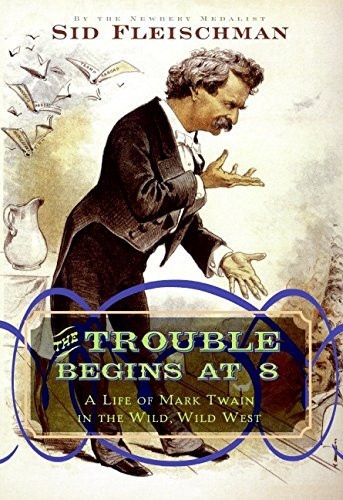
The trouble begins at 8: a life of Mark Twain in the wild, wild West

Fleischman, Sid
"Mark Twain was born fully grown, with a cheap cigar clamped between his teeth." So begins Sid Fleischman's ramble-scramble biography of the great American author and wit, who started life in a Missouri village as a barefoot boy named Samuel Clemens. Abandoning a career as a young steamboat pilot on the Mississippi River, Sam took a bumpy stagecoach to the Far West. In the gold and silver fields, he expected to get rich quick. Instead, he got poor fast, digging in the wrong places. His stint as a sagebrush newspaperman led to a duel with pistols. Had he not survived, the world would never have heard of Tom Sawyer or Huckleberry Finn—or red-headed Mark Twain. Samuel Clemens adopted his pen name in a hotel room in San Francisco and promptly made a jumping frog (and himself) famous. His celebrated novels followed at a leisurely pace; his quips at jet speed. "Don't let schooling interfere with your education," he wrote. Here, in high style, is the story of a wisecracking adventurer who came of age in the untamed West; an ink-stained rebel who surprised himself by becoming the most famous American of his time. Bountifully illustrated.
Greenwillow Books 2008 224 pages

The post card: from Socrates to Freud and beyond

Derrida, Jacques
17 November 1979 You were reading a somewhat retro loveletter, the last in history. But you have not yet received it. Yes, its lack or excess of address prepares it to fall into all hands: a post card, an open letter in which the secret appears, but indecipherably. What does a post card want to say to you? On what conditions is it possible? Its destination traverses you, you no longer know who you are. At the very instant when from its address it interpellates, you, uniquely you, instead of reaching you it divides you or sets you aside, occasionally overlooks you. And you love and you do not love, it makes of you what you wish, it takes you, it leaves you, it gives you. On the other side of the card, look, a proposition is made to you, S and p, Socrates and plato. For once the former seems to write, and with his other hand he is even scratching. But what is Plato doing with his outstretched finger in his back? While you occupy yourself with turning it around in every direction, it is the picture that turns you around like a letter, in advance it deciphers you, it preoccupies space, it procures your words and gestures, all the bodies that you believe you invent in order to determine its outline. You find yourself, you, yourself, on its path. The thick support of the card, a book heavy and light, is also the specter of this scene, the analysis between Socrates and Plato, on the program of several others. Like the soothsayer, a "fortune-telling book" watches over and speculates on that-which-must-happen, on what it indeed might mean to happen, to arrive, to have to happen or arrive, to let or to make happen or arrive, to destine, to address, to send, to legate, to inherit, etc., if it all still signifies, between here and there, the near and the far, da und fort, the one or the other. You situate the subject of the book: between the posts and the analytic movement, the pleasure principle and the history of telecommunications, the post card and the purloined letter, in a word the transference from Socrates to Freud, and beyond. This satire of epistolary literature had to be farci, stuffed with addresses, postal codes, crypted missives, anonymous letters, all of it confided to so many modes, genres, and tones. In it I also abuse dates, signatures, titles or references, language itself. J. D. "With The Post Card, as with Glas, Derrida appears more as writer than as philosopher. Or we could say that here, in what is in part a mock epistolary novel (the long section is called "Envois," roughly, "dispatches" ), he stages his writing more overtly than in the scholarly works. . . . The Post Card also contains a series of self-reflective essays, largely focused on Freud, in which Derrida is beautifully lucid and direct."—Alexander Gelley, Library Journal
University of Chicago Press 1987 521 pages

The moral of the story: an anthology of ethics through literature

Peter Singer,Renata Singer
In The Moral of the Story, Peter and Renata Singer draw on some of the best works of fiction, playwriting, and poetry in order to shed light on the perennial questions of ethics. A vivid montage of literature that touches on a broad range of ethical subjects and themes Offers a unique contribution to the study of moral philosophy and literature Demonstrates how literary sources can add richness to discussions of real-life moral questions and dilemmas Brings together selections and excerpts from the world’s most celebrated short stories, novels, plays, and poetry Features substantive section introductions by Peter and Renata Singer Peter Singer is a leading moral philosopher, widely credited with triggering the modern animal-rights movement. His collection of essays, Unsanctifying Human Life, edited by Helga Kuhse, was published by Blackwell Publishing in 2001.
Blackwell Pub 2005-02-11 621 pages

Why write? collected nonfiction, 1960-2013

Roth, Philip
"Throughout a unparalleled literary career that includes two National Book Awards (Goodbye, Columbus, 1959 and Sabbath's Theater, 1995), the Pulitzer Prize in fiction (American Pastoral, 1997), the National Book Critics Circle Award (The Counterlife, 1986), and the National Humanities Medal (awarded by President Obama in 2011), among many other honors, Philip Roth has produced an extraordinary body of nonfiction writing on a wide range of topics: his own work and that of the writers he admires, the creative process, and the state of American culture. This work is collected for the first time in Why Write?, the tenth and final volume in the Library of America's definitive Philip Roth edition. Here is Roth's selection of the indispensable core of Reading Myself and Others, the entirety of the 2001 book Shop Talk, and "Explanations," a collection of fourteen later pieces brought together here for the first time, six never before published. Among the essays gathered are "My Uchronia," an account of the genesis of The Plot Against America, a novel grounded in the insight that "all the assurances are provisional, even here in a two-hundred-year-old democracy"; "Errata," the unabridged version of the "Open Letter to Wikipedia" published on The New Yorker's website in 2012 to counter the online encyclopedia's egregious errors about his life and work; and "The Ruthless Intimacy of Fiction," a speech delivered on the occasion of his eightieth birthday that celebrates the "refractory way of living" of Sabbath's Theater's Mickey Sabbath. Also included are two lengthy interviews given after Roth's retirement, which take stock of a lifetime of work."--Amazon.
The Library of America 2017-09-12 452 pages

The white man's guide to white male writers of the Western canon

Schwartz, Dana
How can you tell your Faulkner from your Franzen if you haven't actually read either? Schwartz expounds on the most important (aka white male) writers of western literature. From Shakespeare's greatest mystery to the true meaning of Kafkaesque, she tests your knowledge of which Jonathan-- Franzen, Lethem, or Safran Foer-- hates Twitter and lives in Brooklyn. So instead of politely nodding along next time you make an acquaintance at a housewarming party in Brooklyn, you can roll up your sleeves and get to work schooling them in character arcs and the experimental form of your next great American novel. -- adapted from back cover
Harper Perennial 2019-11-05 241 pages

A book of the book: some works & projections about the book & writing

Jerome Rothenberg,Steven Clay
"A collection for the general reader and the specialist, A Book of the Book is an accessible and erudite set of readings on the book as a mythic and material object. These texts comprise a vivid exploration of the poetics of the book, a multifaceted study nurtured by the literary and ethnographic scope of its editors' vision, that argues compellingly for the continued survival of this most mundane and metaphoric of artifacts. In a moment when irresponsibly inflammatory ravings about the demise of print rage through the cultural landscape, this collection offers serious reflection upon the real profundity of the book as a symbolic force within the poetic and spiritual imagination that remains the wellspring of human culture. Drawn from diverse realms--of avant-garde art, anthropology, textual criticism, literature, and speculative thought--this will be the definitive collection for decades to come--a volume whose very physical presence in the hand performs the rhetoric of its pages in offering its riches to the reader." - Johanna Drucker A Book of the Book consists of four sections: "Pre-faces" includes work by Rothenberg, Steve McCaffery, & bp Nichol, Keith A. Smith, Michael Davidson, Anne Waldman, Jacques Derrida, Edmond Jabès (translated by Rosmarie Waldrop), among others; "The Opening of the Field" includes work by Gertrude Stein, William Blake, Susan Howe, Maurice Blanchot, Marjorie Perloff, André Breton and Jerome McGann among others; "The Book is as Old as Fire & Water" includes work on Guruwari designs, novelty books, pattern poetry, celestial alphabets, among others, while "The Book to Come" presents work by Tom Phillips, Johanna Drucker, Alison Knowles, Charles Bernstein, Jess (a complete re-issue of his 1960 work "O!"), Ian Hamilton Finlay, Barbara Fahrner and many others.
Granary Books 2000 537 pages

Philippines

Cixous, Hélène
Philippines is Hélène Cixous's reverie or 'true dreaming' which intertwines Freud's uneasy views on telepathy, autobiographical memories conflating Algeria and Paris, childhood and adult life, shared with her brother 'Pete', and literary evocations from Proust and George du Maurier's forgotten novel Peter Ibbetson. Amid telepathic conversations, real or imagined, and life events uncannily answering one another from a distance, Cixous's dense evocative journey ceaselessly 'returns to its starting point' and, like the twin almonds in one shell evoked by the title, reveals intimate, secret bonds between scenes and beings, real and fictional. Its interpretive sharpness delivered with stylistic elegance and candour will make this study typical of Cixous's art, which plies between literature and criticism, appealing not only to scholars and critics interested in psychoanalysis, autobiography and the act of reading, but also to a broader readership captivated by the hallucinatory coincidences between life, dream and fiction, when 'Reality is the dream. The dream is the true reality'.
Polity 2011-02-07 82 pages

Goldberg: variations

Josipovici, Gabriel
Taking its name from Bach's Goldberg Variations, as well as inspiration from its formal structure, this work hybridizes breezy philosophical meditation and fragment-based novel. Most of the diffused story takes place in nineteenth-century England, where a Jewish writer by the name of Goldberg is commissioned by an incessantly thoughtful insomniac to create a story each day to be told that night, hopefully thus assuaging the man's sleeplessness.
Harper Perennial 2007 189 pages